
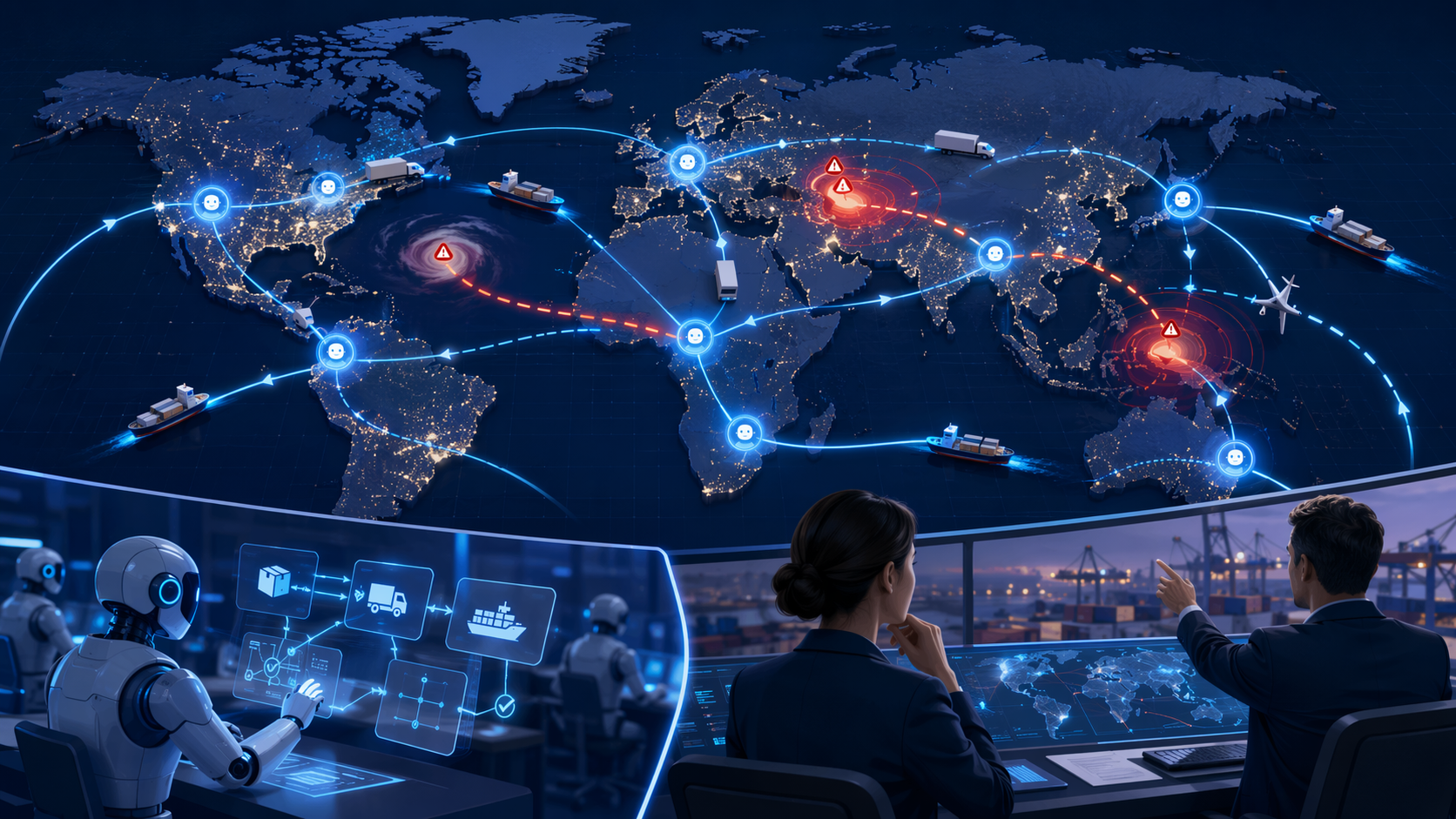
The useful question about AI in logistics and supply chain management is no longer whether a model can see trouble coming. Many control towers can already display a late vessel, a storm track, a port bottleneck, or a carrier failure. The harder question is what happens next: does the system only add another red mark to a dashboard, or can it identify the affected orders, check the feasible recovery options, and take a bounded action before the planner has rebuilt the same evidence by hand?
That distinction matters in 2026 because disruption is not an occasional exception queue. Everstream Analytics’ 2026 outlook says 97% of supply chains face threat from geopolitical fragmentation and 93% face extreme weather risk this year; those figures are forward-looking risk assessments, not measured incident counts, but they describe the operating climate logistics teams are already planning around.[1] In that setting, systems that only visualize disruption leave too much recovery work sitting with people who are already behind the event.
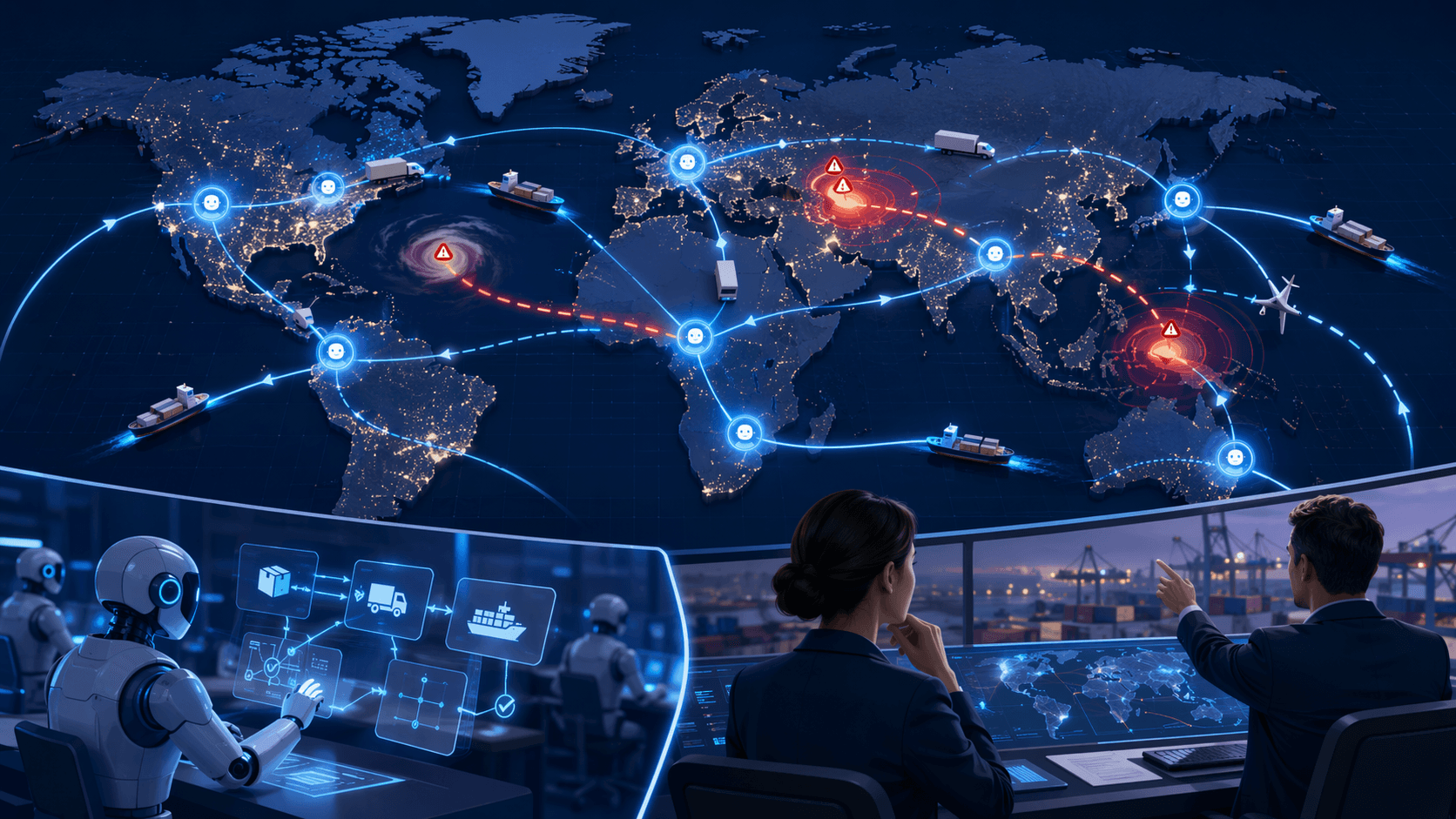
Agentic AI is becoming interesting because it shifts the center of the workflow from notification to action. The better deployments are not trying to make one grand autonomous supply chain brain. They are assigning software agents to specific jobs: watch a lane, validate an appointment, compare carrier options, update a shipment record, notify a customer, propose a rebooking, or execute a recovery step when the action stays inside an approved boundary.
The market evidence points in the same direction, though the time horizons need to stay separated. BCG estimates that agentic AI systems accounted for 17% of total AI value in 2025 and projects that share to reach 29% by 2028.[2] Gartner expects 40% of enterprise applications to embed task-specific AI agents by the end of 2026, up from less than 5% in 2025; it also projects that 60% of supply chain disruptions will be resolved without human intervention by 2031.[3] The first two figures help explain why agentic tools are entering production now. The 2031 figure belongs in the future-state file, not in the proof file for 2026.
The production evidence is strongest where the work is bounded
The clearest logistics example in the available evidence is C.H. Robinson. The reported deployment involves more than 30 AI agents handling over 3 million shipping tasks, with a 40% productivity increase per person per day.[4] Those numbers come through vendor content and should be corroborated against primary company disclosures before being treated as independently audited results. Even with that caveat, the shape of the deployment is important: many narrow agents taking repetitive transportation work out of human hands, rather than a single autonomous system making every logistics decision.
That is exactly where agentic AI starts to earn its keep in logistics. A planner dealing with a port delay does not need another screen that says containers are late. The planner needs the system to know which shipments are affected, which customers or facilities are exposed, which carriers still have capacity, which appointments can be changed, and which recovery moves are allowed without escalating to a manager. If an agent can gather that evidence, update records, initiate approved communications, and reserve a replacement option inside policy, it has reduced the latency of the response even when a human still approves the final exception.
This is why the C.H. Robinson example deserves more attention than a generic claim about autonomous logistics. The reported productivity gain is not presented as a moonshot transformation of network strategy. It is relief from the operational drag that fills transportation teams’ days: shipment updates, appointment coordination, documentation checks, follow-ups, and exception triage. Those tasks may look small from a strategy deck, but they are the work that determines whether a disruption response starts in minutes or waits until the next meeting.
Walmart’s reported result points to a different but still concrete use case. AI-powered route optimization eliminated 30 million unnecessary delivery miles annually, according to the same vendor-content source.[4] That is not, by itself, evidence that Walmart is autonomously resolving port closures or carrier failures. It is evidence that AI can change a logistics outcome that operators care about: fewer wasted miles in the delivery network. In disruption response, the same class of capability matters when the system needs to recalculate feasible paths under constraints rather than simply report that the original path has broken.
Maersk is more adjacent to the core disruption-response question. The available case says generative AI in forecasting and capacity planning compressed market adaptation time from months to weeks.[4] That is meaningful for planning under changing demand and capacity conditions, but it is not the same as autonomous execution of a corrective action during a live exception. It belongs in the evidence set because forecasting and capacity planning shape the option set available to agents, not because it proves full autonomous disruption management.
Detection, recommendation, action, and autonomy are different operating states
A lot of disappointment with supply chain AI comes from treating four different states as if they were one maturity level. Detection means the system identifies a likely problem. Recommendation means it ranks possible responses. Action means it changes something in an operating system. Autonomy means it is allowed to take that action without waiting for human approval. A deployment can be valuable at any of those levels, but the risk changes sharply as it moves from one to the next.
| Operating state | What the system does | Typical logistics example | Human role |
|---|---|---|---|
| Detection | Flags a disruption or exception | Identifies shipments affected by a port delay or weather event | Reviews the alert and starts investigation |
| Recommendation | Compares feasible recovery options | Ranks alternate carriers, lanes, appointment windows, or inventory sources | Selects or rejects the proposed option |
| Bounded action | Executes an approved low-regret step | Sends notifications, updates shipment status, reserves capacity within policy, or triggers a predefined workflow | Monitors exceptions and handles escalations |
| Full autonomy | Changes high-impact plans without prior review | Reallocates scarce inventory, accepts major cost changes, changes customer commitments, or redesigns network flows | Audits outcomes after the fact |
The third row is where much of the credible 2026 value sits. Bounded action is not a consolation prize. In a logistics control room, a five-minute head start on contacting customers, rebooking a load, or protecting capacity can be worth more than an elegant recommendation that waits in a queue. The point is not to remove people from the process everywhere. It is to remove them from work where the decision rules are already known and the cost of delay is higher than the cost of a controlled automated move.
Examples of bounded actions include sending a customer delay notice after an ETA threshold is breached, reassigning a tender to a preapproved backup carrier within a rate ceiling, opening an exception case with all affected orders attached, or holding inventory against a delayed inbound when the allocation rule is unambiguous. These are not trivial tasks. They are also not the same as giving an agent permission to decide which customer loses scarce stock during a regional disruption.
Why the hard decisions still stop at the gate
The boundary becomes obvious when a disruption response changes cost, service promises, inventory allocation, or network strategy. Rerouting a shipment inside a preapproved carrier and cost band is one thing. Paying a premium to protect one customer while another waits is a commercial decision. Rebalancing inventory across regions may look like an optimization problem, but it can alter revenue, margin, store availability, and customer commitments. Those consequences do not disappear because an agent can calculate faster than a planner.
RELEX’s 2026 supply chain survey captures the trust split cleanly: 67% of supply chain leaders are confident in AI for routine decisions, while only 10% trust AI for critical decisions without human review.[5] That is not a rejection of AI. It is a practical distinction between decisions with known playbooks and decisions where the organization has to live with trade-offs after the model has moved on.
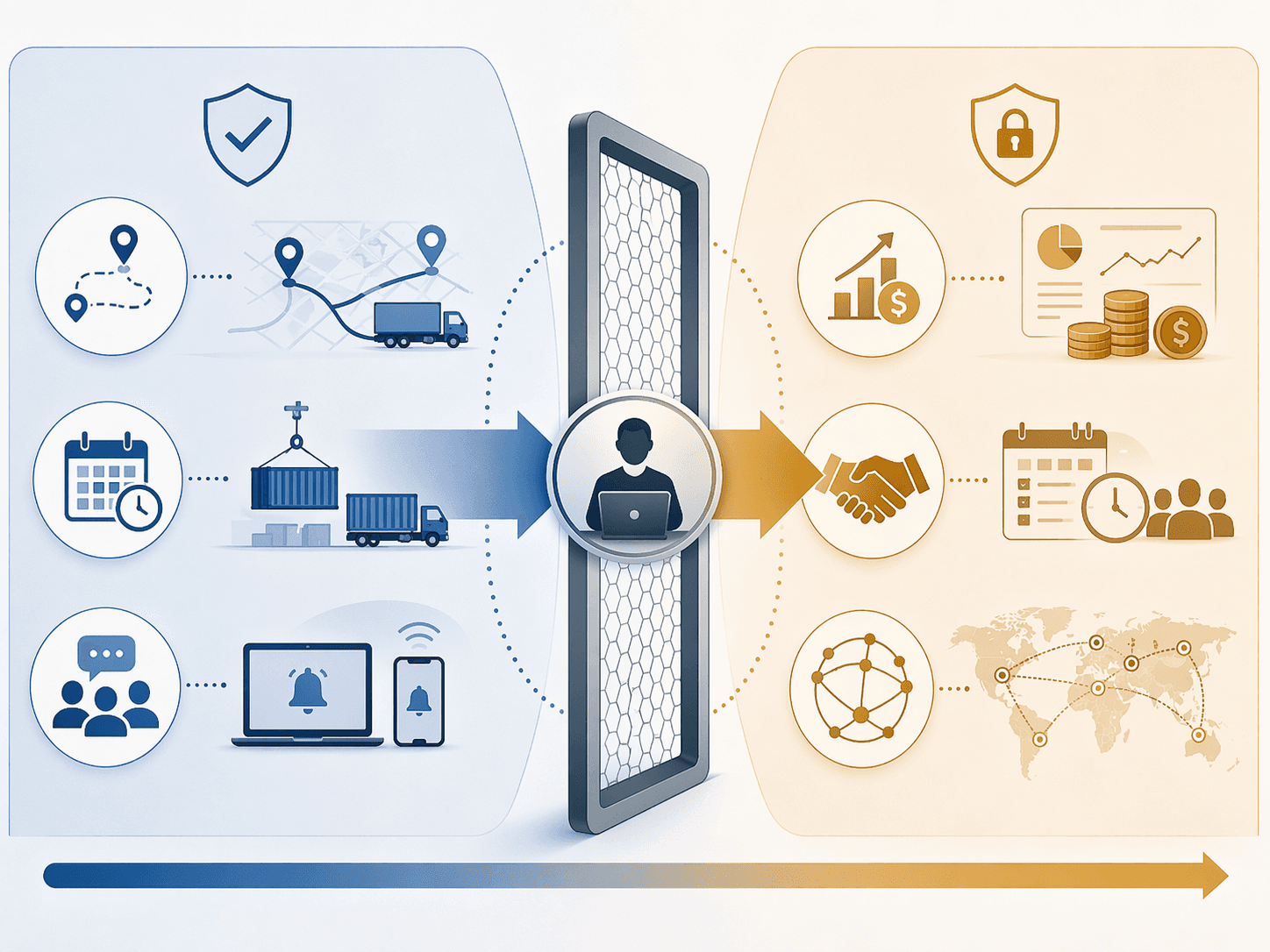
That trust gap is also why the better operating model is graduated autonomy. Low-regret, rule-bounded actions can move toward automatic execution. Medium-impact actions can require approval from a planner, transportation manager, or inventory lead. High-impact actions need explicit escalation, auditability, and accountable ownership. The model may propose the move, but a person or governance body still owns the consequence.
The practical design question is therefore not “Can the agent decide?” It is “What is the agent allowed to decide under this condition, with this confidence level, this cost exposure, this service impact, and this audit trail?” That question is less glamorous than model architecture, but it is the one that decides whether the system survives a bad Tuesday.
Control towers fail when the organization has not agreed on control
A logistics AI agent can only act cleanly if the surrounding organization has agreed on thresholds, handoffs, and authority. Gartner’s 2025 finding that 23% of AI control tower projects stalled because of lack of cross-functional alignment is easy to underestimate.[3] It sounds like a governance footnote until a disruption hits and transportation, inventory, sales, customer service, procurement, and finance all have different definitions of the right recovery move.
This is where many autonomous-response narratives get too smooth. A carrier failure is not only a transportation issue if the replacement option changes cost. A port delay is not only a visibility issue if scarce inventory must be allocated. A weather event is not only a routing issue if it forces customer-priority calls. The agent may detect the exception and assemble the options, but the business still needs rules for who approves a premium freight move, who can change a delivery promise, who can reallocate inventory, and who reviews the action afterward.
The most useful connection between AI capability and operational value is a workflow map, not a model demo. For each disruption type, the company needs to define what the agent observes, which systems it can write to, which actions are automatic, which actions need approval, what evidence is shown to the approver, and how exceptions are logged. Teams building that framework can use a more detailed graduated autonomy governance model to separate routine execution from high-impact judgment.
Where autonomous response already makes sense
The strongest near-term candidates have three traits. The action is reversible or low-regret. The policy boundary is clear. The downstream impact is visible before execution. That combination favors tasks such as exception enrichment, shipment-status updates, customer notifications, appointment rescheduling inside approved windows, backup-carrier tendering under defined constraints, and capacity searches that prepare an approver to act quickly.
- Good candidate: an agent detects that a shipment will miss its appointment, checks available delivery windows, and proposes or books a new appointment when the customer and facility rules allow it.
- Good candidate: an agent identifies all orders affected by a port delay, opens exception records, attaches documents, and notifies the account team with the likely service impact.
- Good candidate: an agent tenders freight to a preapproved backup carrier when the primary carrier rejects a load and the replacement cost stays inside a defined tolerance.
- Poor candidate for full autonomy: an agent reallocates limited inventory away from one customer segment to protect another without commercial review.
- Poor candidate for full autonomy: an agent accepts major premium freight costs to preserve service without finance or management approval.
The dividing line is not whether the task sounds operational. It is whether the organization has already made the policy decision in advance. If the rule says a replacement carrier may be used up to a defined cost threshold, the agent is executing policy. If the move requires choosing which customer absorbs the disruption, the agent is entering business judgment.
This is also the right lens for reading company examples. C.H. Robinson’s reported deployment suggests that agentic AI can absorb millions of recurring shipping tasks when those tasks are decomposed and governed.[4] Walmart’s mileage reduction shows AI changing a measurable logistics outcome in routing optimization.[4] Maersk’s compressed adaptation cycle shows planning and forecasting becoming faster.[4] None of those examples should be inflated into proof that enterprises can hand over all disruption decisions today. They are better read as evidence that production value is arriving first in bounded work.
The 2026 operating model is graduated autonomy
A workable 2026 model gives agents enough authority to reduce latency and workload, without pretending that every logistics exception has the same risk profile. Routine actions move fastest. Exceptions with cost or service exposure pause for review. Strategic moves remain human-owned. That structure is less dramatic than full autonomy, but it is much more likely to hold up under real disruption pressure.
For enterprises evaluating AI in logistics and supply chain management, the test should be operational rather than theatrical. Ask which disruption signals the agent can observe, which affected shipments or orders it can identify, which options it can compare, which systems it can update, which actions it can execute without approval, and which decisions it must escalate. If those answers are vague, the deployment is still a dashboard with better language.
The evidence supports a confident but narrow verdict. Agentic AI is already production-relevant for logistics disruption response where work is repetitive, bounded, and governed. It can shorten the gap between detection and action, reduce planner workload, and improve execution speed in defined workflows. Full autonomy for critical decisions remains a future-state ambition for most organizations, not because agents cannot produce recommendations, but because the business has not yet delegated the authority, accountability, and trust those decisions require.
References
- Everstream Analytics 2026 outlook, Everstream Analytics, 2026.
- How AI Agents Are Transforming Supply Chains, BCG, 2026.
- Gartner research cited in SCMR article and Gartner CSCO Roadmap, Gartner / SCMR, 2025–2026.
- 7 Real ROI Success Stories, Master of Code.
- State of Supply Chain 2026, RELEX, 2026.
Comments
Join the discussion with an anonymous comment.