

The hard part of buying AI tools for supply chain management in Q2 2026 is not finding vendors that say they use AI. It is separating platforms that can safely change how decisions are made from platforms that mainly make existing dashboards, alerts, or planning screens more fluent.
That distinction matters when the shortlist has to survive review by IT, finance, planning, transportation, warehouse operations, procurement, and the people who will be blamed when an automated recommendation creates the wrong purchase order, shipment change, or inventory move. A useful comparison has to ask three questions before it asks who has the longest feature list: How mature is the architecture? How deep is the functional coverage? How much data readiness does the tool assume?

Adoption pressure is real, but it is unevenly governed. ABI Research found that 94% of surveyed supply chain professionals planned to deploy AI for decision support within two years, while Gartner found that only 23% of supply chain organizations that had already deployed AI had a formal AI strategy. Those figures come from different samples and should not be treated as a single global benchmark, but together they describe a familiar buying risk: teams are moving faster than their operating model, data ownership, and exception governance can comfortably support.[1]
The evaluation model below is built for that gap. It does not try to name a universal winner. It gives buyers a way to compare vendors by the decisions they can improve, the systems they can touch, and the complexity they can absorb.
Start with the architecture, not the AI label
Most vendor demos compress three very different capabilities into one word: AI. In practice, the buying decision starts by identifying where the tool sits in the decision chain.
| Question | Why it matters in selection | What to verify in a demo |
|---|---|---|
| Is the AI native to supply chain workflows or layered onto existing modules? | A native planning, fulfillment, logistics, or procurement model usually starts closer to the operational constraint. A general AI layer may still be useful, but it may depend more heavily on configuration and clean upstream data. | Ask the vendor to show the exact workflow where the model reads inputs, recommends action, and hands work to a planner, dispatcher, buyer, or warehouse user. |
| Is the system read-only, workflow-triggering, or bidirectional? | Read-only intelligence can improve visibility. Bidirectional write-back changes operating execution and therefore requires tighter controls. | Ask whether the tool can update ERP, WMS, TMS, planning, procurement, or order records, and under what approval rules. |
| Which data foundations are assumed? | A tool that looks strong in a controlled demo can underperform when item masters, location hierarchies, carrier tables, supplier records, or lead-time histories are inconsistent. | Ask what data must be standardized before go-live and which exceptions will be handled manually. |
| Who owns the exception? | Autonomous or semi-autonomous decisions do not remove accountability. They redistribute it. | Ask who approves overrides, who reviews model recommendations, and how bad recommendations are audited. |
This is where many “best tools” lists become too shallow. A platform that predicts late shipments but cannot feed an execution workflow is a different purchase from a system that can change transportation plans or update order promises. Both may be valid. They should not be scored as if they solve the same problem.
The five dimensions that belong in the shortlist review
The most defensible comparison uses five dimensions: decision agility, integration maturity, scalability with business complexity, partner ecosystem interoperability, and pace of innovation. The first two deserve the most scrutiny because they decide whether AI remains a planning-side insight layer or becomes part of operating execution.
1. Decision agility: from insight to action
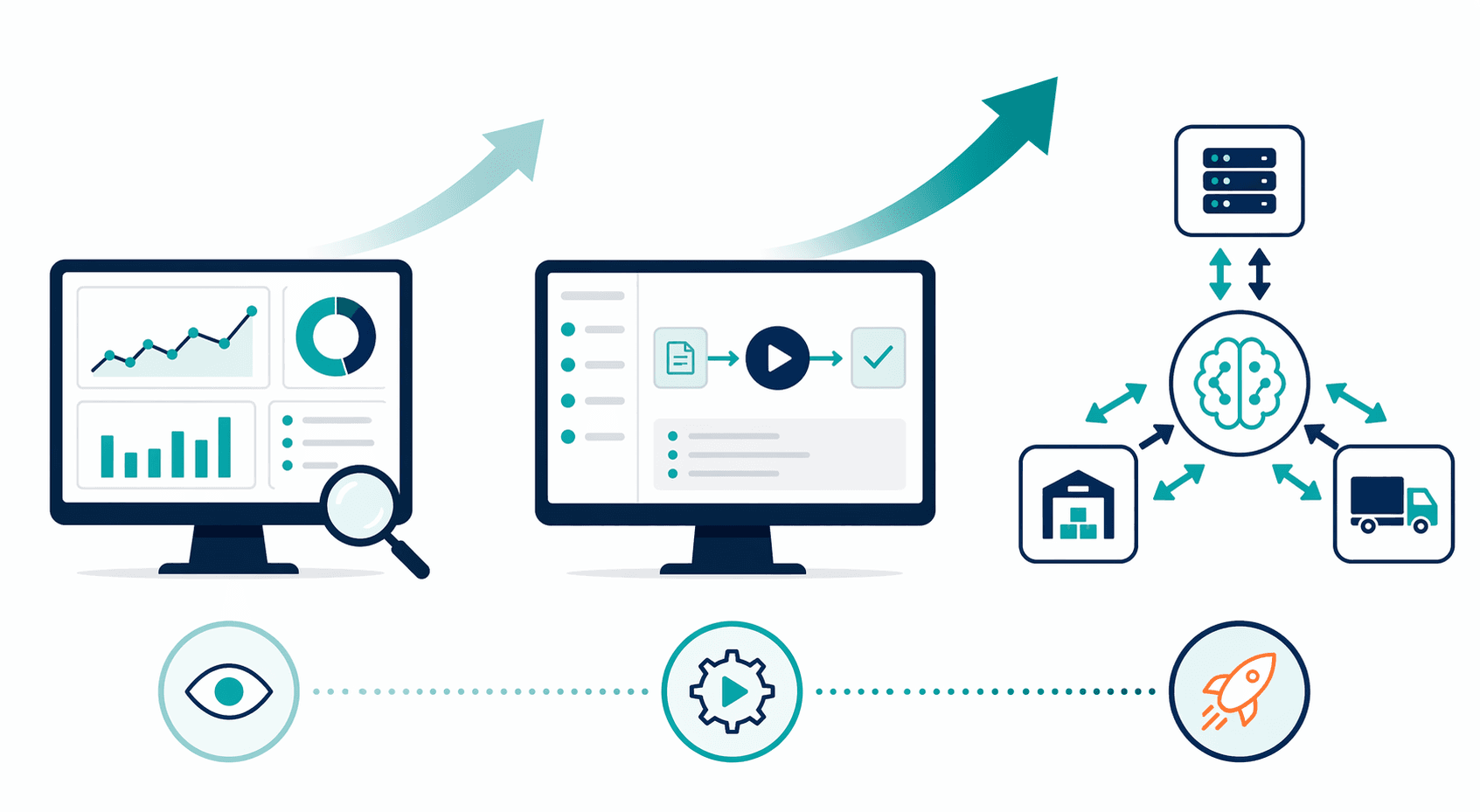
Decision agility is not the same as prediction accuracy. It is the distance between a signal and a controlled action. In supply chain systems, that distance usually falls into three levels.
| Decision-agility level | What the tool does | Operational consequence | Buyer concern |
|---|---|---|---|
| Read-only intelligence | Surfaces forecasts, risks, anomalies, or recommended actions. | A planner, buyer, analyst, or dispatcher still leaves the tool to act elsewhere. | Useful for visibility, but benefits depend on whether users consistently act on the insight. |
| Workflow-triggering intelligence | Creates tasks, alerts, approvals, or scenario options when a condition is met. | The system reduces latency but still keeps a human approval point before execution. | Good fit where risk tolerance is moderate and exception volume is high. |
| Bidirectional execution | Writes approved or automated updates back into ERP, WMS, TMS, planning, procurement, or order-management systems. | The system can alter plans, inventory actions, transportation instructions, or procurement steps. | Requires stronger controls, audit trails, integration testing, and accountability. |
The demo question is simple: “Show the last mile of the recommendation.” If the tool flags a stockout risk, where does the replenishment action land? If it recommends a route change, does the TMS receive it? If it identifies a supplier risk, does it create a sourcing workflow, update a risk score, or merely send a notification? A buyer does not need every decision automated, but the shortlist should be explicit about which decisions can be acted on inside governed workflows.
This is also where accountability belongs. If the system recommends expediting an order, someone must own the cost. If it shifts demand across facilities, someone must own service risk. If it changes a delivery plan, someone must own the customer impact. Decision agility without exception governance is just faster exposure.
2. Integration maturity: the plumbing decides the ceiling
Integration maturity is where supply chain AI projects either become operational or stay decorative. The practical issue is not whether a vendor has APIs. It is whether the tool can exchange the right data with the systems that run the business, at the cadence the decision requires, with error handling that operations can live with.
- ERP integration matters for orders, item masters, bills of material, financial controls, purchase orders, supplier records, and inventory valuation.
- WMS integration matters when recommendations change labor priorities, slotting, fulfillment sequencing, receiving, replenishment, or inventory movement.
- TMS integration matters when AI recommends carrier selection, routing, tendering, appointment changes, mode shifts, or delivery-plan changes.
- Planning-system integration matters when forecasts, constraints, inventory targets, capacity assumptions, and scenario outputs have to remain synchronized.
- Supplier and procurement-system integration matters when AI supports spend analysis, sourcing workflows, supplier risk, contract compliance, or purchase recommendations.
A common weak spot is master data. A route-optimization tool may be perfectly sound and still struggle if delivery windows, addresses, vehicle constraints, and service-time assumptions are wrong. A demand-planning model may look sophisticated and still inherit bad product hierarchies or promotion histories. A procurement AI workflow may rank supplier risk but still depend on inconsistent supplier identifiers across systems.
Buyers should ask vendors to separate three claims: connectors that already exist, integrations that have been implemented for similar customers, and integrations that will be built during the project. Those are different risk levels. Finance and IT will care about that distinction because it affects cost, testing effort, security review, and support ownership.
3. Scalability with business complexity
A mid-market company looking to improve forecasting for a few business units does not need the same platform as a global manufacturer coordinating multi-echelon inventory, constrained supply, contract manufacturing, regional distribution, and service-level tradeoffs. Scalability is not just transaction volume. It is the ability to represent the shape of the business.
| Business complexity | What the AI tool must handle | Shortlist implication |
|---|---|---|
| Bounded operational problem | A specific decision such as routing, ETA prediction, warehouse task prioritization, or inventory exception detection. | Favor tools with narrow functional depth, faster deployment paths, and clear integration points. |
| Functional planning improvement | Demand, supply, inventory, S&OP, procurement, or logistics planning within a defined operating area. | Favor tools that fit current planning processes while improving scenario speed and exception management. |
| Enterprise planning transformation | Multi-site, multi-echelon, cross-functional planning with financial, capacity, supplier, and service constraints. | Favor platforms with mature data models, governance features, implementation partners, and executive sponsorship requirements clearly understood. |
This dimension also protects buyers from overbuying. A company trying to reduce fleet miles does not necessarily need an enterprise planning suite. A company trying to redesign global planning should be cautious about a point tool that cannot scale beyond its first use case.
4. Partner ecosystem interoperability
Partner ecosystem matters when the buyer expects the tool to live inside a broader technology stack rather than replace it. Large ERP vendors may offer stronger native alignment with existing enterprise systems. Specialist vendors may offer deeper functional models in planning, logistics visibility, procurement, or optimization. Neither pattern is automatically better; the question is whether the platform can coexist with the systems already funding and governing operations.
For buyers still mapping the market by functional category, ChainSignal’s AI supply chain vendor directory is a useful cross-reference before the shortlist narrows into architecture and integration questions.
5. Pace of innovation
Pace of innovation should be evaluated with restraint. A rapid release cycle is valuable when it improves workflows, model performance, explainability, integration options, or governance. It is less useful when it mainly adds conversational features that do not change decisions. Buyers should ask how models are refreshed, how new AI features are validated, and how customers control adoption of new capabilities in regulated or operationally sensitive workflows.
Comparing major AI supply chain vendors
The comparison below uses vendor and functional mappings from Panorama Consulting’s 2026 SCM systems overview, monday.com’s 2026 AI supply chain platform list, AIMultiple’s supply chain AI tool index, and ChainSignal’s own vendor directory. These sources use different category boundaries, so the table should be read as a shortlist orientation tool, not a universal ranking.[2][3][4][5]
| Vendor | Primary fit | Decision agility | Integration maturity | Scales best for | Watch point |
|---|---|---|---|---|---|
| SAP Integrated Business Planning / SAP supply chain stack | Enterprise planning and ERP-aligned supply chain transformation | Strong when deployed inside SAP-centered workflows; execution depends on integration scope | High for SAP environments; more complex in mixed estates | Large enterprises with SAP as a core system of record | Implementation effort and data-model discipline can be significant |
| Oracle Fusion Cloud SCM | Enterprise SCM across planning, procurement, manufacturing, logistics, and order workflows | Strongest where Oracle modules are already part of the operating backbone | High in Oracle-centered environments | Enterprises seeking suite consolidation | Buyers should verify non-Oracle integration depth and workflow ownership |
| Blue Yonder | Advanced planning, fulfillment, inventory, and retail or distribution-oriented optimization | Can support sophisticated planning and execution-adjacent decisions depending on module scope | Mature supply chain integration pattern, with project complexity varying by estate | Complex planning and fulfillment environments | Shortlist should clarify which modules are required for the target decision |
| Kinaxis Maestro | Concurrent planning, scenario analysis, and supply-demand response | Strong in planning-side decision speed and scenario comparison | Often integrated with ERP and planning data sources rather than replacing them | Enterprises needing rapid planning response across functions | Execution write-back and downstream workflow design should be tested explicitly |
| o9 Solutions | Integrated business planning, digital planning models, and enterprise scenario planning | Strong for cross-functional planning decisions and scenario modeling | Can support broad enterprise integration programs | Large, complex planning organizations | Model-building effort and governance need realistic internal sponsorship |
| Manhattan Active Supply Chain | Warehouse, transportation, order, and execution-heavy supply chain operations | Strong fit where AI is tied to execution workflows in distribution and fulfillment | High relevance for WMS/TMS and order-execution environments | Retail, distribution, and fulfillment operations | Planning breadth may be less central than execution depth |
| Infor CloudSuite SCM | Industry-specific SCM within Infor-centered enterprise environments | Useful where AI capabilities align with existing Infor process flows | Stronger for Infor estates and verticalized implementations | Mid-to-large companies using Infor as a core platform | Buyers should verify ecosystem fit if the broader stack is fragmented |
| Logility | Supply chain planning, demand, inventory, and S&OP improvement | Strong planning and exception-management orientation | Typically sits alongside ERP and execution systems | Mid-market to enterprise planning teams | Execution write-back and real-time operations integration should be scoped |
| Coupa | Procurement, spend management, sourcing, supplier risk, and supply chain design adjacencies | Strong for procurement and spend workflows rather than end-to-end physical execution | Relevant where procurement systems and supplier data are central | Procurement-led AI programs and supplier/spend governance | Do not evaluate it as a substitute for WMS/TMS or deep planning suites |
| project44 | Transportation visibility, shipment tracking, ETA, and logistics network intelligence | Strong for visibility and exception detection; action depends on TMS and workflow integration | Integration value depends on carrier, shipper, and TMS connectivity | Logistics teams needing shipment visibility and service-risk response | Visibility is not the same as autonomous transportation execution |
| FourKites | Real-time transportation visibility and logistics exception management | Strong in monitoring and logistics risk signals; execution depends on connected workflows | Important where carrier and customer visibility networks matter | Shippers prioritizing delivery visibility and exception response | Buyers should test how alerts become actions in the TMS or customer workflow |
| ThroughPut AI | Operational bottleneck analysis, flow improvement, and supply chain decision support | Useful for identifying constraints and prioritizing operational interventions | Requires clean operational data feeds to move beyond analytics | Teams targeting throughput, inventory flow, or constraint visibility | Confirm whether recommendations remain advisory or trigger governed execution |
The table is intentionally uneven in what it rewards. A transportation visibility platform should not be penalized because it is not an enterprise planning suite. A procurement platform should not be forced into a warehouse-management comparison. The sharper question is whether the vendor’s strength matches the decision family the buyer is trying to improve.
For a more focused mid-market planning comparison, ChainSignal’s Blue Yonder vs. Infor CloudSuite SCM vs. Logility analysis goes deeper on S&OP and planning fit. Buyers focused mainly on replenishment and stock-position decisions may also want to start with the AI inventory optimization software landscape before widening the search.
How different buyers should read the same table
A company with a bounded route-optimization problem
If the immediate problem is routing, dispatch efficiency, or delivery reliability, the shortlist should stay close to transportation execution and visibility. The buyer should prioritize TMS integration, geospatial and constraint data quality, driver and vehicle rules, delivery-window accuracy, and exception handling. Enterprise planning breadth is less important than whether the recommendation can be trusted by dispatchers and executed without manual rekeying.
ROI claims in this category can look unusually strong, but they need context. Thinking Company modeled three-year ROI of 800–1,200% for route optimization on fleets of more than 500 vehicles, while warehouse AI averaged 150–400% in its analysis. Those ranges should be treated as directional and fleet-size dependent, not as promises for smaller or less integrated operations.[6]
A planning organization looking for transformation
If the mandate is enterprise planning transformation, the evaluation shifts toward scenario modeling, data-model flexibility, multi-echelon inventory, capacity constraints, supplier constraints, financial reconciliation, and cross-functional workflow. Here, Kinaxis, o9, SAP, Oracle, Blue Yonder, Logility, and Infor may appear in the same early conversation, but they should not remain in the same lane for long. The buyer has to decide whether the future architecture is suite-led, planning-platform-led, or specialist-plus-integration.
This is where implementation realism matters. A planning transformation usually touches master data, process ownership, scenario governance, forecast accountability, and executive decision cadence. The tool can improve planning latency, but it cannot quietly repair the operating model around it.
A procurement team evaluating supplier and spend workflows
Procurement-led evaluations should avoid being pulled into logistics or planning comparisons too early. The relevant questions are different: Can the tool normalize supplier and spend data? Does it support sourcing workflows? Can it flag risk or compliance issues before a buyer acts? Does it connect recommendations to approvals, contract terms, supplier records, and purchase workflows?
A procurement AI tool that improves supplier-risk triage may be valuable even if it has no role in warehouse execution. The problem is not narrowness. The problem is pretending narrowness is end-to-end coverage.
Implementation effort versus time to value
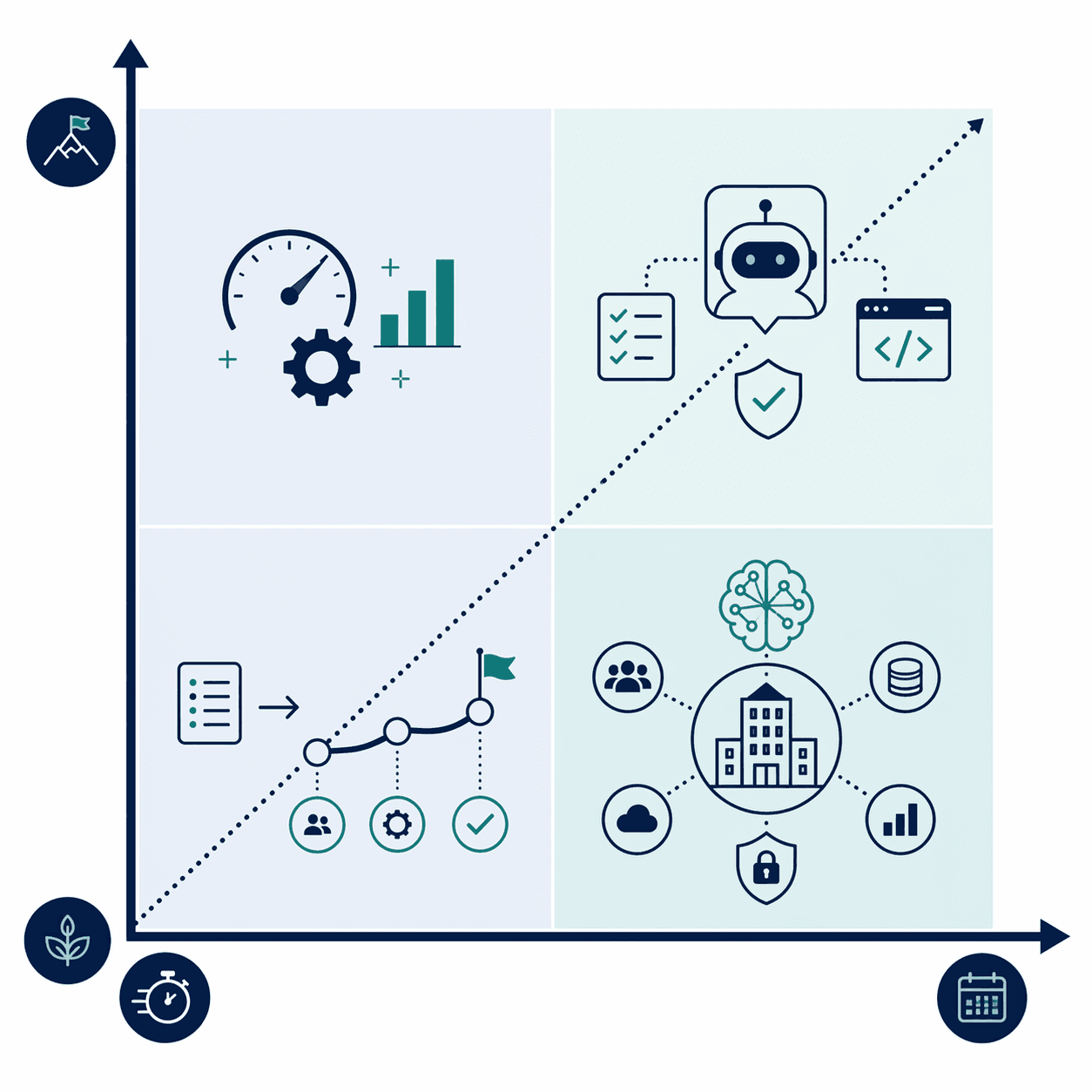
Internal approval conversations usually improve when the shortlist is placed on an effort-versus-time-to-value map. This is where a buyer can explain why a bounded AI agent may show value quickly while a planning transformation belongs in an enterprise program.
| Tool or program type | Typical implementation effort | Likely time-to-value pattern | Best when |
|---|---|---|---|
| Low-stakes AI agents or assistants | Low to moderate; often configured around existing workflows and knowledge sources | Can show value quickly when the task is bounded and the output is advisory | The decision is repetitive, low-risk, and easy for a human to review |
| Point optimization tools | Moderate; depends on data quality and system handoffs | Faster when the tool solves a narrow decision such as routing, slotting, or exception prioritization | The business has a measurable operational bottleneck and clear ownership |
| Visibility and exception-management platforms | Moderate; network, carrier, supplier, or partner connectivity can drive effort | Value appears when alerts reliably reach the teams that can act | Latency and surprise are the main operating problems |
| Planning platforms or suite modules | Moderate to high; requires data alignment, process design, and stakeholder governance | Value builds as planning cycles, scenario reviews, and exception processes change | The organization needs cross-functional planning improvement, not just better analytics |
| Full enterprise planning transformation | High; commonly treated as a 6–18 month program | Value depends on adoption, data readiness, integration depth, and management cadence | The business is redesigning planning across functions, regions, or echelons |
Fast time to value is not automatically better. A quick advisory agent may be the right first move if it removes manual research from a buyer or planner’s day. It is the wrong comparison point for a multi-echelon planning platform that has to reconcile demand, supply, capacity, inventory, and finance. The matrix is useful because it forces the buyer to defend both ambition and effort at the same time.
What to require before a vendor reaches the final shortlist
Before final selection, buyers should ask every vendor for the same evidence. The answers will usually reveal more than the roadmap slides.
- A decision map showing which decisions the tool recommends, triggers, or executes.
- A system map showing ERP, WMS, TMS, planning, procurement, supplier, and partner integrations required for the target use case.
- A data-readiness checklist covering master data, transaction history, constraints, hierarchies, partner data, and exception codes.
- An exception-governance model showing approval thresholds, override rights, audit trails, and escalation paths.
- A deployment plan that separates configuration, integration, testing, change management, and post-go-live support.
- A value case tied to measurable decisions, not broad AI adoption.
If a vendor cannot show where the recommendation lands, which system of record changes, who approves exceptions, and what data quality is required, the buyer is not evaluating an operating capability yet. They are evaluating a promise.
The safer shortlist is built by decision family: the decisions the tool can improve, the systems it can actually integrate with, the data maturity it requires, and the organizational complexity it can scale into. Feature checklists are too thin for this market. A structured evaluation model gives the buyer something better to defend.
References
- The Logistics AI Paradox: 94% Intent, 23% Strategy. ChainSignal.
- The Top 10 Supply Chain Management Systems for 2026. Panorama Consulting.
- 15 AI platforms for supply chain in 2026. monday.com.
- Top 20 Supply Chain AI Tools with Examples. AIMultiple.
- AI Supply Chain Companies 2026: The Definitive Vendor Directory by Functional Category. ChainSignal.
- Logistics AI ROI. Thinking Company. 2026.
Comments
Join the discussion with an anonymous comment.