
The old pharma recall room had a recognizable sound: phones left open, distribution files being corrected in real time, quality teams trying to match batch records against shipment history while legal waited for language that could survive regulatory review. The newer version is quieter when it works. A signal is scored before it becomes a crisis, affected lots are bounded against serialization and distribution data, draft notifications are prepared from approved templates, quarantine instructions route to the right nodes, and reconciliation evidence begins assembling before the first status meeting ends.
That is the practical promise behind pharma recall supply chain AI response. The point is not that AI makes recall decisions by itself. The point is that it can remove enough ambiguity, handoff delay, and manual reconciliation that human quality, regulatory, logistics, and commercial leaders reach the decision boundary with better evidence and less lost time.
The urgency is no longer theoretical. ARVO Ventures, citing Sparta Systems and McKinsey, puts the cost of a single pharmaceutical recall between $10 million and $100 million, with top-tier events reaching $600 million when indirect costs are included.[1] LSPedia, citing Sedgwick’s 2025 recall index, reports that pharmaceutical recall unit volume rose 140.2% in 2025 versus 2024; the same source says Sedgwick tracked 3,295 U.S. recall events and 858 million defective units across industries in 2025, up 26% year over year.[2]

Where AI Changes the Recall Workflow
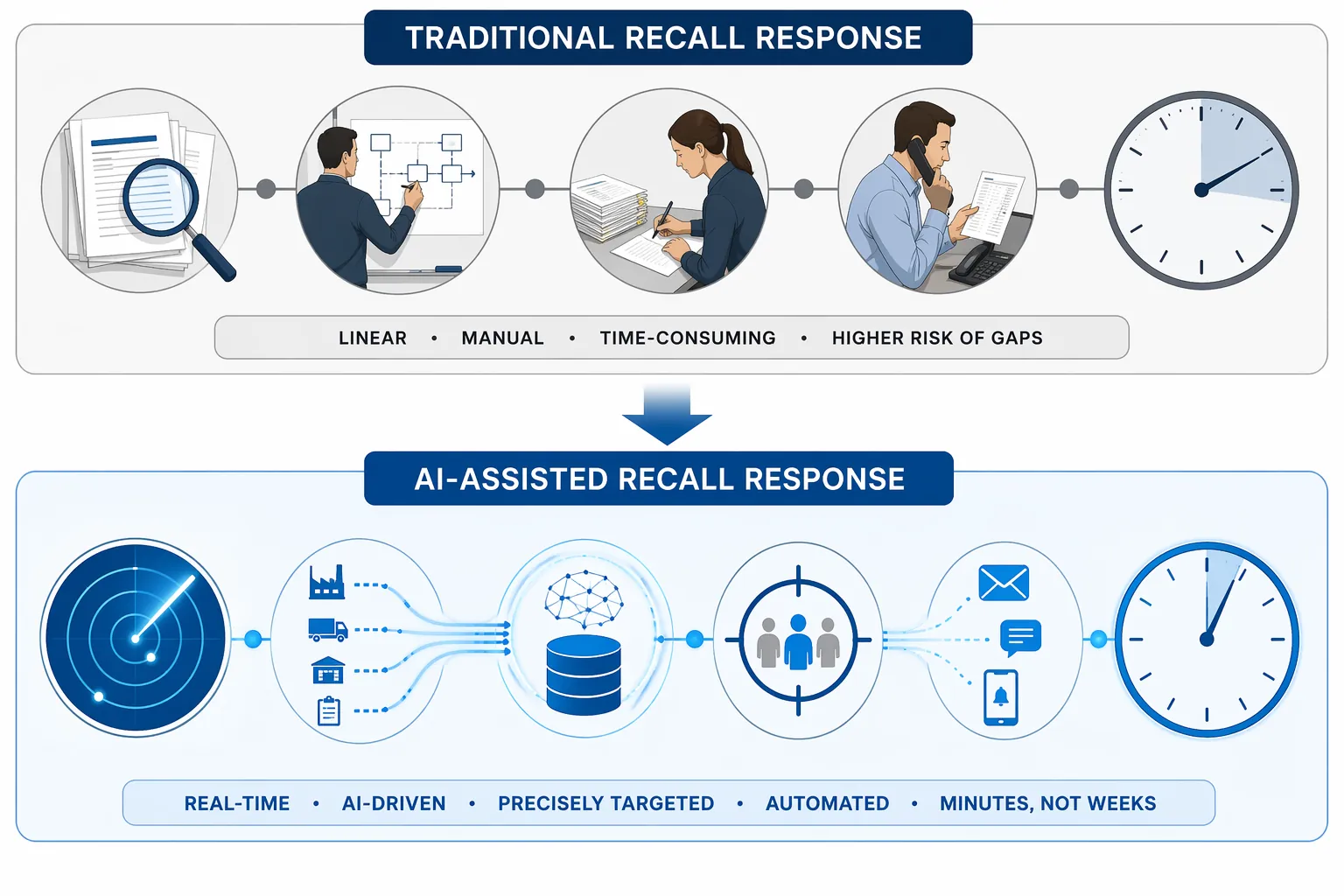
A recall response usually fails slowly before it fails publicly. The first delay is often not the formal decision; it is the uncertainty around whether a quality event, temperature excursion, adverse-event cluster, supplier issue, or regulatory signal is connected to product already in the channel. Traditional teams review deviations, complaints, shipment records, and inventory positions in separate systems. AI changes the sequence by watching those inputs continuously and ranking what deserves attention.
| Recall layer | Traditional burden | AI-assisted change |
|---|---|---|
| Signal detection | Quality, pharmacovigilance, logistics, and regulatory signals are reviewed in separate queues. | Models flag unusual patterns across deviations, temperature excursions, adverse-event data, supplier risk, and regulatory signals. |
| Recall execution | Teams manually draft notices, build distribution lists, issue quarantine instructions, and chase acknowledgments. | Workflow systems prepare notifications, quarantine tasks, decision trees, and reconciliation evidence for human review. |
| Precision bounding | Recall scope is often widened because lot, unit, shipment, and inventory evidence is incomplete or late. | Serialization and traceability data narrow the affected population when the underlying data is connected. |
| Post-recall learning | Root-cause evidence is assembled after exhaustion sets in. | NLP and analytics cluster complaints, deviations, and process records to support corrective action. |
The shift is not one tool replacing one task. It is a compression of the whole sequence from signal to scope to execution evidence. The highest-value systems do not merely answer “which lot?” They help answer: which signal is credible, which product is exposed, which locations must act, which customers must be notified, which inventory must be quarantined, and which proof will be needed when the action is reviewed.
From Signal Review to Earlier Intervention
Predictive recall response begins before anyone writes the recall notice. Models can monitor quality deviations from manufacturing, temperature excursions from logistics, complaint and adverse-event patterns, supplier-risk changes, and regulatory signals. When those inputs are connected, the system can surface combinations that would be hard to see in a weekly manual review: a deviation trend at a packaging line, a lane with recurring temperature drift, and a complaint cluster tied to the same product family.
This is where internal teams should be careful with language. Adoption of AI signal detection is not proof that recalls will fall. A model that detects a temperature excursion earlier may prevent compromised product from reaching a patient, or it may simply escalate an investigation sooner. Both outcomes matter, but they are not the same metric.
ARVO Ventures cites a 2023 IJRMP study reporting that AI-powered recall systems reduced average time to initiate a recall by 35% compared with traditional methods.[1] Because the article relies on the cited study summary rather than a directly reviewed full text, that figure is best used as directional evidence, not as a guaranteed benchmark. It still points to the right operational target: reducing the time between a credible signal and a controlled recall action.
Cold-chain monitoring shows the same pattern. FourKites describes AI control towers and digital twins that predict temperature excursions and support rerouting before product is compromised; its marketing content also cites Teva Pharmaceuticals at a 0.005% cold-chain incident rate.[3] That Teva figure should not be treated as independently verified public disclosure, but the use case is credible: earlier lane-level risk detection gives logistics and quality teams a chance to intervene before a deviation becomes a recall driver.
For teams building this layer, the most useful connection is often between quality and logistics rather than between AI and the board deck. A deviation management system may know that a batch needs investigation. A transportation control tower may know that a lane ran warm. A serialization repository may know where sellable units went. The recall response improves when those facts meet before the weekend reconciliation begins.
For a deeper look at the risk-scoring side of this layer, see how AI predicts drug recall risks in pharma supply chains.
Execution Is Where Hours Are Won or Lost
Once a recall is likely, the work becomes brutally procedural. Someone has to generate the consignee list, confirm shipped and on-hand inventory, draft customer notifications, issue quarantine instructions, route approvals, track acknowledgments, reconcile returns, and preserve evidence. In many companies, those actions still depend on spreadsheet extracts, email chains, shared drives, and people who know which field in the ERP is usually wrong.
AI-assisted recall platforms aim at that coordination drag. Honeywell announced TrackWise Recall Management in May 2025 and said the software can reduce recall execution from weeks to minutes through AI-assisted signal detection, automated workflows, and dynamic decision trees.[4] LSPedia’s Serialized Recall module claims up to a 90% reduction in manual recall-related labor based on operational testing with early adopters.[2] These are vendor-published claims, not independently audited operating results, but they show where serious recall software is now competing: not on prettier dashboards, but on fewer manual touches between decision and execution.
The strongest version of the workflow looks like this: the system ingests a signal, proposes affected product boundaries, creates role-specific tasks, prepares customer and distributor notices from approved language, issues quarantine orders to the relevant nodes, tracks acknowledgments, and builds reconciliation reports as actions close. Legal still reviews language. Quality still validates evidence. Regulatory still owns disposition. But the platform prevents each function from recreating the same facts in its own file.
The difference between “minutes” and “weeks” is rarely the typing speed of the notification. It is whether the system already knows which trading partners received which serialized units, which inventory is still in company control, which product has moved downstream, which templates apply, and which approvals are required for the recall class and market. If those data relationships are missing, AI can draft quickly and still leave the team reconciling slowly.
Return logistics belongs in the same operating design. A fast outbound notice that produces a confused return flow simply moves the bottleneck. Teams that are redesigning recall execution should connect customer notification, quarantine, return authorization, destruction, credit, and reconciliation as one governed process. The downstream flow is covered in more detail in AI recall return logistics.
Precision Bounding Is the Economic Center
Labor savings get attention because they are visible. Precision bounding often matters more because it changes the size of the recall itself. If a company cannot prove which lots or units are exposed, it recalls wider. That may be the correct patient-protective decision under uncertainty, but the uncertainty is expensive: more inventory quarantined, more sellable product destroyed, more customer disruption, more replacement demand, and more time spent explaining why the action was broader than the defect.
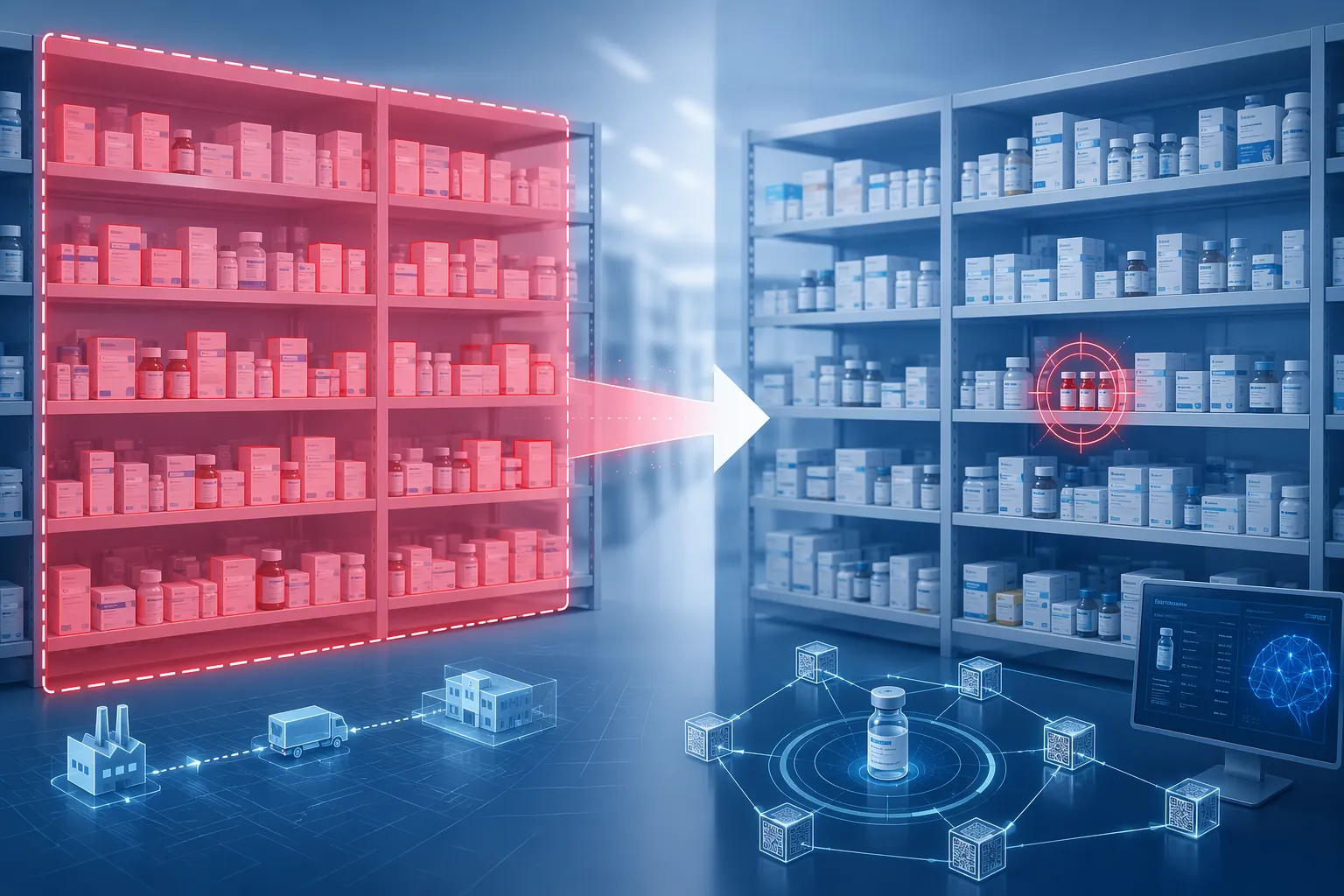
Serialization-level traceability gives AI something operationally useful to reason over. Instead of working only at a broad lot or shipment level, the system can compare serial numbers, aggregation events, packaging records, shipment events, distributor receipts, inventory positions, and return data. When those records are complete enough, the recall team can distinguish product that must be held from product that can remain in distribution.
A hypothetical example shows the difference without pretending to be a real case. Suppose an investigation ties a packaging-material defect to a defined production window. A traditional process may pull every lot touched by that line over a broad period because the team cannot match material exposure, packaging events, and downstream shipment records quickly enough. A connected AI-assisted process can test the exposure boundary against batch records, serial-level events, and distribution data, then prepare a narrower proposed action for quality and regulatory review.
That narrower action is not automatically safer. It is safer only if the evidence is complete, validated, and reviewable. Precision bounding must be defensible to auditors, regulators, customers, and internal quality leadership. The wrong narrow recall is worse than a costly broad one.
This is where the economics move beyond headcount. A bounded recall can reduce unnecessary destruction, protect revenue that would otherwise be lost, avoid avoidable stockouts, and reduce disruption for wholesalers, pharmacies, hospitals, and patients. For companies modeling those tradeoffs, the companion analysis on AI drug recall economics can help separate labor savings from avoided product loss and service-level impact.
The Data Gap Decides Whether the Claims Hold
The market’s strongest recall automation claims assume a data environment many pharma companies do not yet have. VE3, citing LogiPharma 2026 survey data, reports that 65% of pharma supply chain leaders have limited confidence in AI’s ability to predict or mitigate disruption, and that 42% of AI initiatives fail to meet ROI expectations because of disconnected data environments.[5] Those numbers are not a footnote to the AI recall story. They are the condition that determines whether the story is real.
Recall response pulls from more systems than most transformation roadmaps admit. Manufacturing execution, laboratory information, deviation and CAPA, ERP, warehouse management, transportation, temperature monitoring, supplier quality, complaint handling, pharmacovigilance, serialization, distributor data, customer master data, and regulatory correspondence may all matter in the same event. If the data model cannot connect those facts, the AI layer becomes another reviewer asking for extracts.
- Manufacturing and quality data must identify what was made, when, under which conditions, and under which deviations or investigations.
- Distribution and serialization data must show where affected product went and whether the unit, case, pallet, or lot is still traceable.
- Cold-chain and logistics data must preserve excursion history by lane, carrier, node, and product movement.
- Supplier-risk data must connect external quality issues to internal materials, batches, and release decisions.
- Regulatory and customer-notification workflows must record who approved what, when, and on what evidence.
Without those connections, a platform may still be useful for task routing and document generation. It may not be able to support predictive detection or precision bounding at the level executives expect. That distinction matters during vendor selection. A recall demo can look clean with sample data and still collapse when customer master records, distributor acknowledgments, and serialized event histories disagree.
The manufacturing-quality side deserves its own attention because many recall signals begin long before distribution. Plant disruption prediction, deviation clustering, and process-drift detection are adjacent capabilities, not separate modernization efforts. The link between plant signals and recall readiness is explored further in predicting pharma plant disruptions.
Regulators Are Using AI, But Accountability Has Not Moved
Regulatory agencies are also experimenting with AI-supported review. 24x7 Mag reported that the FDA launched a generative AI tool called Elsa in June 2025 to accelerate clinical protocol reviews and help identify high-priority inspection targets; the same article noted that Class I medical device recalls reached a 20-year high in Q2 2025.[6] Fierce Healthcare also covered the FDA’s Elsa launch as part of the agency’s AI push.[7]
That context matters, but it should not be stretched. FDA use of AI for internal review and prioritization does not mean enterprise recall automation is automatically accepted, nor does it change who is accountable for product disposition. Batch release, recall classification support, market action strategy, regulatory notifications, and compliance sign-off remain human-accountable decisions.
A defensible AI recall process therefore needs more than model output. It needs versioned data, explainable recommendations, approval records, exception handling, role-based access, audit trails, and clear escalation rules. The system can prepare the decision package. It should not obscure who made the decision.
Broader AI regulatory dynamics are moving quickly, and supply chain leaders should expect more scrutiny rather than less. The policy context is discussed in AI regulation and supply chain competition.
Agentic Recall Tools Are the Forward Edge
Once the workflow layers are understood, agentic AI becomes easier to place. It is not magic sitting above the recall process. It is an orchestration layer that can sense events, retrieve relevant records, prepare tasks, draft communications, and push structured actions through enterprise workflows under defined controls.
Cegeka describes a Quality Impact Recall Agent using the Model Context Protocol within Microsoft Dynamics 365 workflows to support recall orchestration across ERP processes.[8] VE3’s LogiPharma 2026 playbook similarly frames the next wave as AI systems that continuously sense, synthesize, and prepare decisions across demand, supply, and logistics.[5] These examples point toward a recall environment where the system does not wait for a user to open the right screen; it assembles the next action package when the risk pattern appears.
The control question becomes sharper as autonomy increases. Which tasks may the agent execute automatically? Which require quality approval? Which require regulatory review? Which communications can be drafted but not sent? Which inventory holds can be recommended versus imposed? Those boundaries should be designed before the first live recall, not negotiated inside one.
What Executives Should Validate Before Buying
A credible pharma recall supply chain AI response program should survive operational questioning. The vendor should be able to show how the system handles incomplete master data, conflicting shipment records, distributor nonresponse, returned product without clean serialization history, temperature data gaps, and market-specific notification requirements. Clean demos matter less than ugly exception handling.
- Ask whether speed claims measure detection, decision preparation, notification release, field execution, or reconciliation closure.
- Separate vendor-tested labor reduction from independently verified performance in comparable operating environments.
- Require evidence that serialization, ERP, warehouse, logistics, quality, and regulatory workflows can be connected without manual bridges.
- Test precision bounding against real historical recall or mock-recall data, including exceptions and missing records.
- Define which recommendations are advisory, which actions are automated, and which approvals remain human-controlled.
The most useful pilot is not a generic AI proof of concept. It is a controlled mock recall using actual product, customer, serialization, logistics, quality, and notification data. Measure how long it takes to identify affected product, issue approved quarantine instructions, generate consignee notifications, receive acknowledgments, reconcile returned or destroyed product, and produce an audit-ready evidence file.
That test will reveal whether AI is changing the recall response or merely adding another interface to it. If the organization has connected the data, clarified workflow ownership, and protected human accountability at the regulatory boundary, AI can make recall response earlier, narrower, and much faster. If not, the recall room will still fill up; it will just have a better dashboard.
References
- Smart Recall Management: Reducing Risk & Protecting Patients with AI — ARVO Ventures — https://onearvoventures.com/smart-recall-management-pharma-ai/
- OneScan Recall Management Module — LSPedia — https://www.lspedia.com/products/onescan-solution-suite/recall-management-module
- How AI Control Towers Prevent Pharma Supply Chain Disruptions — FourKites — https://www.fourkites.com/blogs/how-ai-control-towers-prevent-pharma-supply-chain-disruptions/
- Honeywell Launches AI-Assisted Recall Management Software to Help Life Sciences Companies Improve Patient Safety — Honeywell — May 2025 — https://automation.honeywell.com/us/en/news/press-releases/2025/honeywell-ai-assisted-recall-software
- Why Pharma Supply Chain AI Fails Without End-to-End Data Integration — VE3 — https://ve3.global/blog/why-pharma-supply-chain-ai-fails-without-end-to-end-data-integration
- Medical Device Recalls Hit 20-Year High, FDA Implements AI-Driven Review Process — 24x7 Mag — https://24x7mag.com/standards/fda-updates/recalls/medical-device-recalls-hit-20-year-high-fda-implements-ai-driven-review-process/
- FDA rolls out generative AI tool Elsa across agency — Fierce Healthcare — https://www.fiercehealthcare.com/ai-and-machine-learning/fda-rolls-out-generative-ai-tool-elsa-across-agency
- Transforming Product Recalls with AI — Cegeka — https://www.cegeka.com/en-us/blogs/transforming-product-recalls-with-ai
Comments
Join the discussion with an anonymous comment.