
A recall becomes a return-logistics problem the moment someone has to answer four operational questions at once: which units are suspect, where are they now, who must be told, and what physical path keeps them from moving further into use. That is where ordinary returns language starts to fail. A customer return asks how to recover value from an unwanted or defective item. A recall return asks how to regain control over product that may be unsafe, noncompliant, or legally restricted from normal disposition.
The stakes are not abstract. FreightAmigo, citing IQVIA, reports that the FDA recalled 22 food products in October 2024 and that a major pharmaceutical recall averages $12 million per incident; those figures should be treated as a useful risk baseline rather than a universal cost model across industries.[1] The practical lesson is simpler: once a recall starts, every hour spent reconciling complaint files, ERP records, warehouse locations, and customer lists expands the window in which suspect product can keep circulating.
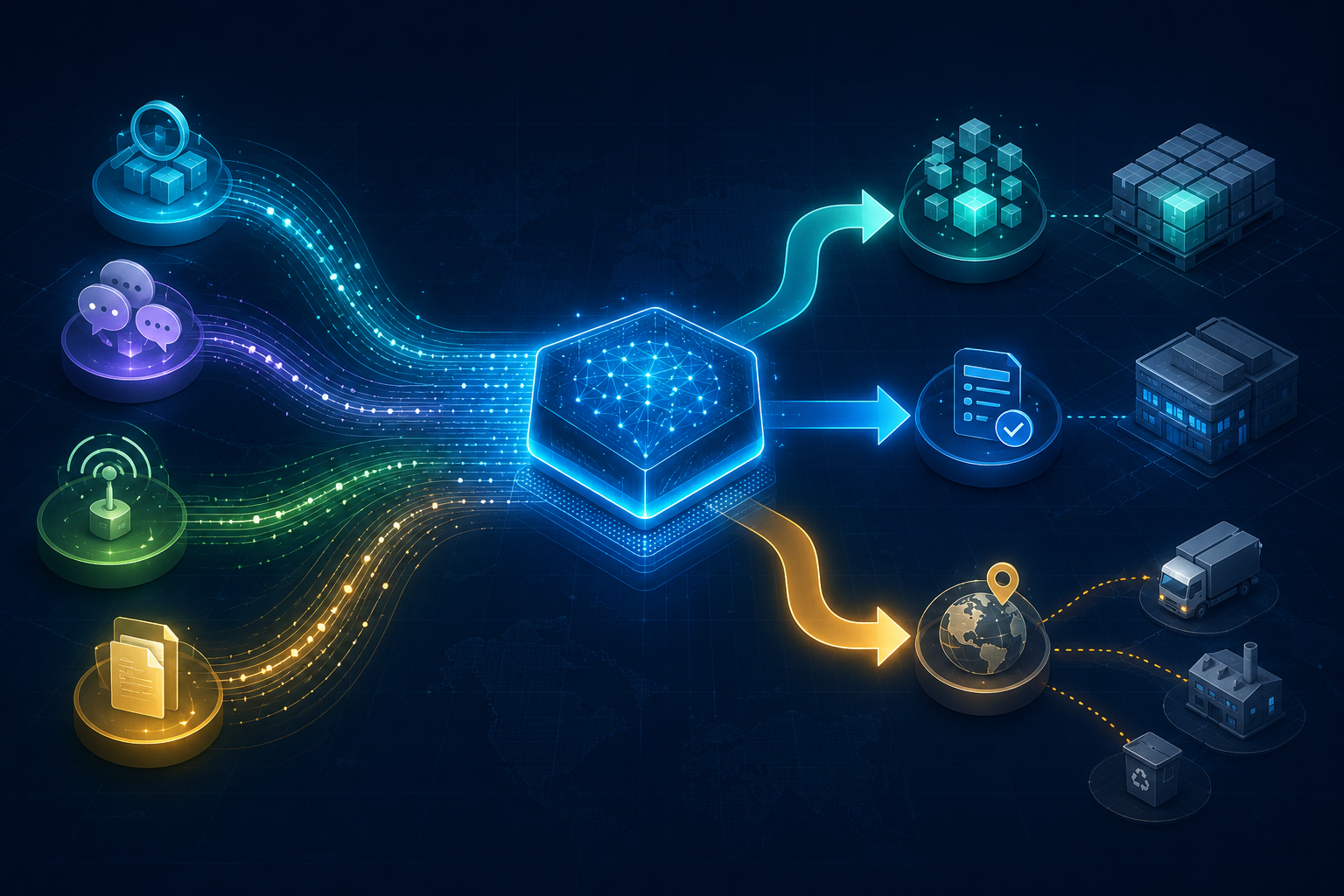
That is the real opening for AI in recall return logistics. The value is not that AI makes recall work frictionless. It is that AI can remove delay and overbreadth from the handoffs that usually slow recall execution: signal detection, scope definition, stakeholder notification, return authorization, routing, segregation, and final disposition.
The recall return flow starts before the return label
In consumer returns, the return event usually starts with a known item and a known requester. In recalls, the first signal may be messier: a complaint spike, a call-center pattern, a field failure, a temperature excursion, a contamination indicator, a supplier notice, or a warranty cluster. The logistics network may not yet know whether it is dealing with one lot, one factory run, one distribution lane, or an entire product family.
Product Law Perspective describes AI systems that continuously analyze consumer complaints, call logs, and sensor data to surface potential hazards in hours rather than the weeks associated with manual processes.[2] That speed matters, but only if it changes what happens next. A faster alert that still dumps an undefined product-line concern on quality, logistics, customer service, and ERP owners is only a louder starting gun.
The better use case is signal-to-scope. AI can compare complaint language, call logs, sensor feeds, production records, warranty data, quality holds, shipment histories, and supplier notices to look for shared identifiers. The output logistics teams need is not a dashboard saying “possible issue.” They need affected lot codes, serial-number ranges, batch identifiers, production dates, shipping destinations, customers of record, and inventory still sitting in nodes that can be stopped before it moves.
Product Law Perspective also reports that AI can help scope recalls to specific serial numbers rather than entire product lines by cross-referencing production and warranty data, reducing cost and legal exposure.[2] That is one of the most important distinctions in the whole recall-logistics argument. AI is not only shortening the time to detection; it can narrow the population of goods that must be withdrawn, quarantined, returned, or destroyed.
For a logistics director, that narrowing changes the physical operation. A product-line recall can trigger broad stop-ship orders, store pulls, customer notifications, returns capacity spikes, and quarantine space that may exceed what regional sites planned for. A lot-specific recall can still be serious, but it gives the network a more defensible target: these SKUs, these lot codes, these destinations, these open orders, these inventory locations.
From hazard signal to affected population
The hardest early work is often not finding that something is wrong. It is proving how far the problem reaches without pulling back everything that looks adjacent. A recall team may have a consumer complaint cluster in one region, a supplier deviation notice, or a sensor event from a cold-chain lane. Each clue points somewhere, but no single clue defines the recall boundary.
AI helps when it can connect those clues across systems that were not designed for a recall room. A complaint model may group reports with similar symptoms or failure descriptions. A quality model may compare those reports with inspection records, production exceptions, or contamination indicators. A traceability model may then map the suspect production window to lots, batches, serials, warehouses, distributors, retailers, clinics, repair depots, or end customers.
Food Logistics describes predictive analytics using machine learning on quality, temperature, and contamination data to flag possible issues before they escalate into recalls.[3] That is especially relevant for 3PLs and food supply chains, where the operator may not own the product but still has to preserve evidence, isolate inventory, and execute the shipper’s instructions quickly. The useful version of prediction is not a vague risk score; it is an exception that can be tied to a product identity and a physical location.
A hypothetical food example shows the difference. If complaints mention spoilage across several stores, a manual review might begin with a broad SKU hold. An AI-assisted workflow could compare complaint timing, delivery records, temperature logs, and lot codes, then find that the common link is a specific production batch and a specific lane. The company may still choose a conservative action, but it is making that decision with a scoped traceability picture rather than a pile of disconnected spreadsheets.
The same logic applies outside food. In consumer electronics, serial-number-level scoping can separate a component batch from an entire model family. In automotive, warranty and service data can help distinguish a supplier part run from a platform-wide issue. In pharma, batch and distribution traceability governs whether retrieval efforts are targeted enough to protect patients without creating avoidable shortages. The industries differ, but the operational question is the same: how much product is actually in scope, and where is it?
ERP execution is where recall AI becomes logistics infrastructure
Once scope is defined, the recall has to become executable. This is where many AI discussions become too thin. A model that identifies suspect lots is useful; a governed workflow that writes the right actions into ERP, notifies the right parties, creates return authorizations, and preserves traceability evidence is more useful.
Cegeka’s Quality Impact Recall Agent is a concrete example of that second category. Built around Dynamics 365 and Copilot Studio, it parses supplier notifications, identifies affected lot codes, creates return authorizations in ERP, and notifies downstream stakeholders. Cegeka says this collapses work that previously took days into minutes.[4] Because Cegeka is a vendor, the claim should not be treated as an independent benchmark for every recall operation. It is still valuable because it shows the shape of the workflow logistics teams actually need.
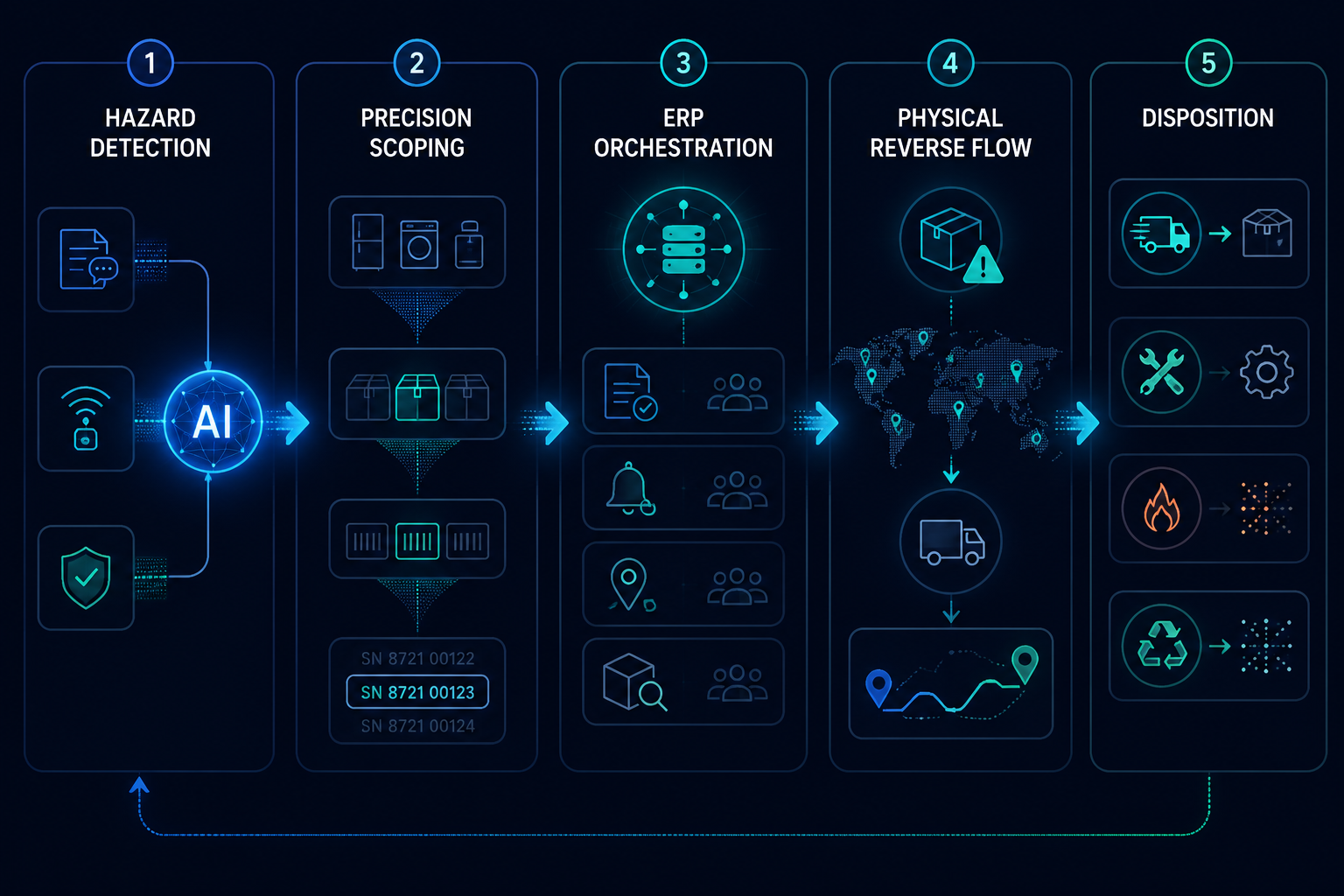
The ERP layer matters because recall work has to leave an audit trail. A stakeholder notification is not just a message. It should connect to a lot, a customer or node, a required action, a timestamp, a response status, and a return or quarantine instruction. A return authorization is not just a customer-service convenience. It controls whether a suspect unit can enter the reverse network, where it is allowed to go, and how it is segregated when it arrives.
This is also where automated notification workflows deserve their own attention. Supplier notices, retailer alerts, distributor instructions, customer-service scripts, field-service tasks, and 3PL operating instructions often move on different clocks. An agentic workflow can reduce the lag between “we know the affected lot” and “every relevant party has a system action.” For a retail-specific example of that narrower notification problem, see How AI Agents Automate Recall Response Across Retail Supply Chains.
The operational gain is not that people disappear from the process. Quality, legal, regulatory, logistics, and customer teams still approve the recall strategy and oversee execution. The gain is that fewer people spend the first night copying lot codes from one file into another, manually matching affected customers, or waiting for a system owner to create the return path.
What the system has to produce
- Affected identifiers: lot codes, batches, serial numbers, SKUs, production windows, or supplier part references.
- Inventory location status: on hand, in transit, delivered, consumed, installed, dispensed, sold, or pending shipment.
- Stakeholder actions: stop ship, quarantine, remove from shelf, notify customers, contact patients, schedule pickup, or await disposition approval.
- Return controls: authorization creation, carrier instructions, packaging requirements, chain-of-custody needs, and receiving-site rules.
- Disposition evidence: inspection results, destruction certificates, refurbishment eligibility, return-to-origin confirmation, or recycling documentation.
Reverse logistics benchmarks help, but recalls are not retail returns
There is a reason recall teams borrow language from reverse logistics. The physical work overlaps: pickups, consolidation, transportation planning, receiving, inspection, labor scheduling, exception handling, and disposition. McKinsey estimates that retailers spend about $200 billion annually recovering value from returned goods, and it reports that AI can reduce forecasting errors by up to 50%, cut labor costs by about 30%, and accelerate processing by 50% to 60% in reverse-logistics settings.[5]
Those figures are useful, but they come from consumer returns, not recall-specific logistics. The transferable pieces are labor forecasting, inbound volume prediction, routing, prioritization, and disposition decision support. The nontransferable pieces are just as important. A recalled item may not be eligible for resale. It may require quarantine, chain-of-custody records, regulatory reporting, destruction, manufacturer retrieval, or controlled refurbishment. The cheapest path is not necessarily a permissible path.
That distinction changes how AI optimization should be judged. In retail returns, a model may optimize for margin recovery, speed, or customer convenience. In recall logistics, the first optimization constraint is control: prevent further use, preserve evidence, avoid mixing suspect and clean inventory, and execute the approved disposition.
Routing suspect product is a compliance problem before it is a cost problem
After notifications and return authorizations go out, the recall becomes physical. Product has to be collected from stores, warehouses, distributors, hospitals, repair channels, customers, or field locations. It has to be labeled correctly, kept separate, received against the recall record, and routed to an allowed disposition path.
AI can support that routing by combining condition data, location, transportation capacity, regulatory requirements, inventory status, and disposition rules. The practical options may include return-to-origin, refurbishment, destruction, or recycling, but those are not interchangeable. A recalled pharmaceutical batch, a contaminated food product, a defective battery, and a mislabeled consumer item sit under different constraints.
| Decision point | What AI can help evaluate | Human or policy control that still matters |
|---|---|---|
| Where to collect from | Affected node locations, shipment histories, customer records, open orders, and in-transit status | Recall scope approval and customer or regulatory notification rules |
| Where to send product | Nearest approved facility, carrier capacity, quarantine space, and return-to-origin requirements | Permitted handling and segregation procedures |
| How to prioritize movement | Risk level, product condition, geography, volume, and downstream exposure | Safety priority over transport-cost minimization |
| Which disposition path applies | Inspection results, product category, condition, lot status, and documented rules | Legal, regulatory, quality, and environmental approvals |
Locus, a logistics technology vendor, says backhaul-optimized reverse logistics can reduce per-item pickup costs from $4–$6 to under $1.50.[6] That claim is worth treating as vendor-sourced evidence from retail-oriented reverse logistics, not as a recall benchmark. Backhaul optimization can matter when recalled goods are geographically dispersed, but a recall route cannot be judged only by pickup cost. If the product requires segregation, temperature control, hazardous handling, or documented destruction, the routing algorithm has to honor those constraints first.
The most useful AI systems therefore look less like generic route optimizers and more like governed decision engines. They can recommend consolidation points, flag nodes that have not responded, prioritize pickups where exposure risk is highest, and prevent a return from being routed to a facility that is not approved for that product or disposition type.
Pharma examples show promise, with sourcing limits
Pharmaceutical recalls make the retrieval problem especially visible because traceability, patient safety, and permitted disposition are tightly constrained. FreightAmigo describes a Pfizer blockchain-plus-AI case that reportedly reduced pharmaceutical recall retrieval time by 50% and saved $18 million per major incident.[1] The example is promising, but the sourcing is indirect in the available material. It should not carry the whole argument without verification from Pfizer or an independently published case study.
Even with that caveat, the direction makes operational sense. Blockchain-style traceability records can help establish where product moved; AI can help interrogate those records, prioritize retrieval, and connect recall instructions to return workflows. The important point is not the technology label. It is whether the system can identify affected units, prove their path, and move them into controlled retrieval faster than manual tracing alone.
Market growth does not prove recall maturity
There is broader market momentum around AI in reverse logistics. Technavio projects the AI in reverse logistics market will grow by $4.60 billion at a 19.8% CAGR from 2025 to 2030.[7] That is directional context, not proof that recall-specific AI adoption is mature. Much of the market conversation still centers on consumer returns, resale, labor planning, and value recovery.
Recall logistics adoption is harder to measure from the available sources. Enterprises may already use AI in quality monitoring, contact-center analytics, demand forecasting, transportation planning, or ERP automation without having a single labeled “recall AI” platform. The more relevant maturity question is whether those capabilities can be connected under recall governance when a hazard signal appears.
Where AI changes recall return logistics most
AI has the strongest recall-logistics impact when it connects four pieces that are often separated during an incident. First, it detects weak signals earlier across complaints, calls, sensors, quality data, and supplier notices. Second, it narrows scope by tying those signals to production, warranty, shipment, and inventory records. Third, it turns the approved scope into ERP actions: return authorizations, stakeholder notifications, lot holds, customer lists, and task records. Fourth, it supports reverse-flow decisions that keep affected goods collected, segregated, routed, and resolved under the right controls.
That is a narrower claim than “AI handles recalls,” and it is the claim the evidence can support. Faster detection matters because it starts the process earlier. Tighter scoping matters because it avoids unnecessary withdrawal while focusing effort on the product that is actually suspect. Automated notifications matter because they reduce handoff delay when downstream parties need instructions. Optimized reverse flows matter because physical goods still have to come back, be isolated, and be resolved under compliance constraints.
The recall does not become easy. It becomes more controlled. For the teams inheriting the incident after the hazard is found, that is the difference that matters.
References
- Reverse Logistics in Pharmaceutical Recalls, FreightAmigo, Jul 2025.
- How AI Is Revolutionizing Product Safety, Product Law Perspective, Mar 2026.
- How AI Helps 3PLs Manage Product Recalls, Food Logistics / RTS Labs, May 2025.
- Transforming Product Recalls with AI, Cegeka, Jan 2026.
- From Cost Center to Competitive Advantage, McKinsey, Feb 2026.
- How AI-Optimized Reverse Logistics Is Becoming Retail's Hidden Competitive Edge, Locus, Apr 2026.
- AI in Reverse Logistics Market Growth Analysis 2026–2030, Technavio, 2025.
Comments
Join the discussion with an anonymous comment.