
The most uncomfortable fact about pharmaceutical supply chain disruption risk is that it often starts inside the four walls of manufacturing, not at a port, a warehouse, or a demand-planning desk. Under routine conditions, manufacturing quality failures are identified as the single biggest cause of drug supply chain disruptions in the National Academies work cited by DES Pharma Consulting.[1]
That matters because a quality issue rarely stays contained as a quality issue. A deviation investigation can hold inventory. A failed inspection can freeze release assumptions. A supplier quality trend can make a validated process suddenly fragile. A problem at a contract manufacturing organization can delay an IND or BLA submission by 6–12 months, a window long enough to strain or exhaust the cash runway of a small biotech sponsor.[1]
So the useful AI question is narrower than the usual transformation pitch. It is not whether AI can make pharma supply chains more “visible.” It is whether AI can see plant-level failure modes forming early enough for quality, planning, procurement, regulatory, and commercial teams to act before the disruption becomes a shortage, a launch delay, or a costly scramble.

What AI Is Actually Trying to Predict
A plant disruption is not one event. It is a sequence of small signals that eventually removes capacity, delays batch release, restricts usable inventory, or forces a sourcing decision under pressure. AI is most useful when it treats those signals as connected rather than as separate dashboards owned by different functions.
In a pharmaceutical manufacturing setting, the inputs that matter are usually operational and quality-heavy: electronic batch records, deviation and CAPA histories, equipment and sensor readings, raw-material availability, supplier quality scores, cold-chain telemetry, inspection outcomes, and planning data. None of those inputs is magic by itself. Their value comes from the way they shorten the time between “something is drifting” and “someone can still do something about it.”
| Signal | What the model may detect | Intervention window |
|---|---|---|
| Batch records and deviation history | Recurring exceptions, longer review cycles, repeat failure patterns | Quality investigation, batch-release prioritization, temporary planning holds |
| Equipment and sensor data | Drift in process parameters, abnormal maintenance patterns, early outage indicators | Maintenance scheduling, production sequencing, capacity reallocation |
| Supplier quality scores | Rising defect patterns, late documentation, repeated nonconformance | Alternate sourcing review, safety-stock adjustment, supplier escalation |
| Inspection and regulatory outcomes | Site-level compliance risk that could affect release, launch, or allocation assumptions | Regulatory planning, launch contingency, allocation decisions |
| Cold-chain telemetry | Temperature excursions, lane instability, rescue-shipment likelihood | Route change, shipment intervention, inventory protection |
The distinction between these signals matters. A sensor anomaly may buy days or weeks before equipment capacity is lost. A supplier quality deterioration may buy weeks or months before a raw-material constraint reaches the line. A regulatory or inspection signal may not tell a planner which batch will fail, but it can change allocation and launch assumptions before commitments harden.
The Predictive Workflow
A credible AI workflow for plant-disruption prediction starts before model selection. The first job is to connect records that are often managed for compliance, planning, procurement, and logistics separately. If the batch record sits in one system, the supplier scorecard in another, the maintenance data in a third, and the launch plan in a spreadsheet, the organization may have plenty of data and still have poor warning time.
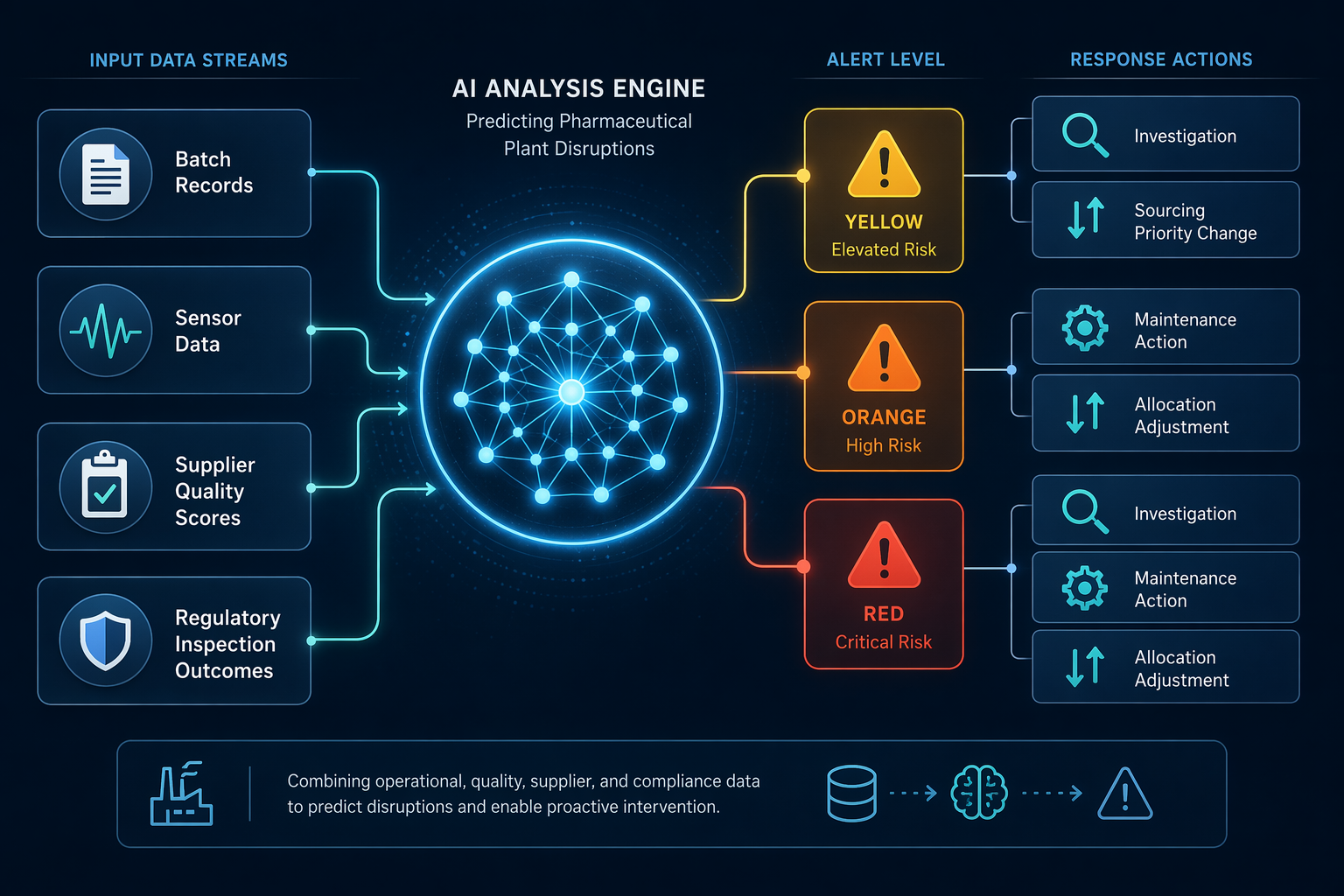
Once the data is connected, the model looks for combinations that human teams may miss because each signal looks tolerable in isolation. A longer-than-usual batch review cycle may be explainable. A supplier documentation delay may be explainable. A minor equipment drift may be explainable. The risk changes when those signals cluster around the same product, line, site, supplier, or release window.
The output should not be a vague red dot on a control tower screen. It should name the vulnerable product, site, supplier, batch family, lane, or launch milestone; show the drivers behind the alert; estimate the likely consequence; and route the alert to the function that can still intervene. A quality-led alert may need an investigation owner. A procurement-led alert may need a qualified alternate path. A planning-led alert may need allocation changes. A regulatory alert may need revised filing or launch assumptions.
The strongest systems also separate alert severity from organizational action. A yellow alert might trigger closer monitoring and documentation review. An orange alert might require a cross-functional decision on inventory, supplier escalation, or maintenance timing. A red alert might force executive trade-offs between markets, launches, customer commitments, and patient-critical supply. The model can recommend escalation, but it cannot decide who is allowed to release inventory, qualify a backup supplier, or change a launch assumption.
That is where many AI pilots become less impressive than their demos. Predictive accuracy is not the same as operational lead time. If an alert arrives after the batch is already stuck in release, after the alternate supplier window has closed, or after the sponsor has committed to a filing date, the model may be technically correct and operationally late.
Why the Adoption Gap Is Still So Visible
The use case is plausible, and the tools are no longer theoretical. Yet adoption is still uneven. The 2025 LogiPharma survey cited in Pharmaceutical Commerce found that only 53% of pharma supply chain leaders use AI for predictive risk alerts, compared with 59% using AI in demand planning; the same reporting notes that 65% still have limited confidence in AI’s disruption-prediction capabilities.[2]
That pattern is believable. Demand planning is a cleaner entry point: the business can compare forecasts, track bias, and decide whether the new model improves an existing planning process. Plant-disruption prediction is harder because the alert often lands in regulated terrain. It may imply a quality investigation, a supplier escalation, a filing risk, or a manufacturing schedule change. A planner can test a forecast. A quality organization has to defend the action it takes from an alert.
Confidence also depends on explainability. A supply chain director does not need a model to expose every parameter in a neural network, but teams do need to know which signals drove the alert and whether those signals are current, validated, and relevant. An opaque warning that says a site is “high risk” may create meeting volume without creating intervention capacity.
The organizational test is simple: when the system flags a risk, does anyone have the authority, time, and evidence to change the plan? If the answer is no, the company has bought earlier anxiety rather than earlier prevention.
What the Evidence Supports So Far
The documented outcomes are encouraging, but they need to be read as early signals rather than settled proof across the industry. McKinsey’s 2025 work on digital strategies in pharma supply chains reports AI copilot deployments associated with 2–3% supply chain cost reduction, 15% forecast accuracy improvement, and 20–30% planning workload reduction.[3]
Those figures are useful because they show that AI is already changing planning work, not just producing innovation decks. They are also bounded. The figures come from a single 2025 paper cited in later industry coverage, and they should not be treated as an independently replicated benchmark for every pharmaceutical manufacturer, product type, or maturity level.[3]
The stronger argument for plant-disruption prediction is not that every company will capture the same percentage improvement. It is that the cost of late reaction is already visible. A CMO disruption that delays a submission by 6–12 months is not just a manufacturing inconvenience; it can change financing needs, clinical-program sequencing, and launch timing for the sponsor.[1]
Cold-chain disruption offers another window into the price of reacting late. The widely cited $35 billion annual cold-chain loss benchmark, originally from older industry work but still repeated in 2025–2026 coverage, appears alongside estimates of $10,000–$15,000 for an expedited cold-chain shipment.[2][4]
Those numbers should not be overextended into a claim that AI prevents all cold-chain losses. They do show why a predictive alert that prevents even a small number of rescue shipments, temperature excursions, or inventory write-offs can matter. In regulated supply chains, the avoidable cost is often not only freight. It is the investigation, disposition delay, replacement inventory, customer communication, and, in the worst cases, unavailable therapy.
Broader connected-supply-chain benchmarks point in the same direction, though they are less specific to plant failure. SCX and LogiPharma reporting cited by pharmaphorum says digital supply chains with high AI adoption achieve 35% lower inventory, 15% lower logistics costs, and 65% higher service levels compared with analog peers.[5]
That is relevant context, not a plant-disruption guarantee. Lower inventory and higher service levels can reflect many capabilities: better planning discipline, better network design, better master data, stronger logistics orchestration, and more mature governance. For the plant-disruption use case, the evidence becomes more persuasive when it connects an alert to a specific avoided action: no emergency transfer, no delayed filing, no preventable stockout, no unnecessary batch hold, or no late supplier surprise.
Where AI Fits Best in the Plant-Disruption Cycle
AI is best suited to disruption risks that leave traces before they become events. It is less useful when the organization asks it to predict isolated shocks with no useful precursor data. In pharma manufacturing, the higher-fit areas are usually repeatable, data-rich, and cross-functional.
- Quality trend detection: identifying recurring deviations, review delays, or process drifts that could affect batch release or site capacity.
- Equipment and process monitoring: flagging abnormal patterns in sensor or maintenance data before capacity is lost.
- Supplier quality and material risk: combining delivery, documentation, and nonconformance signals before a raw-material issue reaches the production schedule.
- CMO and CDMO oversight: surfacing risks at outsourced sites where the sponsor may have less direct operational visibility.
- Cold-chain intervention: detecting shipment or lane anomalies early enough to protect product before disposition becomes the only option.
CMO and CDMO oversight deserves special attention because the consequences can arrive on a different clock. An internal plant issue may trigger capacity rebalancing across a network. A CMO issue can hit a sponsor that does not own the facility, does not control every quality-system detail, and may not have a second validated site ready. For a small biotech, the disruption is not only supply-chain noise; it can become a financing and regulatory milestone problem.
This is where predictive AI has a practical role if the sponsor can access enough leading indicators. Supplier documentation quality, deviation closure patterns, inspection signals, batch-review timelines, and repeated schedule movement may not prove a future delay. But together they can justify earlier governance attention than a monthly status call that stays green until it is not.
The Implementation Risk Is Mostly Human and Procedural
The hard part is not only building a model. It is deciding what the company will do when the model is probably right but not certain. Pharmaceutical supply chains are full of legitimate reasons to hesitate: regulatory commitments, validated processes, supplier qualification requirements, batch-release rules, market allocation obligations, and patient-impact trade-offs.
A useful pilot therefore needs more than a data-science workstream. It needs a response design. Before go-live, the organization should decide which alerts are advisory, which require formal review, which trigger escalation, and which functions own the decision. Otherwise, the model will find risks faster than the organization can absorb them.
| Pilot design question | Why it matters |
|---|---|
| Which disruption type is in scope? | A quality-release risk, supplier-risk model, and cold-chain model require different data and owners. |
| What is the minimum useful warning time? | An alert that arrives too late to change release, sourcing, maintenance, or allocation decisions has limited value. |
| Who receives the alert? | Planning, quality, procurement, regulatory, and logistics teams cannot all treat every signal as equally urgent. |
| What evidence must accompany the alert? | Teams need enough explanation to act in a regulated environment. |
| What action is pre-authorized? | Without a response path, prediction does not become prevention. |
The cleanest early pilots will likely avoid the broad promise of “predict all disruptions.” A better starting point is a bounded use case: one product family, one site network, one high-value supplier category, one CMO portfolio, or one cold-chain lane set. That makes it possible to compare AI alerts against known disruptions, missed signals, false positives, intervention timing, and the cost of action.
False positives deserve serious treatment. In a regulated plant, a bad alert does not merely annoy a planner. It can pull quality people into unnecessary review, distract maintenance teams, create supplier escalation fatigue, or cause leadership to discount the next warning. Trust is not won by showing that the system can detect risk somewhere. It is won by proving that its alerts are specific enough to change decisions without creating constant noise.
Use-Case Verdict for Q3 2026
AI can predict many pharmaceutical plant-disruption risks earlier than manual monitoring when operational, quality, supplier, logistics, and regulatory data are connected. The strongest rationale is not abstract AI maturity. It is the very practical fact that manufacturing quality failures are a leading routine cause of supply disruption, and many of those failures leave operational traces before the supply chain feels the full impact.[1]
The evidence base is promising but not complete. Early adopter reporting shows measurable planning and cost outcomes, while industry surveys show that confidence and adoption still lag the technology’s apparent capability.[2][3] The gap is not a reason to dismiss the use case. It is a warning about how to pilot it.
For a supply chain resilience director evaluating this in Q3 2026, the right verdict is: maturing, high fit, and worth piloting where the disruption mode is specific and the response path is already designable. Prediction is not shortage prevention unless the organization trusts the alert, assigns ownership, and has pre-agreed moves available before patients, sponsors, or launch timelines are exposed.
References
- Pharma Supply Chain: Fundamentals & Challenges in 2026 and Beyond, DES Pharma Consulting, 2026
- LogiPharma 2025 survey cited in Pharmaceutical Commerce 2026, Pharmaceutical Commerce, 2026
- How Digital Strategies Transform Pharma Supply Chains in 2026, McKinsey, 2025
- How AI Control Towers Prevent Pharma Supply Chain Disruptions, FourKites
- Reducing drug shortages: The power of AI in pharma supply chain management, pharmaphorum
Comments
Join the discussion with an anonymous comment.