
For UAE airlines, disruption planning starts before a passenger sees a delay board. An engine trend can move out of tolerance, a stand can lose ten minutes while fueling, catering, cleaning, boarding, and baggage teams wait on one another, and the operations control center can inherit a problem that now touches aircraft routing, crew legality, passenger connections, and maintenance release. The useful question around AI for airline disruption planning in the UAE is therefore not whether an algorithm can optimize a schedule in isolation. It is whether the warning, the turnaround signal, and the recovery plan arrive early enough for people in different rooms to act on the same version of the problem.
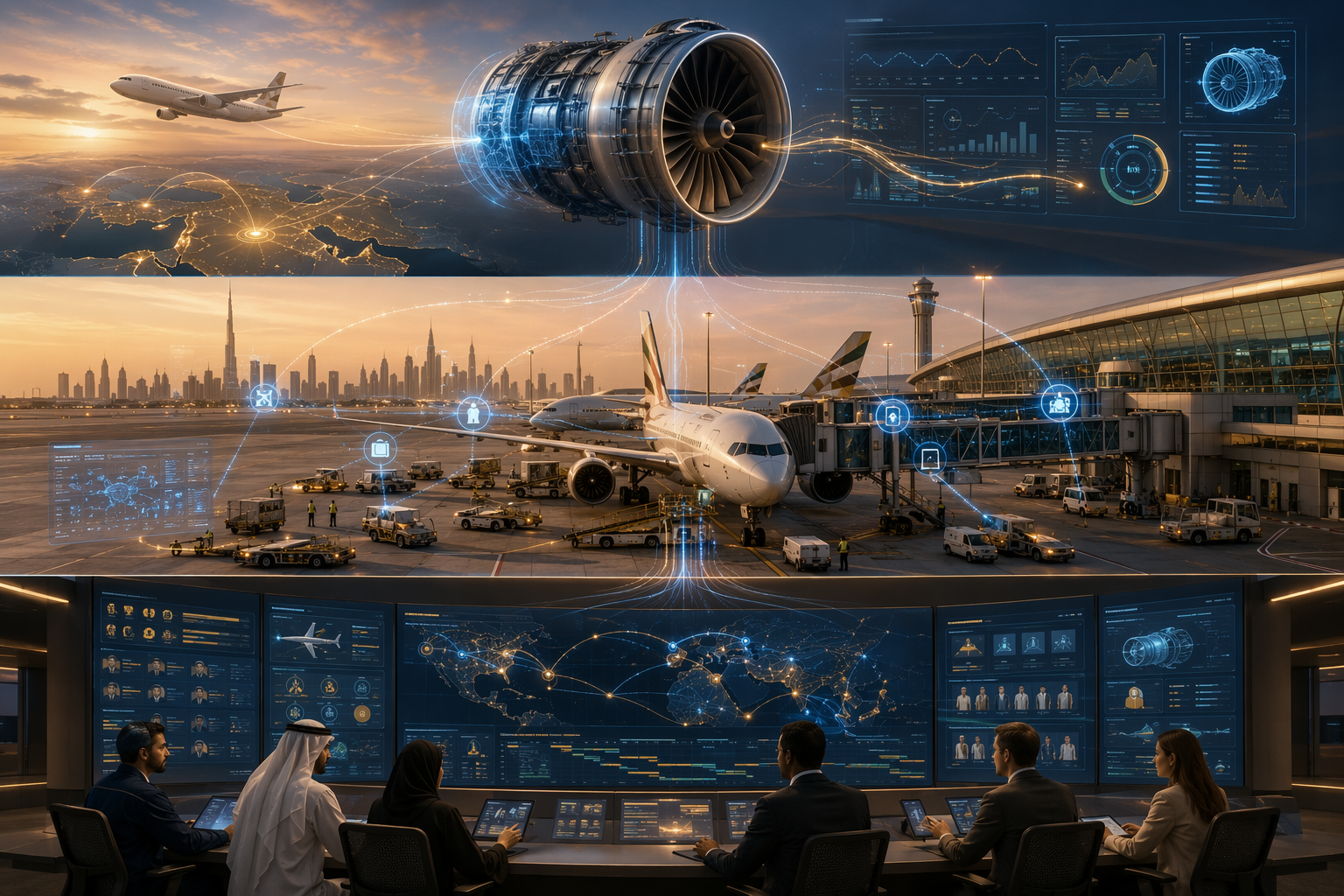
The UAE is a demanding place to test that question because the operating environment leaves little slack. Dubai International handled more than 87 million passengers, and its hub model concentrates aircraft, passengers, bags, crews, and maintenance dependencies into very narrow windows. In that setting, AI has to prove itself across three connected layers: predictive maintenance before the aircraft becomes a visible disruption, apron-level turnaround control while the aircraft is still recoverable at the stand, and network recovery when the day has already started to fracture.
The first useful AI signal is the one maintenance sees before passengers do
Emirates’ predictive engine monitoring is the cleanest entry point because it changes when a disruption becomes visible. In a Khaleej Times report, Emirates chief operating officer Adel Al Redha described AI-supported engine monitoring as a way to detect early signs of engine issues and reduce flight diversions, giving engineering and operations teams more time to decide whether a signal needs action before it becomes a passenger-facing event.[1]
That distinction matters. A diversion is not only a fuel and schedule event. It creates downstream crew problems, passenger rebooking work, maintenance positioning questions, aircraft rotation gaps, and knock-on delay risk at the hub. If engine-health AI moves a decision upstream from “aircraft in flight with an emerging problem” to “maintenance controller reviewing a deteriorating trend,” the operational value is not the model score by itself. It is the extra decision window it gives to maintenance control, dispatch, and the operations control center.
The often-circulated figure of up to 40% fewer diversions should be handled carefully. The research trail attributes that number to secondary coverage of Emirates’ Boeing-related engine-health work, while the Emirates executive comment in the Khaleej Times confirms the direction of impact without publishing that precise percentage.[1] For buyer due diligence, that is still useful, but it is a different class of evidence from an airline-published audited performance table.
DXB’s apron layer turns disruption planning into stand-by-stand visibility
Predictive maintenance can reduce some technical disruptions, but many airline delays are born much closer to the gate. Dubai Airports’ deployment of Assaia’s ApronAI across all aircraft stands at DXB, announced for November 2025 with Emirates as the launch airline, is important because it brings AI into the narrow period when a flight is still physically on the ground and still recoverable.[2]
Stand coverage is not a cosmetic detail. Partial visibility leaves operations teams guessing which exceptions matter and which are just noise. Full-stand apron visibility means the airport and airline can see whether an aircraft is waiting on a belt loader, whether boarding has started late, whether a service milestone has slipped, and whether the remaining turn time is still enough to protect departure. That gives gate teams, ramp coordinators, airline operations, and airport stakeholders a shared operational picture instead of a chain of phone calls after the delay has already hardened.
Assaia’s 2025 Turnaround Report is the strongest quantified support in the available material. Across more than 450,000 AI-enabled turns at 15 airports, the report documented 25% fewer median departure delays, 5% better gate efficiency, and delays that were 6 minutes shorter than regional averages.[3] Those numbers are not a UAE-only controlled trial, but they are directly relevant to why DXB would care about stand-level monitoring at scale: the metric is not “AI adoption,” it is fewer departures leaving late and better use of constrained gate capacity.
| Operational layer | Named UAE deployment | Workflow affected | Measured or stated outcome |
|---|---|---|---|
| Predictive maintenance | Emirates engine-health monitoring | Early detection of technical risk before diversion decisions | Diversion reduction confirmed by Emirates COO; exact 40% figure remains externally attributed |
| Turnaround optimization | Dubai Airports and Assaia ApronAI at DXB | All-stand apron monitoring and turnaround milestone visibility | 25% fewer median departure delays in Assaia’s broader 2025 report |
| Digital turnaround coordination | flydubai and ZestIoT | Cross-function coordination across daily departures | Platform selected across 370 daily departures, targeting coordination-related ground delays |
| Recovery orchestration | SITA OCCam | Aircraft, crew, passenger itinerary, and maintenance recovery planning | Up to 30% disruption-cost reduction claimed by SITA in production use |
This is where airport AI becomes disruption planning rather than airport modernization. If a late inbound aircraft is already known, a stand-monitoring system can show whether the next turn is compressing safely or whether the next flight is about to miss its departure window. If catering is late but fueling, cleaning, and bags are on track, the response is different from a turn where multiple services are drifting at once. The value is in separating recoverable variance from a genuine network threat while there is still time to move people and equipment.
flydubai shows why coordination is its own disruption problem
flydubai’s January 2026 selection of ZestIoT to digitize turnaround operations across its network sits between apron visibility and full recovery orchestration. The airline said the platform would cover 370 daily departures and pointed to IATA’s finding that poor inter-function coordination causes 44% of ground delays.[4] That is a useful number because it identifies a failure mode frontline teams recognize: the aircraft is present, the people are present, the equipment exists, but the handoffs do not line up.
The operational problem is rarely that a single team does not know its job. It is that the turn is a timed relay. A late cleaning update affects boarding. A delayed baggage belt can block pushback even if the crew is ready. A maintenance sign-off can be technically minor and still destroy the departure if the right people only see it after the stand window has closed. Digitizing the turnaround does not remove those dependencies, but it can make the dependency visible early enough for the next team to adapt.
That makes flydubai’s deployment especially relevant for UAE operators evaluating AI vendors. A model that predicts a delay but does not change who is alerted, who confirms the exception, and who has authority to re-sequence work will leave the same coordination burden on the ramp and gate teams. The stronger buying question is whether the system reduces blind handoffs during the turn.
Recovery AI has to solve more than the aircraft problem
Once a disruption escapes the stand, the problem changes shape. The operations control center is no longer deciding whether one flight is late. It is deciding how to protect aircraft rotations, crew legality, passenger itineraries, maintenance requirements, airport slots, and downstream connections without creating a second wave of disruption.
SITA’s June 2026 acquisition of Big Blue Analytics and its OCCam platform is the clearest example in the available research of this autonomous recovery layer. SITA says OCCam can produce a single coherent recovery plan across aircraft, crew, passenger itineraries, and maintenance in minutes, and that production use has cut disruption costs by up to 30%.[5] SITA also frames the size of the prize sharply: a mid-size carrier with more than 100 aircraft can face $70 million to $80 million in annual disruption costs.[5]
The phrase “single coherent recovery plan” is doing real work here. Many airline systems can optimize a slice of the disruption: swap an aircraft, reassign crew, protect high-value passengers, or defer a maintenance task. The hard part is making those decisions mutually survivable. A recovery option that fixes the aircraft rotation but strands illegal crew is not a recovery plan. A passenger reaccommodation plan that ignores the replacement aircraft’s maintenance constraint is not a recovery plan. A maintenance decision that protects one departure while starving the next station of capacity may only move the disruption.
This is also where “agentic AI” needs discipline. Tech Mahindra describes the emerging architecture as systems that sense, reason, execute, and learn.[6] That is a useful vocabulary for the direction of travel, but airline recovery is not a place where labels should outrun governance. The valuable capability is not that an agent acts; it is that the system can expose trade-offs, recommend a joined-up plan, and keep human controllers from manually reconciling four conflicting optimizations under time pressure.
Vendor-published cases are useful, but they should not carry the whole decision
The Code Brew material on agentic AI in UAE aviation, including an Airbus case study, reports 32% fewer operational delays, 40% faster maintenance response, and 35% fewer aircraft-on-ground events.[7] Those are operationally relevant metrics, especially AOG reduction and maintenance response speed, but the material is vendor-published and should be treated as supporting evidence rather than independent validation.
The same caution applies to broad market sizing. Code Brew cites Frost & Sullivan for a UAE aviation AI market projected at AED 3.2 billion by 2027 with a 30–35% CAGR, but the available research did not locate the underlying Frost & Sullivan report independently.[7] A market forecast may help justify attention, but it does not tell an airline whether a controller receives a better recovery option at 02:00 or whether an apron team sees a late service milestone before pushback is lost.
What the connected stack changes inside the operation
The practical promise of AI in UAE disruption planning is not one master system that makes the airline autonomous. It is a connected stack that changes the timing and quality of decisions. Maintenance sees a technical risk before it becomes a diversion. The airport and airline see the turn slipping while the aircraft is still at the stand. The OCC receives recovery options that already account for aircraft, crew, passengers, and maintenance rather than forcing controllers to stitch them together under pressure.
For an airline or airport evaluating this category, the evidence threshold should be operational. The strongest claims name the operator, identify the workflow layer, state the metric affected, and show the source of the number. Emirates’ engine monitoring is compelling because it ties AI to diversion avoidance, although the exact percentage needs careful attribution. DXB’s Assaia deployment is compelling because it covers all stands and connects turnaround visibility to departure-delay and gate-efficiency outcomes. flydubai’s ZestIoT partnership is compelling because it targets the coordination gap across hundreds of daily departures. SITA’s OCCam claim is compelling if buyers can verify production conditions and understand how authority is shared between the system and human controllers.
Implementation constraints still matter. UAE operators have to manage data residency, privacy, cyber risk, integration with airline operations systems, and compliance expectations from aviation authorities. The available research does not provide specific UAE aviation AI operating guidance, so these should be treated as due-diligence conditions rather than as solved details. The system may be impressive in a demo and still fail if maintenance records, crew systems, airport milestone data, and passenger reaccommodation rules cannot be trusted in the same recovery workflow.
That is the practical conclusion for UAE airline disruption planning in 2026. The advantage is not coming from AI as a standalone category. It is coming from connected layers that move from earlier detection, to tighter turnaround control, to faster recovery orchestration. The remaining buyer question is whether the organization’s data, teams, and governance can support that integration when the disruption is live.
References
- Dubai: Emirates’ AI engine monitoring cut flight diversion, Khaleej Times.
- Dubai Airports explores AI-powered turnaround management to elevate performance and guest experience, Assaia, November 2025.
- AI aircraft turnarounds financial savings Assaia, Aerospace Global News.
- flydubai selects ZestIoT to digitise turnaround operations across the network, flydubai Newsroom, January 2026.
- New acquisition brings AI disruption recovery to airlines worldwide, SITA, June 2026.
- The Architecture of Resilience, Tech Mahindra.
- Agentic AI UAE Aviation, Code Brew.
Comments
Join the discussion with an anonymous comment.