
The business case for AI for drug recall management in the supply chain does not start with a model architecture. It starts with a cost line. How many units are pulled? How many hours are spent interpreting notices, matching lots, reconciling serialized product movement, and documenting decisions? How much revenue sits in quarantine because the company cannot prove which product is actually affected?
That distinction matters because recalls are already a recurring operating exposure, not a rare exception. A 2024 analysis of FDA recall data found 3,718 recall events from 2012 through 2023, averaging 330 per year with an increasing trend. The same analysis reported that each recall spanned 1.3 years on average, involved about 400,000 units, and that Class I recalls accounted for 14% of all events.[1] A separate 2025 risk analysis found that Class 1 medical device and pharmaceutical recalls had risen 172% since 2020 and represented more than 11% of all recalls in 2024.[2]
Those numbers do not prove an AI investment pays back. They prove the exposure is large enough to deserve disciplined financial modeling. A faster recall response is useful, but finance will still ask what changed: fewer units destroyed, fewer replacements shipped, fewer labor hours consumed, less revenue held back, or lower regulatory and legal exposure.
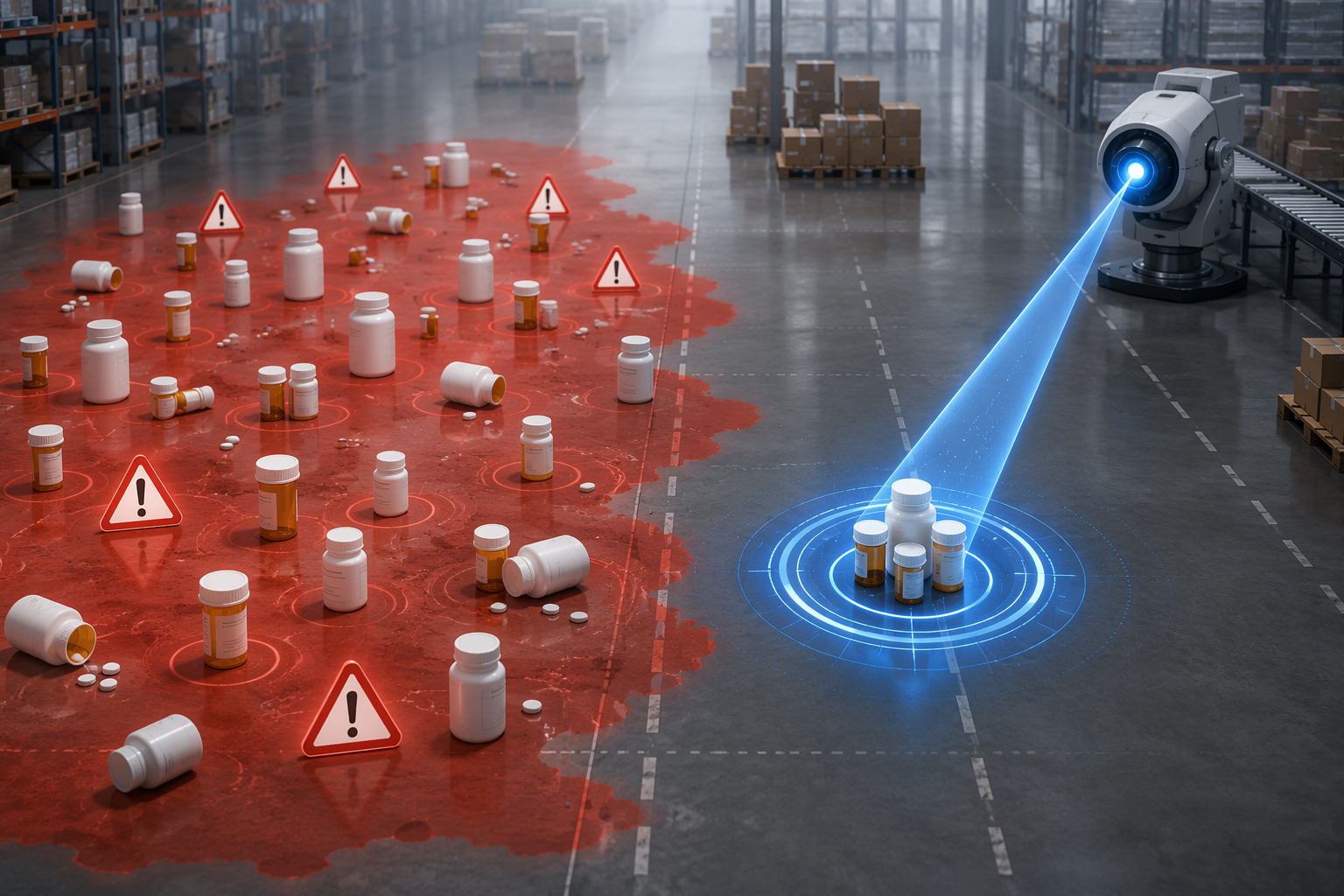
The Two ROI Levers Worth Modeling
Most recall technology presentations list many benefits: speed, visibility, collaboration, compliance, auditability, prediction. Some are real. Few are clean enough to underwrite a budget request. For AI-enabled recall management, the credible economic case usually comes down to two levers.
- Scope compression: narrowing the affected population so the company does not pull, replace, destroy, or quarantine more product than necessary.
- Labor reduction: removing manual interpretation and reconciliation work from recall coordinators, quality teams, customer operations, and supply chain planners.
Everything else should be treated as supporting economics unless it can be tied back to one of those lines. Better dashboards may help. Faster escalation may matter. Prediction may become valuable in specific risk programs. But if the organization cannot translate the capability into units avoided or hours avoided, it is not yet an ROI case; it is an operational preference.
This is also where the AI discussion gets less glamorous and more useful. The highest-value systems do not magically “solve” recalls. They convert messy inputs into usable recall actions, compare those actions against validated product movement data, and help humans defend a narrower decision.
Serialization Maturity Decides Whether AI Has Anything to Work With
AI recall economics are conditional. The same tool can look impressive in an enterprise with unit-level traceability and disappointing in a company still stitching together paper records, spreadsheets, and basic lot history. The difference is not executive urgency. It is data.
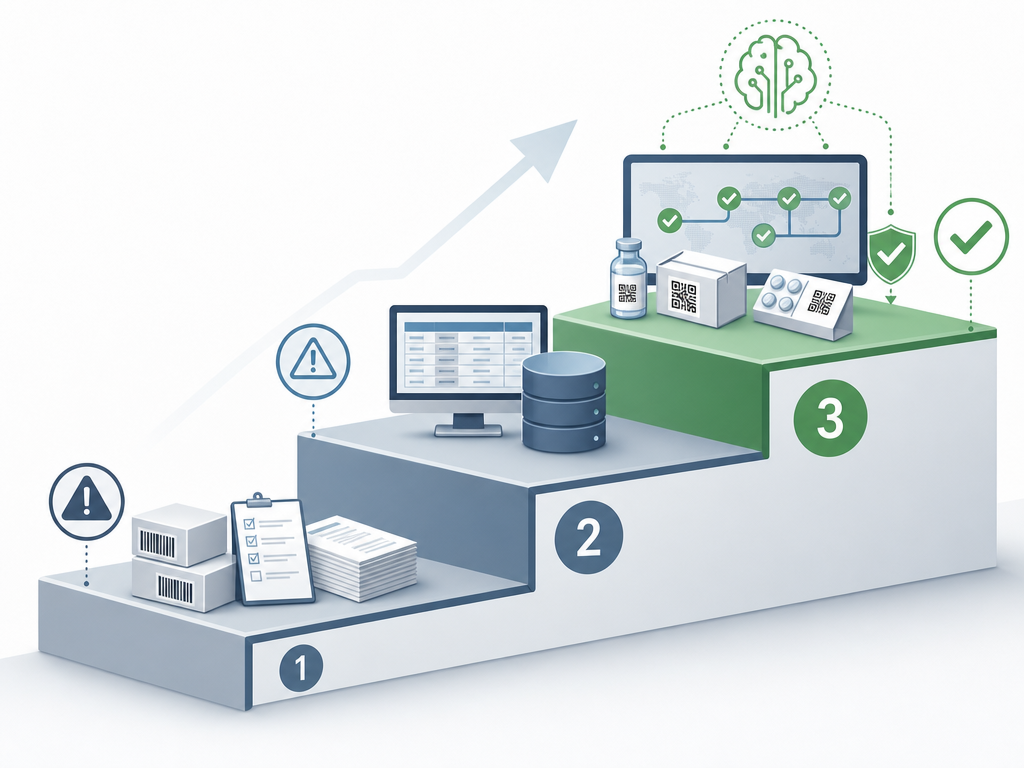
A practical maturity view looks like this:
| Maturity level | Typical data condition | What AI can realistically do | ROI expectation |
|---|---|---|---|
| Level 1: Paper and basic identifiers | Recall files, shipment records, and exception notes are fragmented or manually maintained | Help parse documents or summarize notices, but still depend on people to verify scope | Weak; infrastructure investment should come first |
| Level 2: Lot-level tracking with inconsistent integration | Lots can be identified, but movement, ownership, and downstream location data may be incomplete | Accelerate search and triage, with meaningful human validation still required | Limited; labor savings may be possible, scope compression is constrained |
| Level 3+: Site-level or enterprise serialized traceability | Serialized product movement and lot relationships are digitally available across relevant systems | Compare recall triggers against precise product history and produce defensible narrowed action lists | Strongest; scope reduction and labor avoidance can be modeled |
The uncomfortable part is that Level 1 and weak Level 2 environments often want the AI story most urgently. They are also the least prepared to monetize it. If product movement cannot be trusted, AI can only accelerate the discovery of ambiguity. That may still have some value, but it will not produce the recall economics usually shown in investment decks.
Level 3+ changes the recall equation because the question shifts from “Where might this product have gone?” to “Which serialized units, locations, customers, and lots match the defect condition?” That is where AI can support a narrower recall decision rather than simply making a broad recall move faster.
Scope Compression Is the Cleanest Economic Lever
Scope compression is where the numbers start to matter. PatSnap Eureka reported that effective serialization and lot-level tracking can reduce recall scope by 60–70%, cutting waste, replacement costs, and disruption.[3] That figure is useful because it points to a measurable cost mechanism. It should also be handled carefully: it is best treated as a scenario input tied to effective serialization and lot-level tracking, not as a universal AI performance guarantee.
The mechanism is straightforward. A broad recall pulls every unit that might plausibly be affected because the company cannot defend a narrower boundary. A precision recall uses lot relationships, serialized product movement, location history, and defect criteria to reduce the affected set. AI can help by interpreting the recall trigger, linking it to product and distribution data, and flagging the specific records that need human confirmation.
The savings do not come from the algorithm being clever in isolation. They come from avoiding unnecessary action: fewer saleable units quarantined, fewer replacement shipments, fewer write-offs, fewer customer credits, fewer reverse-logistics moves, and less time spent explaining why inventory is frozen. In a finance model, that is cleaner than claiming “improved agility.”
Personalized therapies raise the stakes because broad action can become unusually expensive. PatSnap Eureka estimated personalized therapy recall costs at $8–12 million per event, excluding litigation and reputational damage.[3] That number is an estimate, not an audited loss benchmark. Still, it illustrates why precise traceability matters when product value, patient specificity, and chain-of-custody complexity are high.
For a budget owner, the correct move is not to copy the 60–70% figure into a business case and call it done. The correct move is to test whether the organization can prove the narrower population during a mock recall. If the answer is no, the savings assumption should be discounted until traceability data, exception handling, and governance improve.
Labor Savings Are Real, but Attribution Matters
The labor case is less dramatic than scope compression, but often easier to observe during implementation. Recall work is full of low-glory interpretation: reading supplier letters, extracting product identifiers, matching affected lots, checking procedures, routing decisions, documenting approvals, and reconciling system records after normal working hours.
LSPedia reports that early adopters of its AI-driven serialized recall workflows saw up to a 90% reduction in manual recall-related labor.[4] That is a company-reported figure from operational testing with early adopters, not an independent peer-reviewed study. It is still worth attention because it describes the right labor pool: manual recall work attached to serialized workflows.
The labor model should separate three categories that are often bundled together:
- Document intake: converting recall letters, supplier notices, and related attachments into structured fields.
- Decision support: checking unstructured complaints, emails, or call notes against recall policies and quality rules.
- Trace reconciliation: matching affected product identifiers against serialized or lot-level movement records.
Oracle’s Recalls Curation Assistant is a concrete example of the first category. It is designed to parse supplier PDF recall letters into structured recall notices, removing manual data entry from the intake step.[5] That does not prove a full recall ROI by itself, but it removes a real bottleneck: the human who must translate an external document into fields the system can actually use.
Cegeka describes a Quality Impact Recall Agent built on Microsoft Copilot Studio and Dynamics 365 ERP MCP that processes unstructured emails and phone calls against company policy.[6] This points to the second category. The valuable act is not chat for its own sake; it is checking messy field input against a defined policy path before the issue becomes another manual queue.
These are narrow tools, and that is a compliment. A recall coordinator does not need a generic transformation platform at 11 p.m. They need fewer fields to rekey, fewer ambiguous attachments to interpret, and fewer unsupported judgment calls. Labor savings become credible when the company measures the before-and-after workflow: minutes per notice, touches per case, rework rate, exception volume, and hours spent reconciling product data.
What Belongs in the ROI Model
A usable ROI model for AI recall management should be built from recall mechanics, not AI enthusiasm. The model does not need to be elegant. It needs to be auditable enough for quality, supply chain, finance, and legal to agree on the assumptions before an event occurs.
| Cost line | How AI can affect it | Prerequisite |
|---|---|---|
| Inventory write-off | Narrows the affected product population when traceability supports a defensible boundary | Reliable lot and serialized movement data |
| Replacement and credit cost | Reduces unnecessary customer remediation tied to unaffected product | Customer, shipment, and product relationship data |
| Quarantine and revenue delay | Shortens the time needed to identify product that can remain available | Fast access to validated product status and location |
| Manual labor | Automates document extraction, notice preparation, policy checks, and reconciliation support | Structured workflows and clear exception ownership |
| Regulatory response effort | Improves documentation completeness and decision traceability | Governed recall process and approved data sources |
The model should also include implementation costs that are easy to understate: system integration, master data cleanup, validation, procedure updates, training, supplier data onboarding, governance, and ongoing monitoring. If those costs are ignored, the business case will look better on paper than it will in the month-end review.
Market growth can support the timing argument, but it should not be mistaken for internal ROI. Research and Markets valued the AI-driven product recall prediction market at $1.71 billion in 2025 and projected it to reach $4.16 billion by 2029, a 25% compound annual growth rate.[7] That signals vendor investment and ecosystem maturation. It does not say a specific pharma company has the traceability maturity to capture returns.
The same discipline applies to broader AI budget narratives. There is plenty of capital moving toward supply chain AI, as discussed in AI investment and supply chain budget planning. Recall management deserves its own test because the financial upside depends less on model novelty than on traceability quality.
Regulatory Pressure Strengthens the Case, but Does Not Replace It
Regulation is pushing the industry toward better data foundations. The FDA is assessing whether and how to leverage AI to strengthen pharmaceutical supply chain resiliency, following Congressional instruction, and the Drug Supply Chain Security Act’s unit-level traceability mandate creates part of the data foundation AI systems need.[8]
That is a tailwind, not a completed policy outcome. It should encourage companies to prepare traceability data for AI-enabled use, but it should not be used as a shortcut around internal economics. A compliance mandate can justify infrastructure. An AI recall tool still needs to show how it lowers recall cost or risk in the company’s own operating model.
There is a useful parallel with broader disruption-response AI. In a network outage, the system’s value depends on whether it can access current constraints, dependencies, and recovery options, not merely whether it can produce a confident recommendation. The same principle applies in recall management, where agentic AI for supply chain disruption response is only as useful as the operational data it can safely act on.
Where AI Actually Enters the Recall Workflow
A defensible implementation does not start by asking AI to own the recall. It starts by placing AI around the work humans should not have to perform manually, while keeping quality and regulatory decisions governed.
- Ingest the recall trigger: parse supplier letters, complaints, emails, phone notes, and internal quality signals into structured data.
- Normalize product references: map names, identifiers, lots, dates, and serialization records to approved master data.
- Match against traceability data: identify affected product movement, current location, customer exposure, and downstream uncertainty.
- Prepare action sets: generate proposed affected-unit lists, notification groups, quarantine instructions, and documentation packages.
- Route exceptions: send ambiguous or high-risk cases to quality, regulatory, supply chain, or legal owners with the supporting evidence attached.
The first two steps overlap with the document-intelligence problem seen across supply chain workflows. For companies still handling recall notices as PDFs and email chains, AI document intelligence for supply chain content workflows is often the most realistic starting point. It can reduce administrative drag before the organization is ready for full precision recall execution.
The third step is where the investment either earns its keep or gets exposed. If serialized traceability is strong, AI can help narrow the action set. If traceability is weak, the system will surface gaps that still require manual investigation. That is not failure; it is a signal that the next dollar may belong in data readiness rather than another AI module.
A Readiness Test Before Funding the Tool
Before approving an AI recall investment, finance and operations should run a readiness test using recent recalls, mock recalls, or quality events. The purpose is not to admire a demo. It is to see whether the company can support the two economic levers under realistic conditions.
- Can the company identify affected product at the serialized unit or reliable lot level without manual reconstruction?
- Can it connect product identity to shipment, customer, location, and inventory status quickly enough to support a narrower recall decision?
- Are recall notices and supplier communications available in formats AI can parse and humans can validate?
- Are exception owners defined for ambiguous matches, data conflicts, and high-risk patient or regulatory scenarios?
- Can the organization measure baseline labor hours and affected-unit scope well enough to prove improvement after implementation?
A company that passes those tests can model AI recall management against scope reduction and labor avoidance. A company that fails them should be honest about the sequence: serialization infrastructure, master data governance, recall-data readiness, then AI-enabled compression. Skipping the middle step usually creates a more expensive version of the same manual uncertainty.
The Decision Rule
AI can change the economics of drug recall management when it works on top of enterprise-grade serialization and usable traceability data. In that environment, the business case can be built around fewer units pulled, less inventory destroyed, fewer replacement costs, shorter quarantine windows, and lower manual workload.
If the organization is still operating with paper-heavy records, fragmented lot tracking, or unreliable product movement data, the better first investment is not a broader AI platform. It is the data foundation that lets a recall decision become narrow, timely, and defensible.
References
- A Retrospective Analysis of Drug Recalls: An Insight into the Numbers, Therapeutic Classes, and Dosage Forms, Journal of Pharmaceutical and Biomedical Analysis, 2024, https://www.sciencedirect.com/science/article/abs/pii/S0731708524003893
- Life Sciences Product Recall Trends and Risk Mitigation Strategies, IMA Financial Group, June 2025, https://imacorp.com/insights/insurance-insights-life-sciences-product-recall-trends-and-risk-mitigation-strategies
- Serialization and Lot-Level Tracking to Support Product Recall Readiness in Personalized Therapies, PatSnap Eureka, September 2025, https://eureka.patsnap.com/report-serialization-and-lot-level-tracking-to-support-product-recall-readiness-in-personalized-therapies
- Recall Management Module, LSPedia OneScan, https://www.lspedia.com/products/onescan-solution-suite/recall-management-module
- Oracle Fusion Cloud SCM 26A Inventory Management What's New: Recalls Curation Assistant, Oracle, https://docs.oracle.com/en/cloud/saas/readiness/scm/26a/inv26a/26A-inventory-wn-f41608.htm
- Transforming Product Recalls with AI, Cegeka, https://www.cegeka.com/en-us/blogs/transforming-product-recalls-with-ai
- Artificial Intelligence (AI) Driven Product Recall Prediction Market Report, Research and Markets, October 2025, https://www.researchandmarkets.com/reports/6177313/artificial-intelligence-ai-driven-product
- Supply Chain News, Reports and Publications, FDA, 2025, https://www.fda.gov/emergency-preparedness-and-response/supply-chain/supply-chain-news-reports-and-publications
Comments
Join the discussion with an anonymous comment.