
Why Recall Pressure Is Rising Now
Pharmaceutical recall teams are being asked to move faster in a system that has already gotten noisier. In 2025, Sedgwick tracked 3,295 total US recall events across five industries and 858 million defective units, up 26% year over year; pharmaceutical recalls alone surged 140.2% by unit volume versus 2024 [1]. At the same time, at least 216 active drug shortages persisted in the US in 2025 after record levels in 2024 [2]. The practical implication is simple: the manual version of recall handling has less room to be slow, and less room to be wrong.

That is where AI becomes operationally relevant: not as one magic layer, but as four different capabilities that touch different parts of the recall lifecycle.
The Four-Layer Model
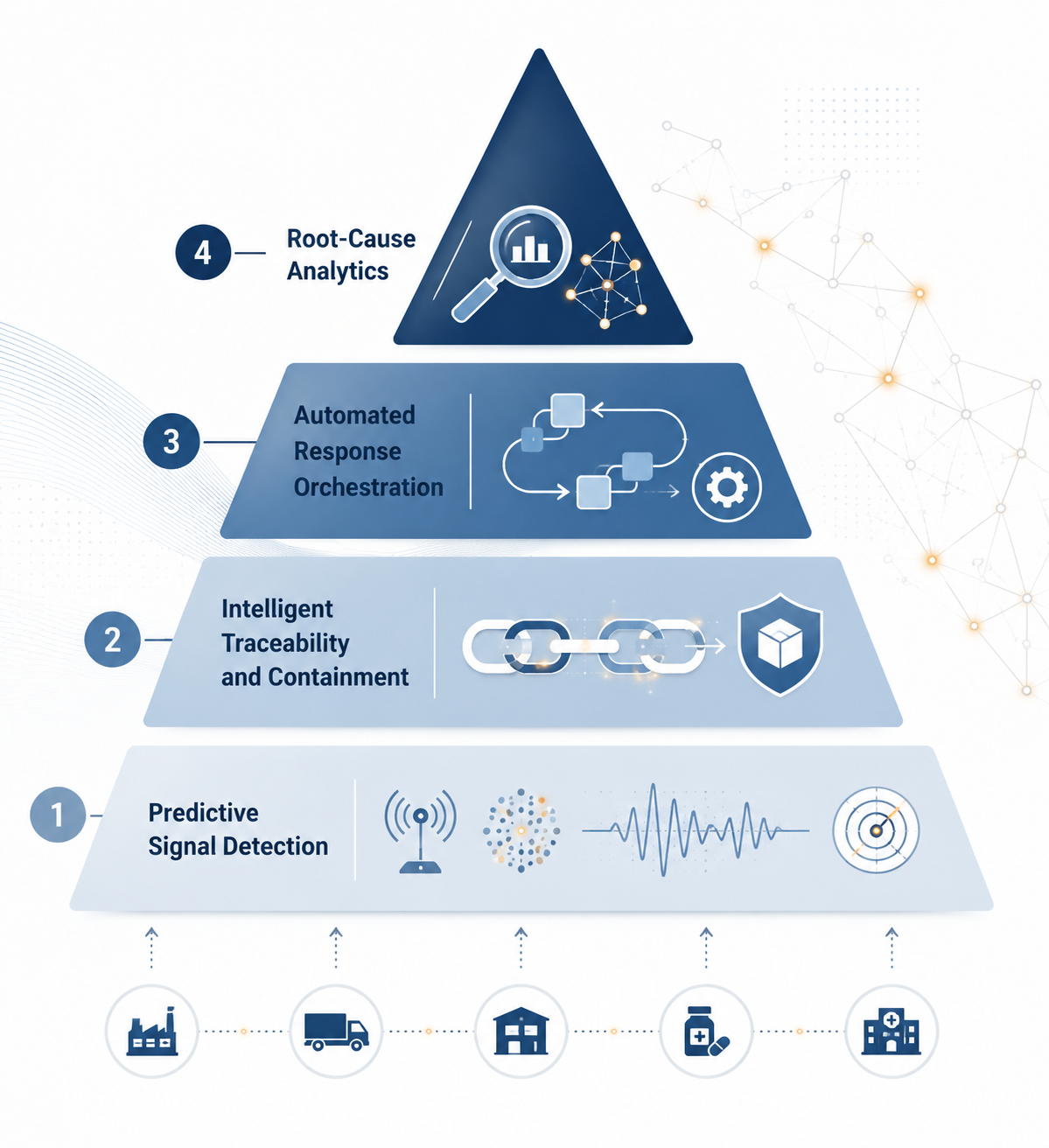
| Layer | What AI changes | Deployment signal |
|---|---|---|
| Predictive signal detection | Monitors inspection reports, adverse-event data, quality deviations, and temperature excursions to surface recall signals earlier than manual review. | Useful as a front-end filter; usually a growing capability. |
| Intelligent traceability and containment | Reconciles serialized events across systems and partners, then narrows the exception instead of raising another generic alert. | Highest operational value when DSCSA data is messy; still constrained by execution quality [3]. |
| Automated response orchestration | Turns a verified recall into tasks, routing, acknowledgments, retrieval tracking, and audit trails. | Commercially visible and measurable, but still point-solution heavy [4][5][6]. |
| Root-cause analytics | Compares batch records, supplier data, and deviation trends to shorten the investigation queue. | Analytically promising, but most dependent on data completeness. |
The sequence matters. Early signal detection only helps if the traceability layer can sort out serial events cleanly. Orchestration only helps once the batch boundary is reliable. Root-cause analytics only helps after containment has started, because the goal is to shorten the investigation, not to invent certainty where the records are broken.
Intelligent Traceability And Containment
This is the brittle middle of the stack. DSCSA requires unit-level serialized traceability, but one inbound or outbound flow may involve 10+ potential failure points across systems and trading partners [3]. That is why generic traceability language is not enough. The useful AI is the kind that can tell a timing mismatch from a structural error, a master-data discrepancy, or a sequencing problem, then route the exception to the right owner instead of expanding the blast radius [3].

That distinction matters because not every discrepancy is the same problem. A timing error may be a reconciliation issue. A structural error may point to a broken message format. A master-data problem may live with the item, location, or trading-partner record. If the system treats all of them as one alert, QA and compliance spend time sorting noise instead of containing risk.
Cold-chain failures show the cost of getting this wrong. One widely cited estimate puts the cost to biopharma at roughly $35 billion annually in lost product and root-cause analysis costs, though the figure comes from a 2019 survey [3]. Even with that caveat, the operational lesson holds: the value of AI is highest when it narrows the exception fast enough to keep good stock moving and bad stock from traveling farther downstream.
Automated Response Orchestration
This is the layer vendors like to show first because it is the easiest to demo, but it is only useful when it stays bounded. Once a batch is confirmed, software can generate recall tasks, route approvals, track acknowledgments, and manage retrieval without asking QA, compliance, or distribution to rebuild the same packet by hand.
- Verify lot and serial boundaries against transaction history.
- Push tasks to QA, compliance, distribution, and field teams.
- Track acknowledgments, retrieval status, and exception closures.
- Preserve an audit trail that shows who approved what, and when.
The commercial evidence is encouraging, but it is still evidence of workflow gain, not autonomous recall. LSPedia says its Serialized Recall module can reduce manual recall-related labor by up to 90% based on operational testing with early adopters [4]. TraceLink says its Digital Recalls offering reduces administrative recall coordination time by 40% and time spent retrieving recalled products by 47% [5]. Honeywell says its TrackWise Recall Management is designed to cut execution from weeks to minutes through automated workflows and AI-assisted batch bounding [6]. Those are meaningful improvements, but they do not prove that end-to-end recall management is solved.
The common limitation is easy to miss: these gains depend on the same underlying records being usable in the first place. If the batch master, serialized event history, and trading-partner data disagree, software can still speed the work, but it cannot remove the need for human review, validation, and exception handling.
Root-Cause Analytics
Once containment starts, the harder question is what failed upstream. Causal AI is useful here because it can read batch records, supplier data, and deviation trends together and surface patterns faster than a manual investigation queue. In practice, that means the investigation owner gets a shorter list of plausible causes, not a machine-issued verdict.
That is also why broader biopharma operations results matter, even when they are not recall-specific. AI is already being used where coordination work is heavy and the process is repetitive enough to tolerate software help. The same logic fits recall investigation: if the system can reduce handoffs and narrow the search space, QA and compliance can spend more time on the decision that actually matters.
Where The Market Actually Sits
The cleanest judgment is also the least promotional one. Point solutions are genuinely useful and are moving into growing adoption, especially in traceability and recall orchestration. Full multi-layer integration is still emerging because the hardest problems are not model quality alone; they are fragmented records, trading-partner variation, validation, auditability, and the human approvals that regulated recalls still require.
AI can materially compress recall time, improve traceability, and sharpen investigation. It can also narrow the mess fast enough to keep downstream teams from carrying unnecessary risk. What it cannot yet do, at scale, is make a pharmaceutical recall fully autonomous without first solving the data and governance problems underneath it.
References
- Sedgwick 2026 State of the Nation Index - American Pharmaceutical Review, Feb. 2026
- Drug shortages persist in 2025 - Pharmaceutical Commerce, May 2026
- DSCSA traceability and cold-chain recall analysis - Pharmaceutical Commerce, May 2026
- Serialized Recall - LSPedia, 2025-2026
- Digital Recalls - TraceLink, 2025-2026
- TrackWise Recall Management - Honeywell, May 2025
Comments
Join the discussion with an anonymous comment.