
The route decision starts before the headline is clean. A tanker scheduled through Bab el-Mandeb is no longer being measured only against a Red Sea transit assumption; it is being measured against a Cape of Good Hope detour, war-risk insurance availability, port congestion at substitute calls, and, in 2026, the possibility that Strait of Hormuz tension tightens the same planning window from the other side.
That is the practical question behind AI for supply chain risk management in oil disruption from Houthi attacks: not whether a model can “predict conflict,” but whether it can give a logistics team enough earlier, cleaner, and better-priced information to choose a route while the cost of waiting is still visible.
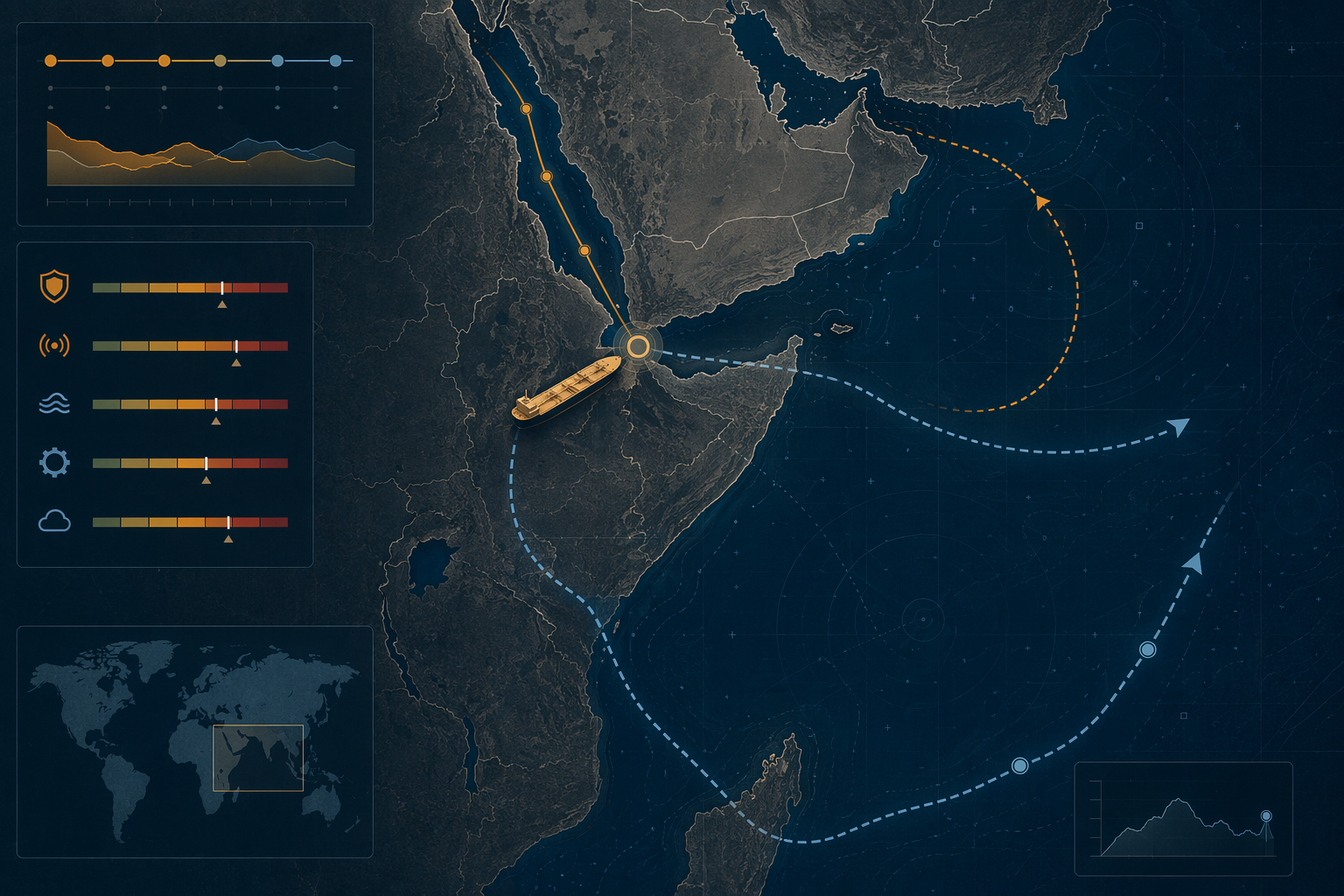
The operating baseline is already severe. project44 reported that Red Sea container traffic fell 68% in August 2024 compared with 2023 as carriers avoided the Bab el-Mandeb Strait, with China-to-Europe transit times up 25% and Southeast Asia-to-U.S. East Coast transit times up 47% in the same disruption context.[1] For oil tankers, the U.S. Defense Intelligence Agency has estimated that routing around the Cape of Good Hope can add about 11,000 nautical miles, roughly 10 days, and around $1 million in fuel cost per voyage.[2]
The insurance signal moved as well. War-risk premiums for Red Sea transits rose by as much as 250% for some Israeli-linked vessels, turning risk appetite into a line item that schedulers and finance teams could not leave outside the route comparison.[3] Then March 2026 added a second chokepoint pressure point: Middle East tensions pushed Brent crude above $100 per barrel, while Roland Berger estimated that pipeline bypass capacity could offset only 15–20% of disrupted oil volumes if Strait of Hormuz flows were constrained.[4][5]
Static routing tables and quarterly country-risk reviews were not designed for that combination. They can document that risk exists. They do not usually tell a control tower whether to hold a vessel, nominate a different port, absorb a Cape delay, or protect a refinery feedstock window before freight, fuel, and insurance prices move again.
Where AI Actually Enters the Route Decision
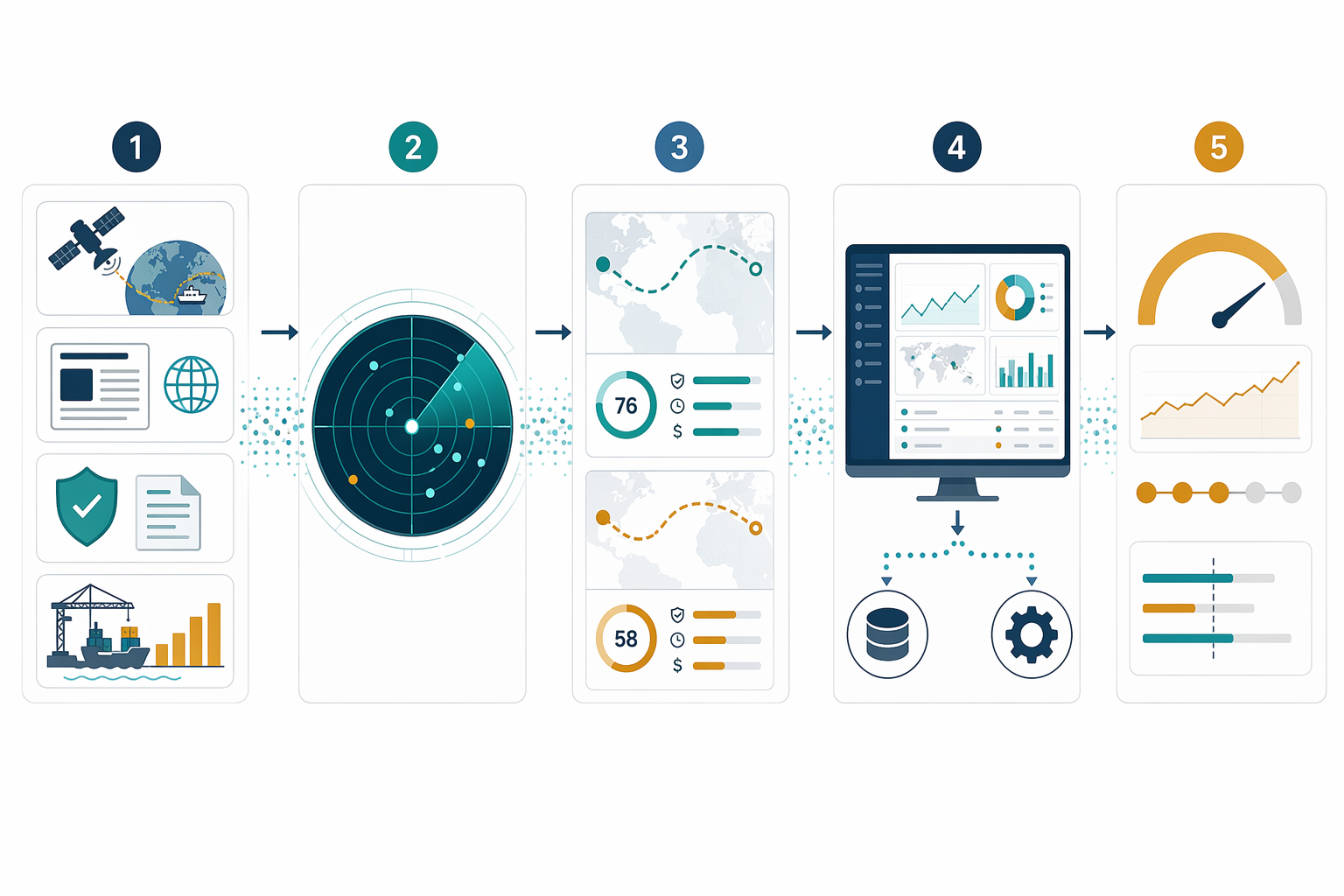
A useful AI risk platform does not make the Red Sea safe. It shortens the distance between weak signals and executable decisions. In this use case, the system has to do six jobs in sequence: ingest live data, detect a risk window, score route viability, compare alternatives, push the recommendation into planning systems, and measure whether the decision improved lead-time reliability or avoided cost.
| Workflow point | What the platform must turn into a decision |
|---|---|
| AIS and satellite ingestion | Whether tankers, escorts, or nearby commercial vessels are changing speed, position, or behavior around a chokepoint |
| News and incident monitoring | Whether a reported attack, threat, ceasefire change, or military response affects a vessel’s planned time of arrival |
| Insurance and risk-premium tracking | Whether the route is still commercially viable once war-risk premiums and coverage constraints are included |
| Port and congestion feeds | Whether an alternative discharge, bunkering, or transshipment option is actually available when the vessel arrives |
| Route scoring | Whether Red Sea transit, Cape rerouting, waiting, or a different port plan has the better cost-time-risk profile |
| TMS and ERP integration | Whether the recommendation changes bookings, inventory plans, purchase orders, refinery schedules, or customer commitments |
The first step is not exotic AI; it is data discipline. AIS and satellite feeds show vessel behavior. News and security feeds show whether a threat is forming into an incident. Insurance availability and war-risk premiums show how underwriters are pricing danger. Port congestion data shows whether the supposed alternative is available or just attractive on a map. Without those feeds in usable condition, the model’s recommendation is only a faster version of an analyst’s uncertainty.
Everstream Analytics says its platform monitors more than 30,000 global data sources for supply chain risk, including Red Sea disruption signals and maritime threat indicators.[6] That scale matters less as a marketing number than as an operating requirement: no single feed is enough when the decision depends on vessel movement, security events, port capacity, and insurance appetite moving at different speeds.
The second step is detecting a risk window rather than waiting for a fully confirmed event. A platform may flag an abnormal cluster of AIS behavior near a chokepoint, a fresh threat statement, a spike in war-risk pricing, and congestion building at the ports that would receive diverted cargo. None of those signals alone proves that a tanker should reroute. Together, they can justify moving the route decision forward by hours.
This is where the boundary matters. AI can be strong at pattern recognition across messy, time-sensitive signals. It is much weaker when asked to forecast a sudden political or military escalation with little precedent in the training data. A serious deployment should treat the model as an early-warning and decision-support layer, not as an authority on whether armed conflict will or will not occur.
The Route Score Has to Include Money, Not Just Miles
A Cape detour is not automatically the safer business decision. It may reduce attack exposure while adding fuel burn, days in transit, demurrage risk, inventory drawdown, and missed refinery or customer windows. A Red Sea transit may look shorter until war-risk premiums, escort requirements, or insurer exclusions change the economics. Waiting can be cheap for a few hours and expensive by the next nomination cycle.
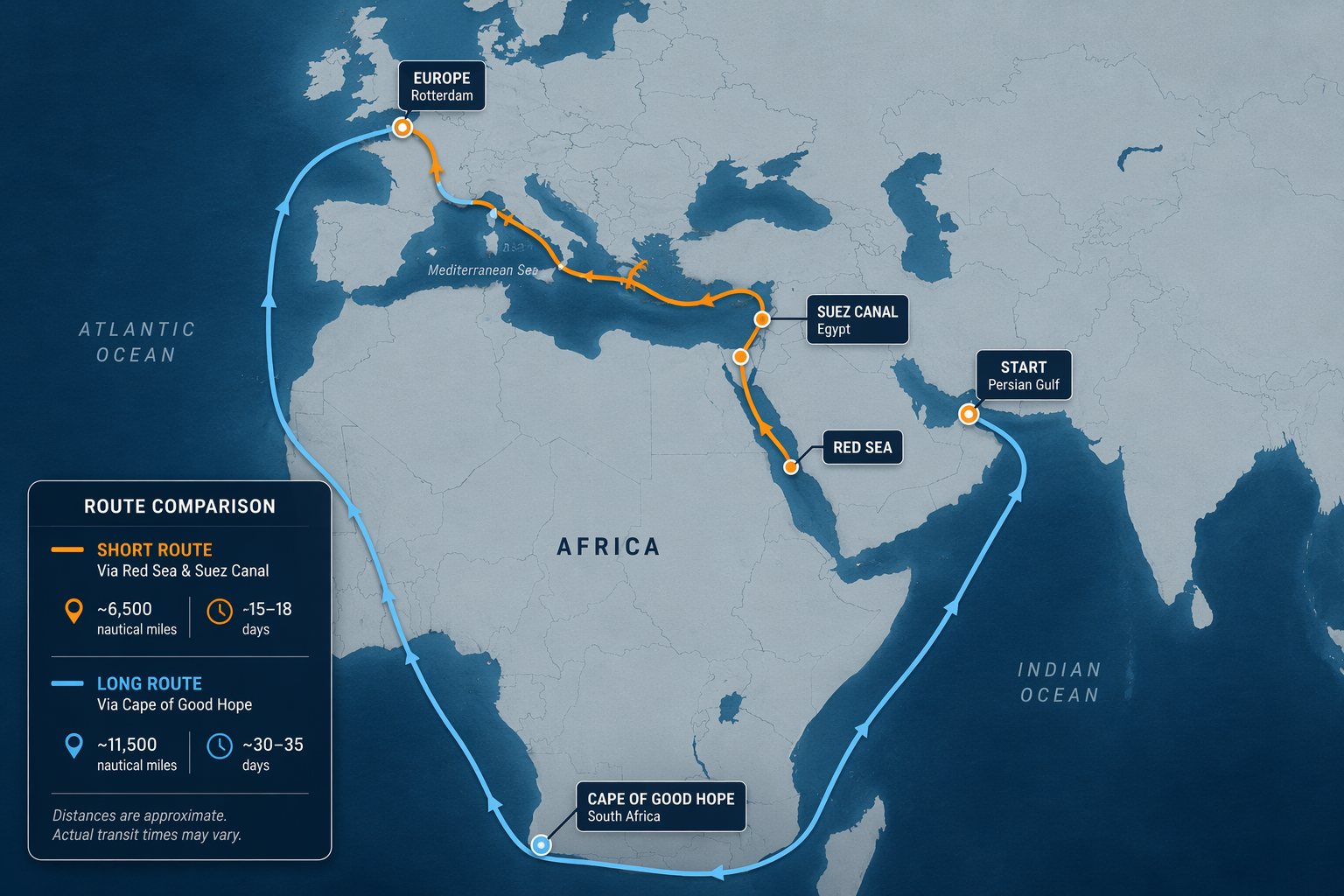
For oil supply chains, the route score should therefore compare at least four choices: continue through the Red Sea, hold position, reroute around the Cape, or redirect to a pre-approved alternative port or storage option. The comparison has to carry the same units a scheduler and finance team use: estimated arrival date, fuel cost, freight impact, insurance cost, port feasibility, inventory exposure, and contractual penalty risk.
That is also where integration separates a useful platform from a dashboard. Onspring’s description of AI-powered supply chain risk management emphasizes real-time visibility, predictive analytics, automated alerts, and risk mapping.[7] In this scenario, those features only become operational when the alert can trigger a review inside a transportation management system, ERP workflow, procurement plan, or control tower process rather than sitting in a separate portal.
A control tower operator needs the recommendation to arrive with a defensible comparison: “Cape reroute adds about 10 days and fuel cost, but avoids a current premium spike and preserves the discharge window at an alternate port”; or “hold for 12 hours because the alternative port is congested and insurance has not yet repriced.” The wording can vary. The test is whether the next approver can see the trade-off quickly enough to act.
This is closely related to broader control tower AI applications, but the Red Sea oil case is less forgiving than many inland disruption examples. A late alert can become a seven-figure voyage-cost decision. A poorly maintained alternative-port list can turn a good risk signal into a queue at the wrong berth.
What the Evidence Supports, and What It Does Not
The strongest evidence is not a single headline number. It is a ladder: visible traffic disruption, measurable route delays, insurance repricing, AI monitoring coverage, operational rerouting, and then outcome metrics. The higher the claim moves up that ladder, the more carefully it needs to be read.
The traffic and transit-time data are the base layer. project44’s Red Sea data shows that the disruption materially changed vessel flows and transit times.[1] That supports the business need for dynamic routing; it does not by itself prove that AI improves the decision.
The monitoring layer is stronger when it explains what signals are being watched. Everstream’s 30,000-source monitoring claim is relevant because Houthi-related disruption cannot be read from AIS alone.[6] But monitoring breadth is not the same as predictive accuracy. A platform can observe more signals and still produce alerts that are late, noisy, or not tied to a feasible action.
The early-warning claim needs a tighter caveat. A LinkedIn article by Doron Azran describes AI-based supply chain risk systems detecting maritime or chokepoint threats more than five hours before news coverage and cites Everstream in that context.[8] That is directionally useful, but it is secondary-source evidence rather than an independently audited benchmark from the original platform documentation.
The performance metrics are also directional. The same Azran article attributes a 25% lead-time reliability improvement during cross-border disruptions to McKinsey and a 20–30% faster recovery-time improvement to Accenture.[8] Those figures fit the expected value of better risk modeling and faster response, but they should not be treated as guaranteed Houthi-route outcomes unless the company can reproduce the measurement in its own lanes, cargo types, and planning systems.
The $220 million avoided-loss case is the most eye-catching and the easiest to misuse. Sensos described an unnamed automaker that used AI-powered political stability scoring to pre-map 12 alternative ports and dynamically reroute shipments during the Red Sea crisis, avoiding $220 million in losses.[9] The dollar figure is vendor-attributed and tied to a single unnamed company, so it is better treated as an existence proof than a normal expected result.
The operational lesson from that case is more portable than the dollar value: the company had alternatives mapped before the crisis forced a decision.[9] AI helped because there was somewhere for the recommendation to go. If the team had discovered port constraints only after the alert, the model would have bought awareness but not necessarily resilience.
A Practical Platform Pattern for Houthi-Linked Oil Disruption
The relevant vendor landscape is best understood by capability, not brand list. Everstream is often associated with global risk-event monitoring and predictive supply chain intelligence. project44 provides shipment visibility and transit-time data. interos.ai and Onspring sit closer to supplier, third-party, and enterprise risk workflows. Digital twin platforms help test how a disruption propagates through inventory, routes, facilities, and customer commitments. In a mature setup, those categories may overlap or feed one another.
For a tanker or oil-linked procurement decision, the platform pattern should look less like a news terminal and more like an operating loop:
- Ingest AIS, satellite, news, security, insurance, port congestion, and internal shipment data.
- Detect abnormal risk windows around Bab el-Mandeb, the Red Sea, Suez, Hormuz, or related port clusters.
- Score each affected vessel, cargo, purchase order, or customer commitment by exposure and time sensitivity.
- Compare Red Sea transit, Cape rerouting, waiting, and alternative port options using cost, time, insurance, and inventory impact.
- Route the recommendation to the TMS, ERP, control tower, procurement desk, or escalation owner with approval thresholds already defined.
- Track the decision afterward against lead-time reliability, avoided premium exposure, demurrage, inventory shortfall, and service impact.
The same monitoring architecture can extend to adjacent maritime threats, including drone attacks on logistics assets and vessel hijacking risk. Those are separate operating problems, but they share one requirement with the Houthi oil disruption case: the signal has to be converted into a decision before the affected asset is trapped in the wrong place. Teams comparing related use cases can look at AI counter-drone systems for supply chain protection and AI pirate hijacking prevention as neighboring patterns, not substitutes for oil-route planning.
The Conditions That Decide Whether AI Mitigates the Disruption
AI mitigates Houthi-caused oil disruption when it changes the decision clock. The team sees a risk window earlier, understands the route economics faster, and has authority to act before the vessel, cargo, or inventory position loses optionality. That is a narrower claim than saying AI predicts Houthi attacks, and it is the claim the available evidence can support.
Four implementation conditions matter more than the model label. The company needs reliable AIS and satellite feeds. It needs current port, berth, storage, and congestion data for alternatives. It needs pre-approved rerouting and procurement playbooks, including who can accept extra fuel cost or a later arrival. It needs the recommendation inside the systems where planners already commit vessels, inventory, and money.
Without those conditions, the platform may still be useful, but only as a warning system. It can say that the Red Sea is becoming riskier, that insurance is tightening, or that the Cape option is gaining value. It cannot create an available port, rewrite a refinery schedule, approve a freight premium, or make dirty master data reliable under stress.
The strongest deployments will look unglamorous from the outside: maintained route tables, live insurance feeds, tested alternative ports, named approvers, TMS and ERP integration, and post-event measurement. In that setup, AI can turn Bab el-Mandeb and Hormuz from a rolling geopolitical briefing into a set of earlier, priced, and repeatable route decisions.
References
- Houthi Attacks Disrupt Global Supply Chains — project44
- Red Sea attacks disrupt global trade — U.S. Defense Intelligence Agency
- Red Sea crisis — Wikipedia
- How conflict in the Middle East is affecting supply chains — Oliver Wyman, March 2026
- Managing the short- and long-term effects of Strait of Hormuz tensions — Roland Berger
- Red Sea transit remains in disarray — Everstream Analytics
- What to Look for in an AI-Powered Supply Chain Risk Management Solution — Onspring
- AI for Supply Chain Risk Management — Doron Azran / LinkedIn
- Navigating Geopolitics and AI: Stabilizing Supply Chains — Sensos, January 2026
Comments
Join the discussion with an anonymous comment.