
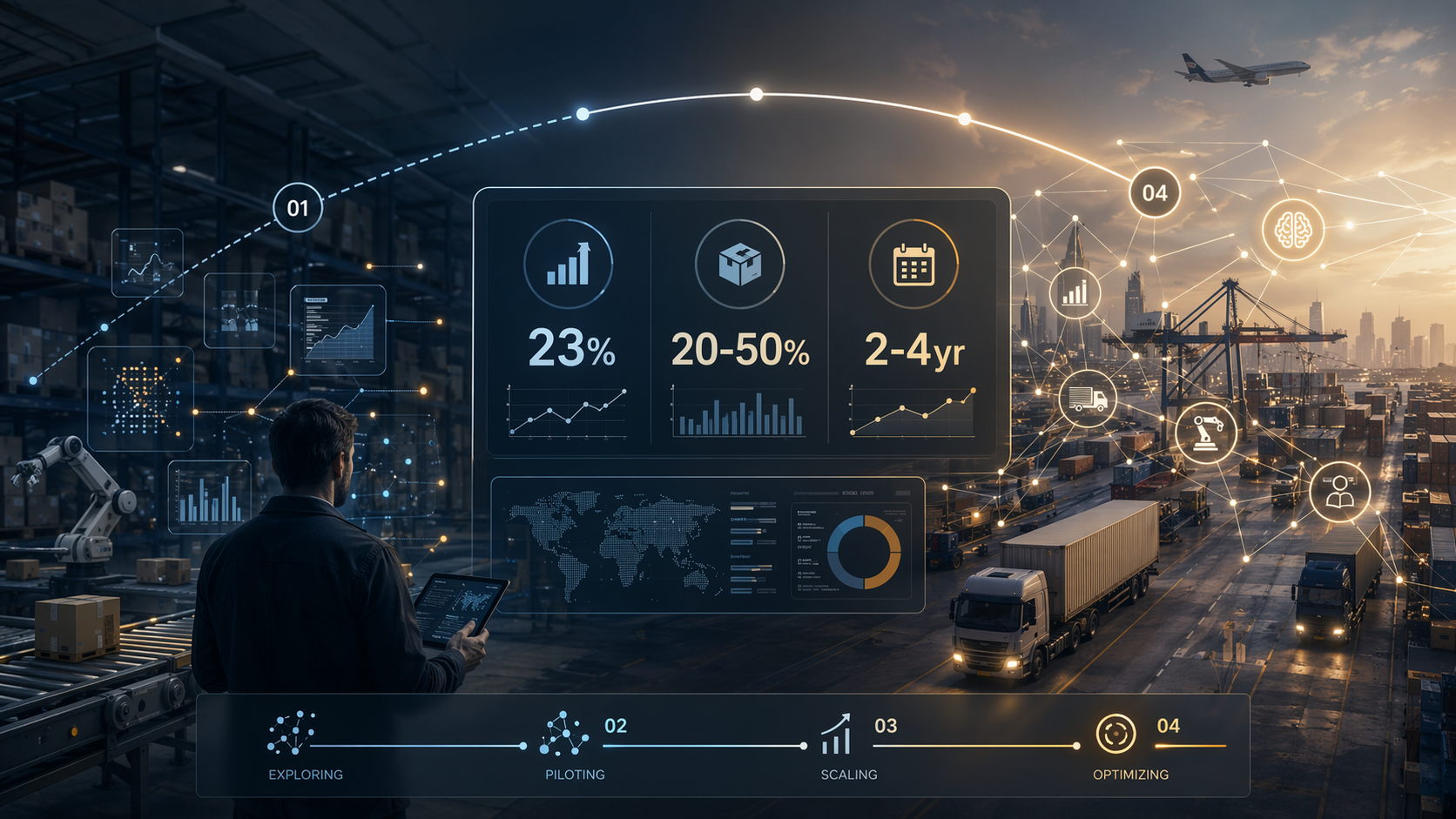
For the use of AI in supply chain management, the CFO question is not whether forecasts improve; it is whether that improvement shows up in margin, working capital, service cost, or cash. The strongest public evidence says yes, but only for mature deployments: Accenture found AI-mature supply chain organizations were 23% more profitable and 6x more likely to use AI and Gen AI widely, McKinsey reports 20–50% lower forecast error with logistics cost reductions of 5–20%, inventory reductions of 20–30%, and procurement spend reductions of 5–15% in AI-enabled distribution, Deloitte says only 6% see ROI in under a year and most satisfactory returns arrive over 2–4 years, and PwC’s 2026 survey shows why the gap stays wide between pilots and full value capture.[1][2][3][4]
The profitability figure comes from mature adopters, not first-year pilots
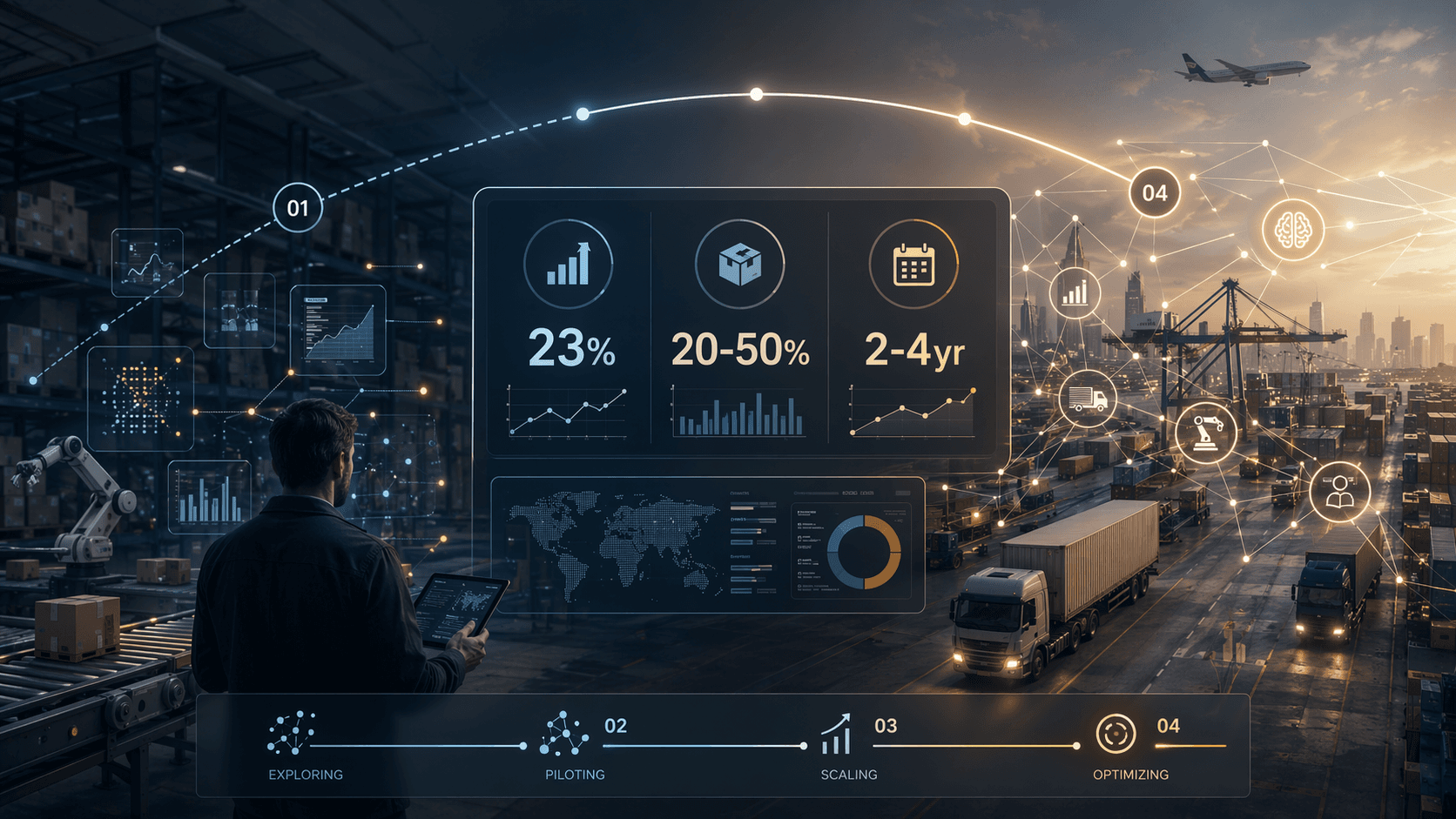
The 23% profitability differential is useful because it is concrete, but it should be read as a maturity signal rather than a promise. Accenture’s finding comes from companies that were already AI-mature, not from newly launched programs, so the right conclusion is narrower: organizations that have embedded AI deeply enough to use it widely tend to outperform their peers, while early-stage users should not expect the same result on the same timeline.[1] That distinction matters because the analyst market-size numbers swing wildly from one report to another when scope changes, which makes them far less useful for a budget review than evidence about operating results.
McKinsey’s ranges point in the same direction. AI-driven forecasting can reduce forecast errors by 20–50%, and AI-enabled distribution use cases are associated with 5–20% lower logistics costs, 20–30% lower inventory, and 5–15% lower procurement spend.[2] Those are real business levers, but they are directional ranges, not a guarantee that every company will convert the improvement into cash. The conversion depends on whether the organization can translate better decisions into fewer expedites, lower safety stock, better labor deployment, or less trapped working capital.
Deployment maturity decides whether the numbers apply
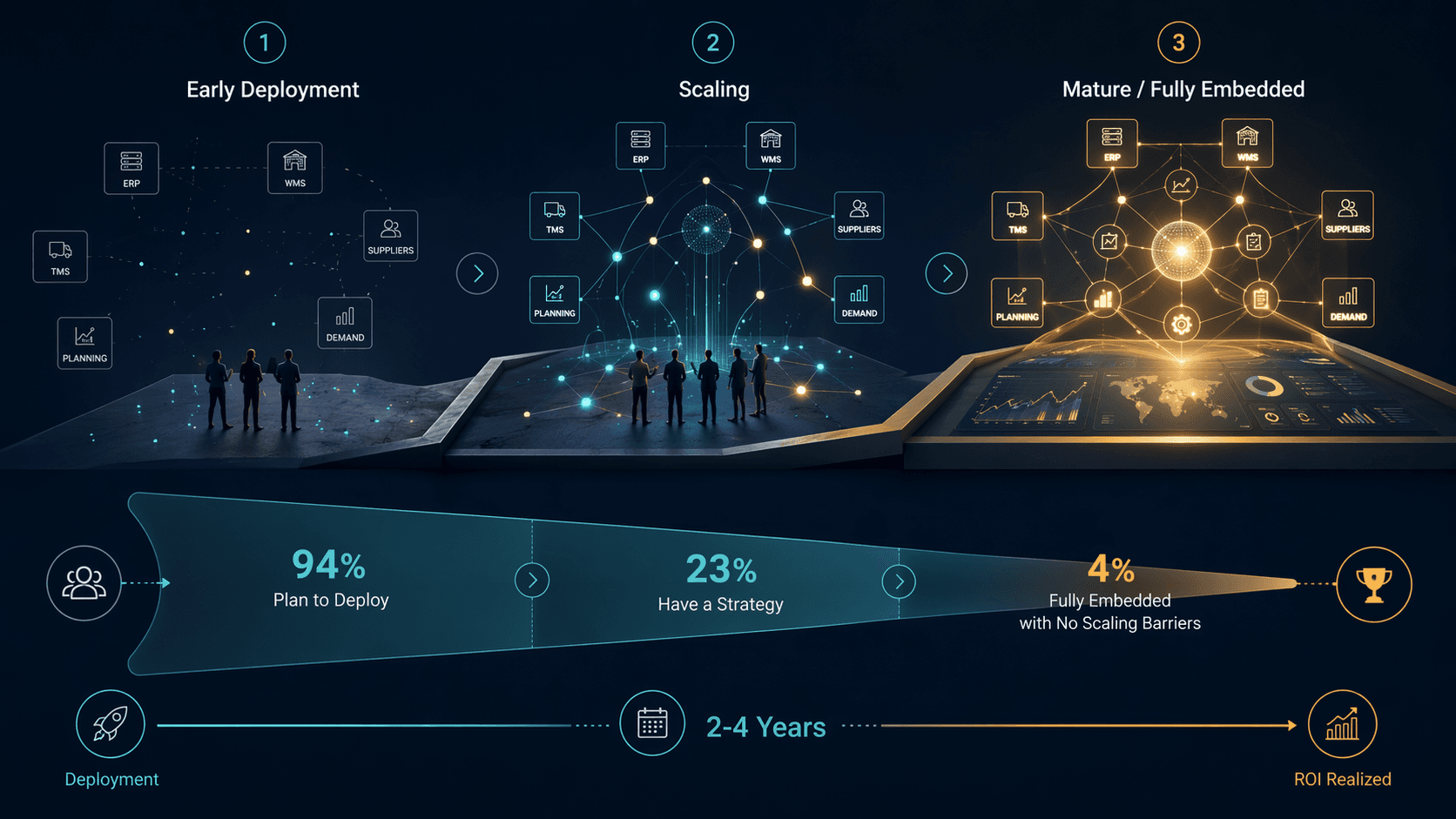
PwC’s 2026 survey makes the maturity problem visible. Only 4% of organizations simultaneously achieved full AI embedding, no scaling barriers, horizontal operating models, and full delivery on tech investments.[4] That is a tiny leader cluster, and it explains why so many AI business cases look strong in the pilot phase but thin in the P&L. The issue is rarely that the model fails to score well enough. It is more often that the organization cannot scale the model across sites, functions, and planning cycles without friction.
PwC also shows the adoption paradox that keeps the room quiet during review meetings: 94% of organizations plan to deploy, but only 23% have a clear strategy to do so. That gap is why broad enthusiasm does not automatically become value capture. Planning to deploy is not the same thing as reorganizing data flows, decision rights, process ownership, and measurement so the technology can actually change operations.
Data readiness is about being actionable, not perfect
The most useful part of PwC’s 2026 data findings is that they reject the lazy excuse on both sides. On one hand, 87% say poor data quality has affected digital value; on the other, 73% agree data does not need to be perfect to create value, and 89% agree that actionable data matters more than comprehensive data.[4] That is the right standard. Supply chain AI does not need immaculate data to start producing value, but it does need connected, usable data that planning, operations, and finance can all work from.
This is also where integration complexity shows up as the real blocker. PwC identifies integration complexity as the top reason tech investments have not delivered, which is a different problem from AI capability itself.[4] A model can forecast well and still fail financially if order systems, inventory records, labor planning, and finance reporting never reconcile. The business case breaks not because the prediction is wrong, but because the organization cannot route the prediction into the decision that changes cost or cash.
The ROI timeline is usually a 2–4 year problem, not a 2–4 month problem
Deloitte’s 2025 survey is the clearest warning against early defunding. It found that 85% of organizations increased AI investment in the past year, yet only 6% saw ROI in under a year, and most satisfactory returns emerged within 2–4 years.[3] That timing matters because many programs are judged against quarterly expectations that are too short for the work required. The early phase usually absorbs integration, process redesign, governance, and user adoption costs before the compounding benefits show up.
That does not excuse weak execution. It does mean that a project can be too early to judge and still be wrong to continue. The difference is measurement. If the team cannot show a path from forecast improvement to inventory, service, labor, expedite, or cash effects, the timeline becomes a story instead of a business case.
High performers measure both the operation and the P&L
PwC’s strongest measurement finding is simple: 83% of high-performing firms measure both operational and financial impact, while weaker programs tend to track only one dimension.[4] That gap is bigger than it sounds. If a team reports better forecast accuracy but never connects it to inventory turns, expedites, service levels, labor hours, or working capital, the CFO is left guessing where the value landed. Better dashboards do not count as ROI unless they change the economics of the operating model.
| Operational metric | Finance question it should answer |
|---|---|
| Forecast error | Did inventory, expedites, or lost sales move? |
| Service level | Did shortages fall enough to protect revenue or margin? |
| Labor productivity | Did cost per order, route, or touch point decline? |
| Inventory position | Did working capital or obsolescence improve? |
That is why the better reading order for the business case is usually not “model first, finance later,” but the other way around. If the team cannot name the operational lever and the financial endpoint in the same sentence, the investment is probably still in the pilot stage.
For a narrower look at where the P&L translation usually breaks, see Why Most Supply Chain AI Investments Miss the P&L Impact — and Where to Invest Instead, and for the upstream question of whether the data environment is ready enough to support the case, The CSCO's Data Readiness Checklist for Supply Chain AI Implementation is the more useful companion read.
The business-case standard that survives CFO review
The practical conclusion is stricter than “AI works” and more useful than “AI is hype.” AI in supply chain can clear a serious ROI bar, but the returns cluster around organizations that have already done the hard work of integration, data connection, process ownership, and measurement discipline. If the forecast improves, the next question is what moved in the operation. If the operation improved, the next question is what moved in the P&L. And if those answers are not visible yet, the investment is probably not ready to be judged — or it was never structured to pay back in the first place.
References
- AI: Built to Scale — Accenture, 2024.
- AI in operations — McKinsey, 2024.
- State of AI in the Enterprise survey — Deloitte, 2025.
- Digital Trends in Operations Survey — PwC, 2026 (US, n=767).
Comments
Join the discussion with an anonymous comment.