
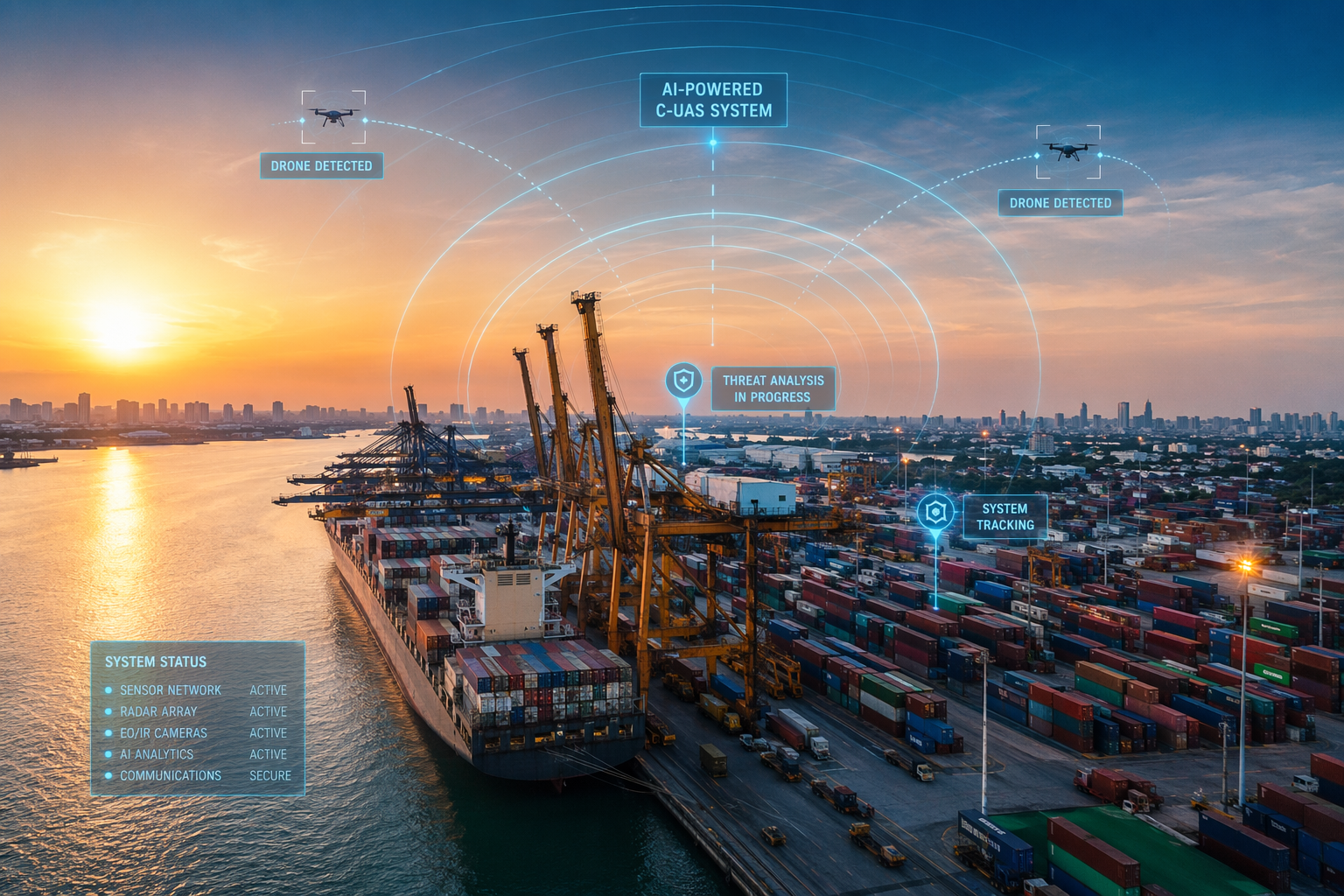
When Kuwait's Shuwaikh Port was hit by Iranian drones in March 2026, the useful lesson for supply chain teams was not that drones had entered another conflict headline. It was that a main commercial port could be damaged and its operations disrupted by an aerial threat that does not respect the old boundary between military targets and logistics infrastructure.[1] For anyone responsible for supply chain resilience against drone attacks, that changes the starting question. The issue is no longer whether unmanned systems can affect commercial flow. It is which ports, terminals, fuel depots, warehouses, and intermodal yards are still assuming the air above them is mostly someone else's problem.
Ports are difficult places to defend even before drones enter the picture. Cranes move, vessels berth late, trucks stack up outside gates, pilots and tugs follow their own windows, and security teams are expected to keep commerce moving rather than freeze the facility every time something looks unusual. A counter-drone system that cannot tell the difference between a hostile platform, an inspection drone, a benign aircraft, and a sensor artifact can become another source of disruption.
The port pattern is the warning
The strongest evidence is not a forecast. It is the repetition of logistics-linked targets. Reporting on the Kuwait strike described damage to infrastructure at Shuwaikh Port and disruption to commercial port operations.[1] Separate port-security analysis has pointed to earlier attacks affecting Ras Tanura in Saudi Arabia and Mokha in Yemen, both of which matter because fuel and maritime logistics nodes sit inside wider supply chain networks.[2]
Russian Black Sea ports, including Tuapse, Kavkaz, and Taman, have also been repeatedly cited in 2025 and 2026 reporting on Ukrainian drone strikes that affected oil and cargo operations. These are active-conflict accounts, and operational details can be shaped by government statements, wartime uncertainty, and information-warfare incentives. The safer conclusion is still serious: commercial logistics infrastructure is appearing often enough in the attack record that supply chain operators cannot treat drone risk as a purely military-base scenario.
Volume matters as much as target selection. Ukraine faced 15,933 Shahed drone launches during June-August 2025 alone, according to data cited in risk analysis of AI-enabled drones.[3] That number does not prove that every commercial port faces the same threat level. It does show what an industrialized drone campaign looks like when a conflict zone overlaps with energy routes, maritime corridors, or border-adjacent logistics.
Market growth is useful mainly as a signal that this is becoming a budget category. Counter-UAS market estimates cited in 2025 industry analysis place the sector at roughly $6.6 billion in 2025 and project about $20.3 billion by 2030, implying a 25.1% CAGR.[4] Those numbers should not be read as evidence that any specific system will protect a terminal. They do explain why more vendors are now trying to convert defense demonstrations into commercial security proposals.
Why the old perimeter does not fit the threat
Traditional site security works best when the threat crosses a defined boundary in a predictable way. A person approaches a fence. A vehicle enters a gate. A vessel arrives at a berth. Drones make that geometry unreliable. They can approach from water, industrial land, or low-altitude urban airspace. They can fly over the gate entirely. They may be small enough to arrive late in the detection chain, especially in cluttered port environments with cranes, container stacks, metal structures, and legitimate radio traffic.
Radar alone is not a complete answer, and neither is RF jamming. Industry analysis in 2025 described adversaries using AI-enabled drones and fiber-optic guidance that can be immune to RF interference, reducing the usefulness of conventional jamming against certain threat types.[4] That does not make RF sensing obsolete. It means RF has to be one layer in a wider system, not the system itself.
The hardest operating problem is deconfliction. Many large logistics sites now have reasons to put their own drones in the air: fence-line patrols, roof checks, gantry crane inspection, tank inspection, storm damage assessment, and post-incident documentation. A system that simply treats every unmanned aircraft as hostile will either shut down useful work or train operators to ignore alerts. In a port operations room, both outcomes are bad.
What AI has to do at a logistics site
The case for AI-powered counter-drone systems is strongest at the classification layer. The facility does not just need to know that something is airborne. It needs to know whether the object is likely a bird, a commercial aircraft, an authorized inspection drone, an unknown drone, or a probable threat; whether its track is consistent with normal activity; and whether the right response is observation, escalation, law-enforcement notification, operational pause, or a legally authorized countermeasure.
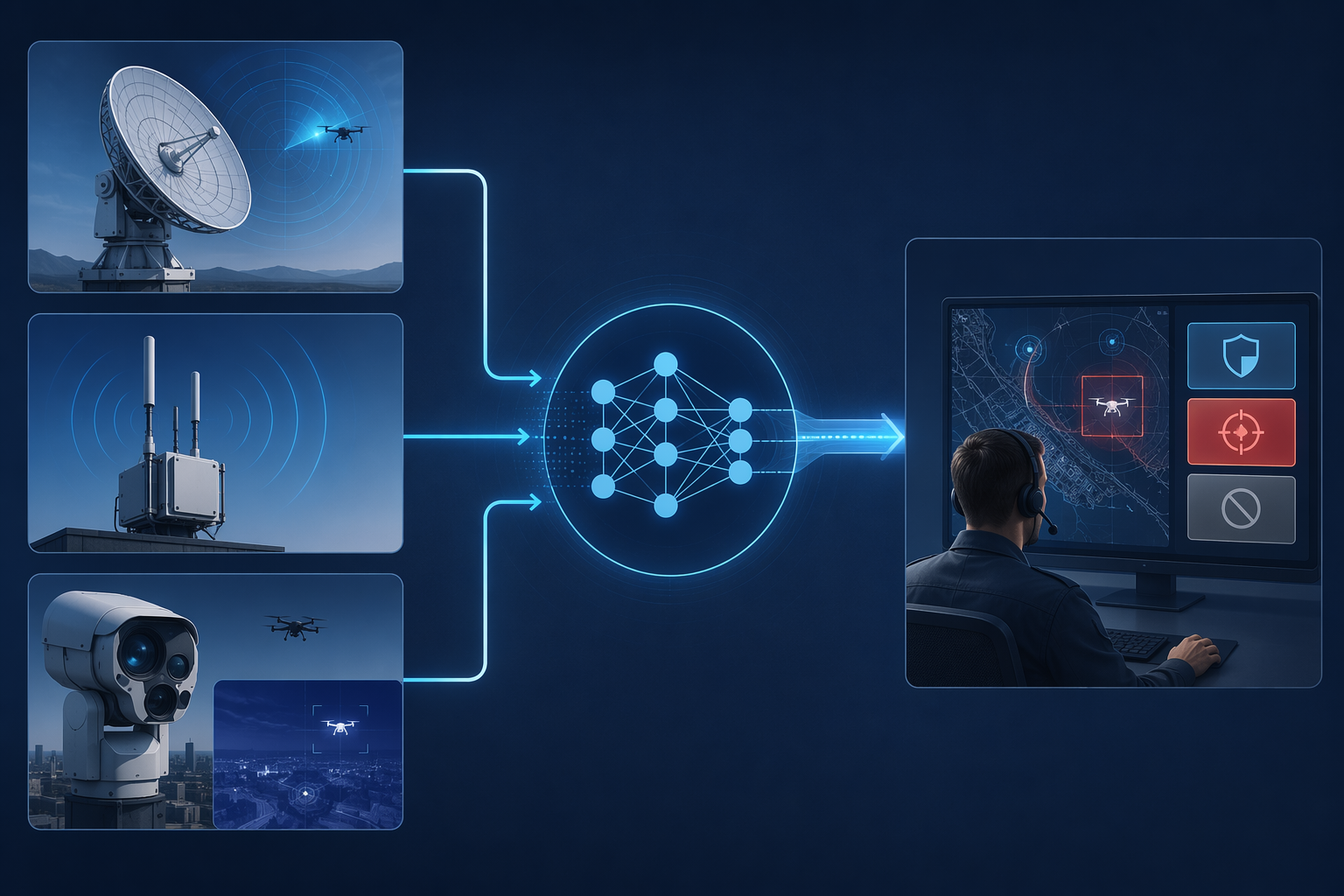
A practical architecture is layered: RF detectors, acoustic sensors, radar, and optical or infrared cameras feed a fused view that machine learning models help classify and prioritize.[4] The AI layer matters because each sensor has weak points. RF sensors can miss silent or fiber-guided systems. Cameras can struggle with weather, lighting, and line of sight. Radar can create nuisance tracks in a dense industrial environment. Acoustic sensors can be degraded by port noise. Fusion gives the operator a better probability-weighted picture than any single sensor can provide.
The response layer should remain governed. Logistics facilities are not military ranges, and legal authority to jam, spoof, intercept, or disable drones varies by jurisdiction and operator type. For most commercial buyers, the first procurement requirement is not an autonomous defeat button. It is reliable detection, classification, alerting, evidence capture, and escalation workflow that can survive contact with real operations.
| Capability | Why it matters at ports and logistics hubs |
|---|---|
| Multi-sensor detection | Reduces dependence on any one signal type when drones use RF silence, fiber guidance, low altitude, or cluttered approach paths |
| Machine learning classification | Helps separate authorized drones, benign aircraft, birds, sensor noise, and likely hostile activity |
| Track continuity | Shows whether an object is approaching critical assets, loitering, or leaving the site |
| Human-governed escalation | Keeps response decisions aligned with law, site policy, and operational risk |
| Security-system integration | Lets drone alerts feed control rooms, incident systems, cameras, access control, and supply chain visibility platforms |
That last point is easy to underprice. A drone alert that stays inside a standalone console may help the guard force but still fail the supply chain team. If a terminal gate closes, a tank farm pauses loading, or a warehouse yard suspends outbound moves, the event belongs in the same operational picture as vessel delays, weather disruptions, cyber incidents, and labor constraints. This is where C-UAS data can complement broader control-tower workflows such as supply chain control tower AI use cases, provided the alert quality is good enough to avoid flooding planners with noise.
Representative AI counter-drone approaches
Vendor comparisons should start with the operating problem, not the brochure category. A port with authorized inspection drones has a different burden than a remote fuel depot with no routine drone activity. A distribution campus near a major airport has a different escalation model than a coastal terminal near a conflict spillover zone. The following systems are useful reference points because their public capability claims map to the problems logistics operators actually face.
Lockheed Martin Sanctum
Lockheed Martin presents Sanctum as a counter-UAS system using real-time machine learning for detection, classification, and tracking. The company also says it demonstrated an end-to-end intercept in under 45 days from integration to live-fire test.[5] For commercial infrastructure buyers, the relevant takeaway is not the intercept claim by itself. It is that detection, classification, tracking, and response are being packaged as an integrated workflow rather than as separate point tools.
Sanctum is most relevant to buyers who need a mature defense-grade architecture and have the budget, legal review, and systems-integration capacity to absorb it. A port authority or energy terminal should still test how its workflows handle authorized drones, nuisance tracks, data retention, local law-enforcement handoff, and any response option that could affect nearby civil airspace.
Anduril Lattice
Anduril's Lattice is important because it represents the software-centered model of counter-drone defense: fuse sensor inputs, maintain tracks, classify threats, and support rapid operator decisions. Industry reporting in 2025 described high-stakes military selection activity around AI-driven counter-UAS fire control, including the U.S. Army's move toward next-generation platforms.[4] That is a meaningful validation signal, but it remains a defense-context signal.
For a commercial logistics site, the question is whether the same command-and-control strength can be constrained to a civilian operating model. The platform has to support policy-based escalation, airspace coordination, evidence review, and safe handoff to authorized responders. A system built to move quickly in a combat environment may still need careful configuration before it is comfortable in a port with pilots, harbor police, private security, maintenance contractors, and inspection drones sharing the same operating day.
DroneShield RFAI
DroneShield's RFAI is relevant for a narrower but very practical reason: RF signal classification. The capability described in industry material focuses on proprietary machine learning used to classify RF signals and distinguish drone types and threat indicators from benign activity in congested airspace.[4] That is close to the daily problem at logistics facilities where not every drone is an intruder.
The limitation is built into the strength. RF classification can be valuable when the drone emits useful signals. It is less complete against autonomous routes, low-emission behavior, or fiber-optic-guided systems. A buyer considering an RF-strong solution should ask how it pairs with radar, optical, acoustic, and procedural controls rather than treating signal intelligence as a standalone shield.
| Vendor approach | Most relevant evidence | Best-fit logistics question |
|---|---|---|
| Lockheed Martin Sanctum | Real-time ML detection, classification, tracking, and reported end-to-end intercept demonstration | Can a defense-grade integrated workflow be adapted to the facility's legal and operational response model? |
| Anduril Lattice | AI-centered command-and-control and high-stakes military counter-UAS platform relevance | Can sensor fusion and decision support be governed tightly enough for civilian infrastructure? |
| DroneShield RFAI | Machine learning RF signal classification for drone and threat discrimination | Can RF classification improve deconfliction without becoming the only detection layer? |
The deployment questions that decide usability
A good demonstration can still fail at a real facility. The procurement team should spend less time asking whether the system uses AI and more time asking what decisions the AI changes under pressure.
- Source validation: Treat active-conflict incident reports as warning signals, then cross-check threat details before designing controls around them.
- Site conditions: Test against local clutter, port noise, weather, lighting, crane movement, vessel profiles, and nearby aviation patterns.
- Authorized-drone workflow: Register approved drones, missions, operators, time windows, and expected flight paths so classification can separate routine activity from anomalies.
- False-positive management: Define who reviews alerts, what evidence they see, when operations pause, and how nuisance patterns are fed back into tuning.
- Response authority: Confirm what the operator, police, aviation regulator, military, or coast guard may legally do before buying defeat capabilities.
- Multi-site cost: Model sensors, integration, monitoring staff, training, maintenance, software updates, and governance across the whole network, not just one pilot site.
There is also an ROI problem that should be stated plainly. The available material does not provide reliable commercial payback data for AI counter-UAS deployments at ports, distribution centers, or logistics hubs. Avoided disruption is a serious business case, especially when a drone incident can stop loading, trigger emergency response, or delay customer commitments. It is also hard to quantify before an incident occurs. Buyers should not let that uncertainty push them into invented savings math.
The more useful financial frame is exposure. Which sites sit near conflict spillover, strategic fuel or maritime corridors, political targets, high-value inventory, or congested urban airspace? Which facilities have single points of failure where a short shutdown cascades into vessel demurrage, missed delivery windows, spoilage, or production stoppage? That exposure analysis can sit alongside other AI-enabled risk programs, including flood disruption planning and pirate hijacking prevention, because the management question is similar: which weak signals deserve operational attention before they become a customer-facing delay?
A practical baseline, not a guarantee
AI-powered counter-drone systems are now the most viable defense category for exposed supply chain infrastructure because they address the problem that matters most: classification under ambiguity. Ports and logistics hubs do not need a tool that panics at every airborne object. They need a fused, explainable, operator-governed view of what is in the air, what it is likely doing, and what response is lawful and proportionate.
That is a baseline, not a procurement shortcut. Before treating any vendor demonstration as commercial readiness, resilience and security teams still need to validate the incident evidence, test their own site conditions, map authorized-drone activity, set false-positive thresholds, confirm response authority, and understand what the system costs across a multi-site network.
References
- Drone Strike Damages Kuwait's Main Commercial Port as IRGC Steps Up Attacks on Gulf Targets — The Media Line
- Counter-Drone Protection at Ports: A Critical Factor for Fixing the Supply Chain — D-Fend Solutions
- AI drones - the unknown risk that's already here — Crawford & Company
- How the counter-UAS industry supply chain is evolving – the new winners — Unmanned Airspace
- Counter UAS for Drone Defense and National Security | Lockheed Martin Sanctum — Lockheed Martin
Comments
Join the discussion with an anonymous comment.