

The phrase "AI logistics company" sounds specific until a buyer has to decide what it actually means. It can describe a visibility platform, a planning system, an orchestration layer, an autonomous operator, or a traditional carrier that has added machine learning to an existing network. That difference matters because the label can hide very different cost structures, workflows, and decision loops.

That ambiguity is not academic. In a 2026 BCG and Alpega survey of more than 180 logistics executives, only about one in ten LSPs said AI was already producing measurable financial impact, while 56% were still exploring or piloting use cases [1]. The regional split is also hard to ignore: Asia-Pacific LSPs reported 31% embedded AI maturity, versus 14% in North America and 6% in Europe [1].
Even the market-size forecasts show how elastic the category has become. One forecast puts the AI-in-logistics market at $17.96B in 2024 and $707.75B by 2034 [2]. Another pegs 2024 at $20.1B with a 25.9% CAGR, which is more conservative and easier to reconcile with the uneven adoption data [3]. The spread does not make one forecast wrong; it shows that "AI logistics" is being used for several different kinds of companies at once.
A spectrum, not a category
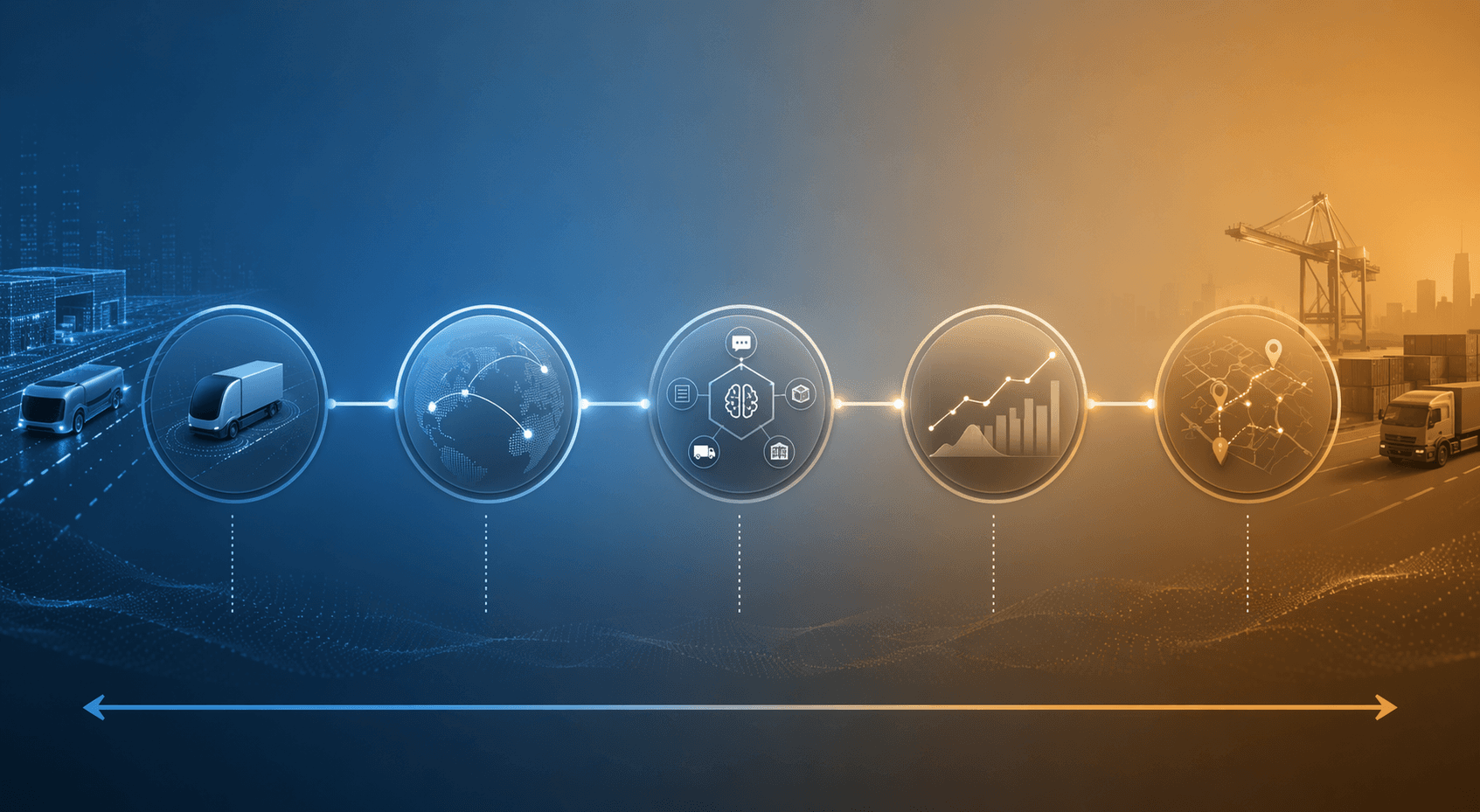
The useful way to read the market is as a spectrum. At one end are AI-native logistics platforms that treat AI as operating infrastructure. At the other are legacy LSPs and carriers that use AI as an overlay on top of terminals, fleets, and labor-heavy execution. Between those poles sit companies that have rebuilt specific planning or orchestration layers without changing the full economics of the network.
The five company types buyers usually mean
The label gets clearer when it is broken into five common types. They are best treated as orientation markers, not as a beauty contest.
- Visibility platforms, such as FourKites and Project44, answer a narrow question: where is the freight, what changed, and who needs to react next?
- Autonomous operations companies, such as Nimble and Einride, ask whether execution can be reduced to software-directed or minimally staffed workflows.
- Planning and forecasting systems, such as Blue Yonder and o9, focus on prediction, inventory, and network decisions before the load ever moves.
- Freight orchestration platforms, such as Uber Freight and Flexport, try to coordinate demand, capacity, and exceptions across a broader execution layer.
- AI agents for logistics, such as Logistics Reply and PTV Logistics, are usually about task automation inside existing workflows rather than replacing the network model itself.
Those categories are different in the question they answer. A visibility platform can be valuable without changing the carrier’s cost base. A planning system can improve decisions without owning execution. An AI-native operator is trying to make the execution layer itself cheaper as it scales.
Where the operating model diverges
The sharpest illustration comes from Warp’s analysis of six public LTL carriers. It is a vendor-published comparison, so it should be read as a framed argument rather than neutral industry research, but the carrier figures it uses are drawn from public filings and are the part worth watching [4]. In that sample, the legacy carriers employed roughly 14,000 to 39,000 people and spent more than $300M annually on tractors and trailers, while AI showed up mostly as a 10% to 15% optimization layer on top of terminal-heavy economics [4]. XPO’s reported 12% empty-mile reduction alongside an 85% operating ratio is the kind of evidence that tells you AI is affecting a metric, not rewriting the business model [4].

The AI-native side of the comparison looks different because the cost base is different. Warp describes a model with zero owned drivers and no terminal capex, where costs fall as density improves rather than rising with fixed infrastructure [4]. Its pricing engine reportedly expanded lane coverage from 13% to 45% in 14 months while processing more than 11M quotes [4]. That is not the same claim as "we improved route optimization." It is a claim about coverage, workflow automation, and the ability to price more of the market with the same operating core.
What to verify before the shortlist
For buyers, the question is less "is this AI-powered?" than "where does AI sit in the operating model?" A vendor that can answer that clearly is easier to evaluate across finance, IT, and operations. A vendor that cannot usually needs a second pass.
| Evidence to ask for | What it tells you |
|---|---|
| Measured financial impact vs. pilot status | Whether AI is already affecting the P&L or still living in experimentation [1] |
| What workflow is automated | Whether the product changes quoting, booking, exception handling, planning, or only visibility |
| What assets the company owns | Whether the model is terminal-heavy and fleet-heavy, or variable-cost and software-led [4] |
| What outcome is reported | Whether the vendor can point to operating ratio movement, cost savings, coverage gains, or a narrower productivity gain |
| How fast the use case reaches payback | Whether the claim resembles routine automation benchmarks such as 10% to 20% savings in 3 to 6 months at €500K to €1M investment, or something much broader and less proven [5] |
Oliver Wyman’s 2025 benchmarks are useful here because they keep expectations grounded: routine automation use cases such as quoting and booking can produce 10% to 20% cost savings within 3 to 6 months at roughly €500K to €1M of investment [5]. That is a credible near-term outcome for a narrow workflow. It is not the same as proving a new logistics operating model. For function-level evidence, the AI ROI playbook for transportation and logistics and the AI use cases in supply chain guide are better next stops than a generic feature list.
A useful shortlist starts with classification. If a company sits on the AI-native end of the spectrum, it should be able to explain how its economics improve with density and how much of execution it controls directly. If it is a carrier or LSP with embedded AI, it should show where the technology changes throughput, labor, pricing coverage, or empty miles. The AI supply chain companies directory is the more practical next step when the question becomes which vendors belong in which bucket.
References
- BCG / Alpega 2026 logistics AI survey, BCG and Alpega, 2026.
- AI in Logistics Market Size, Share & Growth Analysis Report, Precedence Research.
- AI in Logistics Market Size, GM Insights.
- Warp LTL carrier analysis, Warp.
- AI in Transportation and Logistics ROI benchmarks, Oliver Wyman, 2025.
Comments
Join the discussion with an anonymous comment.