
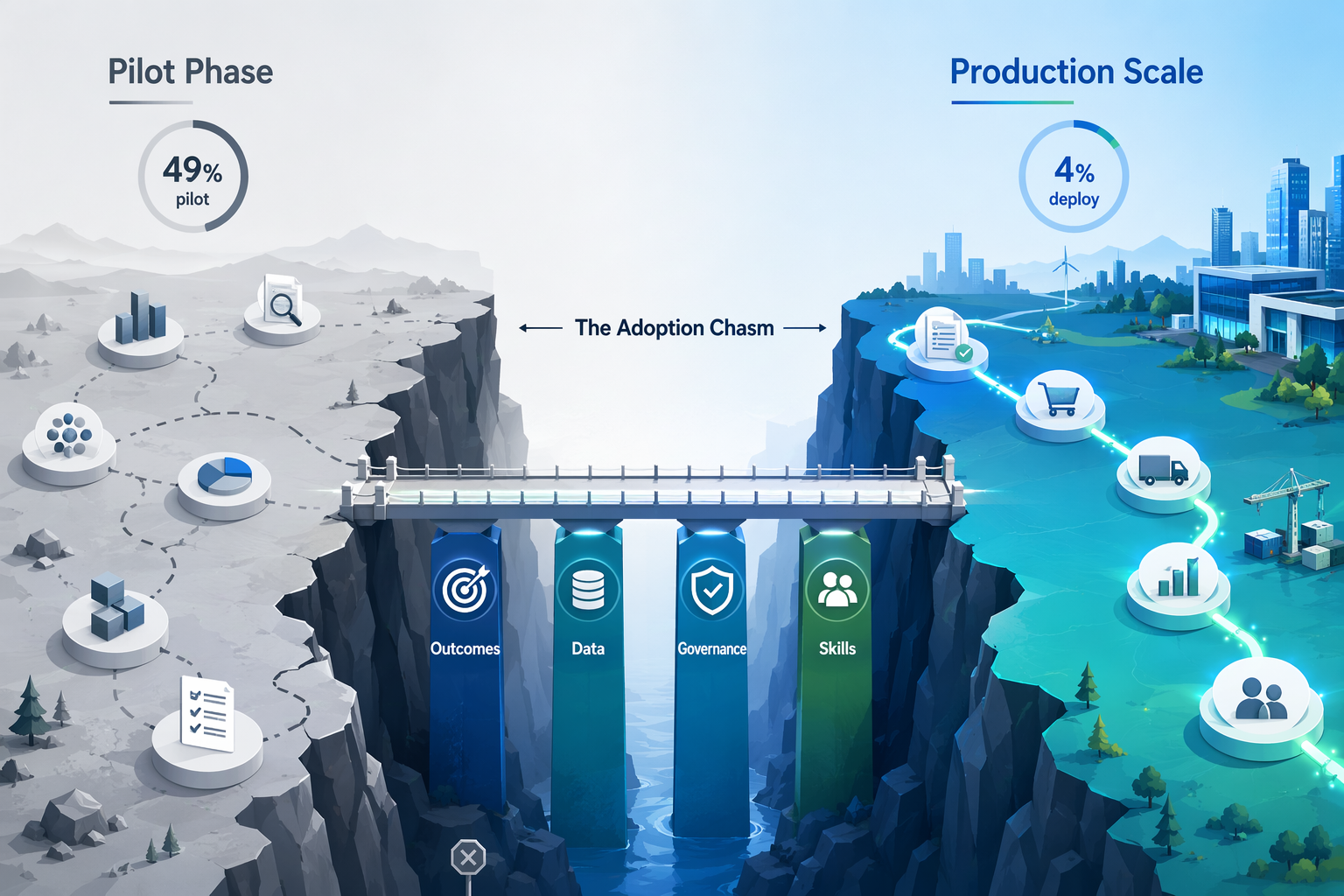

The Procurement AI Adoption Chasm: 49% Piloted, 4% Deployed
If your procurement team has run an AI pilot that never made it into production, you are not alone — you are the norm. According to the Hackett Group's 2025 CPO Agenda, 49% of procurement teams piloted generative AI in 2024, yet only 4% achieved large-scale deployment. That 45-point gap between experimentation and impact is what we call the adoption chasm.
This chasm is not unique to procurement. MIT's 2025 State of AI in Business study found that 95% of enterprise AI pilots across all industries deliver no measurable ROI, and 80% of firms that pilot never reach mature production. But the consequences are particularly acute in procurement, where the promise of AI — automated spend classification, autonomous negotiation, real-time supplier risk scoring — directly addresses chronic pain points like manual data processing, fragmented supplier visibility, and slow cycle times.
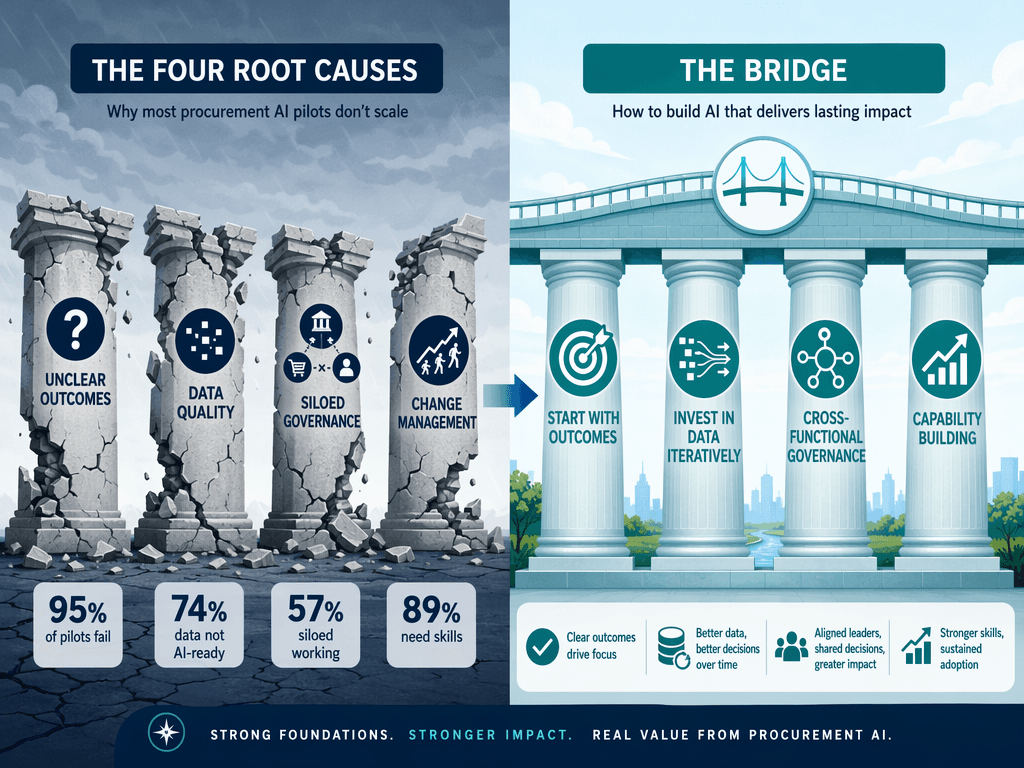
The question is not whether AI can deliver value in procurement — the evidence is clear that it can. The question is why so many teams get stuck in pilot purgatory. Based on data from Gartner, Deloitte, BCG, and the Hackett Group, four root causes consistently emerge. This article diagnoses each one and provides a prescriptive playbook for CPOs and transformation leaders who are ready to close the gap.
Root Cause 1: Unclear Business Outcomes — Pilots Without a Destination
The most common reason procurement AI pilots fail to scale is that they were never designed to solve a specific, bounded business problem. Teams often start with a tool — "let's try generative AI for sourcing" — rather than a measurable outcome — "we need to reduce sourcing cycle time by 30% for low-complexity categories."
This distinction matters because it determines how success is measured. A pilot that starts with a tool has no clear success criteria. When the pilot ends, the team cannot demonstrate whether it worked, and there is no business case for investment in production deployment. The MIT 2025 study found that this pattern — technology-first, outcome-second — is the single strongest predictor of pilot failure.
The contrast is stark for teams that reverse the sequence. Organizations that start with specific, bounded use cases — such as AP automation or spend classification — report 2x to 5x ROI within 12 months, according to Deloitte's 2024 GenAI CPO survey and Hackett Group data. These teams define the outcome first, then select the AI approach that serves it.
Root Cause 2: Data Quality Gaps — 74% of Leaders Say Data Isn't AI-Ready
Data quality is the most frequently cited operational barrier to AI adoption in procurement. Gartner's 2025 survey found that 74% of procurement leaders say their data is not AI-ready. This statistic is often interpreted as a permanent roadblock — "we can't do AI until our data is perfect" — but that framing is misleading.
Data quality is a real constraint, but it is not a binary condition. Organizations do not need perfect data to start; they need data that is good enough for a specific use case. Spend classification, for example, requires clean category codes and supplier names, but it does not require perfectly structured contract metadata. The key is to match the data requirement to the use case, not to wait for enterprise-wide data perfection.
There is also a counterintuitive dynamic at play: AI itself improves data quality. APQC found that 8 out of 10 organizations saw improved data quality as a result of implementing AI. The act of deploying AI forces teams to clean, standardize, and govern their data in ways that manual processes never required. Data quality is not just a prerequisite for AI — it is a byproduct of AI adoption.
For a deeper exploration of data-first implementation strategies, see our article Why 70% of Supply Chain AI Projects Fail — and How Data-First Implementation Fixes It. That article covers the supply-chain-wide data quality challenge; this section focuses specifically on how procurement teams can navigate the data readiness gap without stalling.
Root Cause 3: Siloed Governance — 57% of CPOs Cite Cross-Functional Barriers
Procurement AI does not live inside procurement. It requires data from ERP and finance systems, integration with IT infrastructure, and alignment with compliance and risk management frameworks. When these functions operate in silos, AI initiatives stall before they reach production.
Deloitte's 2025 Global CPO Survey found that 57% of CPOs cite siloed working as the top barrier to AI value delivery. This is not a technology problem — it is an organizational design problem. Procurement teams that attempt to deploy AI without dedicated cross-functional governance structures — a steering committee with representation from IT, finance, data engineering, and compliance — consistently fail to move beyond pilots.
The governance gap is particularly acute for agentic AI use cases, where AI systems take autonomous actions — such as negotiating contracts or approving purchase orders — that cross traditional accountability boundaries. Without clear ownership of model decisions, audit trails, and escalation paths, these use cases remain stuck in pilot mode indefinitely.
For a comprehensive treatment of the governance dimension, see The AI Readiness Gap in Procurement: Why 83% of Teams Lack Governance and What It Costs. That article diagnoses the governance deficit in depth; this section positions governance as one of four root causes that must be addressed together.
Root Cause 4: Insufficient Change Management — 89% Need Skills, 6% Have Begun
Even when the technology works, the organization may not be ready to use it. BCG research found that 89% of executives say their workforce needs improved AI skills, yet only 6% have begun meaningful upskilling. This gap between aspiration and action is the fourth root cause of the adoption chasm.
The skills gap manifests in two ways. First, procurement professionals need to understand what AI can and cannot do — not to become data scientists, but to ask the right questions, validate outputs, and intervene when models produce unexpected results. Second, teams need to adapt their workflows to incorporate AI outputs. A spend classification model that achieves 97% accuracy is useless if no one trusts it enough to act on its recommendations.
MIT's 2025 study offers a data point that challenges the build-it-yourself approach: AI projects built with external partnerships are approximately 2x more successful than internal builds. This does not mean teams should outsource all AI work, but it does suggest that capability building is more effective when it includes structured partnerships — with vendors, system integrators, or academic institutions — rather than relying solely on internal experimentation.
The Bridging Playbook: Four Actions That Close the Gap
Each root cause has a corresponding action. The organizations that successfully cross the adoption chasm do not address these causes in sequence — they address them in parallel, recognizing that outcomes, data, governance, and skills are interdependent.
| Root Cause | Bridging Action | Key Principle |
|---|---|---|
| Unclear business outcomes | Start with outcomes, not features | Define the specific operational metric and target before selecting a tool |
| Data quality gaps | Invest in data quality iteratively | Match data requirements to the use case; let AI deployment drive data improvement |
| Siloed governance | Build cross-functional governance structures | Create a steering committee with IT, finance, data, and compliance from day one |
| Insufficient change management | Invest in capability building | Combine structured external partnerships with internal upskilling programs |
The playbook is not theoretical. The Hackett Group data shows that procurement teams using GenAI achieve 2.6x ROI, 2x savings, and 58% faster cycle times. These are the teams that have addressed all four root causes, not just one. They started with a bounded outcome (e.g., automate AP invoice processing), ensured their data was sufficient for that specific task, established a cross-functional governance model, and invested in training their teams to work alongside AI outputs.
For a deeper dive into the ROI data and the pilot trap, see The Business Case for AI in Procurement: ROI Data, the Pilot Trap, and a Disciplined Adoption Sequence. That article provides the financial evidence that supports the playbook outlined here.
Case Examples: Organizations That Crossed the Chasm
Concrete examples help illustrate what the bridging playbook looks like in practice. Two cases — one focused on autonomous negotiation, the other on spend analytics — demonstrate how organizations have moved from pilot to production by addressing the four root causes.
Kärcher, the cleaning equipment manufacturer, deployed autonomous AI negotiation through Procure Ai. The system handles supplier negotiations for specific categories autonomously, achieving substantial discounts and time savings that manual processes could not match. The key to scaling this pilot was clear outcome definition (reduce negotiation cycle time for low-complexity categories by a specific percentage), data readiness (clean supplier and pricing data for the targeted categories), cross-functional governance (procurement, IT, and legal aligned on the autonomy boundaries), and capability building (category managers trained to oversee AI negotiations rather than execute them).
Pentair, a water treatment company, used Sievo's AI-powered spend classification to achieve a $15 million working capital improvement with 90%+ classification accuracy. The deployment started with a bounded outcome — improve spend visibility for indirect categories — rather than a broad "AI for procurement" initiative. The data was sufficient for the specific classification task, and the governance model included finance and IT from the outset. The result was a production-scale deployment that delivered measurable financial impact within months.
Diagnose Your Team's Stalling Point and Take the Next Step
Not every stalled AI initiative suffers from all four root causes equally. Most teams have one or two dominant blockers. Identifying which root cause applies most to your team is the first step toward a targeted bridging strategy.
- If your team has run multiple pilots but cannot articulate the specific business metric each one was designed to improve, your primary blocker is unclear outcomes. Go back and define the metric before the next pilot.
- If your team consistently cites "data quality" as the reason pilots cannot move to production, but you have not matched data requirements to specific use cases, your primary blocker is data readiness. Start with a use case that requires only the data you already have clean.
- If your AI pilots are technically successful but cannot get approval for production deployment, your primary blocker is governance. Establish a cross-functional steering committee with decision rights for AI deployment.
- If your team has deployed AI tools but no one uses them, your primary blocker is change management. Invest in structured upskilling and consider external partnerships to accelerate capability building.
Once you have identified your primary blocker, the next step is to select the right tooling architecture for your context. See Procurement AI Tools in 2026: Orchestration Layers vs. Full S2P Suites — An Architectural Decision Framework for guidance on choosing between orchestration-layer platforms and full source-to-pay suites.
Comments
Join the discussion with an anonymous comment.