
A refinery outage is a different kind of headline when the repair window is not days or a few weeks, but the rest of the year. In June 2026, Reuters reported that Moscow’s oil refinery, hit by drone attacks, was unlikely to resume production before year-end, according to sources familiar with the matter.[1] For a fuel logistics team, that is not an abstract geopolitical event. It is missing processing capacity, altered product flows, tighter optionality, and a set of contracts suddenly exposed to a node that may not come back inside the planning horizon.
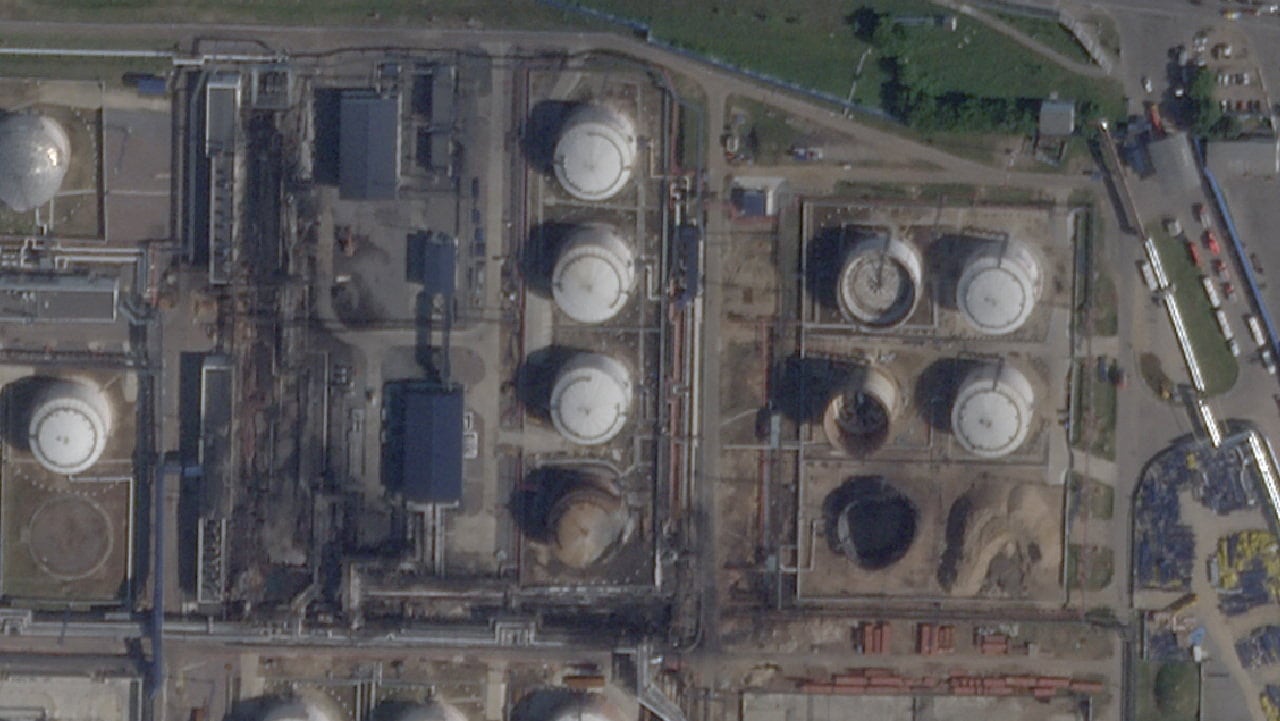
That is the practical entry point for AI drone attacks on the oil supply chain. The important object is not only the drone. It is the refinery unit, pumping station, storage farm, pipeline junction, or port terminal that becomes a repeatable target. Once that node is degraded, downstream buyers do not experience a neat category called “war risk.” They experience inventory drawdowns, rerouted cargoes, supplier calls that do not produce firm answers, and price exposure that may be hard to separate from everything else moving the energy market.
The clearest current case study is the Russia-Ukraine conflict, not because it provides a universal template for every region, but because it has produced the most visible body of strike data. The Baker Institute has identified more than 272 discrete Ukrainian strike events on Russian energy infrastructure between 2022 and early 2026, including strikes on 18 refineries.[2] That moves the issue out of the one-off incident file. It gives supply chain leaders a pattern to model.
When processing capacity becomes the target
Oil supply chains are often discussed as if crude supply is the main constraint. In fuel logistics, processing capacity can be the tighter, more awkward bottleneck. Crude that cannot be refined into gasoline, diesel, jet fuel, or other products does not solve the buyer’s problem. A disrupted refinery may leave crude still available while usable fuel is harder to source, priced differently, or sitting in the wrong geography.
This is why the refinery strike pattern matters more than a broad statement that energy infrastructure is vulnerable. The Baker Institute’s count of more than 272 strike events and 18 refineries hit shows repeated pressure on the infrastructure that converts feedstock into usable product.[2] JPMorgan analysis cited in public reporting estimated 670,000 barrels per day of Russian refinery capacity offline, with 24 refineries hit since January 2024.[3] Those figures are the kind of inputs a risk manager can actually use: affected capacity, number of facilities, time window, and recurrence.
A single refinery fire can sit in a business continuity plan as a local incident. A sustained campaign against refining and energy infrastructure behaves differently. It can erode redundancy, force substitute sourcing, extend lead times, and reduce confidence in the recovery curve. The difficult planning question is not “What if one facility goes down?” It is “What if the facility goes down after other nodes have already been tested, damaged, or put under defensive constraint?”
| Risk model | What supply chain teams usually assume | What the documented drone campaign changes |
|---|---|---|
| One-off facility outage | A repair timeline can be estimated around the damaged asset | Repeated strikes make recovery assumptions less stable |
| General geopolitical disruption | Exposure is mapped mainly through country, sanction, or conflict risk | Specific processing nodes may become the operational point of failure |
| Market price shock | The primary concern is commodity price movement | Physical product availability, routing, and contract performance become equally important |
| Cyber or weather scenario | Mitigation often centers on IT recovery or seasonal preparedness | Mitigation must include kinetic damage, insurance language, alternate terminals, and product substitution |
The same disruption can pass through several desks before anyone names it correctly. Procurement sees a supplier invoking force majeure or quietly revising delivery confidence. Logistics sees longer routes and terminal congestion. Finance sees price volatility and working-capital pressure. Legal sees contract language that may not distinguish war, terrorism, sabotage, and state-linked attacks cleanly enough for the claim that is about to be made.
What makes AI drone attacks different from the old infrastructure threat
Attacks on oil infrastructure are not new. The 2019 Abqaiq attack disrupted 5.7 million barrels per day, about 5% of global daily supply, and remains the obvious reminder that processing assets can be strategically fragile.[2] The newer risk is not that oil facilities have suddenly become targetable. It is that lower-cost, more precise, repeatable strike systems can turn that vulnerability into a sustained supply chain pressure campaign.
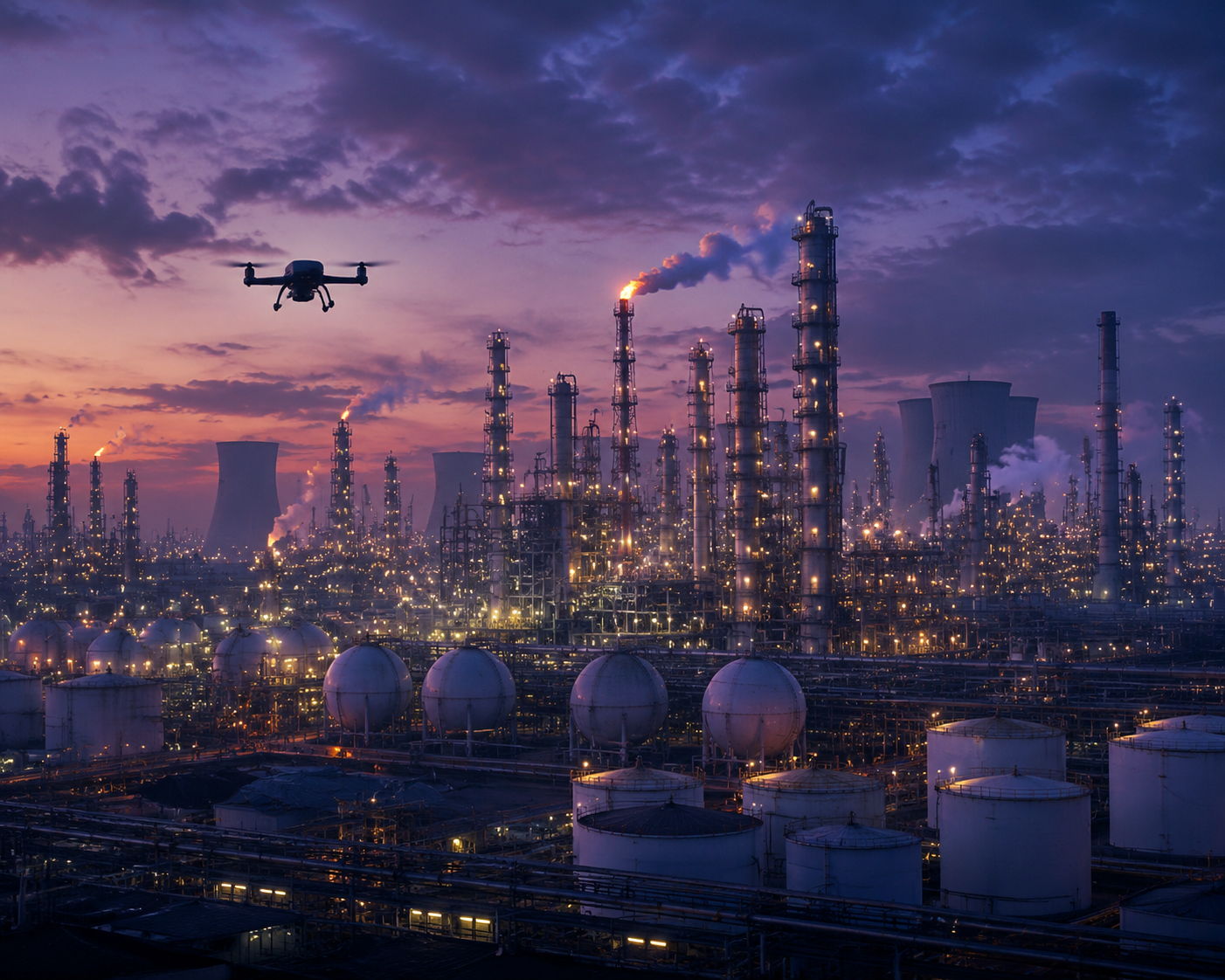
Precision is the first change. CNN reported in 2024 that Ukrainian drones were using AI-enabled capabilities, including machine vision, to help identify or navigate toward targets under conditions where GPS and communications could be contested.[4] That should not be inflated into a claim that every drone in every theater is fully autonomous. The narrower point is already enough: when guidance systems become better at finding specific industrial targets, a refinery is no longer just a large facility. It is a collection of high-consequence units, some of which matter far more than others for recovery time and output.
Cost asymmetry is the second change, and it is the part that should make resilience budgets uncomfortable. Analyst comparisons cited in market reporting have put AI-enabled drone systems in the tens of thousands of dollars, roughly $50,000 to $100,000, against refinery and processing assets worth billions.[3] Even if the exact system cost varies, the planning implication is not subtle. A relatively cheap attack can force expensive inspection, repair, shutdown, rerouting, inventory use, and management attention.
Repeatability is the third change. A weather event has a seasonality profile. A cyberattack has an intrusion and recovery chain. A sanction has a legal effective date and compliance perimeter. A drone campaign can keep probing physical infrastructure after the first incident, and it can do so without waiting for the victim’s recovery schedule. The Baker Institute’s 272-plus strike-event data is important because it documents recurrence, not just capability.[2]
The fourth change is economic reach outside formal policy channels. Sanctions create documented restrictions that legal and procurement teams can map. Physical disruption can produce effects that look similar to policy pressure but do not arrive through a regulation, license, or official notice. A buyer may be technically allowed to purchase a product and still face shortage, delayed shipment, insurance hesitation, or a supplier who cannot process enough volume to perform.
Market data can show the background stress, but it needs careful handling. CNBC reported in April 2024 that Brent crude had risen 13% in 2024 and gasoline futures had climbed 33% amid concern over Ukrainian drone attacks on Russian refineries.[3] Those movements cannot be assigned to drone strikes alone; OPEC+ decisions, demand expectations, other conflicts, and inventory signals all matter. For supply chain planning, the safer conclusion is narrower: drone attacks can become one contributor to market volatility while also creating physical product constraints that price charts do not fully explain.
How the disruption travels through fuel logistics
A drone strike on a refinery does not have to destroy an entire complex to matter. Damage to a critical unit can reduce throughput, alter product yields, require safety checks across connected systems, or keep the site offline while replacement parts and specialist crews are arranged. The downstream consequence may be a diesel shortage in one corridor, higher dependence on imports in another, or a terminal receiving cargoes it was not originally scheduled to handle.
The first visible pressure point is usually capacity. If a refinery or product pipeline is unavailable, buyers do not simply replace barrels one-for-one from the nearest alternative. They have to ask whether substitute suppliers have spare product, whether the product meets specification, whether transport routes are available, and whether contracts allow the necessary substitutions.
The second pressure point is time. Reuters’ reporting on the Moscow refinery is valuable because it puts a long outage window around a single facility: unlikely to resume production this year after the June 2026 report.[1] A six-month-plus planning assumption changes the conversation. Safety stock may cover a short disruption. Spot buying may bridge a temporary gap. Neither is a comfortable strategy when the affected node stays down across multiple planning cycles.
The third pressure point is substitution quality. Fuel is not a generic box on a truck. Product specifications, blending requirements, terminal access, vessel availability, pipeline batch schedules, and local regulations can all limit what counts as a workable replacement. In a prolonged outage, the question becomes less “Can we buy somewhere else?” and more “Can we receive, certify, transport, and use the substitute without creating another constraint?”
The fourth pressure point is information latency. Military reporting, local media, satellite indicators, supplier statements, port data, and price moves may not agree in the first days after an attack. A risk team that waits for perfect confirmation may lose the window to secure alternate supply. A team that reacts to every unverified claim may overbuy, overpay, or trigger avoidable contract friction.
Why this should not sit inside a vague geopolitical risk bucket
A broad geopolitical risk category is useful for board reporting until it starts hiding the operational mechanism. AI drone attacks on oil infrastructure deserve a separate line in the risk register because they do not behave like sanctions, weather, labor action, cyber intrusion, or ordinary country-risk deterioration.
- The trigger can be physical damage to a specific node rather than a legal or market event.
- The affected asset may be a processing bottleneck rather than a supplier’s corporate headquarters or a crude source.
- The campaign can recur during the recovery period, making standard outage curves too optimistic.
- The economic effect can appear through availability, routing, and insurance before it appears in formal procurement restrictions.
- The cost of attack may be low enough that defenders cannot assume the adversary will ration attempts.
This distinction matters when executives ask whether the company has a plan. A generic answer about monitoring the conflict is not enough. The plan has to name the exposed nodes, the products that depend on them, the acceptable substitution paths, and the decision threshold for moving from watch mode to action.
What changes in the risk register
The immediate change is classification. Treat AI drone attacks on oil supply chain infrastructure as a distinct disruption vector with its own indicators, scenarios, controls, and owner. It can still roll up into geopolitical risk for board-level reporting, but the working register should not stop there.
A practical entry should identify the facility class at risk: refinery, pipeline, pumping station, storage terminal, port terminal, power supply to a fuel asset, or rail and road interface. The owner should then map which purchased products, suppliers, lanes, and customer commitments depend on those nodes. The point is not to build a military target list. It is to understand where the company’s fuel exposure is concentrated in assets it does not control.
| Planning assumption | Old treatment | Revised treatment for AI drone attacks on oil infrastructure |
|---|---|---|
| Likelihood | Covered by broad country or conflict rating | Tracked through strike frequency, facility class, geography, and supplier exposure |
| Impact | Estimated mainly through commodity price movement | Estimated through offline capacity, product availability, route options, and outage duration |
| Recovery | Modeled as a single facility repair timeline | Modeled with risk of repeat strikes and constrained repair access |
| Mitigation | General alternate sourcing language | Named substitute suppliers, terminals, products, routes, and contract triggers |
| Governance | Reviewed during periodic geopolitical updates | Escalated when defined infrastructure indicators cross agreed thresholds |
Monitoring also has to become more specific. A useful dashboard is not just a map of conflict zones. It should track reported strikes by facility type, verified outage duration, estimated capacity offline, product affected, supplier exposure, freight and terminal constraints, and insurance or contract notices. Where AI-assisted planning tools are already used for geopolitical supply chain resilience, this is a natural extension: the model needs facility-level operating assumptions, not only country-level risk scores.
Scenario planning should use duration, not just shock size
Many disruption exercises still start with a shock and then walk toward recovery: site hit, supply constrained, alternate source activated, normal service returns. The drone campaign evidence argues for scenarios that hold capacity offline longer and allow repeated disruption during recovery. The Reuters Moscow refinery case gives a concrete duration marker for that exercise: a facility struck by drones and unlikely to resume production for the remainder of the year.[1]
A better tabletop scenario would ask what happens if a key refinery is unavailable for one quarter, then two, while two other regional assets experience temporary disruptions. The exercise should force decisions about allocation, customer priority, spot-market authority, freight premiums, and when procurement is allowed to move before the disruption is fully priced into the market. The structure will look familiar to teams that already run disaster preparedness planning, but the assumptions are different: the damaged asset may be targeted again, and the disruption may not follow a seasonal or geographic weather pattern.
Buffer strategy needs product-level discipline
Buffer stock is the obvious answer and often the least precise one. For fuel and energy-intensive inputs, the question is which product, where it is held, who can access it, how long it remains usable, and which customer or plant gets priority when the buffer is drawn. A generic instruction to “increase inventory” can move cost into the system without solving the actual bottleneck.
For some buyers, the better resilience move may be a smaller physical buffer paired with pre-negotiated access to alternate terminals. For others, it may be specification flexibility, dual qualification of fuel sources, or contractual rights to substitute product grades under defined conditions. The decision depends on the asset map, not on a universal days-of-supply rule.
Supplier diversification has to include infrastructure dependence
Two suppliers may look diversified on a vendor list and still depend on the same refinery, port, pipeline segment, or regional storage system. Drone attacks make that hidden common-mode exposure more important. Supplier reviews should ask not only who sells the product, but where it is processed, how it moves, and which alternate assets the supplier can actually use during a disruption.
This is where procurement and logistics need to review contracts together. Procurement can secure a second supplier that logistics cannot receive from efficiently. Logistics can identify an alternate route that legal has not protected in the contract. Finance can approve a premium source that operations cannot use because specifications or receiving infrastructure were never cleared.
Insurance and contract language should be tested before the claim
Drone attacks can create uncomfortable classification questions. Is the event war, terrorism, sabotage, political violence, or ordinary physical damage? Does coverage depend on attribution? Does a supplier’s force majeure clause cover repeated attacks on upstream infrastructure, or only direct damage to its own facility? These questions should not wait for the first missed delivery.
The review does not require a counter-drone procurement decision. It requires legal, risk, finance, and procurement teams to understand which policies and contracts respond when a refinery or terminal outside the company’s control is disabled. That is the same executive muscle used in other asymmetric threat categories, including ransomware response in supply chains: the incident may be external, but the consequence lands inside operating commitments.
The executive question to answer
The board-level version of this risk should be short, but it cannot be vague. A useful answer names the exposed fuel products, the infrastructure nodes that matter, the supplier dependencies, the assumed outage durations, the trigger points for alternate sourcing, and the cost of holding or buying optionality.
- Which refineries, terminals, pipelines, or ports support our critical fuel and feedstock supply?
- Which of those nodes sit in regions where drone attacks on energy infrastructure are documented or plausible?
- Which purchased products have no qualified substitute, no alternate route, or no contractually reliable backup?
- What happens if a key processing node is unavailable for six months rather than six days?
- Who has authority to secure alternate supply before the market fully reprices the disruption?
Counter-drone defenses are a real adjacent topic, especially for operators that own terminals, refineries, pipelines, or storage assets. But for many supply chain leaders, the first responsibility is not selecting radar, jamming, or interceptor systems. It is recognizing that AI drone attacks on oil infrastructure create a distinct disruption pattern: precise enough to hit critical processing nodes, inexpensive enough to be repeated, sustained enough to alter recovery assumptions, and economically meaningful even when no new sanction has been issued.
Once that pattern is visible, the planning work becomes concrete. Monitor the nodes, not only the headlines. Model duration, not only price. Diversify infrastructure dependence, not only supplier names. Put the contract and insurance questions on the table before the next refinery outage forces them there.
References
- Moscow oil refinery hit by drone attacks is unlikely to resume production this year, Reuters, June 24, 2026.
- Quantifying Ukraine’s Strikes on Russian Energy Infrastructure, Baker Institute.
- Ukraine’s AI drone attacks on oil refineries threaten energy markets, CNBC, April 2024.
- Ukraine’s AI-enabled drones are trying to disrupt Russia’s energy industry. So far, it’s working, CNN, April 1, 2024.
Comments
Join the discussion with an anonymous comment.