
AI for offshore drilling supply chain work is worth evaluating now in four places where the evidence has moved beyond general digitalization talk: logistics vessel optimization, predictive maintenance, AI-augmented procurement, and supply chain control towers. The useful question for Q3 2026 is not whether AI sounds mature. It is whether it changes a decision soon enough to prevent a platform wait, an avoidable overhaul, a rushed critical-spares buy, or a vessel plan that burns fuel while still missing the operating window.
The strongest offshore evidence sits in maintenance, where named operators have tied models to drilling equipment, failure windows, and inspection decisions. Logistics optimization is also credible because fuel burn and sailing plans are measurable. Procurement and control towers are real enough to shortlist, but the buyer should separate consultancy estimates, vendor examples, and independently documented operating results.
| Use case | Function affected | Representative evidence | Measured result | Implementation caveat |
|---|---|---|---|---|
| Predictive maintenance | Drilling equipment, rotating equipment, BOP inspection, critical maintenance timing | Murphy Oil deployed 46 predictive ML models across two Gulf of Mexico platforms; Seadrill used AI-supported Asset Lifecycle Management and visual recognition for BOP annular element damage classification. | Murphy pilot models detected known failures 100-121 days in advance; Seadrill reported a 50% reduction in overhauls versus API RP 8B criteria. | Data readiness is the gating item; Murphy's first production model took six months to deploy. |
| Logistics vessel optimization | Offshore support vessel routing, port windows, weather-aware replanning, fuel consumption | Sercel Marlin and IBS Software/IBM CPLEX examples show AI-assisted offshore route optimization and dynamic replanning. | Reported fuel-consumption reduction of 6-10% in offshore logistics routing examples. | The value depends on live operational constraints, not simply producing a prettier schedule. |
| AI-augmented procurement | Sourcing, long-tail spend, should-cost analysis, contract search, document extraction, three-way matching | BCG estimates AI-enabled procurement can create cost advantage; Enverus illustrates neural search and document extraction in oilfield procure-to-pay. | BCG estimates 4-8% cost advantage in stable markets, 10-15% in volatile markets, and 15-20% savings on long-tail spend using GenAI should-cost models. | BCG figures are consultancy estimates; Enverus examples are vendor-published illustrations, not buyer-wide benchmarks. |
| Supply chain control towers | End-to-end visibility, exception management, disruption simulation, digital twin integration, replanning | Oil and gas control tower models combine real-time logistics visibility with disruption simulation and digital-twin-style planning. | The clearest value is decision latency reduction rather than a single universal savings percentage. | Integration, master data, and domain rules determine whether the tower becomes an operating tool or another dashboard. |

The maintenance evidence is the credibility anchor
Maintenance is where offshore AI stops sounding abstract. A rig supply chain can recover from a late catalogue clean-up or a clumsy requisition workflow. It has far less room to absorb a failed top drive component, a BOP inspection dispute, or a rotating-equipment surprise that turns a planned work scope into an emergency expediting exercise.
Seadrill's Asset Lifecycle Management work is useful because it ties AI-supported condition monitoring to maintenance frequency. The platform uses sensor data from critical rotating and drilling equipment and reported a 50% reduction in overhauls compared with API RP 8B criteria. That is not a vague reliability claim; it is a maintenance-timing claim against a known inspection and overhaul basis.[1]
The same Seadrill material also points to a quieter but important offshore problem: inspection subjectivity. Its AI visual recognition work for BOP annular element damage classification was described as a way to eliminate inspector subjectivity. For supply chain and maintenance planners, that matters because an inconsistent inspection call can pull forward parts, people, transport, and downtime before the equipment condition truly requires it.[1]

Murphy Oil's Gulf of Mexico deployment gives the business case a different kind of weight. The company built 46 predictive machine-learning models across two deepwater platforms. In pilot testing, models detected known failures 100-121 days in advance. That window is large enough to change the practical response: combine work scopes, avoid panic freight, review spares position, secure vendor support, and decide whether to intervene during an already-planned maintenance opportunity.[2]
The Murphy case is also the necessary antidote to easy AI timelines. Its first production model took six months to deploy because the work behind the model mattered: data access, data quality, operational context, and alignment between data scientists and the people who understood the equipment. That six-month figure is not a reason to delay. It is the planning assumption a serious offshore business case should carry.[2]
Halliburton's LOGIX material widens the lens from maintenance planning into drilling performance and failure prevention. In Oman, LOGIX was associated with a 15% improvement in rate of penetration, saving several days per well. In Qatar, real-time drill pipe failure prediction was reported to have prevented a serious event.[3] Those examples are not pure supply chain cases, but they matter to supply chain leaders because drilling performance and equipment failure change the timing and urgency of materials demand.
Logistics optimization earns attention when it respects offshore constraints
Offshore logistics is a good test of whether an AI claim has operational teeth. A supply vessel plan is not a spreadsheet exercise once weather, deck cargo, port windows, fuel burn, backload, priority freight, and platform readiness collide. A model that only sequences stops is less interesting than one that helps a planner see the cost of a route change while there is still time to act.
Sercel's Marlin material and IBS Software's work using IBM CPLEX point to a practical logistics pattern: AI-assisted routing that can optimize offshore vessel movements and re-plan around weather and port-window constraints. The reported fuel-consumption reduction range is 6-10%.[4][5]
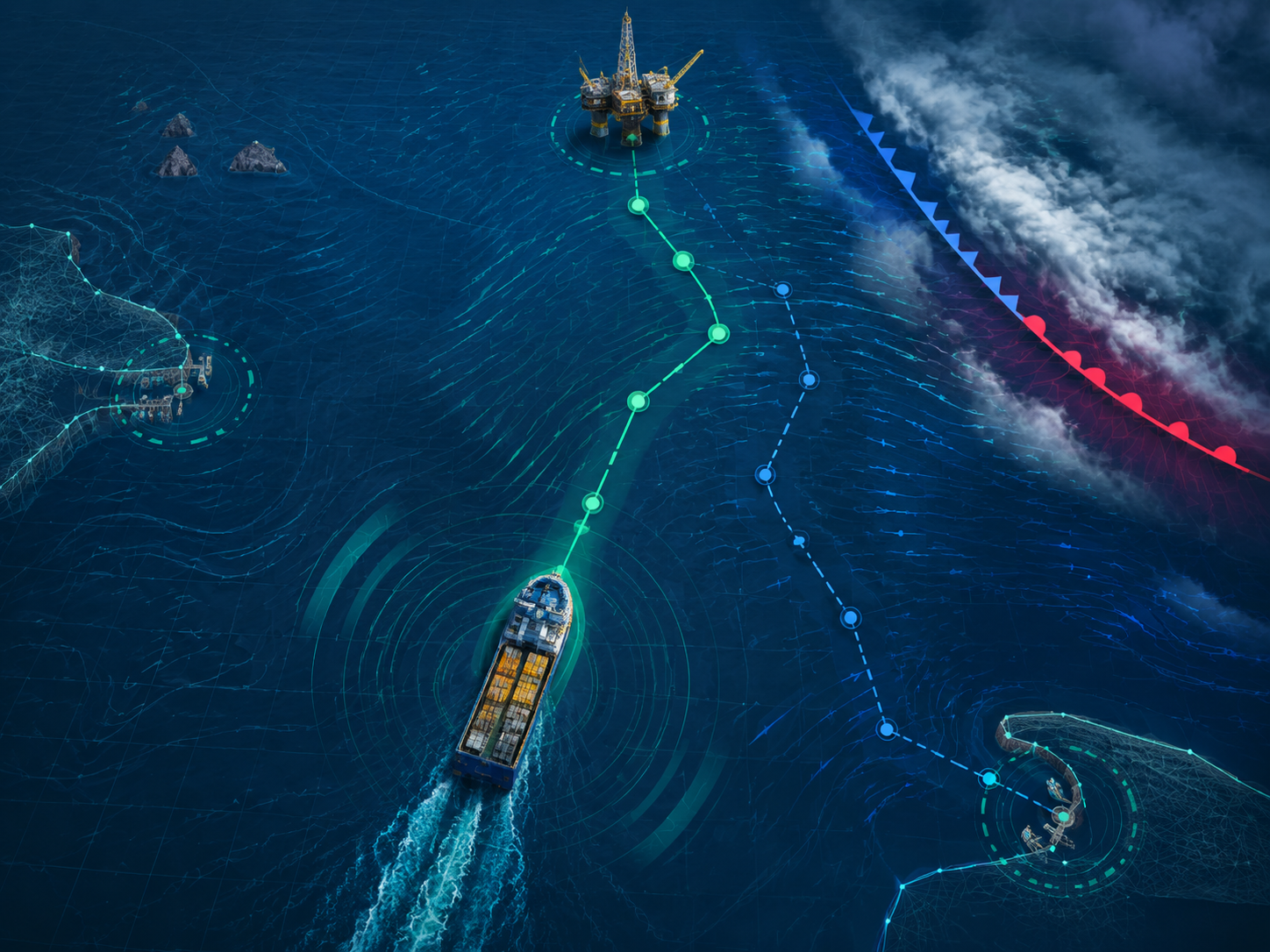
That 6-10% range is tangible because fuel is visible in vessel cost and emissions discussions. The more important operating change, though, is earlier replanning. If a port call slips, a weather front closes a sailing window, or a platform reprioritizes cargo, the logistics team needs to know whether the revised plan creates a new risk somewhere else. AI optimization is useful when it exposes those trade-offs before the deck plan is locked and the vessel is already sailing.
This is also where buyers should be careful with labels. Some route optimization is advanced mathematical optimization. Some is machine learning. Some is rules-based scheduling sold with AI language around it. That distinction is less important than the operating test: can the system ingest the constraints that actually govern offshore moves, and can planners trust the recommendation when the day has already started to go sideways?
Procurement AI is useful, but the evidence is less operator-specific
Procurement is a natural home for AI because upstream buying produces messy evidence: specifications, quotes, contracts, catalogues, supplier histories, delivery promises, inspection records, and invoice mismatches. In offshore drilling, that mess becomes expensive when it touches long-lead equipment, scarce rig capacity, or a critical spare with no acceptable substitute.
BCG's 2025 oil and gas procurement work gives a useful business-case frame, but it should be treated as consultancy analysis rather than an audited offshore operator result. BCG estimates that upstream operators with AI-enabled procurement can achieve a 4-8% cost advantage in stable markets and 10-15% in volatile markets. It also estimates AI can free 50-75% of procurement resources and that GenAI should-cost models can support 15-20% savings on long-tail procurement spend.[6]
The same BCG report matters because it ties procurement pressure to offshore market tightness. It cites 8-12 new floaters under construction compared with 30-40 needed, and rig day rates rising from $200,000 to $450,000. In that environment, procurement misses do not stay inside procurement. They show up as schedule exposure, supplier leverage, and fewer cheap recovery options when demand spikes.[6]
The shortlist-worthy procurement applications are narrower than the phrase “AI procurement” suggests: sourcing-event analysis, long-tail spend clustering, should-cost modeling, commodity and materials price forecasting, contract clause extraction, neural search across technical and commercial documents, and automated three-way matching. Enverus, for example, describes neural search across thousands of contracts and automated document data extraction for oilfield procure-to-pay, including three-way matching.[7] Because that example is vendor-published, it is best read as an illustration of the workflow shape, not as proof of a general savings rate.
For deeper procurement evaluation, the useful follow-on questions are specific: whether AI commodity price forecasting can improve sourcing timing, whether AI contract risk extraction can reduce review bottlenecks, and whether the expected procurement AI ROI is tied to actual spend categories rather than a generic automation percentage.
Control towers are the visibility layer, not a magic operating model
A supply chain control tower for offshore drilling should not be judged by dashboard count. The useful version connects demand signals, purchase orders, inventory, supplier status, freight movement, vessel schedules, port constraints, weather exposure, and asset criticality so that exceptions are visible early enough for someone to intervene.
Oil and gas control tower discussions increasingly include real-time visibility, disruption simulation, and digital twin integration for offshore logistics. The direction is sound: a planner should be able to test what happens if a supplier misses a ready date, a vessel route changes, or a platform pulls a job forward, rather than discovering the conflict through email escalation.[8]
The caveat is that control towers inherit every unresolved data problem around them. If equipment criticality is not coded consistently, if material masters are duplicated, if promised dates are manually overwritten, or if vessel data arrives after decisions are already made, the control tower becomes a better-looking version of the same late conversation.
Readers comparing architectures can use a more detailed breakdown of supply chain control tower AI features, control tower functional clusters, and industry-specific AI control tower use cases. The offshore-specific test remains simple: does the tower shorten the time between a constraint appearing and a planner, buyer, scheduler, or maintenance lead making a better decision?
What sits behind the reported gains
The cases above do not support a claim that AI is universally mature across offshore drilling supply chains. They support a narrower and more useful conclusion: production-grade deployments exist in specific functions, and the strongest results appear where the model is close to an operational decision with measurable consequences.
- Data readiness comes before model confidence. Murphy's six-month first production model is the right planning anchor for maintenance AI, not an exception to ignore.
- Domain knowledge changes the model brief. Offshore equipment failure, BOP inspection, vessel routing, and critical-spares planning all require context that a generic AI team will not infer from tables alone.
- Operational adoption is different from technical deployment. A model that predicts failure 100 days out only creates value if maintenance, procurement, logistics, and operations agree on the action threshold.
- Savings ranges need source discipline. Operator deployments, vendor-published examples, and consultancy estimates should not be blended into one generic ROI claim.
- Integration decides whether AI reduces waiting or adds another review step. The output has to land where planners, buyers, maintenance engineers, and vessel coordinators already make decisions.
Broad digitalization numbers can help explain why boards keep asking about AI, but they are weak substitutes for use-case evidence. Wood Mackenzie was cited in older Offshore Technology coverage estimating that upstream digitalization could save $73 billion per year in Europe. That figure is useful mainly as historical context because it is region-specific and based on older market conditions, not as a current global offshore AI benchmark.[9]
A practical shortlist standard for Q3 2026
For an offshore operator building an AI vendor shortlist, the first filter should be named operational outcomes. Predictive maintenance deserves serious evaluation when the provider can explain what equipment classes it has modeled, what failure modes it has detected, how far in advance, and how the recommendation changes the maintenance plan. Logistics AI deserves attention when it can model real vessel, port, weather, cargo, and platform constraints, not just optimize an ideal route.
Procurement AI should be scoped around the buying problem: long-tail spend, should-cost work, supplier search, contract extraction, three-way matching, or commodity exposure. Control tower work should be scoped around exception management and replanning latency. For more autonomous planning patterns, the relevant question is not whether the roadmap uses agents, but whether agentic AI supply chain deployment patterns include approval controls, audit trails, and domain-specific exception rules.
The budget should include a real data-readiness phase and should not assume value appears as soon as software is connected. A six-month initial production model timeline is a defensible planning assumption for predictive maintenance based on Murphy's experience. Partners should be expected to bring both AI capability and oilfield domain knowledge, because the expensive part of offshore AI is rarely the algorithm by itself. It is knowing which ugly constraint must become visible sooner.
References
- Seadrill ALCM platform, Drilling Contractor, April 2026
- Murphy Oil GOM project, JPT/SPE, January 2025
- Halliburton LOGIX, Halliburton Energy Pulse, September 2025
- Sercel Marlin, Sercel
- IBS Software + IBM CPLEX, IBS Software blog
- Real Cost Advantage in Oil and Gas, BCG, 2025
- Neural search and document data extraction for oilfield procure-to-pay, Enverus, April 2025
- Why the Oil and Gas Industry Needs Supply Chain Control Towers, Logistics Viewpoints, April 15, 2026
- Upstream digitalization could save $73B/year, Wood Mackenzie / Offshore Technology
Comments
Join the discussion with an anonymous comment.