
A sanctions-screened cargo can still fail for a reason no denied-party list will flag: the terminal behind the route stops working. That is the operational lesson from Ukraine’s campaign against Russian energy and logistics infrastructure. The immediate issue for supply chain teams is not whether every strike changes global prices. It is whether a refinery unit, export terminal, pipeline segment, or waterway that sat quietly inside a planning model can become unavailable overnight.
The Caspian Pipeline Consortium terminal at Novorossiysk is a useful doorway into the problem because it was not just a Russian domestic node. Ukrainian sea drone strikes in fall 2025 shut the terminal and forced significant Kazakh oil output reductions. Separate air strikes on the Orenburg gas processing facility also affected Kazakh gas production at Karachaganak Field. For a procurement or enterprise risk team, that is the part that matters: a node can sit inside one country’s war geography while carrying another country’s commercial exposure.
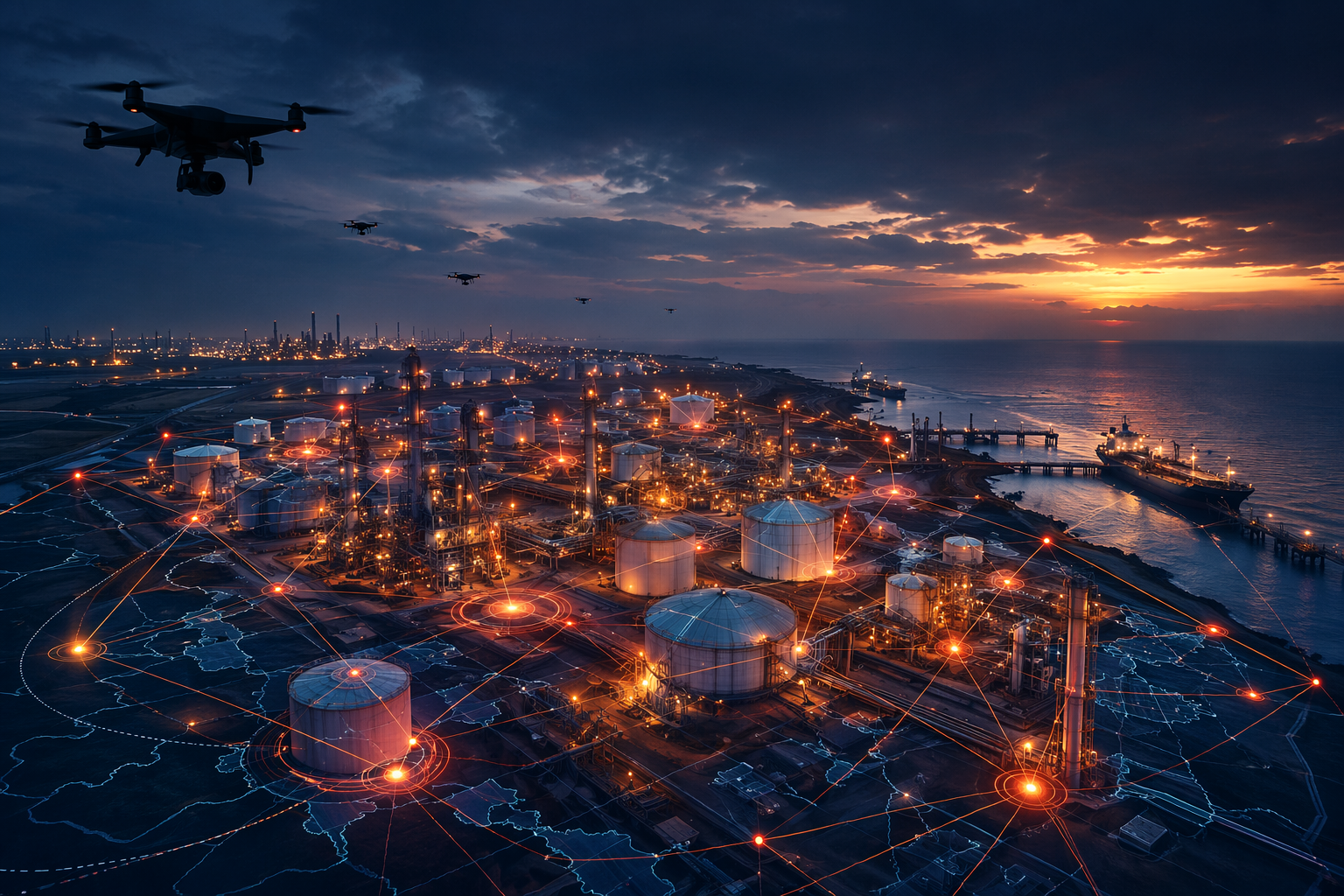
Treating these incidents as war news is too narrow. The more durable question is what changes when supply chain risk is no longer only a policy variable, but a strike-surface variable.
A New Risk Category Is Hiding Inside Familiar Disruption Reports
Gabriel Collins at Rice University’s Baker Institute has used the term “kinetic sanctions” to describe the way physical interdiction can remove energy volumes from the market rather than merely reroute them through discounts, arbitrage, or shadow channels. The phrase is useful, and RUSI-linked analysis has cited the framework, but it should not be treated as settled supply chain doctrine. It is better understood as an emerging name for a practical distinction risk teams already feel in their calendars.
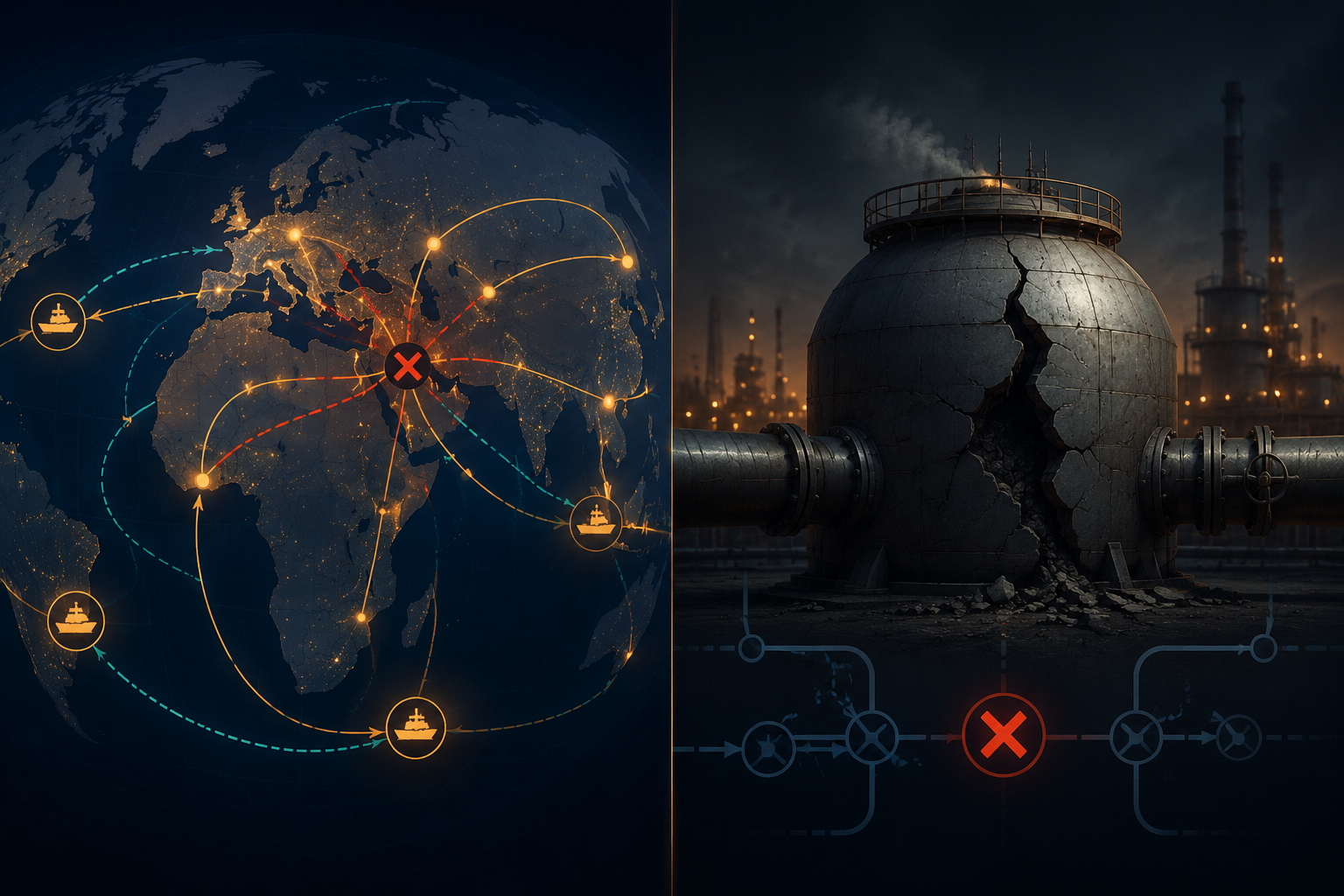
A paper sanction can make a transaction illegal, expensive, reputationally toxic, or hard to insure. It can redirect flows through intermediaries. It can create a discount that someone with enough risk appetite may decide to capture. A damaged export terminal behaves differently. An offline refinery unit does not negotiate. A closed waterway does not care whether the buyer passed screening. Physical capacity has either been reduced, delayed, rerouted, or made too uncertain to plan against.
That distinction is easy to blur in board materials because sanctions, commodity prices, insurance, route changes, and battlefield reports often arrive as separate updates. The operating teams inherit them as one problem. Procurement asks whether a supplier can still perform. Logistics asks whether the named port, corridor, or pipeline is usable. Finance asks whether the cost movement is temporary or structural. Legal confirms the counterparty is not blocked. None of those questions is sufficient if the asset that makes the trade physically possible has joined the strike surface.
The Evidence Has Moved Past Anecdote
The Baker Institute’s count is the load-bearing number: 272 confirmed or suspected strike events on Russian energy infrastructure from April 2022 through February 2026.[1] That does not make every incident equally consequential, and the word “suspected” matters. But it does shift the subject from isolated disruption to recurring operational pressure against a defined class of assets.
Available reporting attributes roughly 10% of Russian refining capacity destroyed, crude processing at a 15-year low of 228.34 million tons in 2025, and nearly 15% of capacity offline at a September 2025 peak to the strike campaign’s effects. The commercial consequence was not simply “less oil.” Russia shifted from exporting more refined products toward exporting more crude, reducing per-barrel revenue and changing the composition of market flows.
That is a different problem from a headline price spike. If a refiner, trader, or downstream buyer models supply only at the commodity level, it can miss the operational change underneath: crude may still move while diesel, gasoline, or other refined-product availability tightens in specific lanes. Capacity loss changes what can be produced, not just where a cargo is allowed to go.
The Druzhba pipeline damage adds another layer. Disrupted fuel deliveries affecting Hungary and Slovakia became a political bargaining chip in EU aid negotiations, according to the research record. That is not just a logistics incident. It is a case where a physical disruption created diplomatic leverage, which then fed back into commercial uncertainty.
The Sea of Azov grain-route reports are more volatile and should be treated with care. Ukrainian military sources claimed that about 90 vessels were struck in one week in July 2026, with roughly 25% of Russian wheat exports suspended and immediate wheat price jumps following the restrictions. Those figures are fast-moving operational claims rather than neutral long-cycle trade statistics. Even with that caveat, the reported pattern is important: a commercial waterway can be constrained by drone pressure without a traditional navy controlling it.
Why Sanctions Screening Misses the Failure Mode
Traditional screening is designed to answer a different question: whether an entity, vessel, owner, bank, port, or commodity movement is prohibited or exposed to policy risk. That remains necessary. Sanctions still affect legality, financing, insurance, counterparties, and reputational exposure. No serious supply chain risk program should demote them to background noise.
But the physical failure mode sits behind the compliance layer. A supplier can be clean, the vessel can be insurable, the purchase order can be lawful, and the route can still fail because the loading terminal lost capacity, the pipeline segment was damaged, a refinery unit went offline, or a waterway became too dangerous to schedule. Static compliance data is weak at detecting that kind of degradation because the risk is attached to infrastructure behavior, not only to counterparties.
| Risk lens | What it can see | What it can miss |
|---|---|---|
| Sanctions and entity screening | Blocked parties, restricted ownership, prohibited trade exposure, legal and reputational constraints | A physically damaged or capacity-constrained node behind an otherwise valid trade lane |
| Commodity price monitoring | Market response, volatility, substitution signals, margin pressure | The specific refinery, terminal, pipeline, or waterway causing the operational constraint |
| Route visibility | Vessel movement, port calls, transit delays, rerouting patterns | Whether the infrastructure node itself has become a repeated strike target |
| Kinetic strike-surface monitoring | Infrastructure exposure, attack recurrence, chokepoint vulnerability, likely capacity consequences | Legal permissibility and longer financial channels unless integrated with sanctions and counterparty data |
This is why “kinetic sanctions” is more than a colorful phrase. It marks a difference in mechanism. Economic sanctions often try to change incentives around trade. Physical interdiction changes the availability of the assets that make trade possible. The two can reinforce each other, but they do not substitute for each other.
The Cost Inversion Boards Need to Understand
The strategic asymmetry is blunt: relatively cheap drone campaigns can degrade infrastructure whose value, capacity, and political importance are vastly larger than the weapons used against it. CES Intelligence describes this as a structural inversion in which the cost of attack has moved permanently below the cost of defense, using Azov and Hormuz templates to argue that boards must map their strike surface rather than only their security perimeter.[2]
For supply chain leaders, “strike surface” should be read operationally. It includes the physical nodes that convert a commercial agreement into actual flow: refineries, terminals, pumping stations, storage farms, railheads, bridges, canals, anchorages, grain elevators, and the maritime approaches around them. Some are owned by a supplier. Some are state-controlled. Some are used indirectly through a tier-two dependency no procurement dashboard has bothered to map. The exposure does not wait for ownership clarity.
The cost inversion also changes the time horizon. A traditional contingency plan may assume a rare catastrophic hit to a major asset. Drone pressure can create something more awkward: repeated degradation, partial repair, renewed attack, uncertain insurance appetite, and shifting route behavior. The asset may not disappear from the map. It may simply stop behaving like a dependable planning assumption.
What AI-Enabled Risk Intelligence Has to Monitor
The answer is not “add AI” to a sanctions workflow and call it kinetic intelligence. A useful platform has to fuse different signals, map them to physical assets, and explain confidence in a way planners can act on before a weekly risk meeting becomes a postmortem.
The first requirement is real-time or near-real-time OSINT fusion. Strike reports, satellite indicators, thermal anomalies, vessel behavior, port notices, local authority statements, insurance advisories, commodity flow changes, and social media claims do not carry equal evidentiary weight. A platform should not flatten them into one alert stream. It should label whether a signal is confirmed, suspected, claimed by a belligerent source, inferred from movement data, or contradicted by other reporting.
The second requirement is infrastructure-node mapping. The system needs to know that a refinery is not just a point on a map. It is connected to crude supply, product output, storage, pipelines, rail loading, port access, maintenance schedules, and substitute capacity. The same applies to a grain route or oil terminal. If the platform cannot connect an incident to the assets and flows behind purchase orders, it will produce interesting alerts and weak decisions.
The third requirement is chokepoint exposure. This is where the kinetic problem overlaps with more familiar disruption planning. A platform that can model a bridge closure, port outage, wildfire corridor, or hurricane reroute has part of the muscle needed for strike-surface monitoring. ChainSignal’s related work on infrastructure attack disruption planning and chokepoint route optimization is relevant because the operating question is similar: what flow depends on a node that can fail faster than the organization can manually replan?
Scenario Modeling Has to Stay Honest
AI scenario modeling is useful when it narrows decisions rather than decorating uncertainty. In this risk category, the model should help answer practical questions: which suppliers depend on the affected node, which alternative routes are feasible, what inventory buffers exist, which contracts carry force majeure or delivery-risk exposure, what substitute capacity is already congested, and which customers will feel the shortage first.
It should also show time horizons. A 48-hour alert is different from a 30-day capacity scenario. A port approach that is temporarily unsafe creates a different response than a refinery unit that requires extended repair. Confidence scores are only useful if the user can see what drives them. If the model is confident because three weak claims echo each other, a human analyst needs to know that before procurement changes allocation.
The buyer test is simple: ask the vendor to walk one incident from signal to decision. What sources were ingested? Which physical assets were mapped? Which shipments, suppliers, and inventory positions were connected? What assumptions drove the disruption window? Where did the system recommend monitoring rather than action? Where could a human override the model? A platform that cannot answer those questions is not yet managing kinetic supply chain risk; it is displaying geopolitical noise.
From Screening Workflows to Strike-Surface Workflows
The workflow change is more important than the dashboard change. Static screening usually starts with a counterparty or transaction. Strike-surface monitoring starts with an asset and asks which commercial flows depend on it. That reverses the order of discovery.
- Map critical physical nodes behind sanctioned and non-sanctioned trade lanes, including terminals, refineries, pipelines, storage sites, waterways, and rail or road chokepoints.
- Attach suppliers, purchase orders, inventory buffers, customers, and transport options to those nodes rather than tracking them only as separate master-data objects.
- Fuse kinetic-threat signals with route, capacity, insurance, commodity, and compliance data so the risk team sees both legality and physical availability.
- Model disruption scenarios by time horizon, confidence level, substitute capacity, and decision owner.
- Push outputs into procurement, logistics, sales and operations planning, and executive risk workflows before the disruption becomes a customer-allocation problem.
This is also where the AI investment case becomes concrete. The goal is not to predict every drone strike. It is to reduce the time between a credible physical-threat signal and a business decision: hold inventory, shift sourcing, reroute, renegotiate delivery commitments, adjust insurance assumptions, or brief the board on exposure. Related planning capabilities, such as AI-driven disruption planning investments and proactive hurricane supply chain planning, already point in the right direction: monitor physical risk early, model alternatives quickly, and move the decision into the workflow where someone can act.
There is a precedent outside conflict zones as well. Monitoring wildfire smoke risk through fused satellite, air-quality, and logistics data shows how physical signals can become supply chain decisions before an asset is formally closed. The kinetic version is harsher, less predictable, and more politically charged, but the data problem is familiar: connect weak early signals to mapped dependencies before the operating window closes.
The Q3 2026 Buyer Question
For supply chain leaders evaluating risk intelligence platforms in Q3 2026, the question is no longer whether a tool screens sanctioned entities. That is table stakes. The question is whether it can recognize when the physical infrastructure behind an apparently valid trade lane has become part of the strike surface.
References
- Quantifying Ukraine's Strikes on Russian Energy Infrastructure, Baker Institute for Public Policy, Rice University.
- Strike Surface Inverted: Drone Attack Cost 2026, CES Intelligence.
Comments
Join the discussion with an anonymous comment.