
If AI demand forecasting is moving as fast as every board deck suggests, why do so many supply chain organizations still feel stuck in 2026? The benchmark answer is uncomfortable but useful: confidence has moved faster than operating capability. In RELEX’s 2026 survey of more than 500 supply chain leaders, 67% said they were more confident in AI than they were a year earlier, yet only 32% were actively investing in and scaling AI, and only 10% trusted AI for critical decisions without human review.[1] Gartner’s 2025 survey found that only 23% of supply chain organizations had a formal AI strategy, even among organizations already deploying AI, while 55% of AI supply chain projects failed to scale beyond pilot.[2]

That is not hypocrisy. It is the shape of a technology crossing from executive intent into planning process, master data, exception governance, finance sign-off, and planner trust. PwC’s 2026 survey of 767 U.S.-based operations leaders at companies with at least $100 million in annual revenue found that 89% said technology investments had not fully delivered expected results, while only 4% described their organizations as fully embedded across all dimensions of digital operations.[3] ABI Research’s 2025 survey, by contrast, found that 94% planned to use AI for decision support within two years.[4] Different samples, different questions, same boardroom tension: nearly everyone wants the capability; far fewer have built the management system around it.
| Benchmark signal | What it measures | 2026 reading |
|---|---|---|
| 67% more confident in AI | Executive and supply chain leader sentiment | The debate has moved beyond whether AI belongs in supply chain planning |
| 94% plan AI decision support within two years | Adoption intent | Boards and operating committees are no longer treating AI decision support as optional |
| 23% have a formal AI strategy | Strategy maturity | Most organizations still lack the operating blueprint needed to govern scaling |
| 32% are actively scaling AI | Deployment stage | Many organizations remain in pilot, planning, or fragmented investment modes |
| 10% trust AI for critical decisions without human review | Autonomy tolerance | Human-in-the-loop forecasting remains the normal operating model |
| 6% saw ROI in under one year | Payback timing | One-year payoff claims need careful scrutiny |
The maturity gap is no longer about awareness
The easiest mistake in 2026 AI demand forecasting planning is to benchmark against public enthusiasm instead of operating maturity. Intent is now a weak differentiator. A company can have executive sponsorship, vendor demos, a pilot in demand planning, and a slide showing forecast accuracy improvement, while still having no durable answer to who overrides the forecast, how exceptions are prioritized, which demand signals are trusted, or how inventory and service decisions change after the model output arrives.
The 23% formal-strategy figure matters because AI forecasting does not scale like a spreadsheet upgrade. A formal strategy decides which decisions AI is allowed to influence, which planning horizons matter, how data quality is remediated, how finance evaluates benefit, and how planners are expected to use model recommendations. Without that, pilots multiply. The organization can end up with a better statistical artifact and no agreed path to change replenishment, production, allocation, or inventory targets.
Gartner’s finding that only 29% of supply chain organizations had built the capabilities needed for future readiness helps explain why so many AI programs stall after a promising proof of concept.[2] The obstacle is not always the model. It is often the unglamorous layer around the model: data ownership, workflow redesign, exception thresholds, performance governance, change management, and the patience to run parallel planning cycles long enough to build trust.
This is where the gap between adoption and effectiveness becomes important. Buying or piloting AI forecasting is adoption. Changing inventory, service, waste, expedite cost, planner productivity, or forecast-value-add behavior is effectiveness. The surveys support a strong claim that adoption intent is high. They support a narrower, more useful claim on effectiveness: only a minority can show that AI has become embedded operating capability.
Four practical states behind the averages
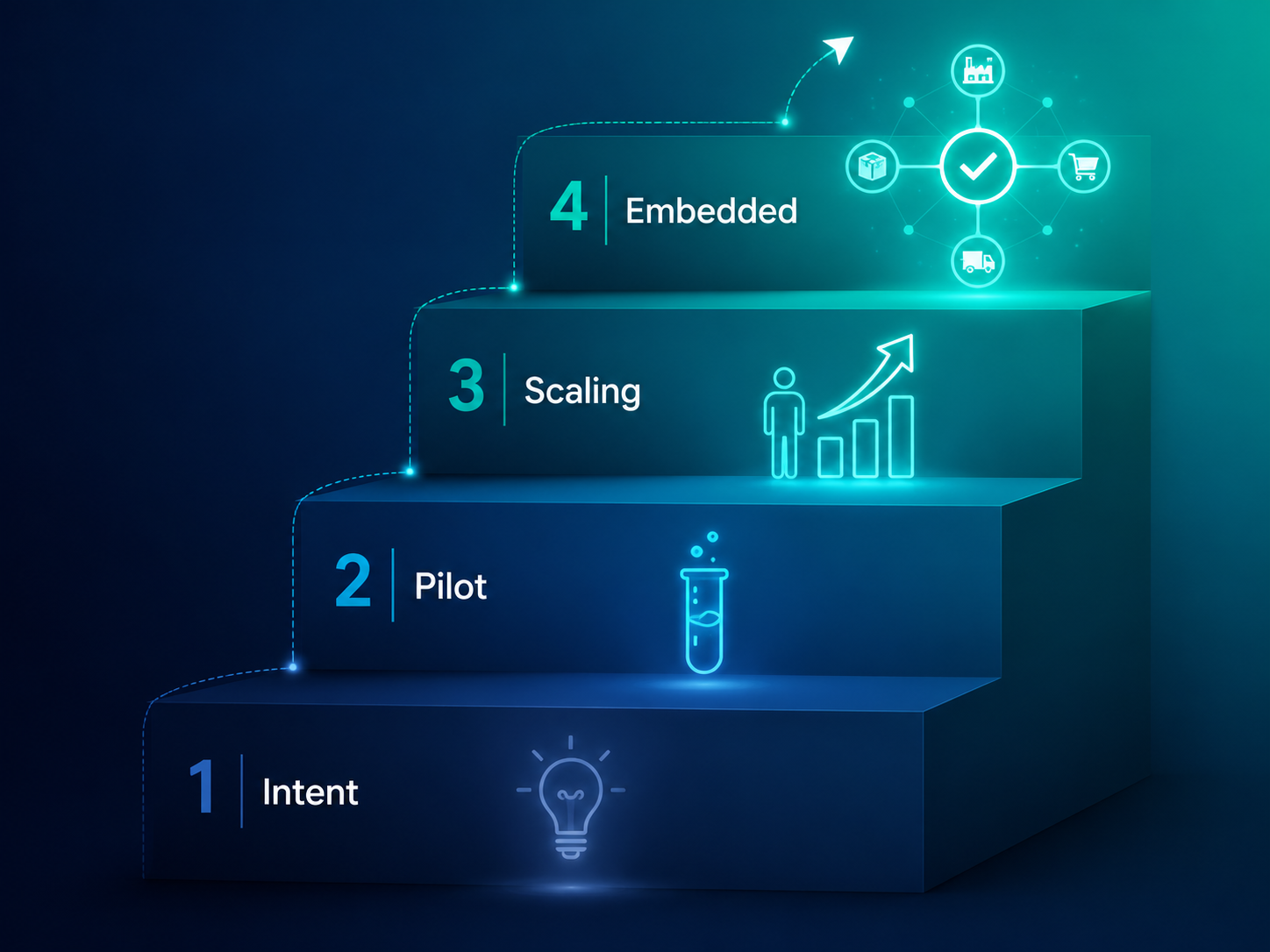
The benchmark numbers become more useful when they are treated as maturity states rather than as a single market average. Most organizations are not simply ahead or behind. They are usually caught in one of four states.
Intent without strategy
This is the organization where executives agree that AI forecasting belongs on the roadmap, but no one has settled the governance questions. The board is asking about AI. Planning leaders are collecting use cases. IT may be evaluating platforms. Finance is asking for payback. The program feels urgent, but the decision architecture is still soft.
The ABI intent figure and Gartner strategy figure should not be read as a matched survey pair, because they come from different samples. They still point in the same direction: executive demand for AI decision support is much broader than formal supply chain AI strategy.[2][4] For organizations in this state, the next move is not another model comparison. It is deciding where AI forecasting will be allowed to change operating decisions and how those decisions will be governed.
Pilots without scaling
This state is more dangerous because it can look like progress for several budget cycles. A business unit runs a pilot. Accuracy improves in a selected category or region. The team presents a credible result. Then the work slows when it has to connect with the rest of the planning system: master data rules, promotion calendars, planner overrides, supply constraints, ERP integration, inventory policy, and S&OP governance.
Gartner’s 55% pilot-failure figure is for supply chain AI projects broadly, not demand forecasting alone, so it should not be overread as a demand-planning-specific failure rate.[2] But demand planning is often the entry point for supply chain AI, and the pattern is familiar enough: proof-of-concept success does not automatically create an operating model. For a deeper treatment of that failure mode, see why AI demand planning pilots fail to scale.
Scaling with human review
This is the most realistic near-term target for many mature supply chains. RELEX found that 54% preferred a human-in-the-loop model, while only 10% trusted AI for critical decisions without human review.[1] That does not make the AI program timid. It means the organization understands the difference between decision support and autonomous decision authority.
In practice, human-in-the-loop scaling means planners do not inspect every forecast line with equal intensity. They review exceptions, high-value items, volatile categories, constrained materials, strategic accounts, and decisions where the cost of a wrong recommendation is high. The model absorbs more pattern recognition; humans concentrate judgment where context, risk, or accountability still matters.
The important design question is not whether humans remain involved. They will. The question is whether human review is structured enough to create learning. If planners override the model, the organization needs to know why: customer intelligence, bad history, promotion uncertainty, capacity constraint, data error, or habit. Otherwise, human-in-the-loop becomes a polite phrase for unmanaged manual rework.
Embedded AI with measurable operating impact
The fully embedded state remains rare. PwC’s 4% figure is broad digital-operations embedding, not a pure AI forecasting maturity score, and its sample is limited to U.S. operations leaders at companies with at least $100 million in annual revenue.[3] Still, the number is a useful reality check. Many leadership teams speak as if the market has already crossed into AI-native planning. The evidence suggests that only a small group has deeply embedded digital capability across the operating system.
At this stage, AI forecasting is not a sidecar. It is connected to planning cadence, exception management, inventory policy, scenario review, and performance management. The forecast is not judged only by statistical accuracy. It is judged by whether better demand sensing leads to different decisions soon enough to matter.
The investment case has to survive a two-to-four-year reality
The ROI conversation is where enthusiasm usually meets the budget cycle. Deloitte’s 2025 data, cited by Open Sky Group, found that 85% of organizations increased AI investment, but only 6% saw ROI in under one year; most achieved satisfactory ROI within two to four years.[5] That timeline should change the way executives frame AI demand forecasting investments.
A one-year business case can still be legitimate for a narrow use case with clean data, clear ownership, and a constrained operational target. But as a general promise, one-year payback is a warning sign. Forecasting value compounds through repeated planning cycles: the model learns, planners calibrate trust, exception rules improve, master data issues get exposed, and downstream inventory or service decisions start to change. A pilot may show accuracy movement quickly. Enterprise benefit usually takes longer to prove.
This does not mean the investment case should be vague. It means it should separate leading indicators from financial outcomes. Early measures can include adoption by planners, override patterns, exception reduction, forecast-value-add behavior, data-quality closure, and cycle-time improvement. Later measures can move toward inventory, service, waste, expedite cost, working capital, and margin protection. For a narrower look at supply chain AI ROI evidence, see what the numbers say about AI ROI in supply chain.
The broader performance claims are promising, but they need careful labeling. Accenture found that companies with next-generation supply chain capabilities were 23% more profitable than peers and six times as likely to use AI and generative AI widely.[6] That is not proof that AI demand forecasting alone causes a 23% profitability lift. The maturity definition includes broader capabilities such as advanced automation, digital twins, and integrated planning. The finding is still useful because it suggests that AI matters most when it is part of a wider supply chain operating model, not when it sits as an isolated analytics project.
McKinsey’s distribution analysis gives a more operational view of where AI-enabled improvements can show up, citing potential inventory reductions of 20–30%, logistics cost reductions of 5–20%, and procurement-spend reductions of 5–15% in AI-enabled distribution operations.[7] Those ranges are not a universal forecast for every demand planning program. They are a reminder that the value pool is often downstream of the forecast itself.
Data readiness is a constraint, not an excuse
Data quality is the most common place for organizations to oscillate between fatalism and denial. PwC found that 87% of operations leaders said poor data quality affected their ability to achieve value from digital initiatives. The same survey found that 73% agreed data does not need to be perfect to drive value.[3] Both statements can be true.
AI demand forecasting does not require an immaculate enterprise data estate before any work begins. Waiting for perfect data can become a way to avoid operating decisions. But it does require enough disciplined history, governance, and context for the model to distinguish signal from noise. Industry guidance commonly points to 18–24 months of clean historical sales data for AI forecasting models.[5] That requirement alone can expose gaps in item history, lost sales, substitutions, promotions, stockouts, channel shifts, and product lifecycle records.
The practical implication is to treat forecasting pilots as data-readiness diagnostics, not as beauty contests between algorithms. A pilot should reveal which data defects block value, which can be worked around, and which must be fixed before scaling. If the team cannot explain how a data issue affected a forecast recommendation, it will struggle to persuade planners to act on the recommendation when the stakes are higher.
That is also why the data conversation belongs in the investment case. Data remediation is not administrative overhead; it is part of the value path. For organizations still sorting out the readiness threshold, the AI readiness paradox is a useful companion piece.
How to place your organization against peers
A credible 2026 benchmark does not begin with “Do we have AI?” It begins with a more specific placement question: which maturity state best describes how AI forecasting actually changes decisions today?
- If leaders agree AI forecasting is important but cannot name the governed decisions it will affect, the organization is in intent without strategy.
- If pilots have shown useful accuracy or productivity signals but have not changed planning cadence, inventory policy, or exception management, the organization is in pilots without scaling.
- If AI recommendations are moving into recurring planning workflows with defined human review and override learning, the organization is scaling with human oversight.
- If AI forecasting is tied to measurable operating outcomes and governed across functions, the organization is approaching embedded capability.
The right next move depends on that placement. Intent without strategy needs decision scope, governance, and ownership. Pilots without scaling need integration, change management, and benefit tracking. Scaling with human review needs disciplined exception design and trust calibration. Embedded programs need to keep proving that better forecasting is changing operating outcomes, not merely producing better analytics.
This placement also prevents a common executive error: using peer adoption to justify acceleration while ignoring peer execution failure. The same market that shows strong confidence also shows weak formal strategy, limited scaling, cautious autonomy, underdelivered technology investments, and multi-year ROI timing. A responsible acceleration case has to contain both halves.
The window is narrowing, but not in the way hype suggests
Gartner predicts that 70% of large organizations will adopt AI-based supply chain forecasting by 2030.[8] The pressure point is not that every company must rush into autonomous forecasting before competitors do. The pressure point is that basic adoption will become less distinctive. As adoption spreads, the advantage shifts toward organizations that learned earlier how to govern AI recommendations, clean and contextualize demand data, redesign planner work, and connect forecasting improvements to financial outcomes.
That is the benchmark judgment for 2026. AI demand forecasting is not waiting to be proven in the abstract, and it is not delivering enterprise value merely because a pilot improved accuracy. Supply chain leaders now have to name which state they are actually in: interested, piloting, scaling, or building the conditions for compounding advantage.
References
- 2026 State of the Supply Chain Report, RELEX Solutions, 2026.
- Gartner Survey Shows Just 23% of Supply Chain Organizations Have a Formal AI Strategy, Gartner, June 11, 2025.
- Digital Trends in Operations Survey, PwC, 2026.
- ABI Research 2025 AI decision support survey, ABI Research, 2025.
- Supply Chain AI Statistics, Open Sky Group, 2025.
- Companies with Next-Generation Supply Chain Capabilities Achieve 23% Greater Profitability, Shows New Research from Accenture, Accenture, 2024.
- Harnessing the power of AI in distribution operations, McKinsey & Company, 2024.
- Gartner Predicts 70% of Large Orgs Will Adopt AI-Based Supply Chain Forecasting to Predict Future Demand by 2030, Gartner, September 16, 2025.
Comments
Join the discussion with an anonymous comment.