
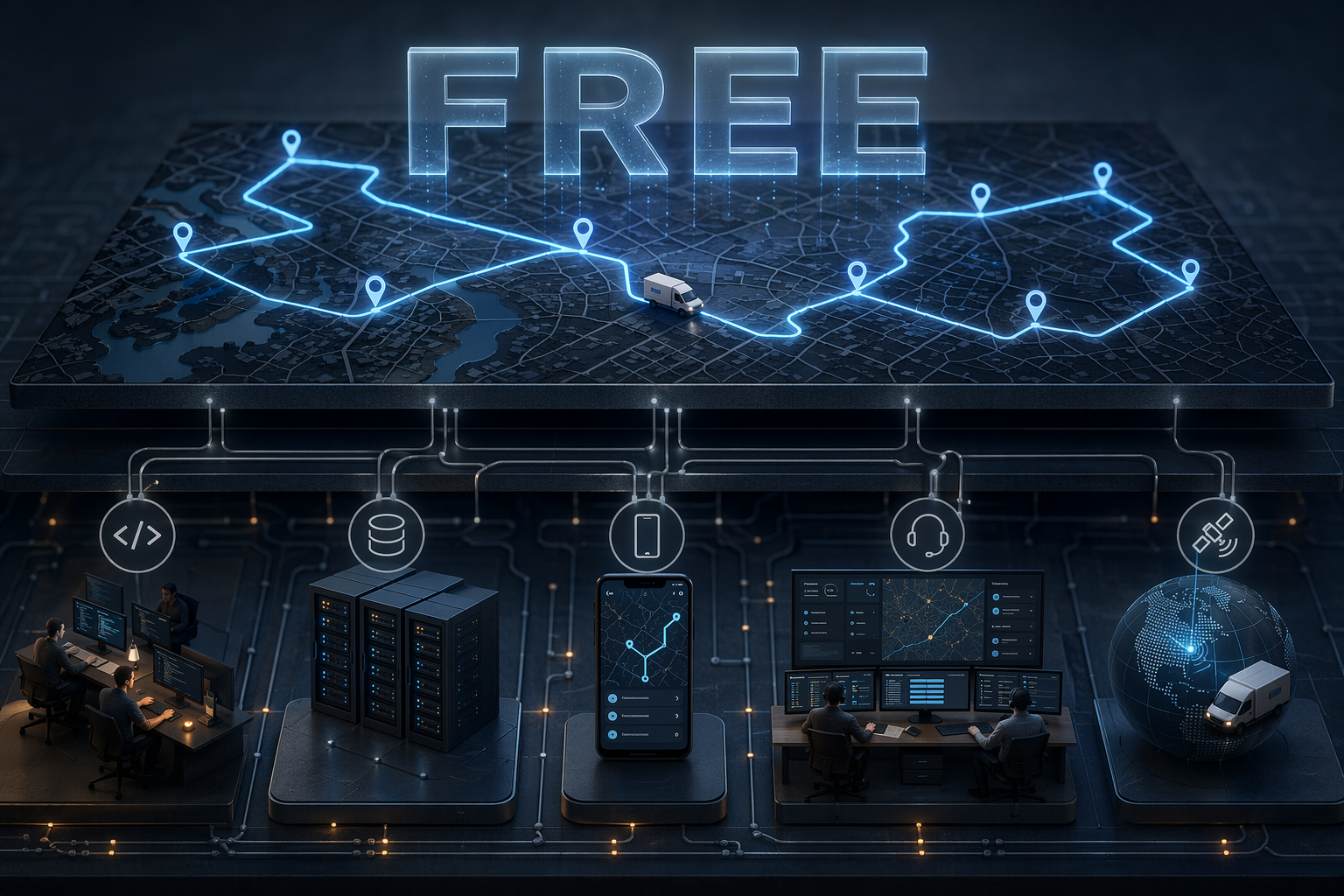
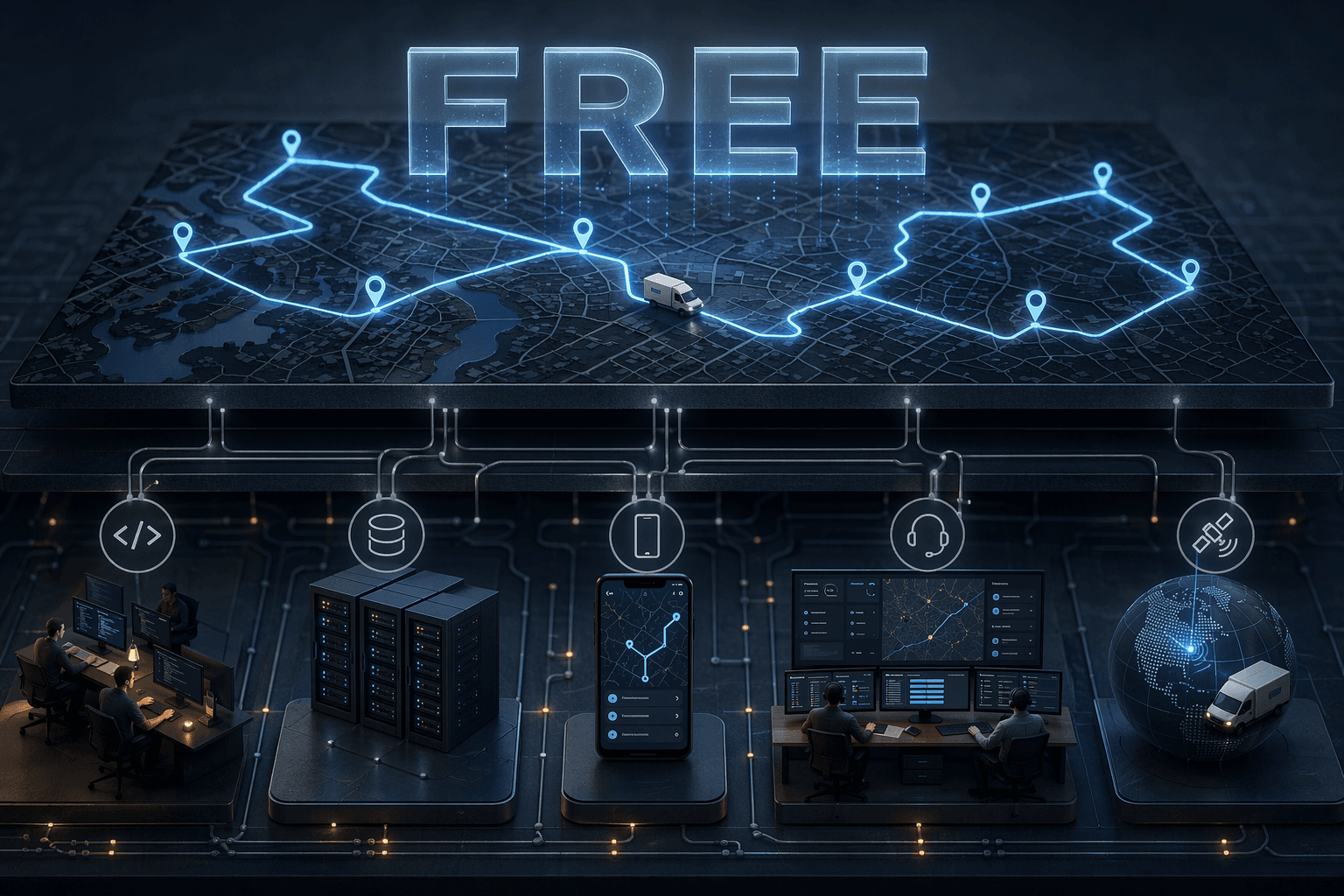
When a supply chain team searches for "AI route optimization free", the real question is not which vendor has the lowest sticker price. It is whether the team can turn a routing engine into an operating system for dispatch, drivers, exceptions, and customer updates. Open-source can be free at the license layer and expensive at the production layer, and OR-Tools is the cleanest example: a powerful VRP solver in C++, Python, and Java that still leaves the production work to the team; community estimates often put that work at 200+ hours [1].
What the engine gives you, and what you still have to build
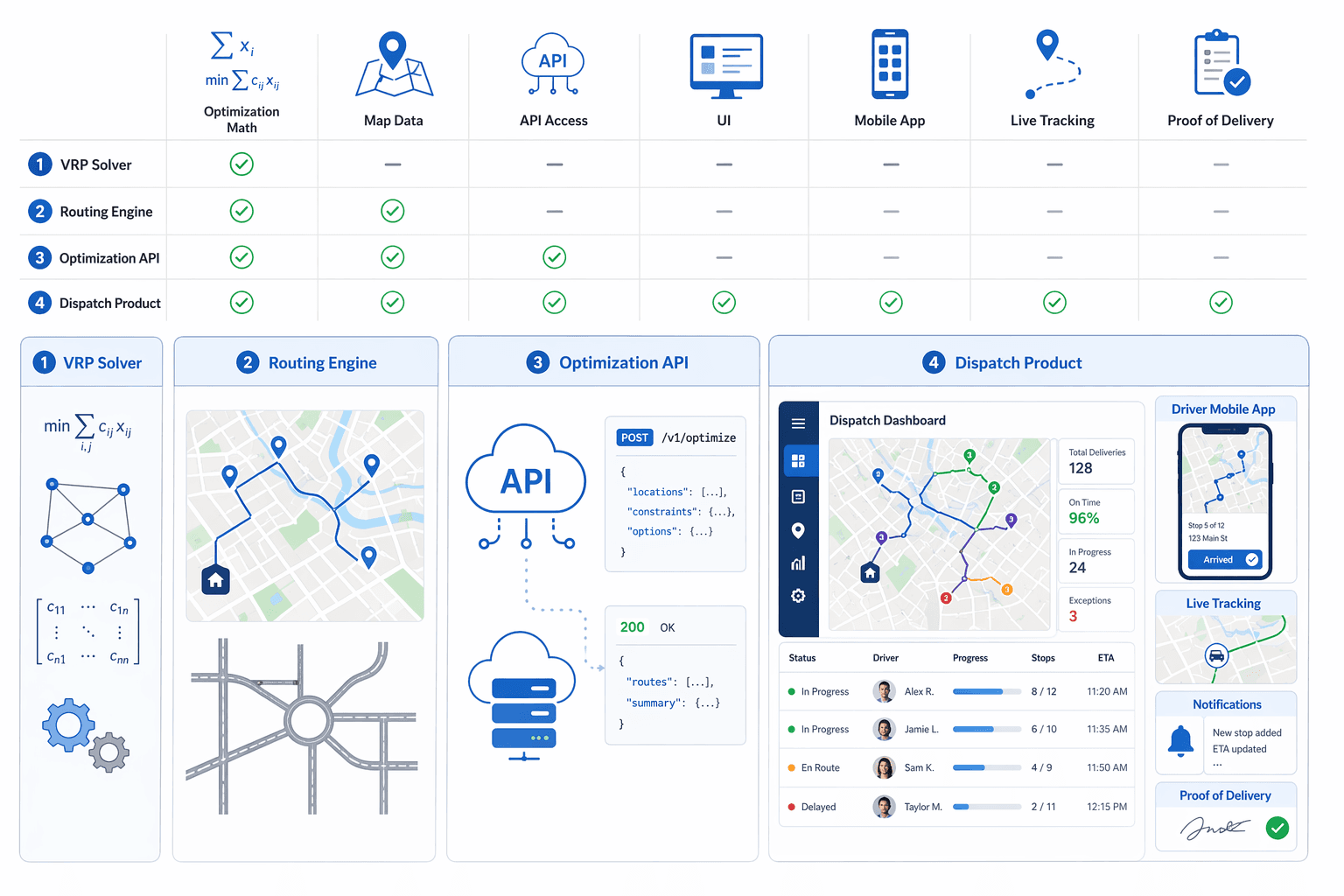
The most common mistake is collapsing four different layers into one idea. A VRP solver finds routes. A routing engine works with map data and path calculation. An optimization API wraps those capabilities behind an interface. A dispatch product adds the things operations actually live in every day: a dispatcher UI, a driver mobile app, live tracking, proof of delivery, and customer notifications. Open-source tools in this space can cover the math and part of the routing logic, but they do not automatically give you the operating layer [2].
| Option | What "free" means | Hidden work or limit | Best fit |
|---|---|---|---|
| OR-Tools self-hosted | No license fee; strong, flexible VRP solver [1] | Community reports often describe 200+ hours to get to production, plus ongoing build and hosting work; a modest deployment often ends up around $200–500/month in infrastructure alone, as a synthesis estimate | Teams with dedicated routing engineers and unusual constraints |
| GraphHopper cloud free tier | 500 credits/day, 5 locations, 1 vehicle, and non-commercial use only [3] | The tier is useful for testing, but it is not a real operating envelope | Small proofs of concept |
| NextBillion.ai free planner | 10 stops, no login required [4] | Enough to validate a routing idea, not to run a fleet workflow | Quick experiments |
| RouteXL free plan | 20 stops free [5] | Good for occasional small jobs, not for a dispatch team | Simple ad hoc routing |
GraphHopper is a useful example because it shows how easily people blur categories. Its open-source routing engine can be self-hosted, but the cloud route optimization layer is a separate product. The free cloud tier is bounded by 500 credits per day, 5 locations, 1 vehicle, and non-commercial use [3].
That is why NextBillion.ai's 10-stop no-login planner and RouteXL's 20-stop free plan matter as on-ramps, not as enterprise answers [4][5]. They are fast ways to see whether the routing idea has legs before anyone commits engineering time to hosting, integration, exception handling, and support.
Where open source still earns its keep
Open source is still the right answer when routing is part of the product, not just a utility. If you have dedicated routing engineers, highly specialized constraints such as cold-chain sequencing or hazmat rules, custom stop logic, or deep TMS integration requirements, the flexibility of an open engine can be worth more than the speed of a packaged tier. In those cases, the question is not whether free software exists; it is whether the organization is willing to own the solver, the maps, the workflow, and the edge cases for the long run.
If you are comparing the payback timeline against the work of building your own stack, the route planning ROI by fleet size overview is the better place to frame that question than a license-cost debate alone.
Why routing keeps looking more valuable
The broader market context says routing is becoming a competitive capability rather than a niche feature. One analyst pegs route optimization software in the $8-9B range for 2026 and roughly $16-24B by 2030-2031 [6].
UPS ORION is the credibility anchor because it shows what routing optimization can do at scale: public reporting ties it to $300-400M in annual savings, 100M fewer miles, and 10M gallons of fuel [7]. That is proof that routing math can matter, but it is also a reminder that the benchmark comes from a mega-fleet operating model, not from a team trying to decide whether to self-host a solver.
Vendor-published AI routing claims are more modest. FleetRabbit describes 15-25% fuel savings and 30-90 day payback at $15-50 per vehicle per month, but those are vendor estimates rather than independent research [8].
That leaves the practical boundary. If your team does not have dedicated routing engineering staff, free-tier commercial APIs are usually the lower-total-cost way to learn and ship. If routing logic is core intellectual property and your constraints are unusually complex, open source can still be the right call. The lowest-cost option is the one your organization can actually operate after the first route is optimized.
References
- Vehicle Routing | OR-Tools — Google for Developers
- Top 10 Open-Source Tools for Route Optimization in 2025 — NextBillion.ai
- GraphHopper Directions API Pricing — GraphHopper
- Top 5 Free Route Optimization Apps (2026) — NextBillion.ai
- The 10 Best Free Route Planners — That Aren't Google Maps — Routific
- Route Optimization Software Market Size, Share & Analysis — Mordor Intelligence
- UPS adds dynamic routing to ORION, saving 2-4 miles per driver — Supply Chain Dive
- AI Route Optimization vs Traditional Methods in 2026 — FleetRabbit
Comments
Join the discussion with an anonymous comment.