
The first plan is usually the cleanest one. A mission objective becomes a priority list. Available drones are sorted by payload, range, position, battery state, sensor fit, and maintenance condition. Routes are drawn around known threat areas and expected denial zones. Then the useful part of the plan begins to decay: a drone drops offline, the threat picture changes, GNSS becomes unreliable, a relay link degrades, or a higher-priority delivery appears while aircraft are already in motion.
That broken-plan moment is where AI drone warfare logistics planning becomes more than a scheduling problem. The system is not merely asking whether one unmanned aircraft can reach one point. It is asking which imperfect assets should be assigned to which tasks, in what sequence, across which corridors, with what confidence, and how much of that decision can still be trusted after communications and intelligence inputs start failing.
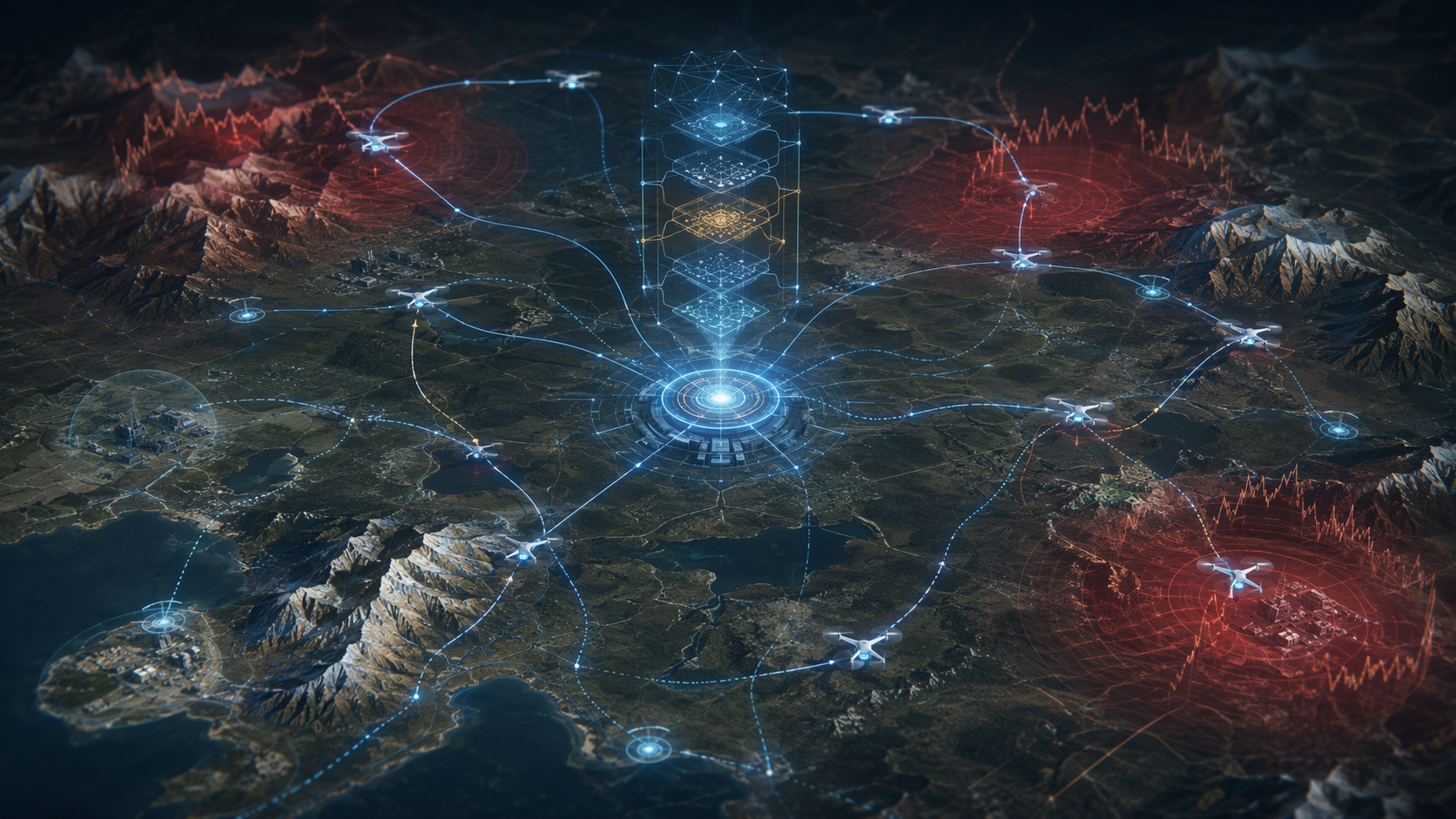
The planning burden is easy to understate because drone swarms are often described from the aircraft outward: sensors, autonomy, endurance, payload. A sustainment planner sees the problem in the opposite direction. The starting point is a moving queue of demands. Some demands are urgent, some are merely important, some are newly discovered, and some are no longer worth servicing because the risk changed. The swarm is a constrained fleet, not a cloud of interchangeable machines.
A useful academic model from Fedorovych et al. makes this explicit by treating combat drone swarm logistics as a planning problem that incorporates target priority lists, threat-risk routing constraints, and multi-drone task sequencing.[1] That matters because it forces the right question. The AI is not just choosing a path on a map. It is converting priorities into assignments, assignments into routes, and routes into a plan that can be revised when the fleet or the battlespace changes.
From Mission Goal to Executable Queue
The first practical move is decomposition. A commander or logistics cell may define a mission goal at a high level: service a set of delivery points, support a maneuver element, inspect a route, seed sensors, or move critical payloads under threat. The planner has to turn that goal into a machine-usable queue. Each task needs attributes: priority, payload requirement, timing constraint, destination or target area, acceptable risk, required sensor or communications capability, and dependencies with other tasks.
The Fedorovych et al. approach is valuable because it does not hide this conversion step. Target or delivery priority is an input to the planning model, not an afterthought. Once priorities are explicit, the algorithm can begin to compare unlike choices: whether to commit two smaller drones to a higher-priority task, delay a lower-priority route, or preserve a scarce asset for a later mission leg.[1]
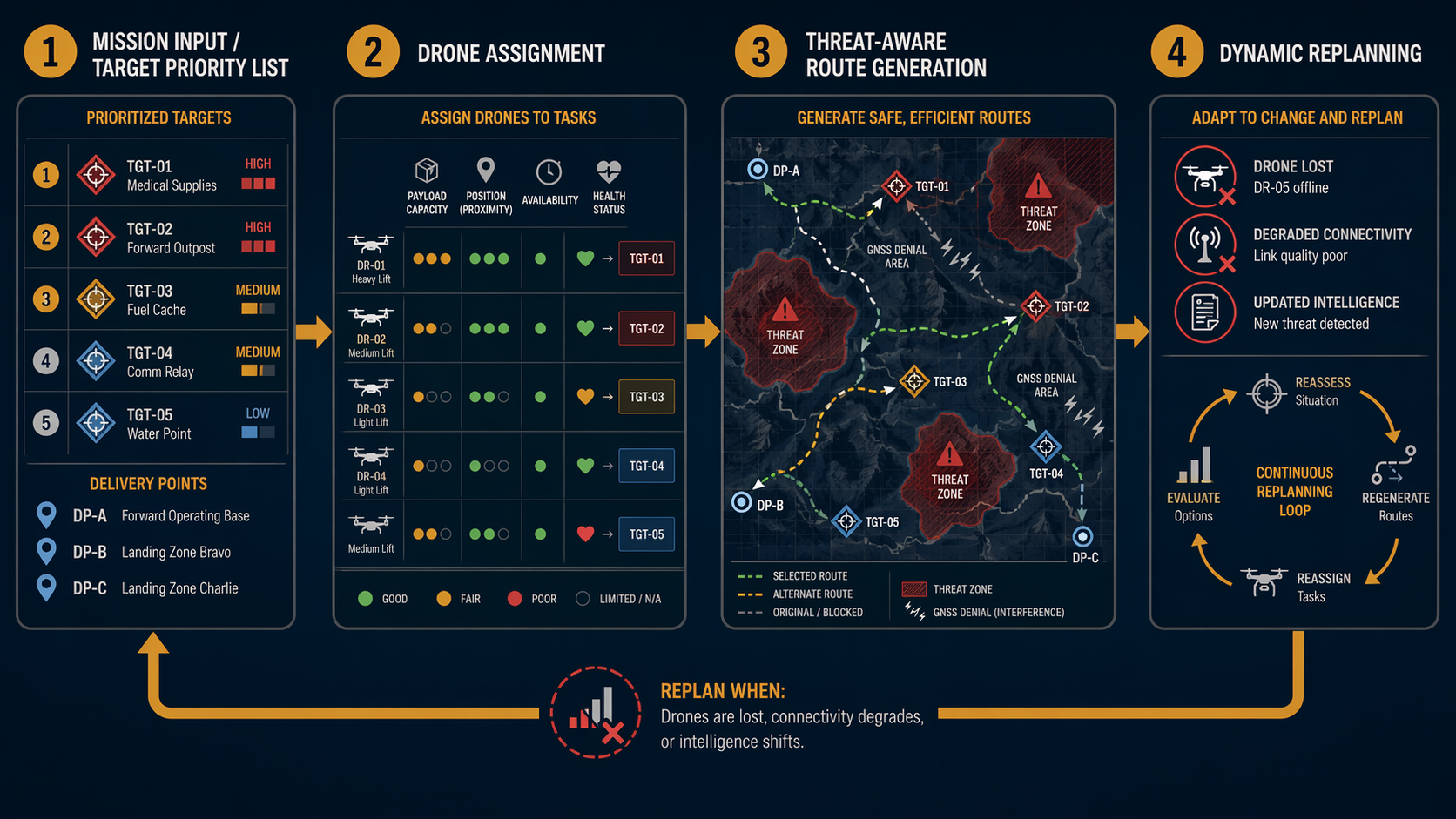
In operational terms, the workflow looks less like a single optimization run and more like a loop:
- Translate the mission goal into prioritized tasks with payload, timing, location, and risk constraints.
- Match tasks to drones using availability, position, payload capacity, communications fit, and fleet-health status.
- Generate routes that account for terrain, known threats, denied areas, and expected link quality.
- Monitor execution and replan when drones are lost, delayed, jammed, damaged, or reassigned.
- Feed the result back into readiness and maintenance records so the next plan starts from a more accurate fleet picture.
The hard part is that every item in that loop depends on data that may be late, noisy, spoofed, or incomplete. A priority list is only useful if the underlying intelligence has not aged out. A route around an air-defense or electronic-warfare threat is only useful if the threat estimate is still plausible. A fleet-status table is only useful if aircraft health, battery condition, payload configuration, and maintenance holds are current enough to affect assignment decisions.
Assignment Is a Fleet Problem, Not a Drone Problem
Once the task queue exists, the allocation step decides which drones should do the work. This is where a swarm starts to look different from a set of individually tasked UAVs. The planner is not assigning a single asset to a single route in isolation. It is managing a pool of assets whose usefulness changes as each aircraft moves, consumes power, loses link margin, avoids threats, or becomes unavailable.
The useful allocation variables are mundane and unforgiving: payload compatibility, launch point, current position, remaining endurance, onboard compute, sensor package, communications path, maintenance status, and recovery options. An AI planner can search across more combinations than a human staff can manually compare under time pressure. But the recommendation is only as good as the asset-status picture it ingests.
A simple hypothetical example shows the distinction. If three drones can technically carry a medical payload, the planner may still select the one that is farther away because the closer aircraft has a degraded battery, a weaker relay path, or a maintenance flag after its previous sortie. That decision can be correct, but only if the system can show why proximity lost to readiness or route survivability. Without that explanation, the operator inherits a recommendation that may look irrational at the worst possible time.
This is also where predictive fleet health enters the planning loop. Datategy describes AI-based swarm management in which predictive maintenance reduces fleet downtime by 30%, but that figure should be treated as a vendor-adjacent directional claim rather than an independently audited benchmark.[2] The underlying point is still important: if maintenance prediction is separated from mission planning, the allocator will keep treating questionable drones as available until a human intervenes or the aircraft fails. If fleet-health scoring feeds the allocator directly, readiness becomes part of the plan rather than a spreadsheet checked afterward.
Threat-Aware Routing Has to Preserve the Reasoning
Routing is where the plan meets the battlespace model. The algorithm must weigh path length, terrain masking, exposure to known threats, expected jamming or GNSS denial, relay availability, weather if available, and the cost of delaying other tasks. In the Fedorovych et al. model, threat-risk routing constraints are part of the formal logistics planning problem, not a separate navigation feature attached later.[1]
That distinction matters for auditability. If route generation is separate from task assignment, the logistics planner may see that a drone was assigned and that a route was selected, but not how risk trade-offs affected the assignment itself. In a contested environment, the route can determine whether the assignment was sensible. A drone with the right payload may be the wrong asset if reaching the destination forces it through a corridor where the threat estimate is unacceptable.
Deca Defense describes a Mission Planning AI that uses reinforcement learning to generate and update plans in contested environments as conditions change.[3] That is the right class of problem for reinforcement learning: repeated decisions under uncertainty, where the system learns policies for route choice, timing, and adaptation rather than merely drawing the shortest line between two points. The planning claim, however, still depends on the quality of the threat, terrain, and fleet inputs. Reinforcement learning does not make stale intelligence fresh.
For the operator, the important output is not just the route. It is the rationale attached to the route. Did the AI choose a longer path to avoid a known electronic-warfare zone? Did it accept a higher-risk corridor because the task priority exceeded a configured threshold? Did it preserve a healthier aircraft for a later mission? Did it reroute because a peer drone reported degraded connectivity? Those are not cosmetic explanations. They are the basis for deciding whether to approve, modify, or reject the plan.
Replanning Under Degraded Links
A swarm planner has to assume that the initial communications pattern will not survive intact. Jamming, terrain masking, relay failure, platform loss, or emission-control requirements can cut the neat command-and-control graph into smaller islands. The planning architecture then determines whether the swarm pauses, waits for instruction, falls back to preplanned branches, or reallocates work locally.
Centralized control gives the command node a clearer view of the plan. It can preserve a single audit trail, enforce commander intent, and make cross-mission trade-offs with more context. That is attractive for logistics work because the costs of a decision may appear outside the local drone cluster: a route may consume a scarce relay slot, delay a critical payload, or leave a recovery window uncovered.
Decentralized control gives the swarm a different advantage. If each drone or local cluster can participate in task allocation, the system can keep operating when the command link is degraded or severed. Datategy describes a shift from centralized command-and-control toward decentralized architectures in which each drone carries its own planning model.[2] That does not make decentralization automatically better. It moves part of the trust problem from the command node to the behavior of many local decision-makers.
| Architecture choice | What it helps | What the planner must verify |
|---|---|---|
| Centralized control | Command visibility, unified prioritization, cleaner audit trail | Whether the system can continue safely when links degrade or the command node loses current status |
| Decentralized or peer-to-peer allocation | Continuity under degraded communications and faster local adaptation | Whether local decisions remain aligned with mission priorities and can be reconstructed afterward |
| Hybrid control | Mission-level human oversight with local autonomy during disruption | Where authority shifts, what thresholds trigger autonomy, and how decisions are logged |
The more realistic answer is often hybrid. SDI.ai describes swarm intelligence as a layered architecture of perception, planning, and action, with human-in-the-loop oversight operating at the mission-goal level rather than at the level of steering each drone.[4] That framing is useful because it keeps the human where human judgment can matter: setting priorities, constraints, abort conditions, and acceptable risk. It does not pretend an operator can manually deconflict every aircraft in a fast-moving swarm.
The design question is not whether a human is “in the loop” as a slogan. It is which loop. A person may approve the mission objective and risk boundaries before launch, review exception requests during execution, and inspect the audit trail afterward. The AI may handle local route updates, peer-to-peer task swaps, and timing adjustments within those boundaries. If the system cannot describe where that boundary sits, the oversight claim is too vague to support operational trust.
Ukraine Shows the Scale, Not a Universal Benchmark
The most useful real-world evidence comes from Ukraine because it shows AI being pulled into drone operations under pressure rather than demonstrated in a clean test environment. War Room, citing Reuters reporting, describes more than 22,000 unmanned missions in the first quarter of 2026, AI integration boosting FPV strike accuracy from 30-50% to about 80%, and the OCHI system drawing on 2 million hours, or 228 years, of battlefield footage to train AI models for tactics and target assessment.[5]
Those figures matter, but not because they provide a neat performance target for every drone logistics program. They come from an active high-intensity war with unusual operational urgency, rapid adaptation cycles, and intense electronic-warfare conditions. A peacetime procurement office, a different theater, or a different sustainment mission should not treat Q1 2026 Ukraine data as a universal benchmark.
The logistics lesson is narrower and more useful. At that scale, manual planning becomes a bottleneck. If thousands of unmanned missions are being generated, observed, adapted, and learned from, then task prioritization, route selection, asset availability, and after-action feedback cannot remain disconnected processes. AI does not eliminate the planner. It changes what the planner must be able to inspect: data provenance, model behavior, confidence levels, exception handling, and whether lessons from previous missions are being folded into future plans without corrupting the decision process.
The Data Inputs Decide How Much Autonomy Is Safe
Every planning model has an appetite. It wants target or delivery priorities, threat maps, terrain data, electronic-warfare estimates, weather if relevant, asset health, payload status, communications availability, and mission constraints. In contested environments, the dangerous assumption is that these inputs are equally reliable. They are not.
Threat data may be stale. Terrain data may be incomplete at the scale a low-flying drone needs. GNSS-denial estimates may be wrong by the time the route is flown. Fleet health may be optimistic if maintenance events are not recorded promptly. A peer drone’s report may be useful, spoofed, delayed, or based on a sensor that has itself degraded. The AI planner may still produce a confident-looking assignment because optimization systems tend to return answers. The evaluation question is whether the system carries uncertainty forward into the recommendation.
For logistics planners, this means the data pipeline is part of the weapon-system evaluation, even when the acquisition discussion wants to focus on autonomy. A planner should be able to see which inputs were used, when they were last updated, how conflicting inputs were resolved, and whether the model treated unknown areas as low risk, high risk, or explicitly uncertain. The difference changes assignment behavior.
A planning system that can ingest degraded data and label it honestly is more useful than one that hides uncertainty behind a polished route display. In a logistics setting, uncertainty does not always cancel the mission. It may change the acceptable asset, timing, redundancy, or level of human approval required before execution.
Auditability Is Not Administrative Overhead
Drone logistics decisions can support lethal effects even when the immediate task is movement, sensing, relay, or resupply. That makes auditability operational, not bureaucratic. If an AI planner routes a drone through a dangerous corridor, sacrifices one asset to preserve another, delays a lower-priority delivery, or reallocates aircraft after a link failure, the staff needs a record of why that happened.
The minimum useful audit trail should capture the mission objective, task priority list, asset-status snapshot, threat and terrain inputs, routing constraints, communications assumptions, model recommendation, human approvals or overrides, and execution deviations. In decentralized systems, the trail also needs to capture local peer-to-peer decisions well enough to reconstruct the sequence after the swarm reconnects or returns.
This is where centralized systems have a natural advantage: a single planning node can produce a cleaner record. Decentralized systems may be more resilient in execution, but they have to work harder to preserve decision history. If local autonomy is allowed to change task assignments during degraded communications, the system needs a way to log not only what changed but what each local agent believed at the time.
That record is also how models improve without turning every after-action review into guesswork. If a route failed because the threat map was stale, that is a different lesson from a failure caused by bad fleet-health data, poor communications assumptions, or an allocation policy that overvalued speed. Without traceable decisions, the organization may update the wrong part of the system.
Why Procurement Is Moving Toward the Planning Layer
The market context is not the argument, but it explains why these questions are reaching procurement and evaluation cycles now. Research and Markets estimated the military logistics AI market at $2.73 billion in 2025 and projected it to reach $4.63 billion by 2029, a 14.1% compound annual growth rate.[6] SDI.ai also cites a GlobalData patent trend indicating that more than 50% of drone swarm control patents were granted in the past three years.[4]
Those are maturation signals, not proof that every claimed capability is ready for field use. They do show why planners are being asked to evaluate systems that package allocation, routing, reinforcement learning, swarm intelligence, and predictive maintenance into one operational promise. The proper response is not to dismiss autonomy or accept the demo. It is to test the planning loop under degraded conditions.
What Planners Should Be Able to Verify
A drone swarm logistics planner does not need the system to expose every model weight or algorithmic detail during a mission. The planner does need enough visibility to decide whether the recommendation is operationally trustworthy. That standard is practical:
- Can the system show how mission goals became prioritized tasks?
- Can it explain why specific drones were assigned, including payload, position, availability, communications fit, and health status?
- Can it identify which threat, terrain, and denial assumptions shaped the route?
- Can it keep operating when command links degrade without losing alignment with mission priorities?
- Can it distinguish fresh, stale, conflicting, and uncertain data in the planning display or approval workflow?
- Can it reconstruct route changes, peer-to-peer reallocations, human approvals, and overrides after the mission?
If those questions cannot be answered, the system may still be impressive autonomy. It is not yet a trustworthy logistics planning system for contested environments.
The transition from single-UAV logistics to coordinated swarm logistics is being driven by the planning layer: decomposition, allocation, threat-aware routing, dynamic replanning, and readiness feedback. Better airframes matter, but they do not solve the queue. The bottleneck is the ability to keep assigning scarce, imperfect assets against changing priorities when the network, threat map, and fleet condition are all under stress.
AI can make that scale manageable. Its value depends on whether planners can verify the inputs, understand the architecture, and reconstruct the decisions. In contested drone logistics, the plan that matters is not the one drawn before disruption. It is the one the system can still justify after disruption has started.
References
- Military logistics planning models for drone swarms, Fedorovych et al.
- AI-powered Management for Defense Drone Swarms, Datategy, 2025-07-21
- Mission Planning AI, Deca Defense
- Military Drone Swarm Intelligence Explained, SDI.ai
- AI's Growing Role in Modern Warfare, War Room, U.S. Army War College
- $4.63B Artificial Intelligence (AI) in Military Logistics Global Markets, Research and Markets via Yahoo Finance
Comments
Join the discussion with an anonymous comment.