

A new product forecast usually fails before anyone opens the forecasting tool. The SKU has no sales history, the launch date is locked, the first buy is due, and the only number available is the one someone is willing to defend in a meeting. Traditional demand forecasting is built to learn from prior demand patterns. For a true cold-start SKU, that anchor is missing.
That is where ai in demand forecasting becomes more than a dashboard upgrade. The useful version does not pretend the missing history exists. It builds a substitute: first by finding products that are similar enough to be informative, then by estimating how adoption should unfold after launch. When those two pieces are used together, the forecast is no longer just a merchant’s best guess with a spreadsheet wrapper.

Why the cold-start SKU breaks ordinary forecasting
For replenishment items, history is doing much of the work. Seasonality, trend, promo lift, day-of-week effects, store-level sell-through, lost sales adjustments — all of that depends on some record of what happened before. A new product introduction removes the most trusted input and leaves the planner with partial signals: the category, the price point, the intended store count, the launch window, maybe an image, and a few claims from product or marketing.
The consequences are not academic. If the opening order is too high, the miss becomes markdown pressure, warehouse congestion, and awkward post-launch explanations. If it is too low, the first read is contaminated by stockouts, the commercial team loses sales, and the next forecast inherits bad demand signals. If nobody trusts the first forecast, the launch calendar starts slipping into manual review loops.
The default workaround is judgment. Judgment has a place, especially when the business knows something the data does not. The problem is using judgment as the whole method. A planner can remember a comparable launch, a merchant can argue for a higher buy, and finance can push back on inventory exposure. None of that creates a repeatable way to compare one new SKU with hundreds or thousands of prior products across attributes, channel plans, and adoption patterns.
The AI substitute: similar SKUs first, adoption curve second
Cold-start AI forecasting works because it narrows the blank space. It does not forecast from nothing. It uses the information available before launch and connects the new item to demand patterns already observed elsewhere.
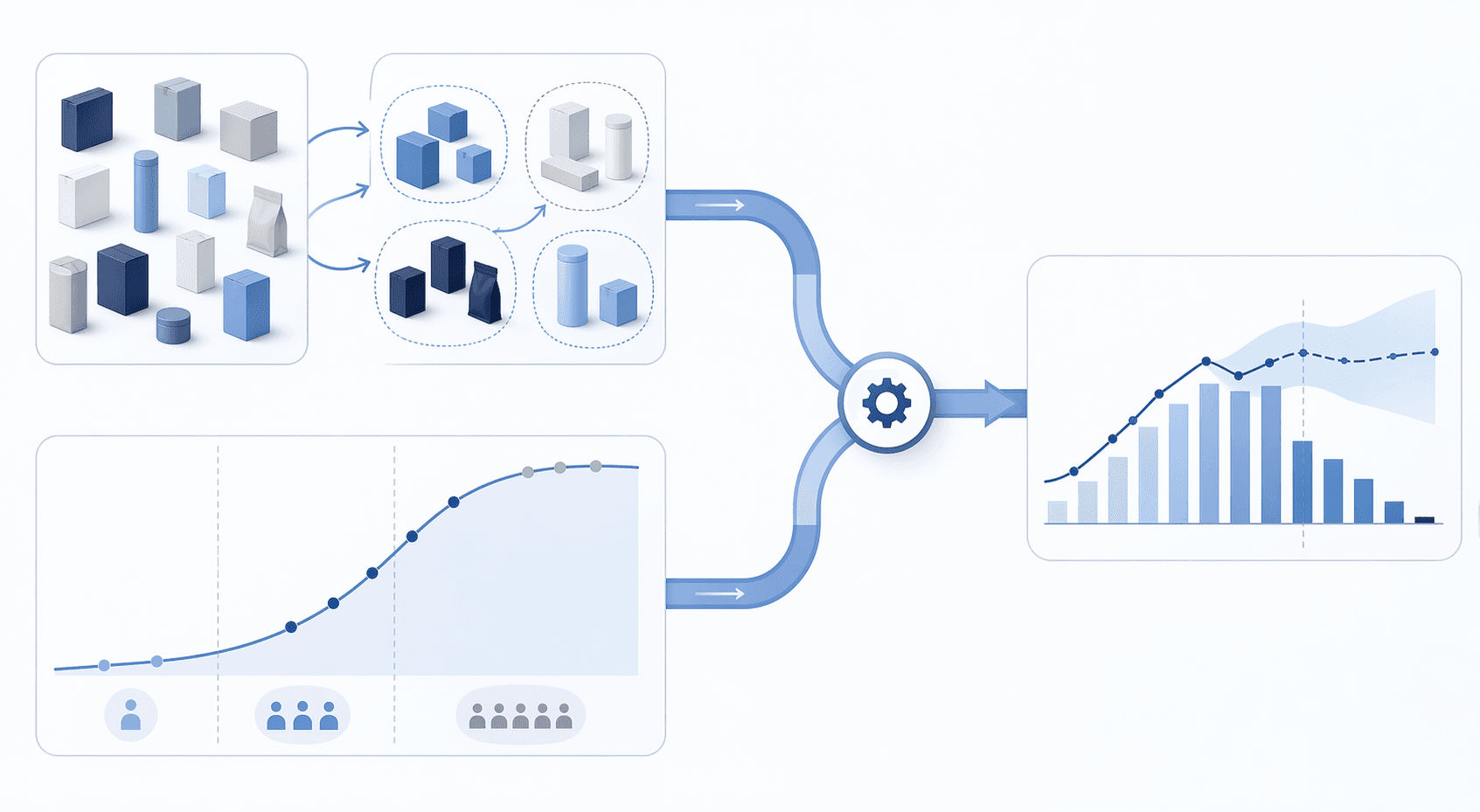
The mechanism usually has two parallel tracks:
- SKU similarity clustering: the model groups the new product with existing or past products that look commercially similar.
- Bass diffusion modeling: the model turns the launch into an adoption curve rather than assuming demand appears fully formed on day one.
Those two tracks answer different questions. Similarity clustering asks, “What prior products should we learn from?” Diffusion modeling asks, “How quickly should demand build, peak, and mature?” A cold-start forecast needs both. Similar products without an adoption curve can still overstate the first few weeks. A diffusion curve without good analogs can be beautifully shaped and commercially wrong.
What the similarity model is actually comparing
A useful similarity model is not just matching product names. It can compare structured attributes such as category, subcategory, brand, pack size, color, material, price tier, launch season, promotion plan, and intended store penetration. In categories where appearance matters, computer vision can also use product images as an input, helping distinguish products that share a taxonomy label but are visually very different.
Store penetration matters more than teams often admit. A new SKU launching in a small test set should not inherit the volume pattern of a chainwide launch just because the product attributes match. The same is true for price. A premium line extension may sit in the same category as a mass item, but the demand curve, inventory risk, and substitution behavior can be very different.
This is also where the model needs to know whether the item is genuinely new or merely new to the item master. A new flavor in an established range, a new colorway, a reformulated product, and a category-first innovation should not be treated as the same forecasting problem. The closer the SKU is to a line extension, the more the system should lean on parent-item and family behavior. The more novel the product is, the more it has to rely on broader analogs and adoption assumptions.
Why Bass diffusion belongs in the forecast
Similarity tells the model where to look. Bass diffusion helps it decide how demand spreads. In practical terms, the model separates early-adopter behavior from imitation behavior: some customers buy because the product is new, marketed, or solves an immediate need; others buy later because awareness spreads, distribution improves, reviews accumulate, or the product becomes familiar.
That matters for launch planning because the first few weeks are not just smaller versions of steady-state demand. A consumer electronics accessory, a seasonal fashion item, and a CPG line extension can all have different adoption shapes. The wrong curve can put inventory in the wrong week even when the total-season forecast looks defensible.
Bass diffusion also forces one uncomfortable assumption into the open: market potential. The model has to assume some ceiling for the addressable demand. If that ceiling is fixed too high, the launch forecast can justify inventory that the market will not absorb. If it is fixed too low, the business may underbuy a product with real breakout potential. This is one of the places where a forecast can look mathematically clean while still being operationally dangerous.
What the evidence supports
The strongest published benchmark comes from AWS. In its cold-start discussion for Amazon Forecast, AWS says the service’s cold-start capability is up to 45% more accurate than previous approaches for products with no historical data. That is a vendor-published benchmark, so it should not be read as a universal guarantee, but it is still important because it isolates the exact problem planners care about: products with zero history, not general forecast accuracy on mature items.[1]
Impact Analytics reports a similar directional pattern from fashion retail work, stating that AI-driven new-product forecasts across multiple fashion retailers are 25–30% more accurate than judgment-based methods. The available public material does not provide enough methodology detail to treat that as a category-wide law, but it reinforces the same conclusion: structured cold-start modeling can beat unaided judgment in NPI forecasting.[2]
| Evidence source | What it says | How to use it |
|---|---|---|
| AWS cold-start benchmark | Amazon Forecast cold-start capability is up to 45% more accurate than previous approaches for products with no historical data. | Useful as the strongest public proof point, with the caveat that it is vendor-published. |
| Impact Analytics fashion retail evidence | AI-driven new-product forecasts are 25–30% more accurate than judgment-based methods across multiple fashion retailers. | Useful as supporting evidence, especially for short-lifecycle retail categories. |
| Industry-reported operational impact | Retailers using AI cold-start forecasting typically reduce initial overstock and stockout rates by 20–35%. | Useful for stakeholder framing, but should be validated against the company’s own launch baseline. |
The practical range to take into a planning conversation is therefore not “AI will be accurate.” It is narrower and more useful: for new products, cold-start AI forecasting has documented accuracy improvements in the 25–45% range over prior or judgment-based approaches, with reported reductions in initial overstock and stockout rates of 20–35%.[1][2]
For teams building a broader business case, this cold-start use case should sit inside the larger economics of forecast improvement. A separate ROI discussion can cover labor, inventory, service level, and working-capital effects across the full planning process; this use case is specifically about the NPI blind spot. See the measurable ROI of AI in demand forecasting for that broader framing.
The human review is not optional
The most common failure mode is not that the model cannot calculate. It is that the analog set is wrong, the launch context changed, or the diffusion assumptions passed through review because the number looked precise.
MIT Sloan Management Review has emphasized the need to pair people and AI in product demand forecasting, with domain expertise remaining essential for validating model outputs and adjusting assumptions. That point lands especially hard in cold start because there is no post-launch history yet to discipline the model. The expert review has to happen before the inventory commitment, not after the first bad read.[3]
The review should be specific. A planner should be able to inspect which products were used as analogs, why they were considered similar, and whether the new product’s launch conditions match the historical cases. A merchandiser should be able to challenge whether a prior item is commercially comparable. A category manager should be able to flag a product that looks similar in attributes but sits in a different competitive context.
Diffusion parameters need the same treatment. If the model assumes rapid imitation behavior because a previous item spread quickly, someone has to ask whether this launch has the same media support, shelf placement, price accessibility, and consumer visibility. If the model assumes a fixed market potential, someone has to ask whether the ceiling reflects current distribution and category demand, not last year’s assortment plan.
Where the method breaks or needs restraint
Cold-start AI works best when the business can describe the product well before launch. If attributes are thin, product hierarchy is messy, pricing is not final, store penetration keeps changing, or images are unavailable in image-sensitive categories, the model has less to work with. A sophisticated algorithm cannot rescue a launch file that does not say what is actually being launched.
Line extensions deserve particular caution. They are often called “new products” because the SKU is new, but the demand behavior may be heavily tied to an existing parent item, brand franchise, or flavor family. Treating every line extension as a true cold start can overcomplicate the forecast and ignore useful internal history. Treating every line extension as a simple continuation can miss cannibalization, novelty lift, or distribution differences.
Bass diffusion has its own limits. It is most useful when adoption behavior is a meaningful part of the problem. It is less helpful if the product is mainly constrained by allocation, shelf space, or one-time seasonal timing. Its fixed market-potential assumption also has to be handled carefully. A launch forecast that depends on an inflated market ceiling will create inventory exposure even if the curve shape is reasonable.
Parameter calibration is another quiet risk. Early-adopter and imitator coefficients can be estimated from analogous categories, but those analogs have to be defensible. If a model borrows adoption behavior from a prior category with different price points, media support, or purchase frequency, the output may be consistent with the data and still wrong for the launch in front of the team.
Deployment paths: platform feature, retail application, or graph model
Cold-start forecasting usually arrives in one of three ways. Some companies get it as part of a broader AI forecasting platform. Some use a retail- or fashion-specific application focused on NPI planning. Others evaluate graph-based approaches that can reason across product, supplier, category, and relationship data without requiring SKU-level sales history.
Kumo.ai describes a graph-based approach in which new SKU nodes can be connected to categories, suppliers, and similar products, allowing forecasts without direct sales history. The same vendor overview also positions o9 Solutions and Blue Yonder among enterprise demand forecasting tools that use analog-based approaches for new products. Because this is vendor-published material, it is best used to understand available deployment patterns rather than to rank vendors by independently verified performance.[4]
| Approach | How it handles cold start | What to check before trusting it |
|---|---|---|
| Analog-based forecasting | Finds prior products similar to the new SKU and transfers demand patterns with adjustments. | Whether the analogs are commercially comparable, not merely close in hierarchy. |
| Similarity clustering with ML | Uses product attributes, price, launch context, store penetration, and sometimes images to group SKUs. | Whether the clustering logic is visible enough for planners and merchants to challenge. |
| Graph-based ML | Uses relationships among products, categories, suppliers, and other entities to infer demand for new nodes. | Whether the graph contains the relationships that actually drive demand in the business. |
| Diffusion modeling | Models adoption over time using early-adopter and imitation behavior. | Whether market potential and adoption parameters match the actual launch plan. |
The vendor question should come after the workflow question. Who creates the launch record? When are attributes complete enough to forecast? Who approves the analog set? Who can override diffusion assumptions? Does the forecast feed the buying process before purchase orders are cut, or does it arrive after the first commitment has already been made? A cold-start model that sits outside the NPI calendar will become another number people cite after the decision.
What a reasonable operating model looks like
A workable cold-start process does not need to be elaborate, but it does need clear ownership. The forecast should be generated early enough to shape the opening buy, then reviewed by people who understand the category and launch plan. The system should preserve the model’s analogs and assumptions so the team can learn after launch rather than argue from memory.
- Before forecast generation: complete the launch attributes, price, channel scope, store penetration, launch timing, and available product images.
- During model review: inspect the similarity cluster, remove bad analogs, and confirm whether the SKU is a true new product or a line extension.
- During diffusion review: challenge market potential, early-adopter assumptions, and imitation behavior against the actual marketing and distribution plan.
- After launch: compare forecast, shipments, sales, stockouts, and markdown exposure so the next cold-start cycle has better calibration.
The after-launch step is where too many organizations lose the learning. If the product stocked out in week two, the forecast error should not be scored as if demand disappeared. If the launch was delayed, the model should not be blamed for missing a calendar that changed. If the merchant overrode the forecast, the override should remain visible. Otherwise the organization cannot tell whether the model failed, the input file was wrong, or the decision process ignored the better number.
What stakeholders can reasonably expect
The fair promise is not autonomous NPI planning. It is a better starting point for a decision that used to begin with a blank history file. Based on the available evidence, AI cold-start forecasting can improve new-product forecast accuracy by 25–45% over judgment-based or previous approaches, and retailers using these methods report 20–35% reductions in initial overstock and stockout rates.[1][2]
That improvement is worth taking seriously. It is also conditional. The model has to compare the new SKU with the right analogs. The diffusion curve has to reflect a realistic launch. The people reviewing the forecast have to challenge the assumptions before the buy is placed, not after the miss is visible.
References
- Generate cold start forecasts for products with no historical data using Amazon Forecast, AWS Machine Learning Blog
- AI-Driven Cold Start Modeling for Retail Demand Forecasting, Impact Analytics
- Pair People and AI for Better Product Demand Forecasting, MIT Sloan Management Review
- Best AI Demand Forecasting Tools for Enterprise (2026), Kumo.ai
Comments
Join the discussion with an anonymous comment.