
Supply chain risk from climate volatility is no longer mainly a question of whether a dashboard can show a storm icon near a port. The useful question is earlier and harder: can the model give procurement, planning, logistics, and finance enough localized confidence to change a decision before the disruption becomes visible in orders, capacity, or inventory?
The pressure to answer that question is rising. Everstream Analytics cites UN data showing 7,348 major weather and climate events since 2000, compared with 4,212 in the prior 20 years, a 74% increase.[1] That number does not automatically prove every company faces the same exposure. It does explain why the old operating rhythm feels thin: wait for a warning, identify impacted lanes or suppliers, expedite alternatives, and then spend the next quarter arguing about whether the disruption was exceptional.
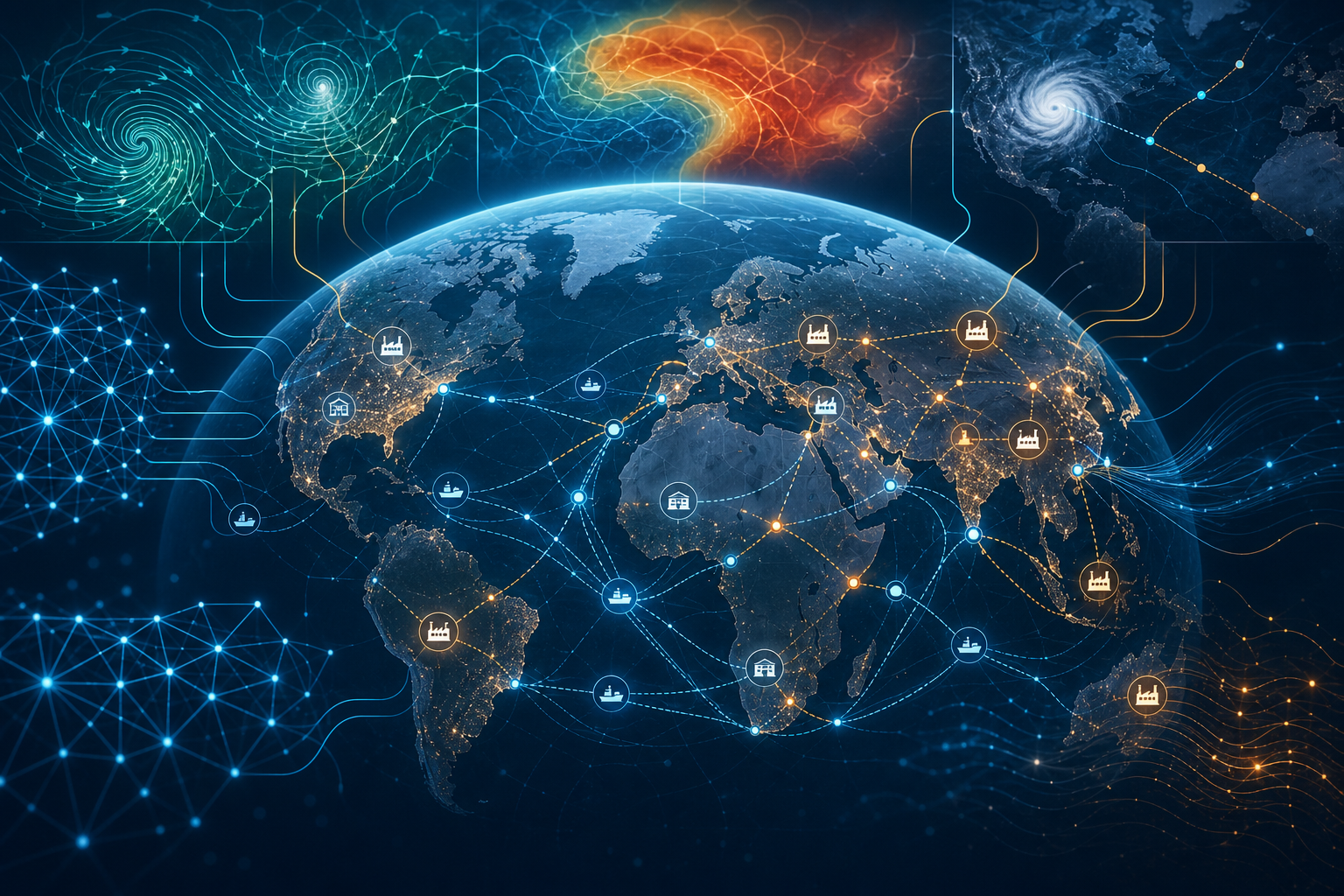
Conventional supply chain risk management often detects weather risk after it has already entered the operating system: a supplier misses a production slot, a road closure delays inbound material, a crop region revises expected output, or demand spikes in a geography that planners treated as normal. The promise of AI climate modeling is not that it removes uncertainty. It is that it can move the risk signal upstream and make it specific enough to price, simulate, and act on.
The Stack Matters More Than The Forecast
A weather forecast by itself rarely tells a supply chain leader what to do. A forecast becomes useful when it passes through a chain of translation: first into likely physical impacts, then into affected sites, tiers, lanes, commodities, and demand pockets, and finally into a decision frame that executives can compare against cost, service, and cash consequences.
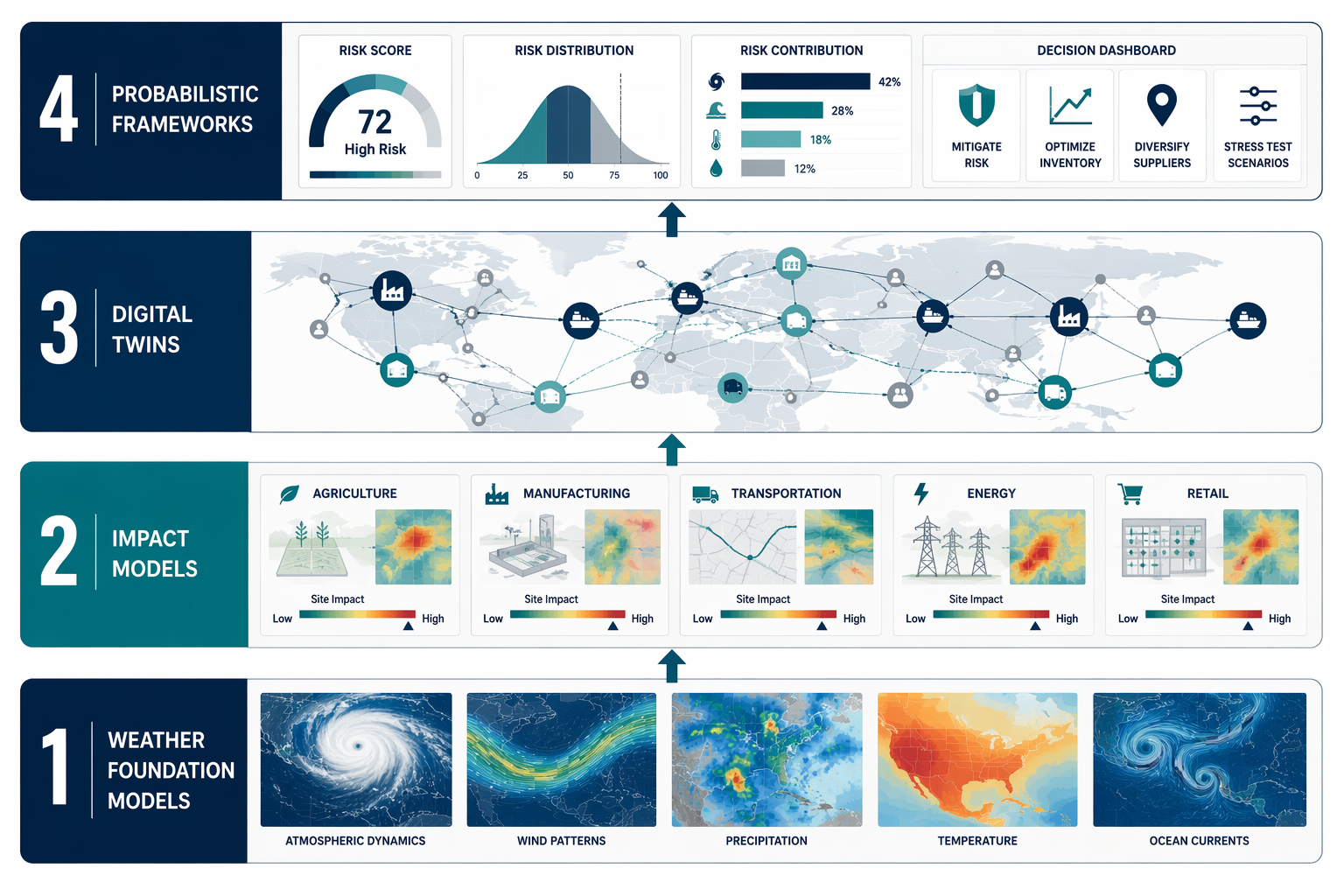
That is why the modeling stack is the center of the investment case. Weather foundation models sit at the forecast infrastructure layer. Impact models translate atmospheric signals into operational consequences. Digital twins test how those consequences move through a supply network. Probabilistic frameworks turn the result into a risk score, a loss range, or a planning scenario rather than a single deterministic answer.
| Layer | What It Adds | Supply Chain Decision It Can Inform |
|---|---|---|
| Weather foundation models | Medium-range and high-resolution weather prediction at lower computational cost | When to watch a region, lane, port, or production cluster |
| Impact models | Translation from weather signals into demand, supply, yield, or disruption indicators | Whether to pre-build inventory, reallocate supply, or qualify alternates |
| Digital twins | Simulation of how a localized event propagates through nodes and flows | Which site, tier, route, or customer promise absorbs the shock |
| Probabilistic frameworks | Risk ranges, scores, and time horizons for executive tradeoffs | How much risk to fund, insure, hedge, or accept |
A good implementation does not ask executives to trust a black-box climate model in isolation. It asks them to compare options: shift 20% of expected volume to an alternate supplier, hold extra stock for a defined window, pull forward orders before a likely weather-driven demand spike, or accept the exposure because the expected consequence is below the cost of mitigation.
Why AI Weather Models Change The Forecast Layer
Traditional numerical weather prediction is not obsolete. It remains a scientific backbone. But it is computationally heavy, and that matters for supply chain planning because many operating decisions require repeated scenario runs, regional sensitivity tests, and updates across thousands of nodes rather than one beautiful forecast for one location.
A 2025 Nature Communications perspective describes integrated artificial intelligence as a framework for earlier warning of complex climate risk, including the potential to connect climate hazards with social and economic exposure.[2] The important label is perspective. It is a serious research vision, not proof that every deployed platform can already produce reliable enterprise-grade early warnings across all hazards and geographies.
Still, the direction is material. The same research discussion points to AI models outperforming conventional numerical weather prediction in medium-range forecasting at a fraction of the computational cost.[2] For a supply chain team, lower compute cost is not an abstract technical advantage. It can mean more frequent refreshes, more locations modeled, more scenarios compared, and more time left for planners to act before procurement options narrow.
This is where systems such as Nvidia Earth-2 and Google DeepMind’s GraphCast belong in the conversation. They are not supplier-risk platforms by themselves. They are part of the forecast infrastructure layer that can feed more detailed simulation and impact modeling. Nvidia’s Earth-2 ecosystem has been described as foundational AI infrastructure for high-resolution weather and climate prediction, with organizations including NOAA, S&P Global, and The Weather Company connected to that ecosystem in public reporting.[3][4]

The practical test is whether that infrastructure can be connected to the operating grain of the business. A five-day or ten-day hazard signal over a wide region helps. A forecast tied to a supplier site, inbound rail corridor, packaging sub-tier, agricultural sourcing basin, or temperature-sensitive demand zone helps more.
Impact Models Translate Weather Into Business Consequences
The translation layer is where many AI climate investments either become useful or become theater. Operations teams do not need another map shaded red. They need to know whether the red area changes expected output, inbound availability, labor productivity, storage requirements, transportation reliability, or customer demand.
ClimateAi’s FICE model is a useful example because it is described as quantifying the timing, duration, and magnitude of weather-related demand spikes and supply disruptions. The model integrates government weather services, macro indicators, and consumer spending data across more than 100 sectors.[5] That combination matters because the same heat event can mean different things to a beverage company, an apparel retailer, a utility contractor, or a food distributor.
Timing tells planners when the decision window opens and closes. Duration tells them whether the response is a one-week allocation problem or a season-long supply issue. Magnitude tells finance whether the exposure justifies a higher-cost mitigation such as alternate sourcing or expedited freight. Without those three dimensions, a climate signal is easy to admire and hard to operate.
The same logic applies upstream. Climate.ai has argued that 85% of risks reside in tier 2–4 suppliers, using a geography-as-proxy approach for multi-tier risk mapping.[6] That figure should not be treated as a universal law for every category. It does highlight the blind spot that matters most: many companies have strong visibility into their direct suppliers and weak visibility into the sub-tier locations where climate exposure can quietly accumulate.
For readers who want the operational use-case layer after the technical model discussion, ChainSignal’s guide to AI weather forecasting for supply chain disruption covers deployment patterns in more detail.
A Useful Warning Names The Affected Node
The difference between a weather alert and a supply chain alert is specificity. “Flood risk in Southeast Asia” is an environmental observation. “Two second-tier component suppliers serving a single assembly plant may lose outbound capacity during the week when safety stock falls below target” is a planning signal.
This is why site-level supplier mapping is not a data-cleanup side project. It is the connective tissue that allows climate modeling to affect sourcing and inventory decisions. If the supplier master only knows a headquarters address, if tier relationships are incomplete, or if lane alternatives are not modeled, forecast skill cannot fully become resilience.
The Suntory and ClimateAi case gives a concrete deployment signal without proving the whole market case. ClimateAi reported projected 30–40% yield declines in key commodity regions and described 5–7 day early warning on coffee supply disruptions.[7] Those numbers are useful because they connect climate signals to commodity availability and response time. They should not be read as a guaranteed benchmark for every crop, supplier network, or company maturity level.
A five-day warning can be enough to adjust allocation, communicate with suppliers, or pull forward transport. It is usually not enough to redesign a sourcing base. Longer-horizon climate modeling may support category strategy, facility location, or supplier qualification, but those decisions depend on different governance, capital, and commercial constraints than short-term disruption response.
That distinction is often lost in vendor language. Better forecast skill is not the same thing as avoided loss. Avoided loss requires authority to act, available alternatives, data that names the exposed asset, and an operating process that does not wait for certainty.
Digital Twins Make The Forecast Testable
Once a climate model identifies a likely hazard and an impact model connects it to an operational variable, the next question is propagation. A port closure, heat wave, drought, or storm rarely stops at the first node. It moves through capacity buffers, contractual commitments, customer priorities, storage limits, and substitution rules.
A supply chain digital twin gives planners a place to test that movement before the real network does. In a mature setup, the twin does not simply display suppliers on a map. It represents flows, lead times, inventory positions, production dependencies, approved alternates, logistics constraints, and demand assumptions. Climate outputs become scenario inputs: temperature anomaly, rainfall deficit, wind risk, flood probability, projected yield pressure, or likely transportation interruption.
The payoff is not perfect prediction. It is comparative planning. If a heat-plus-drought scenario reduces expected output in a commodity region, the model can test whether earlier purchasing, alternate origin sourcing, customer allocation rules, or price-risk hedging produces the least damaging tradeoff. If a storm threatens a logistics node, the twin can compare rerouting cost against the service risk of waiting.
This is also where compound hazards matter. Environment+Energy Leader summarized Boston University research describing AI models that forecast hurricane activity across seasons and address compound hazard events, including combinations such as heat plus drought and rainfall plus supply chain stress. The summary states that compound events are consistently more damaging than single-variable models suggest.[8] Because the available source is a trade summary, it should be used directionally. The underlying planning point is still important: supply chains fail through combinations, not tidy single hazards.
A rainfall forecast may not look alarming if transportation buffers are healthy. The same rainfall forecast becomes a different decision if the region is already dealing with labor shortages, low inventory, high seasonal demand, or a constrained alternate route. AI climate modeling is most valuable when it can combine those conditions rather than scoring each variable in isolation.
Executives Need Probabilities, Not Just Alerts
At some point the model output has to survive an executive meeting. The chief supply chain officer cannot ask for emergency inventory, dual sourcing, supplier development funds, or route redundancy on the basis of a colorful hazard layer alone. The decision needs a probability, a time horizon, and a business consequence.
PwC’s climate risk modeling framework is useful here because it expresses climate risk as scores from 5 to 100 and spans short-term five-year projections through longer-term 20–30 year horizons. The SupplyChainBrain discussion also reports PwC’s view that AI significantly boosts accuracy in this type of modeling.[9] The exact score should not be mistaken for magic precision. Its value is that it gives leadership a common scale for comparing exposures across assets, suppliers, and time horizons.
A probabilistic framework changes the conversation from “Will this happen?” to “What range of outcomes are we willing to fund against?” That shift matters because many climate-driven decisions are insurance-like. The company may spend money on redundancy that is never visibly “used,” or it may accept risk because mitigation is more expensive than the expected impact. Either choice is defensible only if the assumptions are explicit.
The better risk score is not necessarily the one with more decimal places. It is the one that lets decision-makers trace the path from climate signal to operating exposure: which site, which tier, which product family, which demand region, which financial consequence, and which time window.
This is where AI climate modeling differs from general risk dashboards. Dashboards often centralize visibility. Modeling should change the action set. For logistics-specific ROI framing, ChainSignal’s piece on what AI for risk assessment in logistics actually delivers is a useful companion.
Where The Investment Case Breaks
The strongest technical stack still fails if the enterprise data underneath it is weak. Climate models need location precision. Impact models need clean links between weather variables and business outcomes. Digital twins need current network logic. Probabilistic scoring needs historical disruption records that separate weather coincidence from weather causation.
The first practical due diligence question is supplier geography. Do you know where the product is actually made, where critical inputs originate, and which logistics nodes the material must pass through? Many organizations can answer that for tier 1 suppliers and strategic facilities. Fewer can answer it for tier 2–4 exposure, contract manufacturers, packaging, ingredients, or specialized subcomponents.
The second question is outcome history. If a hurricane, drought, flood, freeze, or heat wave affected the network in prior years, did anyone record the operational consequence in a way a model can learn from? A disruption log that says “supplier delay” is less useful than one that records location, hazard type, duration, lost production, expediting cost, service impact, and recovery time.
The third question is model drift. Climate change can weaken assumptions learned from historical weather patterns. A model that performed well under one distribution of temperature, precipitation, storm behavior, or seasonal timing may degrade as those distributions shift. That does not make AI climate modeling unusable. It makes monitoring, recalibration, and human review part of the operating model rather than an afterthought.
The analogy to geopolitical risk is instructive. Pattern breaks are difficult for AI systems when the past stops being a reliable guide. ChainSignal’s discussion of the limits of AI in geopolitical supply chain risk is not about climate modeling, but the governance lesson carries over: a confident model should still be challenged when the underlying regime changes.
What A Credible Program Looks Like
A credible AI climate modeling program usually starts narrower than the marketing deck. Pick a category, region, hazard, or logistics flow where climate exposure is already material and where the business can act if the model is right. Tropical storm exposure around a constrained port, flood risk for a regional distribution network, drought pressure in an agricultural sourcing basin, or heat sensitivity in demand planning are better starting points than a global all-hazards map.
The working sequence is straightforward enough to test:
- Map the assets, suppliers, sub-tiers, lanes, and demand pockets that matter to the selected exposure.
- Connect weather foundation model outputs to the relevant hazard variables and time windows.
- Use impact models to translate hazard variables into supply, demand, yield, logistics, or capacity effects.
- Run scenarios through a digital twin or equivalent network model to identify propagation and bottlenecks.
- Express the result as probability, severity, time horizon, and decision options.
- Track forecast performance, false alarms, missed events, business impact, and model drift.
Not every company needs the full stack on day one. A manufacturer with concentrated flood exposure may begin with site mapping and a flood-risk platform; ChainSignal’s buyer-oriented comparison of AI platforms for supply chain flood risk management fits that more specific path. A company exposed to hurricanes may find more value in a hazard-specific workflow such as AI tropical storm disruption planning.
What matters is that the pilot does not stop at prediction. A severe-weather signal should lead to a documented decision: reroute, pre-position, reallocate, expedite, qualify, insure, hedge, communicate, or explicitly accept risk. If no decision changes, the model may still be scientifically interesting, but it is not yet a supply chain capability.
The Investment Judgment
AI climate modeling is becoming a credible planning layer for supply chain risk because it improves the forecast layer, translates hazards into business impacts, supports network simulation, and gives executives probabilistic decision frames. The strongest evidence supports a narrower claim than the most ambitious vendor language: these models can improve early warning and decision quality where the data and operating process are ready for them.
The right investment threshold is not enthusiasm for AI. It is readiness to connect model output to supplier geography, historical disruption data, business-impact mapping, scenario governance, and drift monitoring. Where those foundations are strong, AI climate modeling can move supply chain risk management from reactive response toward predictive planning. Where they are weak, it will produce sharper-looking maps of risks the organization still cannot act on.
References
- Climate Change Is Accelerating Supply Chain Disruption, Everstream Analytics.
- Early warning of complex climate risk with integrated artificial intelligence, Nature Communications, March 2025.
- How AI can unlock resilience in supply chains, World Economic Forum.
- Manufacturers Hope AI Will Save Supply Chains From Climate Crisis, WIRED.
- AI Weather Forecasting and Supply Chain Risk Management, TraxTech.
- Climate Risk and Supply Chain Risk Mapping, Climate.ai.
- Unlocking Resilient Supply Chains: Suntory’s ClimateAi Strategy, Climate.ai.
- AI Climate Models Are Advancing Risk Forecasting, Environment+Energy Leader, April 2026.
- Watch: Protecting Supply Chains With Climate Risk Modeling, SupplyChainBrain.
Comments
Join the discussion with an anonymous comment.