
The slow part after a marine casualty is often not the tow, the inspection, or the reroute. It is the file. In the BBC Marmara grounding, the manual investigation stretched for 29 months, which kept cargo, insurers, and operations teams waiting long after the vessel had stopped being the day's problem. That is the real use case for AI in maritime accident investigation and supply chain recovery: not a slogan about smarter shipping, but a faster way to turn scattered evidence into something that can move claims, release cargo, and give planners a believable timeline.
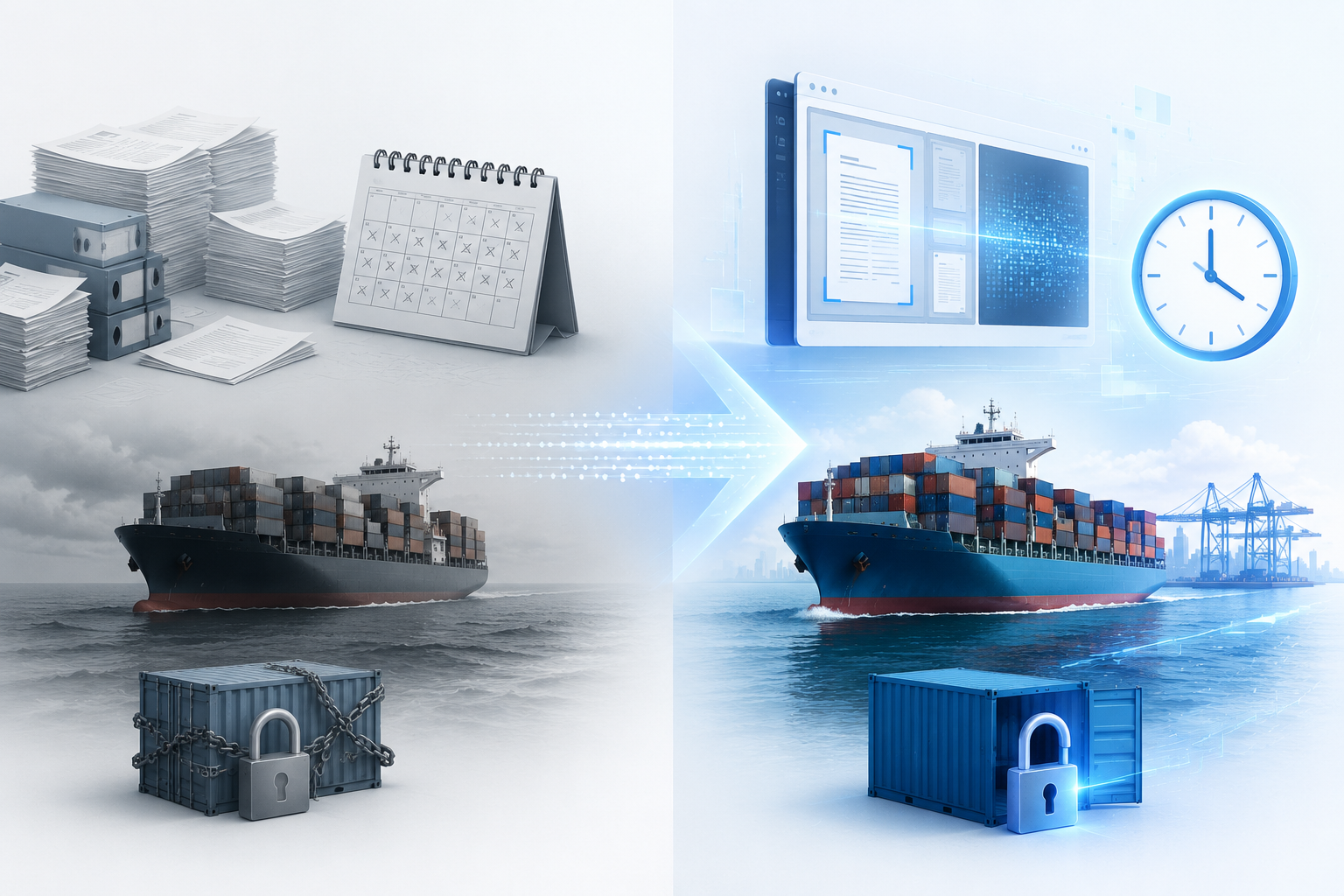
That delay matters because disruption is not rare enough to treat as a one-off exception. One industry summary citing McKinsey, Coupa, and Resilinc says companies experience a supply chain disruption lasting at least a month every 3.7 years on average, and that shocks can erase 45% of one year's EBITDA over a decade [1]. Those figures come from different methods, so they should not be blended into a single total cost, but they do explain why a frozen investigation file becomes a supply chain problem instead of an administrative one.
| Investigation step | Manual pattern | AI-assisted shift |
|---|---|---|
| Evidence gathering | Scans, emails, and witness notes are assembled by hand | RAG and NLP pull relevant prior cases and extract structured facts |
| Incident reconstruction | Timelines stay fragmented across logs and images | Computer vision and sensor alignment rebuild the sequence faster |
| Downstream use | Claims and planners wait for a settled narrative | Structured findings can feed release, rerouting, and control-tower updates |
What changes in the investigation layer
The strongest evidence so far comes from retrieval, not from generic summarization. In a 2026 arXiv study, Kim and Kim built a multi-field hybrid RAG framework on 13,329 KMST tribunal reports covering 1971 to 2025. NormRecall@100 rose from 0.18 to 0.55, and AI-assisted root-cause draft quality scores moved from 3.34 to 3.72 [2]. That is a research result, not proof of production deployment, but it shows why maritime accident work responds well to retrieval: the model is not inventing a tidy story, it is surfacing older rulings, vessel terms, and recurring causal patterns fast enough to shape the first draft.
That matters because the first hour of investigation is usually a search problem disguised as a judgment problem. The evidence sits in tribunal records, survey notes, cargo documents, maintenance logs, and messages written for people who were not expecting to defend them later. RAG is useful here because it can pull comparable cases back into view instead of forcing investigators to rebuild context from scratch.
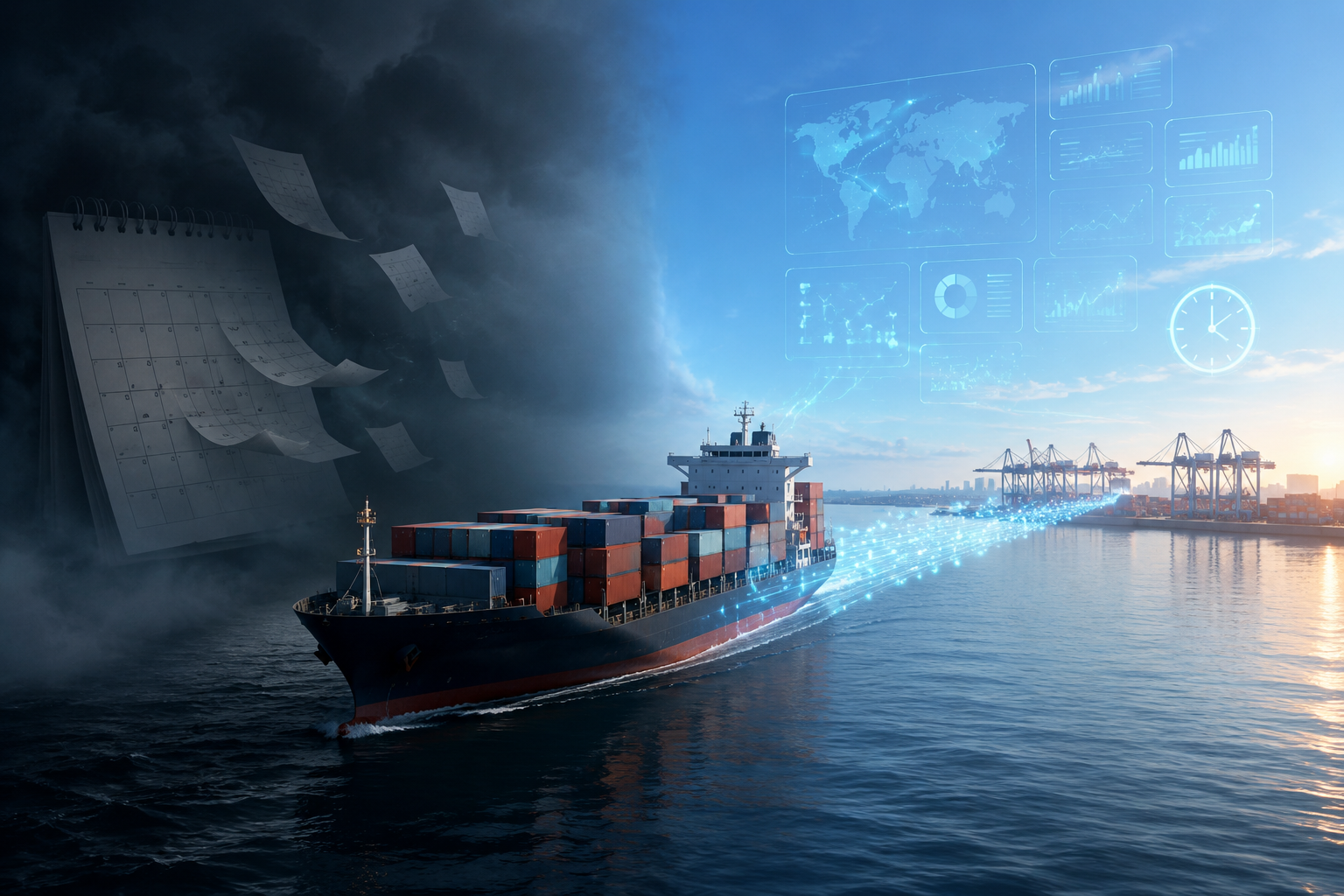
The same pattern shows up in a different form in the April 2026 SafeMTS pilot from the Bureau of Transportation Statistics, where LLMs were able to classify free-text maritime near-miss descriptions, even though inconsistent formats and incomplete records still limited usability [3]. That is the practical boundary of the whole category: maritime evidence is usually messy before it is useful. AI helps most when it can normalize that mess quickly enough for humans to keep working.
Computer vision adds another piece. It can help reconstruct incident sequences from deck, terminal, or berth imagery, align visible damage with timestamps, and separate what was seen at the scene from what was later written into a report. On its own, that is just better evidence handling. In combination with RAG and NLP, it becomes a faster path from accident scene to a case file that other teams can actually use.
Where investigation data becomes recovery data
The real payoff starts when the investigation output is structured well enough to enter the systems that manage routing, detention, and ETA risk. In Siemens Digital Logistics' account of its Portcast integration, the platform ingests more than 200 data sources and is said to reduce manual updates by 80%, detention and demurrage charges by 15%, and expedited freight costs by 5% [4]. That is the bridge the market usually skips: investigation data does not matter because it is elegant, it matters because it can change the next operational decision.
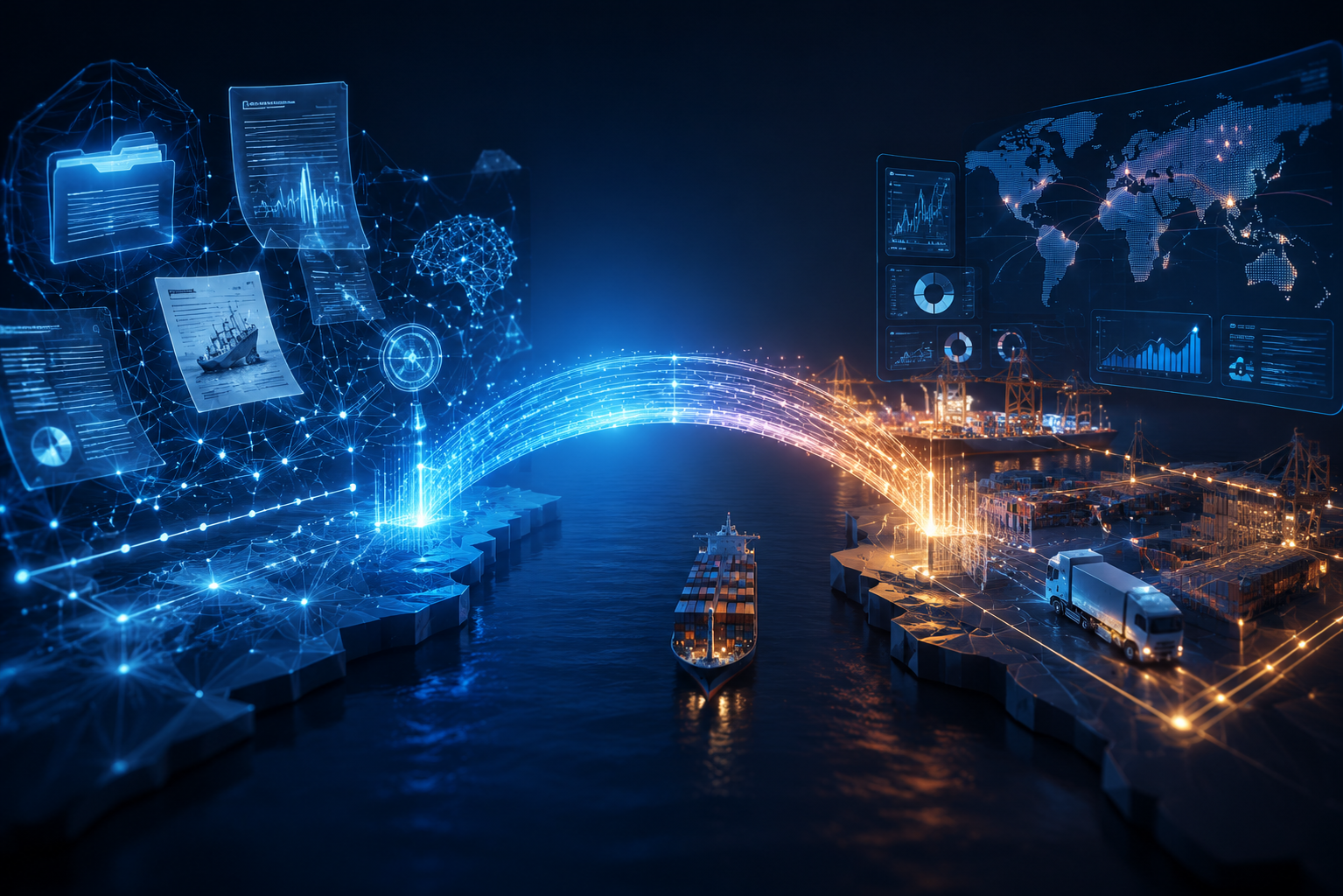
Once that handoff works, the same evidence file can support several different teams at once. A claims handler needs enough structure to decide what is probable and what remains open. A planner needs enough confidence to stop holding inventory in limbo. A control tower needs an updated view of delay exposure that is grounded in the incident rather than in rumor or repetition.
That is also why the integration gap matters so much. Most current tools are strong either on evidence extraction or on disruption prediction, but not on both. In practice, that means a model can explain an accident better than before and still leave the downstream systems waiting for a person to translate the finding into ETA changes, escalation rules, or release decisions.
The broader risk environment makes that weakness more expensive. CSIS estimated that $2.45 trillion in goods transited the Taiwan Strait in 2022, and it noted that a reroute around the Cape of Good Hope can add about $1 million per trip [5]. Everstream reported a 965% increase in cyberattacks on logistics between 2021 and 2025, including a 61% rise in 2025 alone [6]. Those are separate studies with separate methods, not one combined cost model, but they point to the same operating reality: disruption is no longer a single-event problem.
Buyers are already leaning in on the automation side. ABI Research said 65% of supply chain professionals consider AI or GenAI important or very important in technology purchase decisions, while 77% are considering or piloting mobile automation [7]. That does not mean the maritime investigation workflow is mature; it means the demand is there for systems that can turn evidence into action instead of leaving it in a document stack.
Maritime accident investigation is an overlooked upstream bottleneck in disruption recovery. AI can compress the time between incident and usable evidence, which shortens the wait for insurance resolution and cargo release. The remaining constraint is the handoff into prediction platforms, where the value only appears if investigation outputs can feed ETA drift, detention exposure, and rerouting decisions.
References
- The Cost of Supply Chain Disruptions: 20 Statistics - Conexiom
- A Multi-Field Hybrid Retrieval-Augmented Generation Framework for Maritime Accident Investigation - arXiv, 2026
- New SafeMTS Study Highlights AI Innovations to Boost Maritime Safety - Bureau of Transportation Statistics, April 2026
- When sea freight gets smarter - Siemens Digital Logistics, 2025-09-05
- State of Maritime Supply Chain Threats - CSIS, 2024
- Are You Prepared for the Supply Chain Disruptions of 2026? - Everstream Analytics
- Supply Chain Disruptions 2026: How to Build Resilience with AI and Automation - ABI Research
Comments
Join the discussion with an anonymous comment.