
Flood risk in supply chains is no longer a corner case. One 2025 supply-chain risk roundup says flooding accounted for 70% of weather-related disruptions in 2024 [1], and NOAA’s billion-dollar disaster database recorded 123 flood events and 27 billion-dollar disasters in 2024, with total losses of about $182.7 billion [2]. In the same buyer conversations, 72% of supply chain executives now say automated mitigation is mandatory [3]. That is why the shortlist is not really about “climate AI” as a category. It is about which platform can help a team decide earlier which lanes, suppliers, and inventory positions are about to fail. Everstream also says 22 of the top 25 global ports face increased annual precipitation by 2050 [4], which is a good reminder that this is not just a supplier problem.
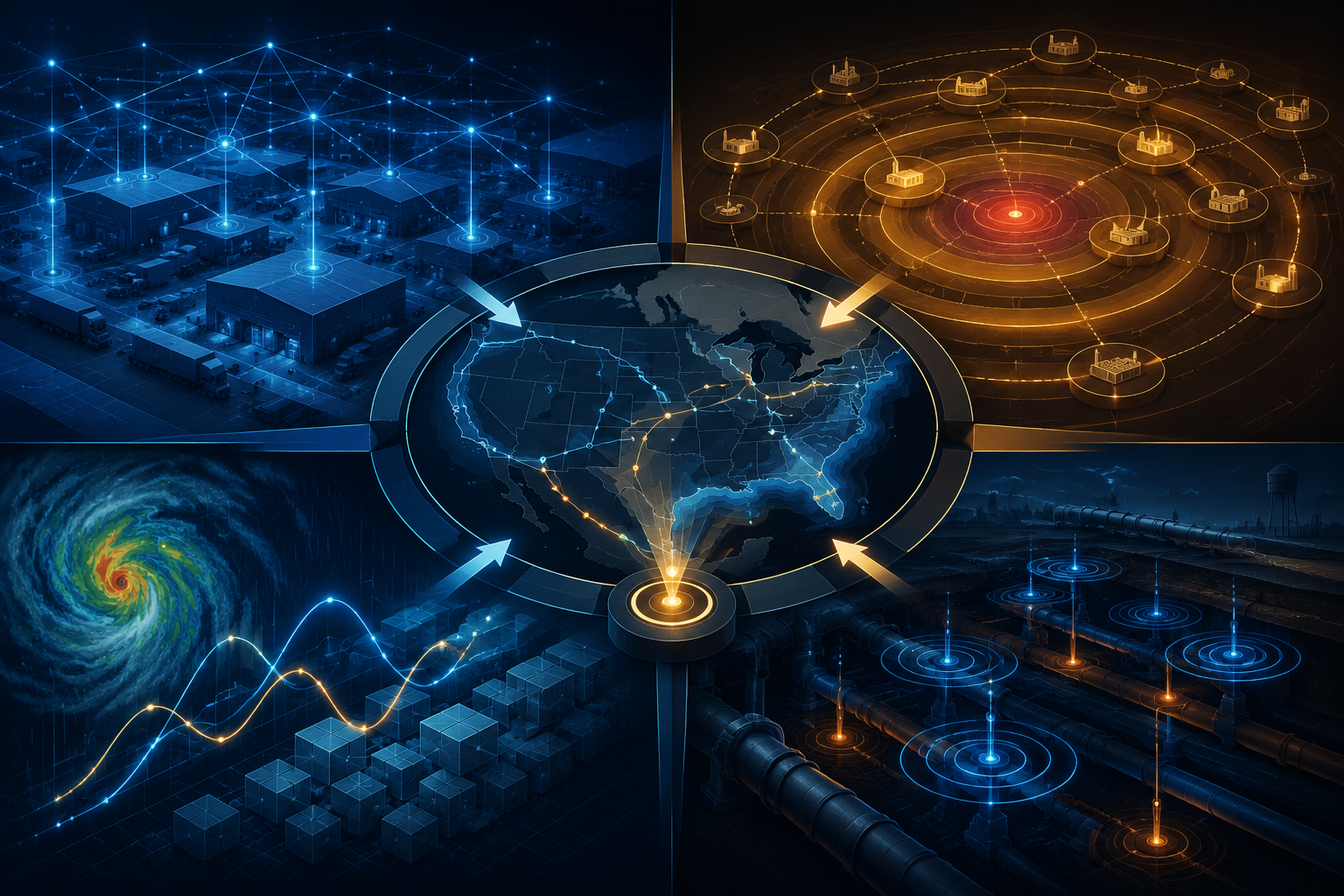
Four technical bets, not one category
| Platform | Technical bet | What it is best at | Main boundary |
|---|---|---|---|
| Everstream Analytics | Supply chain digital twin with applied meteorology [4] | Seeing how floods, storms, and transport constraints change network exposure and freight decisions | Needs buyer validation on data freshness, workflow actionability, and whether the model turns into rerouting or pre-positioning |
| Interos | Multi-tier catastrophic risk scoring with automated sub-tier discovery [5] | Finding hidden supplier exposure beyond Tier 1 and flagging who is in the storm path | Needs proof that the score becomes an operational action, not just a risk alert |
| ClimateAi | Weather forecasting tied to demand shifts and inventory positioning [6] | Planning stock moves ahead of hurricane or flood-driven demand changes | Best understood as a decision tool for inventory and revenue, not a full supplier-visibility platform |
| Jacobs Flood IQ | Infrastructure-focused predictive ML [7] | Reducing flood incidents in physical infrastructure systems | Useful comparison point for infrastructure-heavy buyers, but not a direct substitute for supply chain visibility tools |
Why Everstream and Interos sit closest to the buying problem
Everstream and Interos are often put in the same search because both sound like “risk platforms,” but they start from different technical bets. Everstream is closer to a supply-chain-aware digital twin: it maps network exposure, layers in weather intelligence, and tries to show where a flood will change the operating plan. That makes it a strong fit when the buyer needs to see which routes, sites, or freight moves should change before the disruption hits.
Everstream’s own case studies report a 30% reduction in revenue loss from disruption, a 50–70% faster time to identify and assess disruption impact, a 5% reduction in expedited freight costs, a 10% improvement in on-time performance, and more than $2 million in annual savings in temperature-sensitive freight [4]. Those are vendor-reported results, not independent benchmarks, but they do show the kind of operational claim the platform is trying to make: not just awareness, but a change in freight, service, and revenue outcomes.
Interos starts from a different place. Its Catastrophic Risk Model is built around multi-tier supplier exposure and automated discovery of sub-tier risk, which matters when the Tier 1 supplier is fine but a deeper node in the chain is sitting in the flood path. In the Cooper University Health Care case, Interos says the team identified three suppliers in Hurricane Idalia’s path and pre-positioned orders before those suppliers cut off orders [5]. Interos has also published materials tying weak sub-tier visibility to about $45 million in annual loss [5]. The useful buyer question is whether that visibility is deep enough and current enough to trigger action before the cutoff window closes.
Where ClimateAi changes the decision
ClimateAi is easier to misunderstand if it is treated as a pure hazard platform. Its stronger use case is weather intelligence linked to demand shifts and inventory positioning. In one vendor case study, a building materials company used ClimateAi to pre-position Florida-code-approved inventory ahead of Hurricane Ian and reported $15 million in incremental revenue [6]. That is a single case, not a universal result, but it shows why the product belongs in a different bucket from a network-mapping tool: the value is not only avoiding damage, but placing the right stock where demand is likely to spike.
That distinction matters for evaluation. If the real pain is stockout risk, channel demand spikes, or the timing of product movement into a storm region, ClimateAi deserves a look. If the problem is unknown supplier tiers or route exposure, it is the wrong first comparison.
Why Jacobs is useful, but in a different field
Jacobs’ Flood IQ result with United Utilities is strong evidence that flood-related machine learning can reduce incidents in infrastructure operations. The reported outcome was about a 20% reduction in flooding and pollution incidents across 78,000 km of sewer network [7]. That is impressive, but it is still an infrastructure context, not a supply chain logistics context. It is useful as a boundary case for buyers who own campuses, utilities, ports, or other physical systems where drainage and flood control are part of the operating environment. It should not be treated as a replacement for supplier mapping, transport visibility, or inventory mitigation tools.
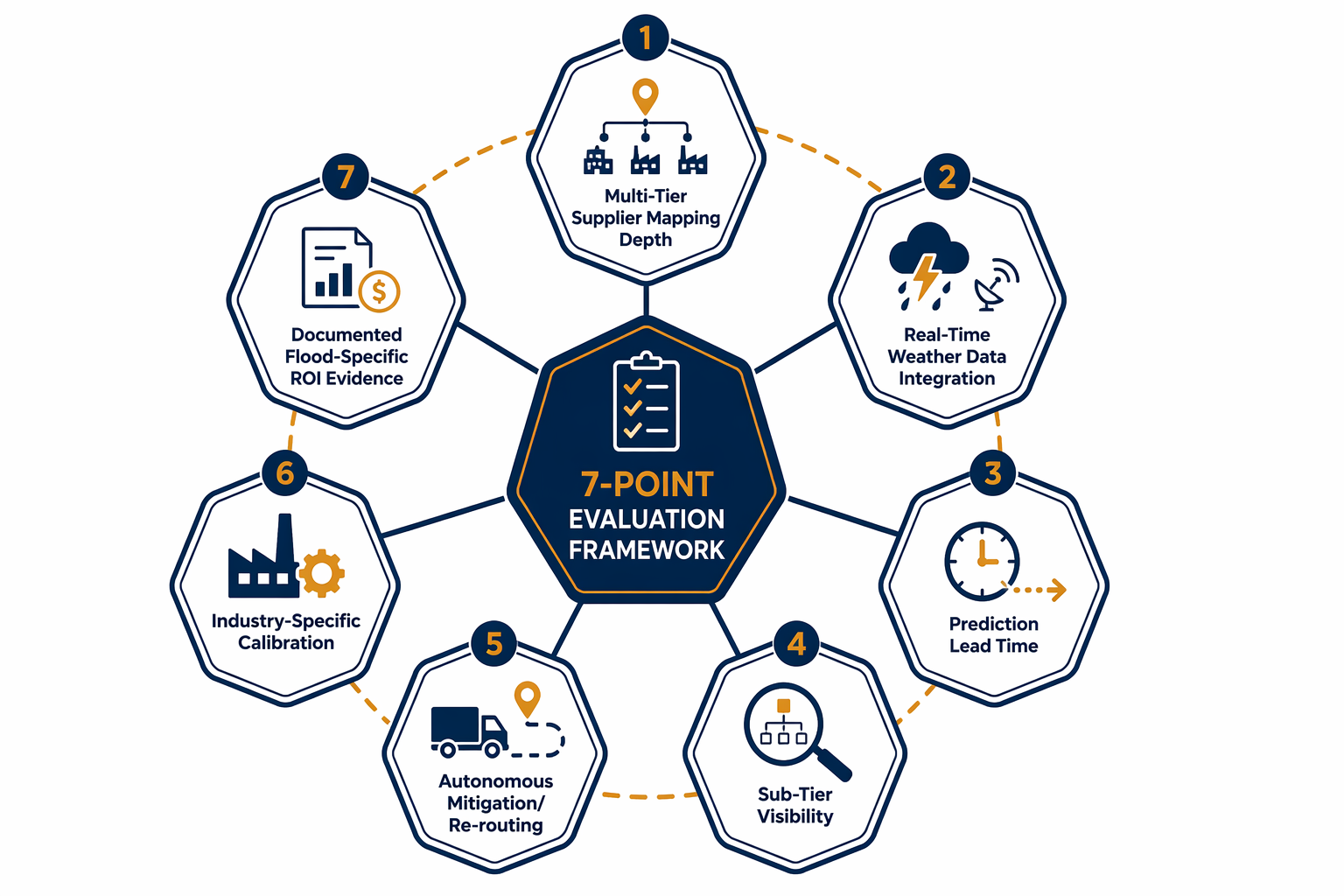
The seven criteria that should decide the shortlist
The market still lacks independent head-to-head benchmarks for supply-chain flood prediction, so the right move is to test vendors against the decision you actually need to make. The seven criteria below are the most useful way to separate a tool that can predict weather from a platform that can change operations.
| Criterion | What to verify in a pilot |
|---|---|
| Multi-tier supplier mapping depth | Can the platform reliably trace beyond Tier 1 and show which lower-tier nodes matter to your network? |
| Real-time weather data integration quality | Does it combine satellite, radar, and river-gauge inputs, or is it mostly a generic weather feed? |
| Prediction lead time | Does it give you enough warning to act on pre-positioning, rerouting, or order changes instead of just issuing an alert? |
| Sub-tier visibility beyond Tier 1 | Can procurement or logistics see the hidden dependencies that usually stay outside a standard supplier list? |
| Autonomous mitigation or re-routing capability | Can the system trigger workflows, recommend alternate lanes, or support a real mitigation action? |
| Industry-specific calibration | Has the model been tuned for your sector’s operating reality, not just for generic weather risk? |
| Documented flood-specific ROI evidence | Can the vendor show flood-related outcomes, not only broad resilience claims? |
That last point is where many procurement reviews get blurred. A vendor may have a real hurricane story, a sewer-network ML deployment, and a supplier-risk score, but those are not interchangeable proofs. The buyer should ask for flood-specific evidence in the same operational setting the platform is being bought for, and should not accept a generic climate narrative in place of a measurable supply-chain result.
The fit question is narrower than the category label suggests. Choose Everstream when the core need is a supply-chain-aware digital twin with meteorological disruption intelligence. Consider Interos when sub-tier exposure and catastrophic supplier discovery are the weak spot. Look at ClimateAi when weather-driven demand shifts and inventory positioning matter as much as physical disruption. Evaluate Jacobs when flood exposure belongs to infrastructure systems rather than conventional supplier or logistics networks. Because the platforms overlap in pitch but not in technical bet, the shortlist should be run as a pilot against the seven criteria, with the hardest scrutiny aimed at data inputs, actionability, and flood-specific proof.
References
- 1. Flooding tops the list of supply chain risks in 2025 — DOXA
- 2. Billion-Dollar Weather and Climate Disasters — NOAA
- 3. Supply Chain Statistics — Tradeverifyd
- 4. Everstream Analytics — Everstream Analytics
- 5. Catastrophic Risk Model — Interos
- 6. Hurricane Ian case study — ClimateAi
- 7. AI flood intelligence — Highways Today
Comments
Join the discussion with an anonymous comment.