
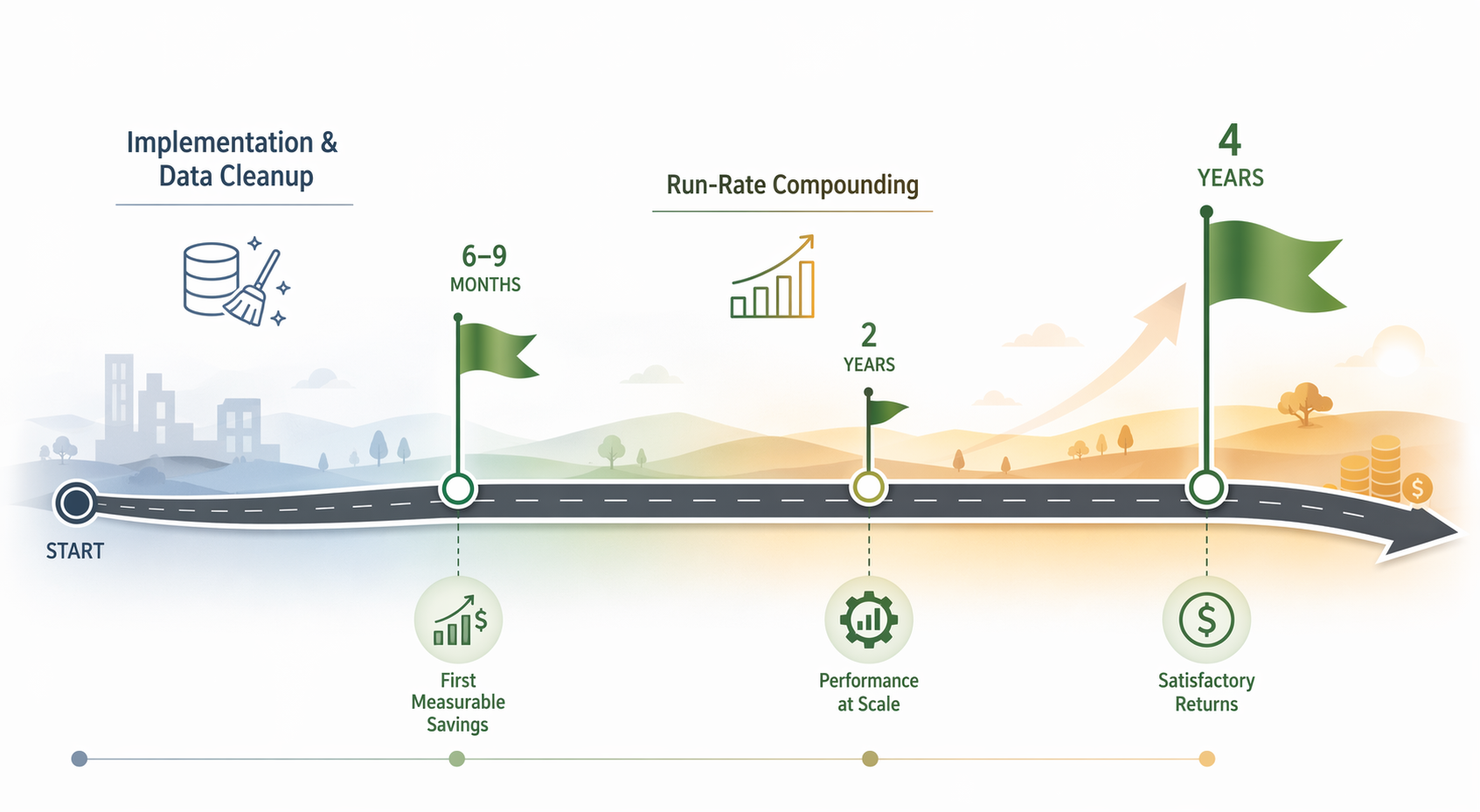
The uncomfortable part of the business case for AI in procurement is not whether the software can find savings. It often can. The harder question is whether those savings arrive on the clock used in the investment request. Deloitte’s 2025 generative AI survey captures the mismatch cleanly: 85% of organizations increased AI investment, but only 6% reported ROI in under a year, while satisfactory returns most often appeared over a 2–4 year period.[1]
That is not a case against procurement AI. It is a case against treating a pilot result, a first negotiation win, or a dashboard insight as if it were already a fully realized return. A procurement team may see its first measurable savings in 6–9 months, and some negotiation-cycle benefits can appear earlier. But a CFO is usually asking a different question: after implementation cost, data cleanup, user enablement, supplier-cycle timing, and adoption drag, when does the investment produce a return that can be defended in the forecast?
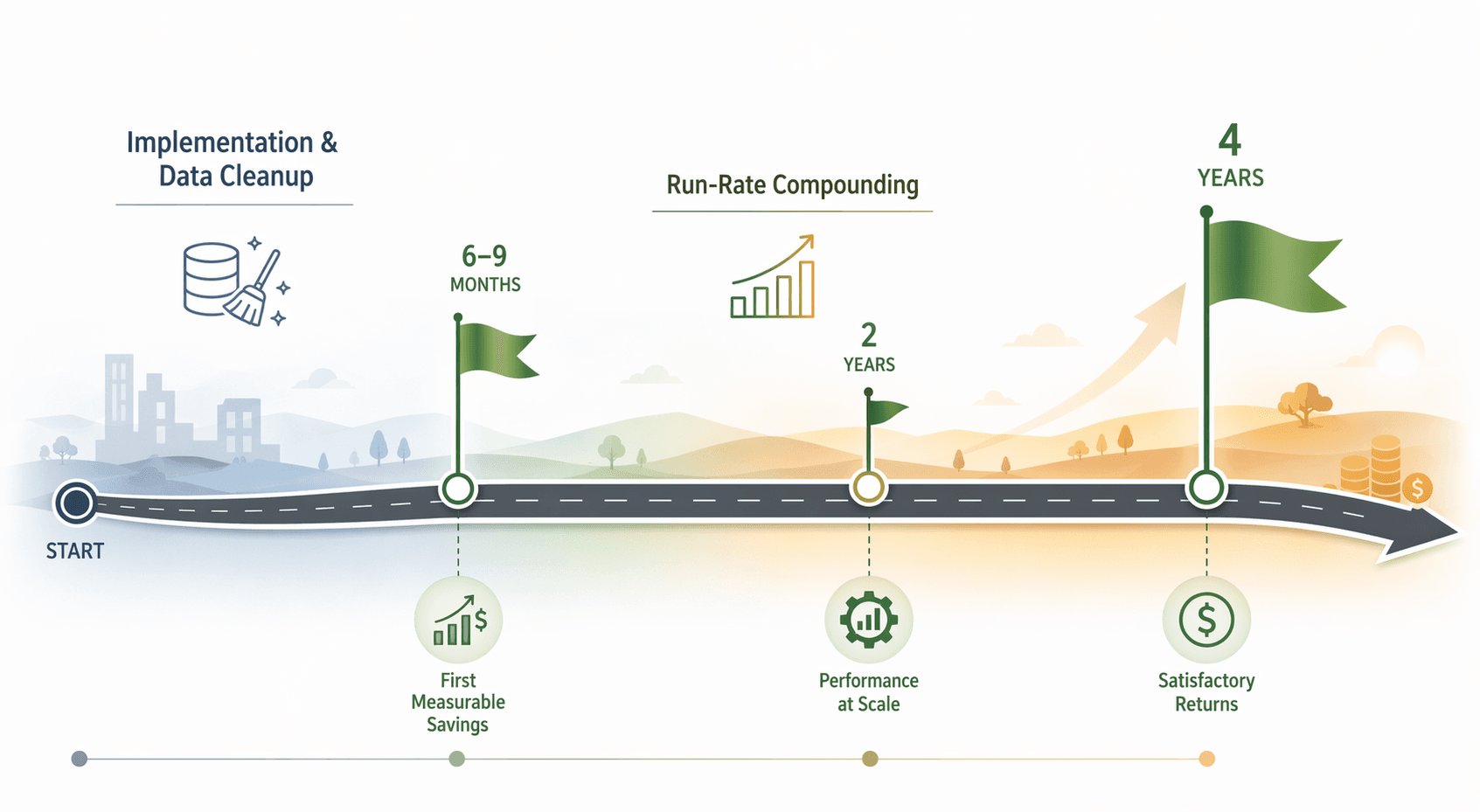
The answer from the available independent evidence is fairly consistent: build the case for early savings, but fund and govern the program on a 2–4 year return path. The finance problem starts when those two time horizons are collapsed into one.
The ROI Clock Starts Before the Savings Clock
Procurement savings usually have to pass through several gates before they become finance-recognized value. A model may identify price variance. A category manager may use that insight in a negotiation. The supplier may agree to a new price. The new price may apply only to future purchase orders. The lower invoice may not hit the P&L until the next production or consumption cycle. If the spend is capitalized, inventory-held, or budget-retained, the timing can stretch further.
This is why early indicators matter but should not be oversold. Deloitte’s timeline data allows for first negotiation-cycle savings in 8–14 weeks and compounding run-rate effects after 4–6 months, while still placing satisfactory ROI for most organizations in the 2–4 year window.[1] Those are not contradictory findings. They describe different measurement points.
| Measurement point | What it can show | What it does not prove yet |
|---|---|---|
| 8–14 weeks | A first negotiation cycle may use AI-generated benchmarking, supplier comparison, or should-cost insight. | The program has not yet absorbed full implementation, adoption, and operating cost. |
| 4–6 months | A run-rate pattern may begin to emerge as more events or categories use the tool. | Savings may still be committed, avoided, or forecast rather than fully realized. |
| 6–9 months | First measurable savings may be visible enough to compare against the original case. | This is still early for enterprise-wide payback, especially where data remediation is material. |
| 2–4 years | Returns can include multiple buying cycles, better adoption, cleaner data, and broader use-case coverage. | The result still depends on category selection, governance, and whether savings were actually captured. |
The practical implication is straightforward: the first savings clock can start during a sourcing event, but the ROI clock starts when money is committed to software, implementation, process redesign, data work, and people’s time. A business case that ignores that front-loaded cost is not conservative; it is incomplete.
What the Initial Cost Base Can Include
Cost estimates vary because organizations are not buying the same thing when they say they are buying procurement AI. One team may be adding an analytics layer to clean spend data. Another may be building supplier-risk scoring, contract intelligence, demand forecasting, and guided sourcing workflows across several systems. A third may be trying to create agentic workflows that touch ERP, supplier portals, and approval processes.
Thinklytics estimates $220,000–$480,000 for the first three procurement AI use cases, including data cleanup, model build, and enablement.[2] That is a useful planning band because it names work that is often hidden in a software-only estimate. It should still be read with the right caveat: Thinklytics is a consulting provider offering procurement AI services, so the figure is best used as one benchmark, not as a market average.
ISG’s 2025 enterprise AI adoption work gives a wider sanity check, placing procurement-adjacent AI use cases at an average of $1 million–$2.6 million per use case.[3] That range is much larger than the Thinklytics estimate, but the difference is not automatically a conflict. It may reflect broader enterprise scope, heavier integration, more complex governance, larger operating models, or use cases that extend beyond a focused initial procurement deployment.
| Cost benchmark | Reported range | How to use it in a business case |
|---|---|---|
| Thinklytics 2026 | $220K–$480K for the first three use cases | Useful for a focused initial procurement program; treat as provider-originated and validate against internal data and integration needs. |
| ISG 2025 | $1M–$2.6M per procurement-adjacent AI use case | Useful as an upper-bound check for larger enterprise deployments, especially where system integration and change management are substantial. |
For finance review, the exact label matters less than the completeness of the cost stack. The estimate should include data profiling and cleanup, taxonomy work, integration, model configuration or build, testing, supplier and contract data mapping, category-manager enablement, governance, ongoing support, and the internal time needed from procurement, IT, finance, legal, and business stakeholders.
The most optimistic procurement AI cases often understate the last item. Internal labor is easy to exclude because it does not always appear as a new invoice. It is still a cost. If category managers spend time validating supplier records, if IT resolves data feeds, and if FP&A has to create new savings-recognition rules, the program is consuming capacity that should be visible in the return model.
Savings Ranges Are Useful Only When the Use Case Is Named
A single ROI percentage for procurement AI is not very meaningful. Spend analysis, supplier-price benchmarking, specification rationalization, demand forecasting, logistics optimization, and contract leakage detection do not have the same baseline, cycle time, or capture mechanism. The better question is which value pool the use case is attacking and how much of that value can realistically be recognized.
BCG’s February 2025 research reports 15–45% category-level cost reduction depending on category.[4] The width of that range is the important part. It suggests meaningful upside, but it also warns against taking the top end and applying it across addressable spend. A fragmented, poorly sourced category with large price dispersion is not the same as a mature direct-material category already under tight contract discipline.
McKinsey’s 2024 procurement and operations work gives a different lens: AI-enabled distribution can reduce logistics costs by 5–20% and procurement spend by 5–15%.[5] Those figures are valuable because they separate logistics and procurement spend rather than blending every operational benefit into a single savings claim. They also show why the baseline has to be defined before the percentage is accepted.
| Use case or value pool | Reported savings or performance range | Conditions to attach before using the number |
|---|---|---|
| Category-level cost reduction | 15–45% | Depends on category type, data maturity, supplier market, sourcing history, and implementation quality. |
| AI-enabled distribution | 5–20% logistics cost reduction | Relevant where logistics network, routing, inventory placement, or distribution decisions are in scope. |
| Procurement spend reduction | 5–15% | Requires a defined addressable spend baseline and a savings-recognition method. |
| Supplier-price benchmarking | 4–12% negotiation leverage | Provider-synthesized benchmark; strongest where price variance exists and suppliers can be competitively challenged. |
| Demand forecasting | 8–18% inventory reduction | Inventory benefit may affect working capital before it affects P&L. |
| Specification rationalization | 6–14% unit cost savings | Requires authority to change specifications, not just analytics that reveal over-specification. |
The Thinklytics use-case ranges are more granular: supplier-price benchmarking at 4–12% negotiation leverage, demand forecasting at 8–18% inventory reduction, and specification rationalization at 6–14% unit cost savings.[2] They are useful for shaping hypotheses, especially when an organization is choosing among early use cases. But because they are a secondary synthesis from a provider source, they should be tested against the organization’s own spend profile before they become a committed forecast.
Accenture’s 2024 supply chain research adds a higher-level benchmark: companies with AI-mature supply chains were 23% more profitable than peers and 6 times as likely to use AI or generative AI widely, based on a sample of 1,148 companies.[6] That is a useful signal about maturity and performance, but it should not be converted into a procurement AI ROI percentage. More profitable companies may have better data, stronger operating discipline, and broader digital capabilities alongside AI adoption.
A Defensible ROI Model Separates Four Kinds of Value
The cleanest procurement AI business cases do not push every benefit into the same savings bucket. McKinsey’s 2026 procurement performance framework defines ROI as total value created divided by total cost, with total value including realized savings, leakage avoided, working-capital benefits, and revenue enablement.[7] That distinction matters because each value type has a different path into financial reporting.
- Realized savings: lower paid prices, reduced freight cost, eliminated duplicate spend, or other reductions that can be tied to actual transactions.
- Leakage avoided: value protected by preventing off-contract buying, missed rebates, maverick spend, or noncompliant supplier use.
- Working-capital benefits: inventory reduction, payment-term optimization, or improved demand-supply alignment that releases cash or reduces capital tied up in operations.
- Revenue enablement: supplier resilience, faster sourcing, or better material availability that supports sales, production continuity, or customer service.
A sourcing team may care about all four. FP&A will usually ask which ones reduce the budget, which ones improve cash, which ones avoid a future cost, and which ones are strategic benefits that should be tracked but not booked as savings. The answer determines whether the benefit belongs in the P&L forecast, the working-capital plan, the risk register, or the narrative supporting the investment.
This is where many AI cases become fragile. A tool that flags contract leakage may create value even when the budget does not fall. A demand forecast that reduces inventory may improve cash conversion before it changes gross margin. Supplier-risk scoring may prevent disruption, but the avoided loss is difficult to prove unless the organization has a clear counterfactual. Those benefits are real enough to manage, but not all of them should be booked the same way.
Why Data Readiness Changes the Payback Period
Procurement AI depends heavily on data that is often scattered across ERP records, contracts, supplier masters, purchase orders, invoices, catalogs, specifications, and sourcing-event histories. Gartner’s 2025 Leadership Vision for CPOs reports that 74% say their data is not AI-ready.[8] That is not a minor implementation note. It is one of the reasons a one-year payback promise can unravel.
Bad supplier names, duplicate records, inconsistent units of measure, missing contract terms, and weak category taxonomies do not merely make dashboards untidy. They change which price comparisons are valid, which suppliers can be benchmarked, which contracts are enforceable, and which spend is actually addressable. If the first phase of the program has to repair those foundations, the savings clock may start later than the software subscription.
For organizations still assessing their starting point, a structured data review belongs before the ROI promise, not after it. A practical place to begin is a dedicated data readiness assessment for AI procurement automation, because the level of remediation required can materially change both cost and timing.
Do Not Turn Pilot Failure Data Into a Procurement Verdict
MIT’s 2025 State of AI in Business study found that 95% of enterprise AI pilots failed to deliver measurable ROI.[9] That figure is sobering, but it is not a procurement-specific failure rate and should not be used as if it were one. Its better use is as a warning about pilot economics: a technically successful pilot can still fail as an investment if it does not reach workflow adoption, financial measurement, and scale.
Procurement has some advantages over more speculative AI domains. It has spend baselines, supplier records, price histories, contracts, sourcing events, and working-capital metrics. Those are finance-friendly ingredients when they are clean enough to use. Procurement also has a disadvantage: savings are politically and operationally contested. A supplier concession, a budget reduction, a cost avoidance claim, and a lower invoice are not the same thing.
The pilot, therefore, should prove more than model accuracy or user enthusiasm. It should prove that the organization can move from insight to negotiated action, from action to transaction-level evidence, and from transaction evidence to an agreed finance treatment. Without that chain, the project may produce intelligence without producing recognized return.
Which Early Use Cases Can Carry a Business Case
The best first use case is not always the one with the highest theoretical savings range. It is the one where the organization has enough data, enough spend, enough decision authority, and enough cycle time to turn AI insight into measured value. A category with visible supplier price variance and an upcoming sourcing event may beat a larger category where specifications are locked, suppliers are sole-source, or contracts are not up for renewal.
Supplier-price benchmarking can show early movement because it fits naturally into negotiation. If the data shows that similar parts, lanes, services, or suppliers are priced inconsistently, the category manager can use that evidence in a sourcing event or renegotiation. The value still depends on supplier leverage and contractual timing, but the route from insight to action is short.
Specification rationalization can produce attractive unit-cost opportunities, but it often requires engineering, quality, operations, or product stakeholders to approve a change. The analytics may be fast; the governance may not be. In the business case, that means savings should be phased according to decision rights, not according to the date the AI identifies the opportunity.
Demand forecasting and inventory optimization often belong in a different value bucket. An 8–18% inventory reduction benchmark is meaningful, but the first financial benefit may appear as working-capital improvement rather than a clean procurement savings line.[2] That is still valuable. It simply needs the right owner and the right metric.
For teams comparing candidate use cases in more detail, a companion AI procurement use-case catalog with ROI and implementation guidance can help separate use cases that are analytically impressive from use cases that are financially measurable.
The CFO Version of the Business Case
A CFO-ready case for procurement AI does not need to be pessimistic. It does need to be explicit. The baseline should say which spend is addressable, which period it covers, which categories are excluded, whether taxes and freight are included, and whether the comparison is against prior-year actuals, current contract prices, market benchmarks, or budget.
- Use ranges, not point estimates, for savings and cost.
- Separate committed savings, realized savings, avoided leakage, working-capital benefit, and revenue enablement.
- Show when each benefit is expected to hit: negotiation, contract, purchase order, invoice, budget, cash, or P&L.
- Include implementation, integration, data cleanup, enablement, internal labor, and ongoing support.
- Phase the return over 2–4 years, even if the first measurable savings appear within the first 6–9 months.
The model should also make adoption visible. If the tool is expected to support ten sourcing events in year one but only three category teams are trained, the forecast is overstated. If the savings case assumes contract compliance but buying channels remain unchanged, leakage may persist. If the AI identifies alternate suppliers but qualification takes a year, the benefit belongs later in the plan.
A useful finance review will challenge the business case in predictable ways: against what baseline, over what period, with what cost included, and under whose authority will the saving be captured? Procurement leaders should welcome those questions early. They force the distinction between a promising analytical finding and a bankable financial outcome.
A Realistic Benchmark Position
Taken together, the evidence supports a positive but disciplined position. Procurement AI can expose savings that manual processes miss, especially in price variance, category analysis, contract leakage, forecasting, and specification decisions. The strongest savings ranges are large enough to justify serious investment, but they are conditional on category economics, data readiness, user adoption, and the organization’s ability to convert insight into negotiated and realized value.
Procurement AI can be financially attractive, but the defensible case separates first savings from full ROI, includes implementation and enablement costs, uses ranges instead of point estimates, and frames the CFO conversation around a 2–4 year return path rather than a one-year miracle.
References
- Deloitte 2025 State of Generative AI, Deloitte, 2025
- AI Procurement Material Cost Reduction 2026, Thinklytics, 2026
- ISG 2025 State of Enterprise AI Adoption, ISG, 2025
- BCG research on AI in procurement, BCG, February 2025
- Revolutionizing Procurement: Leveraging Data and AI for Strategic Advantage, McKinsey, 2024
- Accenture supply chain AI research, Accenture, July 2024
- Redefining Procurement Performance in the Era of Agentic AI, McKinsey, February 2026
- Gartner 2025 Leadership Vision for CPOs, Gartner, 2025
- MIT 2025 State of AI in Business, MIT, 2025
Comments
Join the discussion with an anonymous comment.