
Tariff volatility now lands in the planning calendar before it lands in the earnings call. A new duty changes landed cost, but the practical work spreads much wider: procurement has to reopen supplier comparisons, planners have to test inventory buffers, finance has to revise margin assumptions, and commercial teams have to decide how much price the market can absorb.
That is why the discussion has moved past generic “resilience” language. KPMG’s 2026 supply chain trends analysis treats disruption as a permanent operating condition, making scenario planning a baseline requirement rather than an occasional exercise.[1] McKinsey’s December 2025 Supply Chain Risk Pulse survey found that 82% of companies reported supply chains affected by new tariffs, while the weighted average pass-through rate was only 45%.[2] In plain planning terms, most of the cost cannot simply be invoiced downstream.
The exposure is not confined to finished consumer goods. Suplari, citing S&P Global Market Intelligence, reported that tariffs affect 41.8% of all U.S. imports and 38.3% of intermediate goods used by manufacturers.[3] That pulls tariff risk directly into bills of material, production sequencing, supplier qualification, inventory placement, and working-capital tradeoffs. A vendor-hosted Ivalua, KPMG, and Prewave survey panel also reported that 91% of supply chain and procurement decision-makers expected disruptions from new trade policies, though the limited published methodology means the figure is best read as a field signal rather than a definitive benchmark.[4]
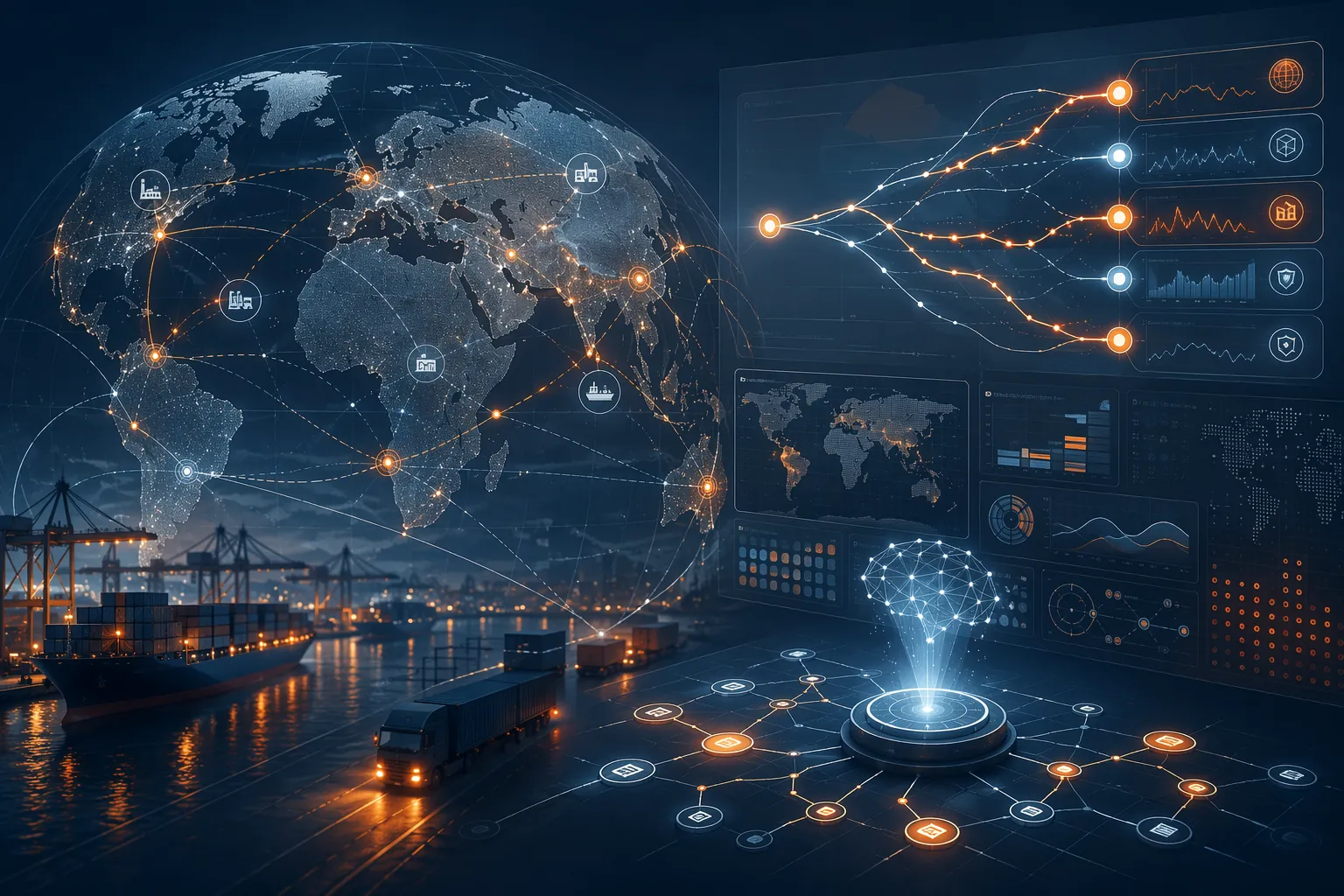
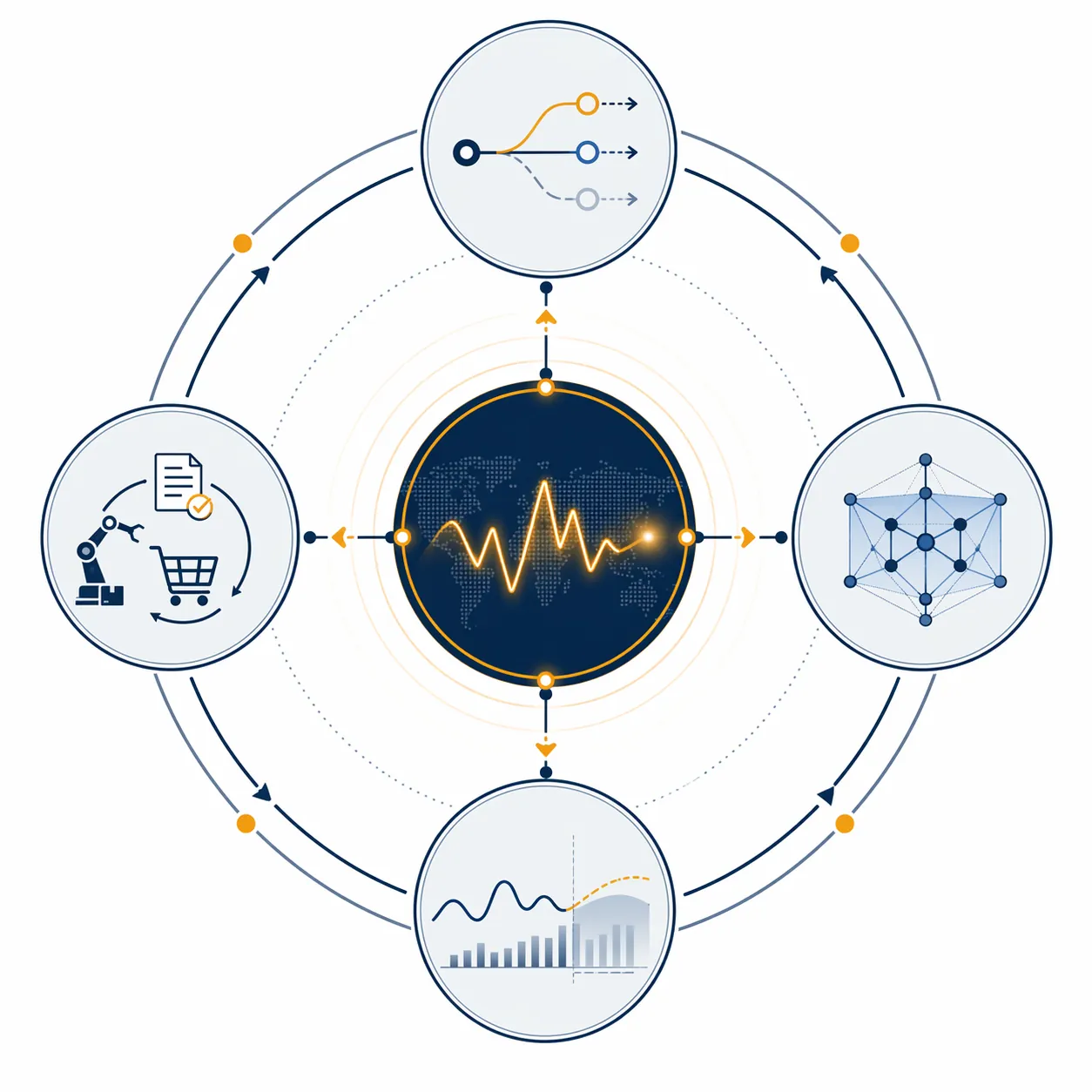
The question is therefore narrower than whether AI can help supply chains. It is which planning decisions become materially better when tariff exposure is modeled continuously instead of handled as a one-off escalation. Four capabilities matter most: multi-scenario modeling, digital twin simulation, agentic procurement support, and dynamic demand and inventory forecasting. They are not equal in maturity, and they should not all be trusted with the same level of autonomy.
| Planning capability | Tariff problem it changes | Decision it supports |
|---|---|---|
| Multi-scenario modeling | Too many supplier, transport, production, and inventory alternatives to compare manually | Which option protects margin, service, and capacity under several tariff paths |
| Digital twin simulation | Policy changes propagate through the network in non-obvious ways | Where the network breaks first, and what mitigation should be tested before execution |
| Agentic procurement support | Supplier risk and sourcing work becomes continuous | Which supplier events, RFPs, and purchasing options need buyer review |
| Dynamic forecasting | Limited price pass-through makes demand, inventory, and margin assumptions unstable | How to reset demand, stock, and financial plans as tariff assumptions change |
Scenario Modeling Turns Tariff Exposure Into Comparable Choices
Tariff response used to start with a spreadsheet question: what happens if this code, supplier, or country becomes more expensive? The harder question arrives ten minutes later. If the company moves volume to another supplier, does transport cost rise? If it pulls inventory forward, does it trap cash in the wrong region? If production shifts, does the new site have capacity, tooling, labor, and approved materials? If price rises, what happens to volume?
Multi-scenario AI planning is valuable because it compresses the comparison cycle. FreightWaves, covering Kinaxis, described manufacturers using AI-powered orchestration to compare tariff scenarios simultaneously across alternative suppliers, transportation options, production plans, and inventory strategies, rather than waiting for departmental evaluations that can take days or weeks.[5] Kinaxis is one example, not the whole market; the broader point is that tariff response becomes a portfolio of options instead of a queue of disconnected analyses.
The quality of the comparison matters more than the number of scenarios. A useful planning run does not merely say that Supplier B is cheaper after a tariff change. It shows whether Supplier B can support the required volume, whether logistics capacity offsets the apparent savings, whether inventory must be repositioned, and whether service risk moves from one customer segment to another. It should also preserve the assumptions behind the recommendation, because procurement and finance will have to defend the move when the next policy update arrives.
This is where many planning teams separate useful AI from impressive demos. A planner does not need a black-box answer that says “switch suppliers.” A planner needs ranked options, visible constraints, sensitivity ranges, and a way to show executives what changes if the tariff is delayed, broadened, narrowed, or challenged. For teams comparing planning platforms, the practical evaluation should look less like a feature checklist and more like a live tariff drill: load the exposure, change the policy assumption, run the alternatives, and watch where the decision bottleneck moves. For a broader planning-platform comparison, see Blue Yonder vs. Kinaxis supply chain planning comparison.
Digital Twins Show Where a Tariff Decision Echoes Through the Network
Scenario modeling compares choices. Digital twin simulation tests how those choices behave inside the network. The difference is important. A sourcing alternative can look acceptable in a cost model and still create problems at a port, plant, warehouse, or customer lane once real constraints are added.
Gartner identified intelligent simulation as one of its top supply chain technology trends for 2026.[6] Dataiku describes supply chain digital twins as models of the end-to-end network that can stress-test tariff scenarios before policy changes take effect.[7] Those descriptions can sound abstract until a planning team uses the twin to answer a concrete question: if a tariff changes the preferred source for a component, which plants lose material availability first, which lanes become congested, and which customers are exposed to service deterioration?
A useful digital twin does not need to replicate every molecule of the supply chain. It needs to represent the constraints that change the decision. For tariff planning, those constraints often include approved supplier lists, country-of-origin rules, lead times, minimum order quantities, production capacity, transportation lanes, inventory policies, service commitments, and margin thresholds. If those variables are stale or incomplete, the twin may only make the wrong answer arrive faster.
The best use is pre-execution stress testing. Before procurement shifts volume, the team can simulate whether the alternate supplier increases risk elsewhere. Before inventory is pulled forward, finance can see the working-capital consequence. Before production is rebalanced, operations can see which constraint becomes binding. That is especially useful when tariffs change close to purchasing deadlines, because the planning team can bring executives a short list of tradeoffs instead of a single recommendation wrapped in fragile assumptions.
Digital twins also create a bridge between planning and execution. Control towers and network twins are often discussed together because planners need both visibility and simulation: what is happening now, and what is likely to happen if a mitigation plan is chosen. For more on those execution-layer models, see three control tower models and ROI.
Agentic Procurement Is Useful, But It Is Not a Permission Slip for Autonomous Buying
Tariff volatility creates procurement work that does not fit neatly into quarterly sourcing cycles. Buyers need to monitor supplier exposure, check country-of-origin changes, reopen cost models, trigger RFPs, compare substitutes, and decide when a tariff-driven move creates more risk than it removes. That is a plausible home for AI agents, provided the organization is clear about where the agent acts and where a human buyer reviews.
KPMG identifies AI-enabled tariff simulators and tariff-management platforms as critical tools in the 2026 planning environment.[1] Pando describes AI agents for continuous supplier risk monitoring, RFP execution, and purchase optimization under trade policy volatility.[8] RELEX also discusses AI use cases across purchasing and supply chain planning.[9] These are useful signals from the market, but they should not be read as evidence that fully autonomous procurement has become normal operating practice.
The safer near-term pattern is bounded automation. An agent can watch for tariff-relevant supplier changes, assemble comparable bids, flag contracts that need review, draft sourcing events, or recommend order adjustments within approved guardrails. It should not quietly move strategic volume to an unproven supplier because a cost model improved. Tariff mitigation can introduce compliance, quality, continuity, and customer-commitment risk; those risks need accountable owners.
The governance questions are practical. Which suppliers are eligible for automated comparison? Which purchase categories can be optimized without executive approval? Which tariff assumptions are authoritative? What happens when the agent recommends a move that improves landed cost but worsens service? Who signs off when legal uncertainty changes the risk profile? The live legal landscape around tariff authority, including the February 2026 Learning Resources v. Trump decision noted in current industry discussion, makes that governance layer harder to treat as an afterthought.
For teams evaluating this area, the right benchmark is not whether an agent can generate a sourcing recommendation. It is whether the agent reduces buyer workload while improving auditability. The recommendation should come with source data, constraints, approval routing, and a record of what changed. For related use cases, see agentic AI procurement and logistics use cases and agentic AI supply chain readiness.
Dynamic Forecasting Matters Because Tariff Costs Do Not Stay in One Column
The 45% weighted average pass-through rate in McKinsey’s survey is the planning pressure point.[2] If companies could pass nearly all tariff cost downstream, tariff planning would still be complex, but the margin problem would be simpler. When pass-through is partial, every assumption becomes connected: price, volume, inventory, supplier mix, margin, working capital, and service.
Dynamic demand and inventory forecasting is not just a better statistical forecast. Under tariff uncertainty, the forecast has to absorb changing landed costs, likely price actions, competitor behavior, customer elasticity, and replenishment timing. A retailer may need to decide whether to buy ahead before a tariff effective date. A manufacturer may need to protect scarce components for higher-margin products. A distributor may need to model whether customers pull demand forward, pause orders, or switch to substitutes.
AI can help by refreshing forecasts as assumptions change and by detecting patterns faster than a monthly planning cycle can. But the forecast still needs business interpretation. If the model sees a demand spike before a tariff deadline, the planning team has to decide whether that is durable demand, pull-forward, panic buying, or channel loading. Treating all of those as the same signal can leave the company with inventory in the wrong place after the policy window closes.
The inventory decision is just as important as the demand signal. Tariff volatility can make safety stock look attractive, but extra inventory is not neutral. It consumes cash, raises obsolescence risk, and may lock the company into a sourcing assumption that changes again. Dynamic forecasting earns its place when it lets planners compare service protection against margin and working-capital cost, not when it merely recommends “more buffer.” For a deeper look at forecasting benchmarks, see AI demand forecasting accuracy benchmarks.
The Adoption Gap Is Now Part of the Planning Problem
The market is moving, but not as far as some vendor language suggests. The Ivalua, KPMG, and Prewave survey panel reported that 77% of organizations were rolling out AI tools, again with the caveat that the published summary provides limited methodology.[4] RELEX’s 2026 State of Supply Chain report, based on 500-plus supply chain leaders with a retail and CPG skew, found that 67% were more confident using AI, while only 10% trusted AI for critical decisions without human review.[9] McKinsey separately found that only 19% of companies were deploying AI at scale.[2]
That gap is not a minor implementation footnote. It changes how tariff-response operating models should be designed. If AI is mostly in rollout or pilot, the process still needs human review gates, clear exception handling, and executive-ready scenario outputs. If the data foundation is weak, adding an AI layer may expose the problem rather than solve it. If the organization lacks agreement on which tariff assumptions are official, faster modeling can simply create faster disagreement.
There is also a budget tension. McKinsey found that the share of companies planning major investments in digital supply chain systems fell from 47% to 25% year over year as companies diverted resources to tactical tariff responses.[2] That is the awkward part of the current cycle: the burning platform can justify better planning tools, while the firefighting can also consume the money and attention needed to implement them.
Gartner’s longer-range prediction is more aggressive: by 2031, it expects 60% of supply chain disruptions to be resolved without human intervention.[10] That should be treated as a forward marker, not a description of current maturity. In 2026, the credible operating model for most companies is hybrid. AI narrows the option set, refreshes the analysis, exposes network consequences, and prepares procurement actions. People still own the policy assumptions, risk appetite, supplier commitments, and final tradeoffs.
That hybrid model is not a failure of ambition. It is what tariff volatility requires right now. The risk is structural and multi-variable, but the decisions carry legal, financial, operational, and customer consequences that most organizations are not ready to delegate completely. The useful test for AI planning tools is whether they shorten the distance between a policy shock and a defensible decision.
A serious evaluation should therefore ask four questions. Can the tool model tariff scenarios across suppliers, lanes, production plans, inventory positions, and margin assumptions? Can it simulate network consequences before the company acts? Can it support procurement work without hiding governance risk? Can it refresh demand and inventory plans as policy, price, and customer behavior change? If the answer is yes, the tool belongs in the tariff planning conversation. If the answer depends on clean data, clear approval rights, and disciplined rollout, that is not a disqualifier; it is the implementation work.
For broader adoption and ROI context, see AI supply chain disaster preparedness bottlenecks, supply chain AI ROI from pilot to P&L, and the AI supply chain strategy gap.
References
- Supply Chain Trends 2026 — KPMG
- Supply Chain Risk Survey — McKinsey, December 2025
- Tariff Response Plan for Procurement — Suplari
- How Tariffs Impact Procurement and Supply Chains — Ivalua
- AI shifts from planning to execution as manufacturers confront tariff uncertainty — FreightWaves
- Gartner Identifies Top Supply Chain Technology Trends for 2026 — Gartner, June 30, 2026
- Supply Chain Resilience With AI — Dataiku
- Why AI Agents Are Essential for Navigating Trade Policy Volatility — Pando
- Supply Chain AI — RELEX
- Gartner Predicts 60% of Supply Chain Disruptions Will Be Resolved Without Human Intervention by 2031 — Gartner, March 18, 2026
Comments
Join the discussion with an anonymous comment.