
The important shift in supply chain AI in 2026 is not that systems can explain more. It is that some are being designed to act. Gartner put agentic AI and collaborative multiagent systems among its top supply chain technology trends for 2026, under an autonomy-and-agency theme, and forecast that 40% of enterprise applications will integrate task-specific AI agents by the end of 2026, up from less than 5% today. It also expects 50% of cross-functional supply chain management solutions to use intelligent agents to autonomously execute decisions by 2030.[1]
That forecast matters because it moves the discussion out of the safe territory of recommendations. A demand-planning model that flags a potential stockout still leaves the planner to open the order screen, check the supplier constraint, negotiate the service tradeoff, and explain the working-capital impact. An agentic system is meant to close more of that loop: detect the issue, reason through options, coordinate with other systems or agents, execute a bounded action, and leave evidence of what it did.

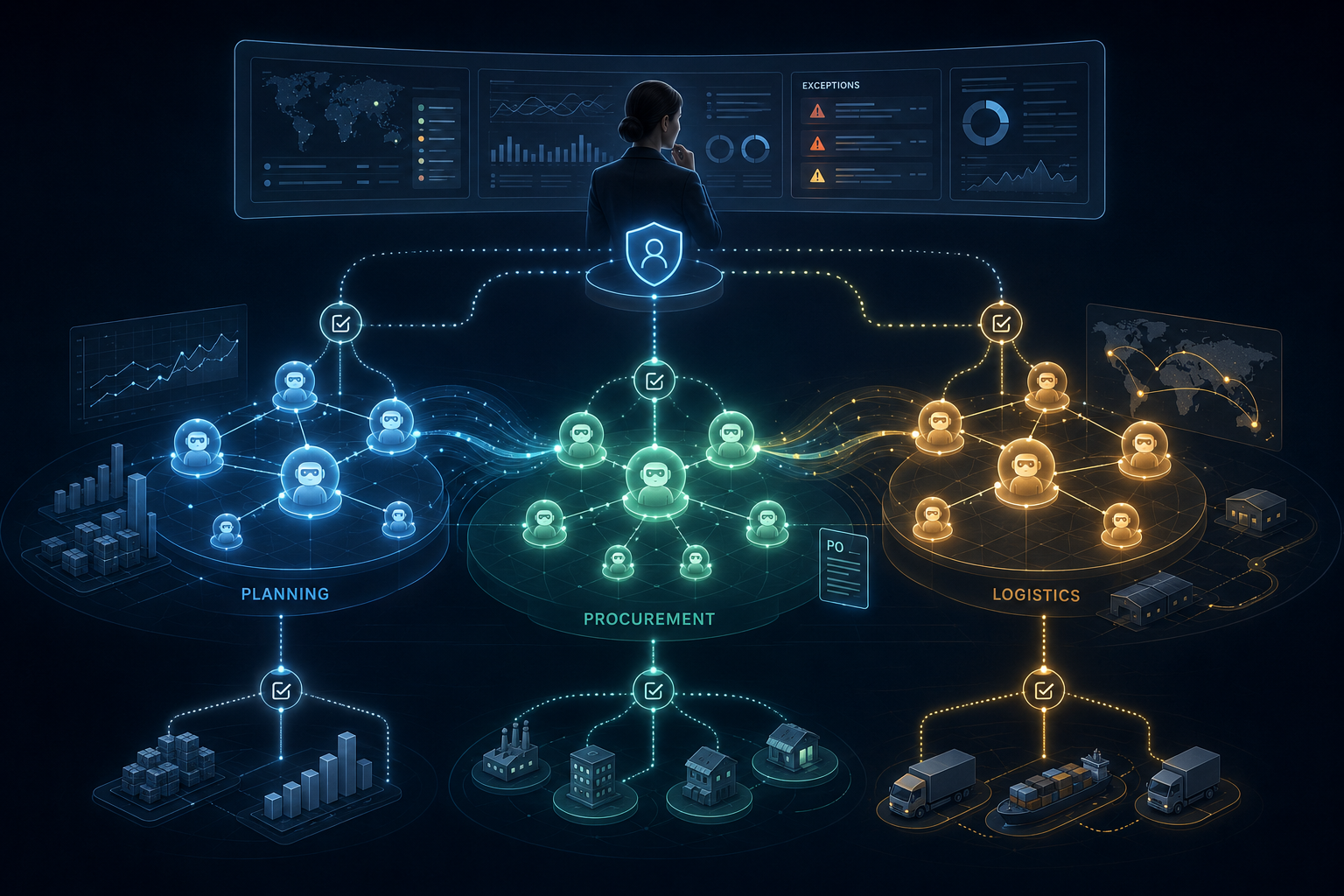
In supply chain terms, agentic AI means systems that can reason, plan, coordinate, and execute within defined planning, procurement, logistics, and service constraints. The useful boundary is not whether the interface looks conversational. It is whether the system is allowed to change something operational: create a replenishment proposal, trigger a spot buy, reassign a shipment, file a customs document, open a supplier exception, or rebalance supply against demand.
The prize is large enough to justify executive attention. BCG estimates that agentic AI in supply chain can deliver working-capital reductions of up to 30% and EBITDA uplift of 2 to 4 percentage points. It also says agentic systems represented 17% of total AI value in 2025 and projects that share to reach 29% by 2028.[2] Those are not small dashboard-efficiency numbers. They imply fewer buffers, faster exception handling, tighter service-cost tradeoffs, and decisions that move before the next weekly meeting.
The catch is that the same value case exposes the adoption problem. Working capital comes down only if the organization trusts the system enough to reduce inventory, change buying behavior, or move transportation commitments. EBITDA improves only if the agent’s action does not create hidden expediting, customer-service, compliance, or planner-rework costs somewhere else. In production, autonomy is never just a model property. It is an operating permission.
Where Autonomy Is Becoming Operational
The most credible 2026 use cases are not abstract “AI copilots.” They sit in workflows where a delay, mismatch, missing document, or policy exception already has a known decision path. Deloitte describes five agentic supply chain applications: always-on disruption detection and resolution, autonomous trucking brokerage, agentic customs filing, continuous service-level optimization, and procurement automation with exception resolution.[3] The common pattern is not novelty. It is that the agent can observe a narrow operating context, compare options, and push a transaction or escalation into systems people already use.
Disruption response is the easiest place to see why this is different from predictive supply chain AI. A traditional control tower can alert a planner that a port delay, supplier miss, or transportation failure threatens a customer order. An agentic control-tower workflow can evaluate alternate inventory, supplier, route, and service options; recommend or execute the approved recovery move; and document the reason. The hard question is not whether the agent can generate options. It is whether it is allowed to choose the recovery action before the customer-service team, logistics team, and finance owner all agree on the service-cost tradeoff.
That distinction is why logistics is one of the more practical early domains. Transportation buying has repeated decisions, comparable options, clear timing pressure, and measurable outcomes. Dataiku describes a transportation buying example involving autonomous negotiation and sourcing, where agents support the buying process rather than merely summarize carrier data.[4] In a constrained version of the workflow, an agent might source capacity within lane, service, rate, and carrier-policy thresholds, then route exceptions to a human when price, reliability, or customer impact falls outside bounds.
Customs filing is another useful test of production seriousness. The agent does not need a dramatic personality; it needs correct product, shipment, origin, destination, classification, and documentation data. It must know which filings can be prepared automatically, which require compliance review, and which missing field blocks release. If the agent submits bad information, the consequence is not an ugly chat transcript. It is a delayed shipment, a compliance exposure, or a human team cleaning up a preventable exception.
Procurement has a similar split between attractive demos and durable operating design. KPMG identifies three forces making agentic procurement more likely in 2026: capability maturity, strategic pressure to embed agents across the procurement lifecycle, and operating-model evolution toward extreme automation and agentic AI.[5] The practical use cases are often less glamorous than a fully autonomous buying organization: supplier onboarding checks, intake triage, purchase-order exception handling, contract-policy matching, invoice dispute routing, and low-risk sourcing events.
The procurement manager’s concern is predictable and legitimate. If an agent resolves an exception by changing a delivery date, substituting a supplier, or approving a price variance, who owns the decision? If it leaves the exception unresolved, who is paged? If it resolves the exception correctly but creates a budget or service issue downstream, which function carries the variance? Agentic procurement becomes useful when those answers are designed before the workflow is automated.
Supply-demand balancing shows the same pattern at a broader level. Dataiku describes medical device manufacturing with supply-demand balancing agents, a domain where service, regulatory, inventory, and production constraints collide.[4] This is exactly where agentic AI can be valuable, because the decision is rarely isolated. Pulling supply forward may protect a hospital order but consume constrained component inventory. Delaying a lower-priority order may improve service for one customer segment while creating a sales escalation elsewhere. The agent has to reason across the network, but the business still has to define which tradeoffs it is authorized to make.
The Value Case Runs Into the Trust Gap
The most uncomfortable number in the 2026 agentic AI discussion is not a market forecast. RELEX’s 2026 State of the Supply Chain research found that only 10% of organizations trust AI to make critical supply chain decisions without human review.[6] That does not mean organizations reject AI. It means they distinguish between using AI to prepare a decision and allowing AI to take one.
PwC’s 2026 survey adds a second constraint: only 4% of organizations report success across embedded AI, scaled agents, horizontal operating models, and delivered ROI.[7] That result is more useful than another proof-of-concept success story because it names the full stack. Scaled agents need embedded workflows, horizontal operating models, integration discipline, and measurable returns at the same time. A strong model cannot compensate for fragmented process ownership.
This is where the supply chain AI conversation often gets sloppy. Adoption is not the same as effectiveness. A function can deploy agents into procurement intake, planning exceptions, or logistics triage and still keep every consequential decision behind a human approval gate. That may be the correct first stage, but it should not be counted as autonomous execution. Likewise, a vendor-published workflow can show what is technically possible without proving that a typical enterprise has the data, authority model, and audit discipline to run it at scale.
| Workflow | What the agent may do | What remains human-owned |
|---|---|---|
| Disruption response | Detect risk, compare recovery options, trigger approved reroute or replenishment action | Service-cost policy, customer prioritization, override on high-impact exceptions |
| Transportation buying | Source capacity within lane, rate, carrier, and service thresholds | Exceptions outside policy, strategic carrier commitments, material cost tradeoffs |
| Customs filing | Prepare filings, validate required data, route missing or risky records | Compliance interpretation, disputed classifications, regulatory accountability |
| Procurement exceptions | Match policy, resolve low-risk mismatches, route supplier or price anomalies | Supplier strategy, budget exceptions, contractual judgment |
| Supply-demand balancing | Recommend or execute bounded allocation and replenishment moves | Customer segmentation rules, scarcity tradeoffs, financial exposure |
The table is deliberately framed around authority, not features. If a team cannot say what the agent is permitted to do, it is not ready to scale the agent. If it cannot say who reviews exceptions, it is not ready to reduce headcount assumptions. If it cannot reconstruct why the system acted, it is not ready to let the action touch customers, suppliers, carriers, or regulators.
Readiness Starts Below the Agent Layer
The data foundation for agentic supply chain work is more demanding than the foundation for a dashboard or chatbot. Agents need to act across systems that were rarely designed around the same business objects. A planner may think in item-location-week. Procurement may think in supplier, contract, purchase order, and payment terms. Logistics may think in shipment, lane, carrier, appointment, and accessorial charge. Finance may care about working capital, margin, accruals, and authorization limits. The agent has to move through these objects without silently changing their meaning.
That is why cross-system ontology and data fabric are business-value infrastructure. Before an agent can rebalance supply, it must know whether available inventory is actually available to promise. Before it can source transportation, it must know which carriers are approved, which rates are current, and which service failures matter. Before it can resolve a procurement exception, it must know whether the variance is a harmless master-data mismatch or a policy breach. These are not backend details. They decide whether autonomy saves work or creates new work.

A useful readiness architecture has four connected layers: trusted operational data, policy and governance rules, oversight design, and bounded execution authority. The layers do not mature evenly. Many companies can build an agent that drafts an action long before they can prove the data lineage behind that action or assign accountability for the result.
- Trusted operational data: The agent can identify which system is authoritative for inventory, supplier status, order priority, rate, lead time, and customer commitment.
- Shared business ontology: Planning, procurement, logistics, finance, and service teams use compatible definitions for the objects the agent touches.
- Policy gates: The organization defines thresholds for value, service impact, compliance exposure, supplier risk, and customer sensitivity.
- Audit trail: Every agent action records the triggering event, data used, options considered, rule applied, execution path, and human override if any.
- Oversight model: Humans are not inserted everywhere; they are placed where judgment, accountability, or exception cost justifies review.
Human oversight also needs more precision than the usual “human in the loop” language. Some decisions require approval before execution. Others only need human-on-the-loop monitoring, where the agent acts inside policy and a person reviews exceptions, patterns, or sampled outcomes. Low-value, reversible actions can often be automated earlier than high-value, irreversible, or compliance-sensitive moves. The oversight model should follow consequence, not organizational comfort.
Graduated Autonomy Is the Practical Scaling Path
The cleanest production path is usually graduated autonomy. Start with observe-and-explain workflows, move to recommend-and-draft, then allow execution inside narrow thresholds, and only later widen the domain. This is not a lack of ambition. It is how an organization learns whether the agent’s decisions survive contact with master data, exception ownership, audit requirements, and budget consequences.
| Autonomy level | Typical authority | Readiness test |
|---|---|---|
| Advisory | The agent identifies issues and explains options | Users trust the signal and can trace the data behind it |
| Drafting | The agent prepares orders, filings, messages, or exception resolutions for approval | Human reviewers correct less than they reject for policy reasons |
| Bounded execution | The agent acts within value, risk, service, and compliance thresholds | Exceptions are clear, auditable, and routed to the right owner |
| Expanded orchestration | Multiple agents coordinate across planning, procurement, logistics, and service workflows | Cross-functional tradeoffs are governed before the system acts |
The last row is where collaborative multiagent systems become more than an architecture diagram. A planning agent may detect demand risk, a procurement agent may evaluate supplier options, a logistics agent may source capacity, and a service agent may assess customer impact. If each agent optimizes locally, the business gets faster conflict. If they share constraints and escalation rules, the system can coordinate around the enterprise objective rather than the loudest functional metric.
Finance has to be in that design earlier than many technology roadmaps assume. BCG’s working-capital and EBITDA projections are attractive because they are economic outcomes, not technology usage metrics.[2] But the levers that create those outcomes often sit across functions: inventory buffers, payment terms, expedite costs, premium freight, service penalties, obsolete stock, and constrained-supply allocation. If finance only appears at the business-case approval meeting, the agent may optimize an operating metric while hiding the economic tradeoff.
Workforce design deserves the same treatment. Agentic AI does not simply remove manual steps; it changes the work left behind. Planners review fewer routine alerts but more boundary cases. Procurement teams spend less time chasing status and more time governing supplier and policy exceptions. Logistics coordinators may move from transactional booking to exception oversight and carrier-performance intervention. Control-tower operators become responsible for monitoring autonomous flows, not just reacting to red dashboards.
What Separates a Serious Deployment From an Agentic Label
A serious deployment can answer plain operational questions. Which decisions are fully autonomous today? Which are drafted for approval? Which systems can the agent write back to? Which data sources are authoritative? Which actions are reversible? Which exception queues get created? Which team is accountable when the agent acts correctly according to policy but the policy produces a bad business result?
Those questions matter more than broad market-sizing claims. Market estimates for AI in supply chain vary partly because sources define the market differently: some include analytics, some include generative interfaces, some include automation platforms, and some isolate agentic execution. For an operating leader, the useful scope is narrower. The relevant system is the one that touches a decision, a transaction, a commitment, or an exception path.
The same discipline should apply to performance claims. A pilot that reduces alert review time is promising, but it does not prove autonomous decision quality. A sourcing agent that finds a lower rate does not prove network-level value if service failures increase. A supply-balancing agent that protects priority demand does not prove working-capital benefit if planners compensate by rebuilding shadow buffers. Outcome measurement has to follow the consequence chain, not the demo step.
By Q3 2026, the direction is clear enough: agentic AI is moving into supply chain workflows, and it is more consequential than another layer of predictive recommendations. The constraint is equally clear. The organizations most likely to capture the upside are not the ones that give agents the broadest mandate first. They are the ones that grant autonomy gradually, on governed data, with accountable operating models and cross-functional orchestration already in place.
References
- Gartner Identifies Top Supply Chain Technology Trends for 2026, Gartner, June 30, 2026.
- How AI Agents Are Transforming Supply Chains, BCG, 2026.
- Agentic Supply Chain Artificial Intelligence Manufacturing, Deloitte, March 2026.
- Supply Chain AI Trends 2026, Dataiku, 2026.
- Supply Chain Trends 2026, KPMG, 2026.
- 2026 State of the Supply Chain, RELEX.
- 2026 survey on embedded AI, scaled agents, horizontal operating models, and ROI, PwC.
Comments
Join the discussion with an anonymous comment.