
The annual planning calendar is a poor instrument for US-Canada tariff exposure now. A manufacturer can finish a sourcing review in January, lock freight assumptions in February, approve a margin plan in March, and still find that the next tariff move has made the whole chain of decisions stale before the next quarterly meeting. The argument that follows is rarely about tariffs in the abstract. It is about which file is current: procurement’s supplier terms, logistics’ lane costs, finance’s margin bridge, sales’ customer commitments, or compliance’s HTS classification table.
That is why AI supply chain planning for US Canada tariffs has become less a technology experiment than an operating requirement. In Thomson Reuters’ 2026 Global Trade Report, based on 225 trade professionals, 72% cited tariff volatility as the top impact on their work, up from 41%; 76% expected tariffs to remain in place for four or more years; and 68% ranked supply chain as their top priority, double the prior year’s level.[1] Those numbers matter because they describe a planning condition, not a temporary inconvenience.
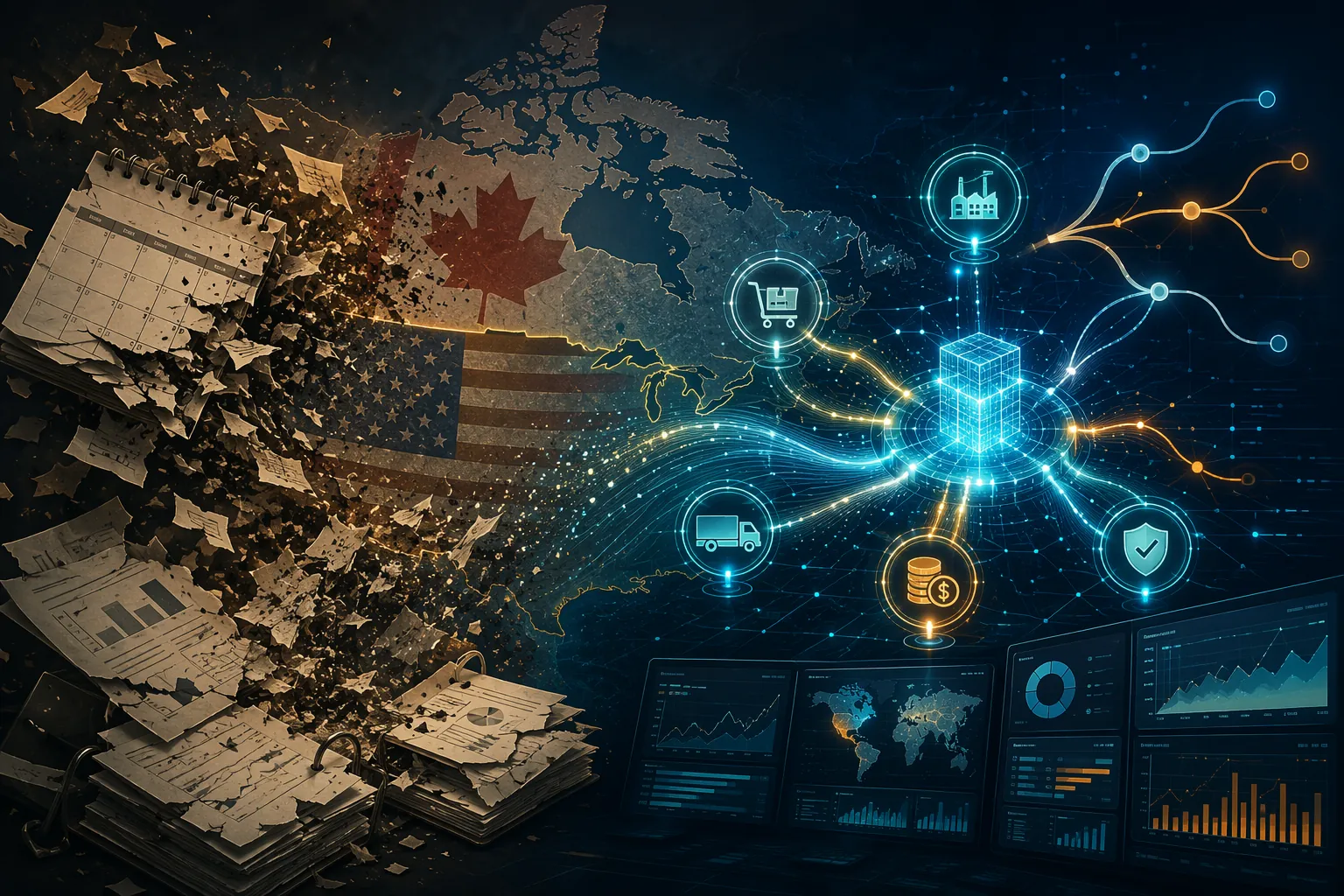
A June 2026 analysis from AI in the Chain makes the same point from the planning side: tariff uncertainty, freight-rate volatility, and geopolitical disruption have made static planning obsolete, pushing companies toward real-time scenario planning with digital twins that bring procurement, logistics, finance, and compliance data into the same model.[2] The useful part of that framing is not the phrase “digital twin.” It is the demand that the model carry enough operational detail to survive a meeting with people who own different parts of the P&L.
The Tariff Response Loop Has To Shrink
A tariff shock creates a chain reaction. Compliance first needs to know which classifications are affected. Procurement needs to know which suppliers and contracts are exposed. Logistics needs to know whether alternative lanes change freight cost, service time, or border complexity. Finance needs to see margin exposure by product, customer, and region. Sales wants to know whether prices are changing and when. Inventory planners need to decide whether to pull stock forward, rebalance across warehouses, or tolerate a service risk.
Traditional planning tools can answer parts of that sequence. The delay comes from stitching the answers together. A tariff rate changes, then analysts export purchase orders, cleanse supplier lists, check classification codes, add freight assumptions, send landed-cost files to finance, wait for pricing input, and discover that one team used last month’s supplier table while another used a revised SKU hierarchy. By the time the executive call starts, the organization may have several careful answers that cannot be reconciled.
| Tariff-response action | What the planning system must connect |
|---|---|
| Detect the policy change | Tariff rate, effective date, affected categories, compliance ownership |
| Map exposure | SKUs, HTS classifications, suppliers, contracts, lanes, inventory, customer commitments |
| Simulate alternatives | Supplier changes, country-of-origin shifts, freight lanes, lead times, landed cost |
| Test commercial impact | Price pass-through, margin absorption, demand response, customer segmentation |
| Adjust inventory | Safety stock, forward buys, warehouse placement, working-capital limits |
| Push the decision | Approved scenario, planning assumptions, execution tasks, audit trail |
AI planning earns its place only if it compresses that loop. The software is not valuable because it produces a more polished dashboard. It is valuable when a planner can change a tariff assumption and see the effect move through supplier selection, landed cost, inventory, demand, and margin quickly enough for the organization to choose a response before the next set of conditions changes.
A Digital Twin Is Only As Good As The Data It Can Reconcile
In tariff planning, the digital twin is not a decorative replica of the supply chain. It is the working version of the network: suppliers, facilities, lanes, bills of material, SKUs, customer demand, inventory policies, lead times, landed-cost rules, and compliance attributes. If the model does not know which imported component belongs to which finished good, which HTS code applies, which supplier term governs duty liability, and where the margin sits, it cannot answer the real question.
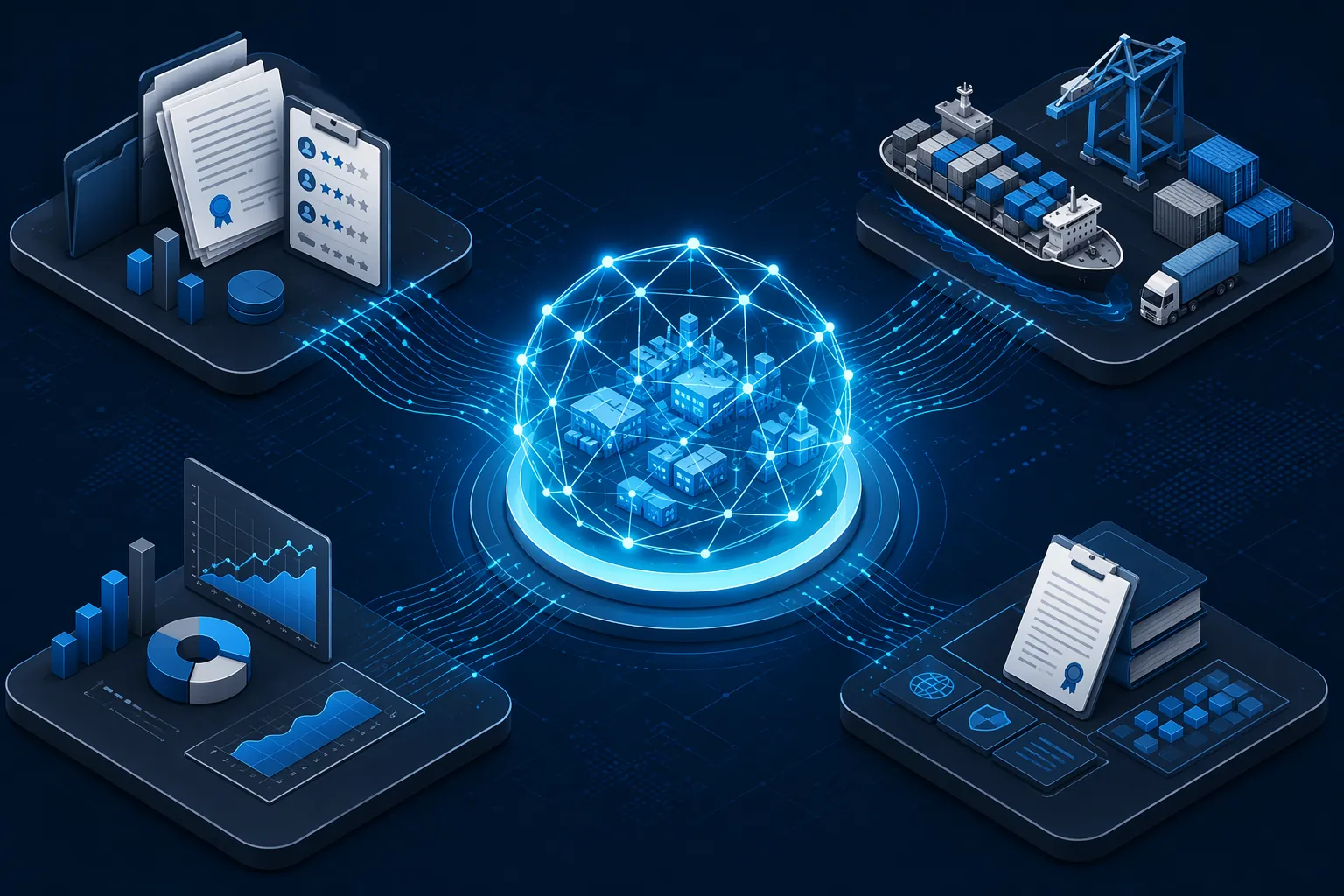
This is where many AI planning programs either become useful or become expensive theater. Procurement data alone can show supplier exposure, but not customer margin. Logistics data can show cross-border lanes, but not whether a sourcing change triggers a classification review. Finance can calculate gross margin erosion, but not whether an alternative supplier can meet lead-time or quality requirements. Compliance may hold the data that determines whether the scenario is lawful or wishful.
The practical requirement is a governed data layer that lets different functions argue from the same scenario. Procurement can still challenge supplier feasibility. Finance can still challenge the margin assumption. Compliance can still block an option that fails classification or documentation requirements. But they are no longer debating whether the base data came from the right spreadsheet.
This also explains why mid-market and enterprise buyers should be careful with broad AI claims. A platform that can run sophisticated simulations will still struggle if supplier master data is incomplete, if HTS codes are maintained outside the planning environment, if freight assumptions are updated manually, or if pricing decisions live in a separate commercial workflow. The platform may reveal those gaps faster. It does not make them disappear.
Scenario Modeling Turns The Tariff Question Into A Set Of Trade-Offs
The first useful scenario is usually not exotic. It asks what happens if the current tariff assumption applies to current purchase orders, current suppliers, and current freight lanes. That baseline matters because it identifies the size and location of the problem. A company may discover that the largest duty increase is not in the highest-volume product line, but in a lower-volume component with little pricing power and no qualified alternate source.
From there, AI-enabled planning can compare alternatives that would take too long to evaluate manually: shift volume from one supplier to another, split demand between plants, use a different lane, change inventory placement, absorb cost for a strategic customer, or pass through price on products where demand is less sensitive. The decision is still a business decision. The compression comes from letting planners see the consequences side by side instead of waiting for each function to rebuild its part of the analysis.
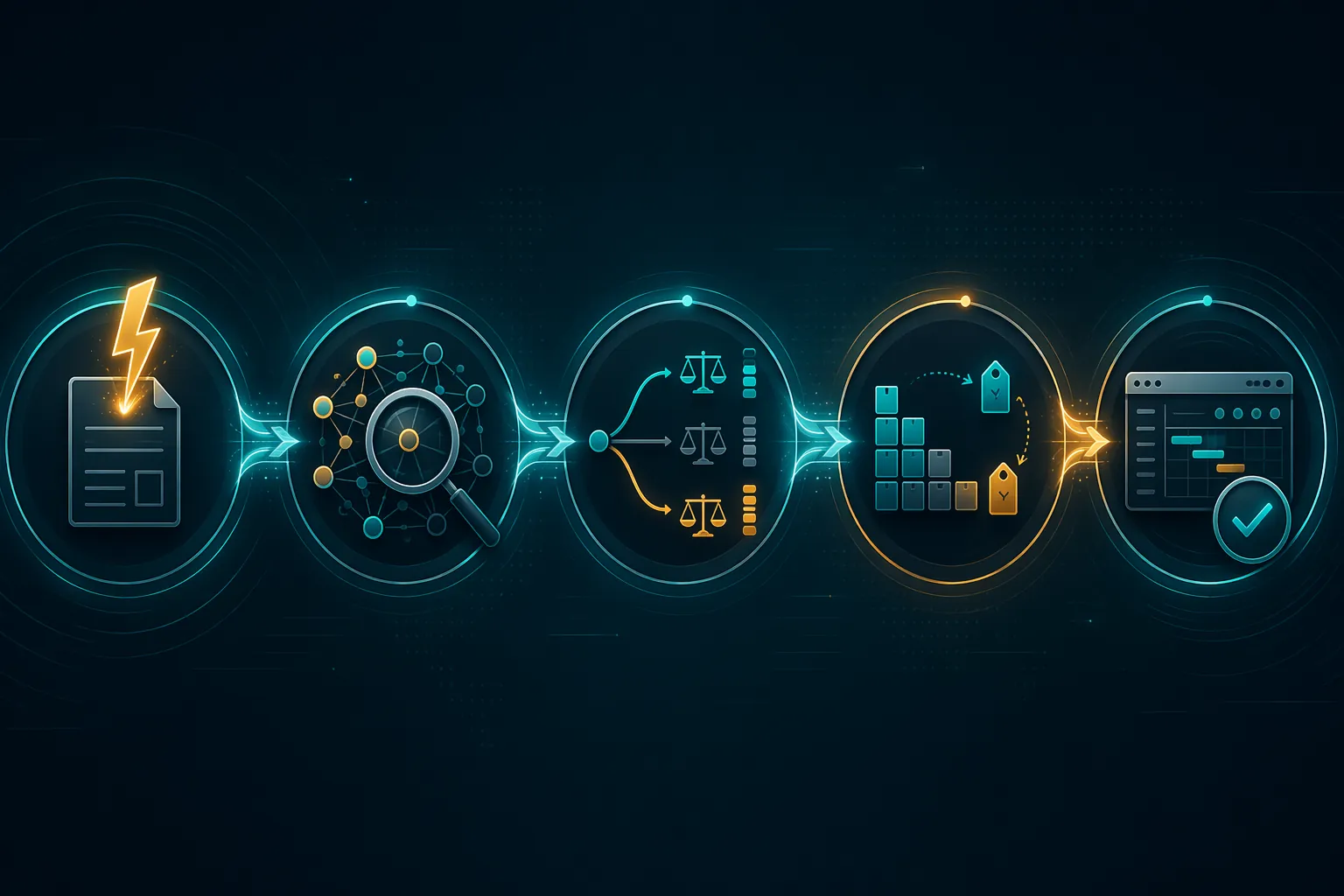
The strongest scenario workflows keep the audit trail visible. If the approved plan assumes a Canadian supplier shift, a different freight lane, and partial price pass-through, the model should preserve those assumptions. When the tariff rule changes again, planners need to revise the scenario, not reconstruct the logic from meeting notes.
Sourcing Reconfiguration Is The Obvious Test Case
Sourcing is where the value of a unified model becomes easiest to see. C3 AI describes a tariff-resilience framework in which a unified digital twin lets companies model alternative suppliers across the United States, Mexico, and Canada and compare landed costs under different tariff scenarios in hours.[3] Kinaxis Maestro customers are also described as using dynamic what-if analysis to model sourcing alternatives when tariff assumptions change.[4]
Those examples should be read as capability patterns, not as proof that every implementation will produce the same result. The operational point is that sourcing alternatives cannot be judged on tariff rate alone. A supplier that avoids one duty exposure may increase freight cost, lengthen lead time, strain capacity, trigger new compliance work, or create a service-level risk. A planning model that compares only purchase price and tariff rate gives procurement a narrow answer. A model that includes capacity, lanes, lead times, classifications, and margin gives the business a decision.
This is also where finance has to be inside the workflow, not downstream from it. If an alternate supplier protects gross margin but increases working capital or service risk, the scenario needs to show that before the sourcing team treats it as the preferred path. The same applies in reverse: a higher landed cost may be acceptable if it protects a customer commitment that carries strategic value.
Pricing And Demand Models Keep Margin Decisions From Becoming Guesswork
Tariff planning does not end when a lower-cost supply option is unavailable. In many categories, the next question is commercial: pass the cost to customers, absorb it, change promotions, alter pack or product mix, or accept a lower margin for a defined period. Dataiku describes AI helping companies evaluate when to pass tariff costs to customers versus when to absorb them, using demand elasticity models to simulate the effect of different choices.[5]
The important distinction is that elasticity modeling estimates response; it does not guarantee behavior. A tariff-driven price increase may be accepted in one segment and rejected in another. A customer under contract may have different pass-through terms from a spot buyer. A product with few substitutes can behave differently from one sitting in a crowded category. The planning system needs to make those differences visible enough that sales and finance can choose deliberately.
Inventory Front-Loading Has To Be Timed, Not Just Authorized
When an effective date is known, inventory planners may consider pulling supply forward before the tariff applies. ConverSight describes AI decision intelligence being used to optimize safety stock levels ahead of tariff implementation dates while minimizing working-capital impact.[6] That caveat is essential. Front-loading can reduce duty exposure, but it can also tie up cash, crowd warehouse space, increase obsolescence risk, and leave the company overstocked if demand softens.
A useful model does not simply recommend “buy ahead.” It shows which SKUs justify earlier purchases, where that inventory should sit, which customers or regions it protects, and how long the working-capital burden lasts. It should also show when the tariff exposure is smaller than the cost of carrying the extra inventory.
From Scenario To Execution
The weak handoff in many tariff responses is the gap between analysis and execution. A planning team may identify the preferred scenario, but procurement still has to change orders or suppliers, logistics has to book differently, finance has to update margin expectations, and compliance has to preserve the documentation that supports the decision. If the scenario remains a presentation artifact, the organization has only accelerated analysis, not response.
This is why tariff planning increasingly overlaps with control-tower and execution workflows. The approved scenario should create tasks, update planning assumptions, and make exceptions visible. If the decision is to shift 30% of a component to an alternate supplier, planners need to know whether the supplier accepted the volume, whether the lane has capacity, whether lead time changed, and whether the margin assumption still holds. For a related look at real-time disruption response, ChainSignal’s article on AI shipping disruption control towers covers the execution-side logic.
The governance layer matters here. Someone has to own the approved scenario. Someone has to decide whether a new tariff interpretation triggers a rerun. Someone has to lock or revise the assumptions used by sales, finance, and procurement. AI can propose, rank, and refresh scenarios; it should not quietly change the operating plan without accountable review.
What To Make Of The ROI Claims
There is enough performance evidence to justify serious budget conversations, but not enough to treat every published gain as transferable. A second-hand citation of McKinsey 2026 survey data reports that AI adopters saw a 12.7% drop in logistics costs and a 20.3% reduction in inventory; because the original McKinsey source was not independently verified in the available research, those figures should be used as directional support rather than a benchmark promise.[7]
FreightWaves reports that Kinaxis customer evidence shows measurable first-year improvements in inventory, customer service, and disruption response time, and frames AI in supply chain planning as moving from “nice-to-have” to necessity under tariff pressure.[4] That is useful, but it is still vendor-adjacent evidence. Buyers should ask what baseline was used, which process changed, how much data integration was already in place, and whether the gains came from planning automation, better data governance, process redesign, or all three.
Market-growth forecasts tell a similar story: momentum is real, but it is not the same as implementation success. Global Trade Magazine reported that the AI market reached $19.8 billion in 2026, and cited Gartner forecasts that supply chain management software with agentic AI would grow from less than $2 billion in 2025 to $53 billion by 2030, with 60% of disruptions handled without humans by 2031.[8] Those forecasts show where vendors and buyers are heading. They do not remove the need to validate whether a company’s own tariff data, planning process, and governance are ready.
The Practical Threshold
For US-Canada tariff exposure, the threshold question is not whether a planning platform has AI features. It is whether the organization can connect the affected tariff rule to SKUs, suppliers, purchase orders, contracts, freight lanes, inventory positions, pricing decisions, and margin exposure without rebuilding the truth by hand.
Companies with that foundation can use digital twins and scenario engines to compress tariff-response work from weeks to hours: detect the policy change, map exposure, compare sourcing and landed-cost alternatives, test commercial options, adjust inventory, and push an approved plan into execution. Companies without that foundation may still benefit from targeted tools, especially for bounded use cases such as pricing analysis or safety-stock optimization, but they should not expect a platform purchase to solve fragmented procurement, logistics, finance, and compliance data.
That is the sober case for AI supply chain planning for US Canada tariffs. The technology can shorten the decision loop dramatically when the operating model is ready for it. In a fragmented data estate, it will mostly make the fragmentation visible faster.
References
- The 2026 supply chain challenge, Thomson Reuters
- Tariffs, Freight Rates, and AI, AI in the Chain, June 2026
- How to Build Tariff-Resilient Supply Chains, C3 AI
- AI shifts from planning to execution, FreightWaves
- Navigating the Tariff Storm, Dataiku
- U.S. Tariffs and Supply Chain, ConverSight
- McKinsey 2026 survey data on AI adopters in supply chains, LinkedIn / Dmitry Sverdlik
- Top 5 Supply Chain Trends for 2026, Global Trade Magazine
Comments
Join the discussion with an anonymous comment.