
The serious question behind supply chain AI use cases in procurement and logistics is no longer whether teams can generate a better forecast, dashboard, or recommendation. It is whether the system can take the next approved step without creating a control problem for the people who will have to explain it later.
That distinction matters because experimentation has already run far ahead of scaled deployment. Generative AI adoption in procurement nearly doubled from 50% to 94% between 2023 and 2024, yet only 4% of organizations had reached large-scale deployment, according to figures cited by SupplyChainBrain from Hackett Group research [1]. For readers who have watched pilots multiply while shared-service queues stay stubbornly full, the 4% number is the useful one.
Agentic AI is being proposed as the next answer because it attacks the handoff that most analytics tools leave untouched. Predictive AI tells a buyer that a supplier commitment may slip. Agentic AI, within predefined authority, checks the commitment, compares it with demand and inventory exposure, drafts the supplier follow-up, opens an exception, recommends or initiates a reallocation, and records what it did. The promise is not a smarter tab on the screen. The promise is fewer unresolved handoffs between insight and action.
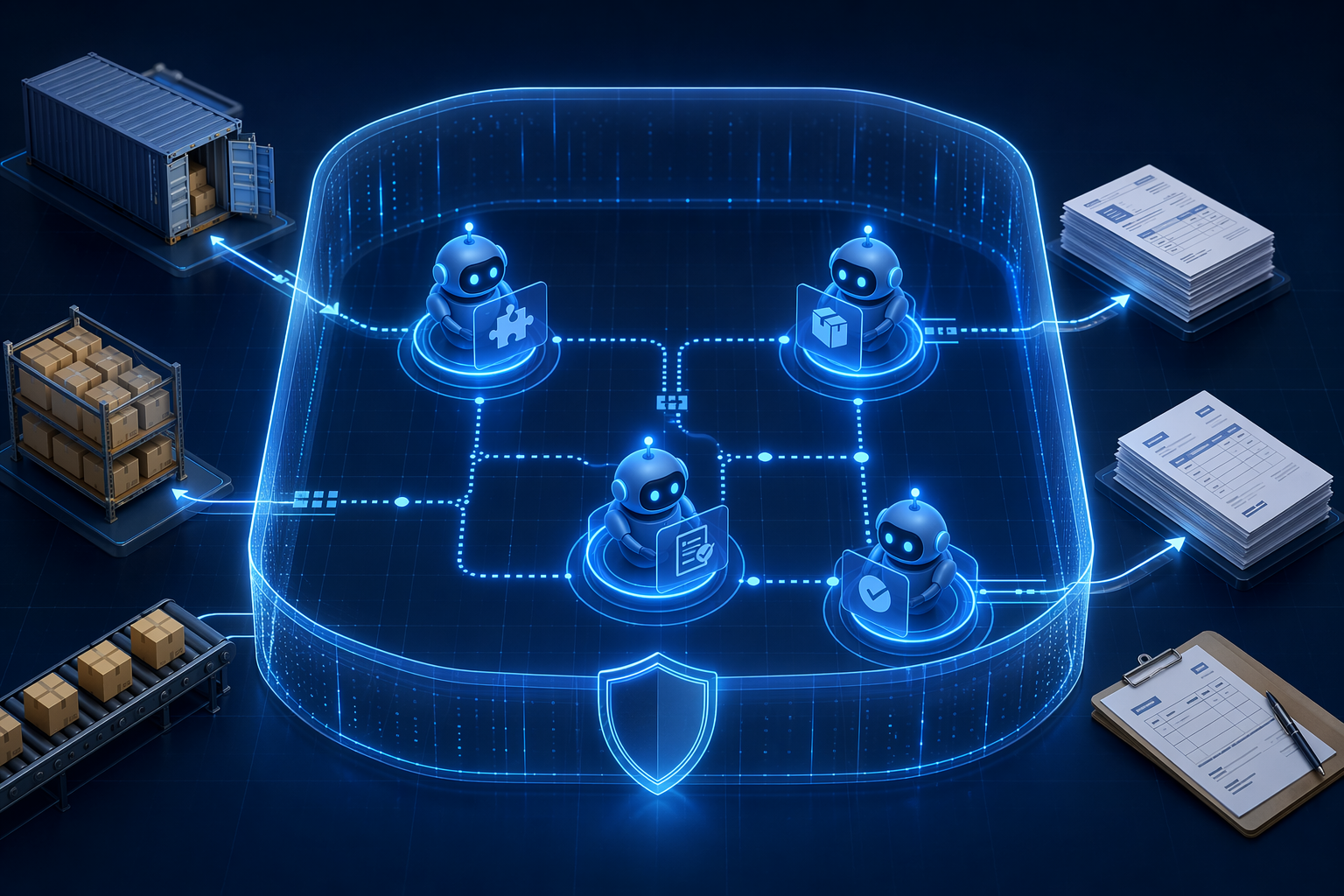
What Autonomous Execution Means in Procurement and Logistics
Autonomous execution does not mean an AI agent gets a blank check to run the supply chain. In the workflows that are credible in 2026, autonomy is narrower and more useful: the agent performs a bounded transaction, inside policy, with escalation rules and an audit trail.
A practical agentic workflow usually moves through five steps. It detects an event, interprets the context, compares possible actions against policy, acts or escalates, and leaves evidence behind. The sequence is mundane by design. Procurement and logistics do not need theatrical autonomy; they need reliable completion of work that currently dies between an alert, an inbox, and an overbooked manager.
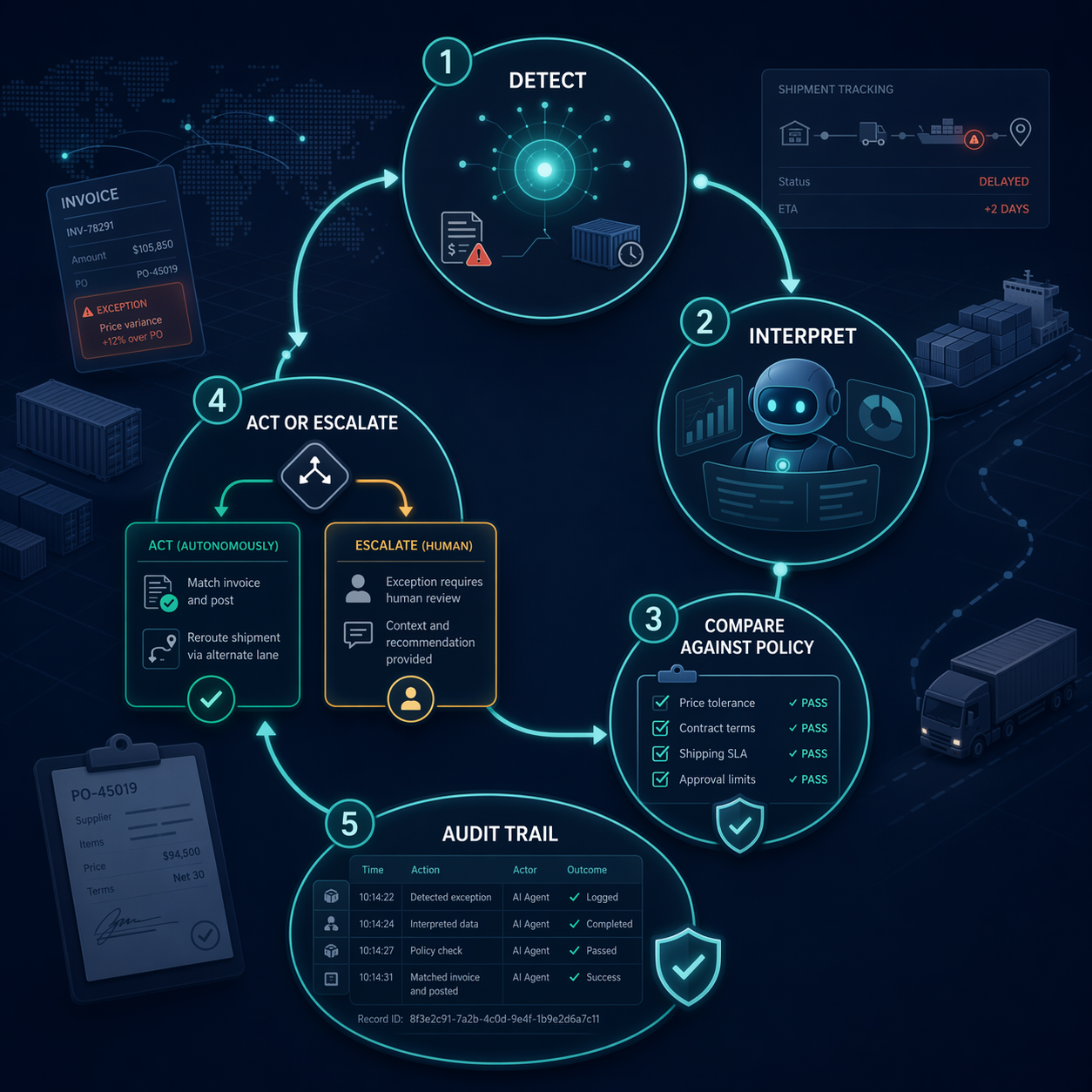
| Workflow stage | What the agent does | Where a human still matters |
|---|---|---|
| Detect | Identifies an invoice mismatch, shipment delay, demand spike, missing document, supplier commitment change, or off-contract purchase attempt. | Confirms that the event types being monitored are the right ones. |
| Interpret | Pulls context from purchase orders, contracts, supplier records, shipment status, inventory positions, or demand signals. | Owns data definitions and resolves conflicting master data rules. |
| Compare against policy | Checks thresholds, approval limits, preferred supplier rules, freight policies, tolerance bands, and segregation-of-duties constraints. | Sets the policy and decides which exceptions are material. |
| Act or escalate | Matches an invoice, drafts a PO, initiates an RFQ, routes a shipment exception, requests missing documents, or escalates a blocked decision. | Approves high-risk, high-value, or policy-breaking moves. |
| Audit trail | Records inputs, decision logic, action taken, timestamp, and handoff owner. | Reviews samples, investigates exceptions, and validates control performance. |
This is the point where many procurement AI discussions get too abstract. The useful line is simple: if the system only recommends, it is still an insight tool. If it can complete the next approved transaction step and show its work, it is starting to behave like an operating layer.
Procurement Use Cases Where the Handoff Is the Work
Procurement has an odd position in the agentic AI conversation. It is full of repeatable transactions, approval rules, supplier data, contracts, and exceptions, yet ISG figures cited by SupplyChainBrain put procurement at only 6% of AI use cases across enterprise functions [1]. That creates room for early movers, but it also explains why many teams are still proving the basics: clean enough data, stable enough policy, and workflows integrated enough for an agent to act.
Invoice matching is the cleanest starting point because the decision boundary is visible. An agent can compare the invoice against the purchase order, receipt, contract terms, tax treatment, and tolerance rules. If the variance is within policy, it can approve the match or route it to payment. If the price, quantity, supplier identity, or tax treatment falls outside tolerance, it escalates with the specific reason instead of dropping another generic exception into the accounts payable queue.
Purchase order creation is similar when the request is routine. The agent can turn an approved requisition into a PO, apply the right supplier record, check contract coverage, confirm budget coding, and send the order for final release or direct dispatch depending on authority. The value is not that a PO is hard to create. The value is that small delays in PO creation create late confirmations, supplier confusion, and end-of-month cleanup work that no dashboard fixes.
Spend classification is another foundation, though it should not be oversold as autonomy by itself. Classifying spend can improve category visibility and make downstream automation safer. The agentic layer appears when classification triggers action: flagging a probable off-contract purchase, suggesting the preferred supplier, routing the request to a category manager, or blocking a maverick transaction that clearly violates policy. Teams that need the deeper category-management view can connect this to established practices for AI-enabled spend analysis.
Maverick spend prevention is one of the more politically sensitive use cases because it changes who gets to bypass process. A useful agent does not simply scold requesters after the fact. It intercepts the request at the point of purchase, checks whether a contract or preferred supplier exists, compares the item or service against policy, and either redirects the requester or creates an exception path. The human decision is still available, but the silent leak into unmanaged spend becomes harder.
RFQ generation and supplier discovery sit closer to strategic sourcing, so the authority level usually needs to be tighter. An agent can assemble a draft RFQ from specifications, historical buys, contract terms, supplier performance records, and category rules. It can identify candidate suppliers, prepare outreach, and collect responses. Award decisions, supplier qualification overrides, and high-value commercial commitments still belong in a higher governance tier. For a deeper sourcing-specific treatment, see how agentic AI is reshaping strategic sourcing.
Logistics Agents Are Most Useful When Exceptions Have Rules
Logistics teams already live with exception data. The problem is that a delay alert rarely resolves the delay. Someone still has to judge the impact, find options, check cost and service constraints, notify the right people, update documents, and make sure the decision is visible downstream.
Autonomous shipment exception management is credible when the action space is bounded. A shipment delay is detected. The agent checks customer promise dates, inventory at destination, production dependency, carrier alternatives, lane restrictions, premium freight rules, and cost thresholds. If a reroute or mode change falls inside policy, it executes or prepares the carrier instruction. If the cost, customer impact, or regulatory exposure exceeds the limit, it escalates with the recommended options already assembled.
Demand-supply reconciliation is harder because the consequences can move across regions and functions. When demand spikes in one region, an agent can compare available inventory, open orders, replenishment timing, service priorities, and allocation rules. It may recommend reallocation or initiate a low-risk transfer if thresholds are clear. But if the action would starve another market, violate customer commitments, or consume scarce supply, autonomy should stop at a recommendation and escalation package.
Document orchestration is less glamorous and often more immediately useful. Bills of lading, invoices, customs documents, packing lists, certificates, and carrier instructions all create failure points when they are missing or inconsistent. An agent can detect a missing customs document, pull known shipment and order data, request the missing field from the responsible party, assemble the document packet, and update the shipment record. The gain is not intellectual brilliance; it is fewer containers, invoices, and customer orders waiting on clerical gaps.
The Evidence Is Promising, but It Is Not a Free Pass to Scale
Among the available operational examples, the strongest is a vendor-reported Fortune 500 manufacturer case from Unframe AI. The company reported that AI supplier commitment monitoring produced 100% visibility into supplier commitments, three weeks of advance warning for disruptions, and a 30% reduction in supply-driven stockouts [2]. Those are exactly the kinds of operational outcomes worth watching: visibility, warning time, and fewer stockouts.
But the source matters. This is a vendor customer case, not an independently audited benchmark. It should be read as evidence that the workflow is plausible, not proof that every manufacturer can copy the result. The useful lesson is the shape of the workflow: the agent did not merely predict risk; it monitored commitments and created earlier operational intervention.
That caution is necessary because enterprise AI pilots have a poor conversion record. A MIT NANDA study cited by SupplyChainBrain found that 95% of enterprise AI pilots delivered no measurable P&L impact, with the problem attributed not simply to model failure but to unfocused pilots and systems that did not learn effectively inside the workflow [1]. That statistic should not be used as a lazy argument that AI does not work. It should be used to stop teams from calling a demo a deployment.
A contained pilot has to define the transaction, the allowed actions, the escalation points, the baseline, and the business metric before the agent goes live. If the pilot is invoice matching, the success measure might include exception cycle time, touchless match rate, rework rate, and payment accuracy. If the pilot is shipment exception handling, it might include time to resolution, avoidable premium freight, customer promise recovery, or inventory exposure. For a broader view of why strategy fails before technology does, see the supply chain machine learning strategy gap.
Governance Decides Which Actions Can Be Automated
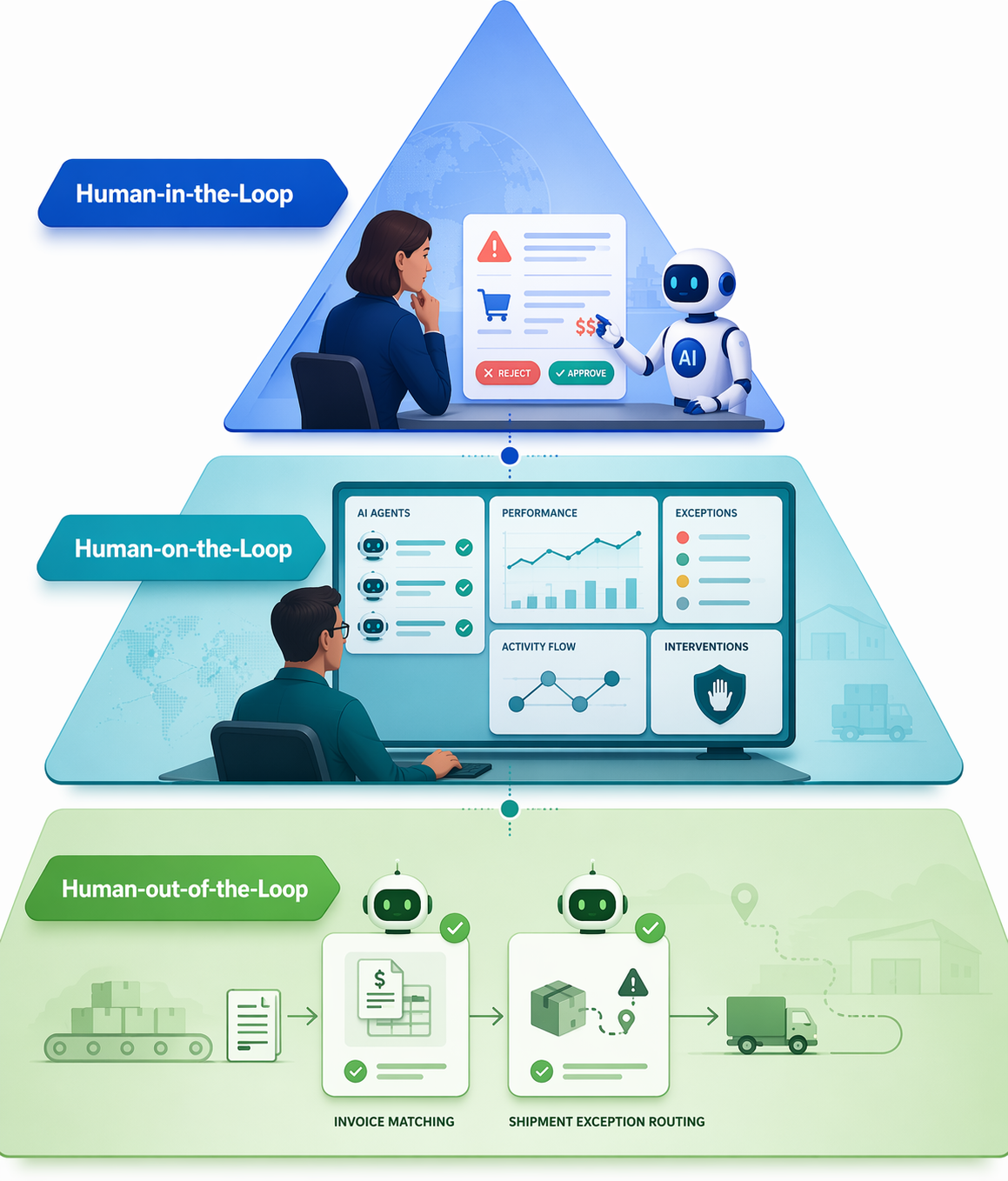
The governance question is not whether humans are in or out. The question is which humans are involved, at what point, for which decision risk. A three-tier model is the cleanest way to keep autonomy useful without pretending that all procurement and logistics decisions carry the same exposure.
Human-in-the-loop for high-risk decisions
Human-in-the-loop means the agent prepares the decision, but a person approves the action before it is executed. This tier belongs to high-value supplier awards, contract deviations, restricted-party concerns, unusual payment releases, major allocation changes, premium freight outside policy, or decisions that could materially affect service, compliance, or financial reporting.
In this tier, the agent earns its keep by compressing analysis time. It assembles the supplier history, contract clauses, shipment options, cost exposure, and policy conflicts so the decision-maker is not rebuilding the case from scattered systems. The human still owns the judgment.
Human-on-the-loop for routine oversight
Human-on-the-loop means the agent acts within an approved range while a supervisor monitors performance, samples decisions, and intervenes when patterns drift. This is suitable for repeatable work with moderate business exposure: routine supplier follow-ups, standard RFQ preparation, exception routing, replenishment recommendations, or shipment actions that remain within cost and service thresholds.
The oversight role should not become another dashboard nobody has time to read. It needs exception queues, sampling rules, control alerts, and review ownership. If a logistics supervisor is expected to monitor agent behavior, the workflow must show which decisions were made, which were escalated, which were overridden, and which policy threshold was used.
Human-out-of-the-loop for low-risk, high-volume tasks
Human-out-of-the-loop is appropriate only where the decision is low risk, high volume, and tightly bounded. Examples include invoice matches within tolerance, document completeness checks, status updates, routine supplier reminders, duplicate record flags, or shipment exception routing that does not change cost, service priority, or compliance exposure.
This tier still needs controls. Full autonomy without auditability is not an operating model; it is an unmanaged control risk. SupplyChainBrain’s discussion of autonomous procurement emphasizes the need for a “glass box” approach, where agent actions remain explainable and traceable rather than hidden behind opaque automation [1]. Teams building this architecture can connect the operating model to broader AI governance for supply chain decisions.
What ROI Claims Should and Should Not Mean in 2026
Efficiency claims around agentic procurement need careful handling. Secondary sources cite 25–40% procurement efficiency improvement as a potential benchmark attributed to McKinsey, but that should be treated as potential rather than a planning assumption. It is not a substitute for measuring a real baseline in the specific workflow being automated.
The same restraint applies to autonomy forecasts. Gartner projections cited by SupplyChainBrain indicate that 15% of daily logistics decisions could be autonomous by 2028 and that 60% of disruptions could be resolved without human intervention by 2031 [1]. SupplyChainBrain also cites projections that agents could manage 60–70% of end-to-end transactional procurement by 2028 [1]. These are directional signals, not current-state proof.
The better ROI question is narrower: did the agent remove work from a named workflow, reduce delay or error, and improve a business outcome that finance recognizes? A procurement agent that classifies spend but does not change compliance, sourcing action, or working-capital behavior may be useful, but it has not yet proven P&L impact. A logistics agent that detects delays but leaves every reroute to a manual email chain has improved awareness, not execution.
For procurement leaders building the financial case, the useful split is between activity metrics and outcome metrics. Activity metrics include touchless processing, cycle time, exception backlog, and manual handoffs. Outcome metrics include fewer stockouts, lower avoidable premium freight, improved contract compliance, reduced rework, fewer payment errors, or measurable working-capital effects. Readers who need a more detailed benchmark discussion can use Procurement AI ROI in 2026 as a companion view.
A Credible 2026 Deployment Pattern
A credible agentic AI deployment in 2026 usually starts small enough to be controlled and important enough to matter. Invoice matching for a defined supplier group, shipment exception handling on a specific lane family, supplier commitment monitoring for constrained materials, or document orchestration for a recurring customs process all make better pilots than a broad mandate to “autonomize procurement.”
- Choose a bounded workflow with repeated decisions, visible handoffs, and enough volume to measure.
- Define success before deployment, including baseline performance and the P&L-relevant metric.
- Assign each action to a governance tier before the agent is allowed to execute.
- Integrate with the systems where work actually happens, not just with an analytics layer.
- Require an audit trail that shows inputs, policy checks, actions, escalations, and overrides.
- Review whether the agent reduces work and improves outcomes, not whether the demo looked intelligent.
This pattern also explains the procurement adoption gap. The problem is not that teams have ignored AI; the 94% adoption figure says the opposite. The problem is that many pilots have not crossed into integrated execution at scale. For more on that gap, see The AI-in-Procurement Chasm.
Agentic AI is credible in procurement and logistics in 2026 where the workflow is bounded, the policy is explicit, the data is good enough for the decision, and the audit trail is non-negotiable. Routine transactions and structured exception handling are the natural starting points. High-risk commercial, compliance, and allocation decisions still need human judgment. The useful question is not whether agents can replace procurement or logistics teams. It is whether they can take the approved next step often enough, safely enough, and measurably enough to stop AI from becoming one more impressive pilot with no operational consequence.
References
- Why 2026 Is the Year of AI Agents for Autonomous Procurement, SupplyChainBrain
- Top 10 AI Use Cases in Supply Chain Management, Unframe AI
Comments
Join the discussion with an anonymous comment.