

The uncomfortable question around the use of AI in supply chain management is no longer whether companies are interested. They are. The question is why so much of that interest still fails to show up in working capital, freight cost, margin leakage, or cash conversion.
That gap is now large enough to stop treating it as normal implementation noise. MIT research reported by Fortune in August 2025 found that only 5% of AI pilot programs achieved rapid revenue acceleration, while most stalled without measurable P&L impact.[1] PwC’s 2026 Digital Trends in Operations Survey of 767 U.S. operations leaders found that 89% said technology investments had not fully delivered expected results, and 87% said poor data quality had affected value.[2] Deloitte’s 2025 research adds the timing problem: 85% of organizations increased AI investment, yet only 6% saw ROI in under a year, with most satisfactory returns arriving over a two-to-four-year window.[3]

There is a lesson in those numbers that gets missed when every steering committee slide calls the next pilot a transformation. AI can identify a better forecast, predict a late order, flag a service exception, or surface an inventory imbalance. None of that automatically means cash moved. Someone still has to resolve the dispute, release the inventory, reject the wrong charge, approve the claim, update the promise date, or stop the premium freight decision from becoming the default answer.
The companies that get faster financial proof tend to put AI closer to those resolution points. The work is less elegant than a forecast demo. It usually involves invoices, deductions, carrier conversations, exception queues, master data defects, and uncomfortable ownership questions. It also has one advantage finance understands: there is already money stuck there.
The deployment center of gravity is still too far from the cash
Planning and forecasting attract AI budgets for understandable reasons. They have executive visibility. They fit neatly into the language of resilience and service. They produce dashboards that look like progress. FourKites, citing ABI Research, describes a deployment pattern in which supply chain AI priorities lean heavily toward planning, forecasting, visibility, and optimization use cases.[4] Because that source is vendor-linked, it should be treated as directional evidence rather than a final market verdict. Still, the pattern matches what many finance reviews already see: prediction gets funded before resolution gets fixed.
That does not make planning a bad use case. A better demand forecast can matter a great deal. A cleaner supply plan can reduce noise across procurement, manufacturing, inventory, and transportation. But those benefits often mature through several operating cycles, and the financial signal is easily mixed with pricing changes, service choices, market demand, supplier behavior, and inventory policy. If the CFO is asking what changed this quarter, the answer is rarely clean.
The faster test is different: where is an operational exception already creating a financial consequence, and can AI reduce the time between detection and resolution? That is why freight disputes, carrier deduction review cycles, unavailable-to-promise inventory, and premium freight deserve more attention than they usually receive in AI portfolio discussions.
| Cash-trapping workflow | What AI should shorten | Financial signal to watch |
|---|---|---|
| Freight disputes | The path from invoice exception to validated recovery, rejection, or payment decision | Recovered overcharges, avoided duplicate payments, dispute aging, freight audit leakage |
| Carrier deduction review cycles | The loop between service failure, evidence collection, deduction decision, and carrier response | Approved deductions, overturned deductions, cycle time, unresolved balances |
| On-hand but unavailable-to-promise inventory | The reconciliation between system quantity, allocation status, holds, quality blocks, and customer promise logic | Released inventory, avoided expedites, reduced backorder pressure, improved available-to-promise accuracy |
| Premium freight | The escalation path from predicted service miss to approved expedite, alternative action, or prevention | Premium freight as a share of total freight, avoidable expedite spend, exception closure time |
These workflows are not glamorous, but they are measurable. They have timestamps, owners, counterparties, documents, approval paths, and ledger consequences. A model that ranks freight invoice exceptions by recovery probability is easier to defend than a model that claims it improved planning quality but cannot isolate the effect from everything else that changed in the quarter.
Prediction only creates value when someone can act
The weak link in many supply chain AI pilots is not the prediction. It is the handoff after the prediction. A late shipment risk appears on a dashboard. A replenishment issue is flagged. A carrier invoice looks suspicious. An item shows as on hand but cannot be promised. Then the organization falls back into the same queue, the same email chain, the same spreadsheet, and the same review meeting.
That is how a technically successful pilot becomes a financially invisible one. The model can be right and the business can still fail to capture value. If nobody changes the tender, challenges the invoice, releases the hold, updates the allocation rule, or prevents the expedite, the P&L has no reason to care that the probability score improved.
This is also where measurement breaks. Deposco survey data, cited in Open Sky Group’s supply chain AI statistics compilation, found that 47% of companies cannot measure AI supply chain ROI at all.[5] That finding should not be read as proof that AI creates no value. It means many organizations have not connected use cases to a financial measurement path tight enough to survive review.
Resolution workflows make that path shorter. A freight dispute was opened, prioritized, supported with evidence, and closed. A deduction was reviewed faster or reversed with better documentation. Inventory moved from unavailable to promiseable. Premium freight was avoided because the exception was intercepted before the expensive option became inevitable. The measurement is still imperfect, but the line from action to financial consequence is much less abstract.
For broader benchmark context, ChainSignal’s supply chain AI use case ROI analysis is useful. The distinction here is narrower: when the business needs proof inside a finance review, the strongest candidates are often the workflows where an exception already has a receipt, invoice, chargeback, claim, deduction, or inventory availability consequence.
Freight disputes: the model should not stop at finding the anomaly
Freight audit and payment is one of the clearest places to separate AI theater from AI value. A useful system does more than say an invoice looks wrong. It helps determine why it looks wrong, which documents support the dispute, whether the issue is recoverable, who owns the next action, and when the claim is likely to age out.
The financial logic is straightforward. If an accessorial charge is invalid, a duplicate invoice slips through, a rate table is applied incorrectly, or a shipment is billed against the wrong contract terms, cash can leak without anyone making a strategic decision. The work is not strategic in the conference-room sense. It is operationally tedious. That is exactly why it is a reasonable AI target.
The stronger use case is not “AI for freight.” It is AI that reduces dispute aging, increases the share of exceptions reviewed before payment deadlines, improves evidence packaging, and lowers the manual effort needed to close a recoverable claim. A transportation analyst should not have to rebuild the same shipment story from a TMS record, invoice PDF, rate card, delivery receipt, and email trail every time a carrier charge looks wrong.
This is also why logistics ROI remains hard to measure when AI is deployed only as visibility or prediction. A predicted late shipment may or may not become an avoidable cost. A disputed charge has a much clearer audit trail. For readers working through that distinction in more detail, ChainSignal’s piece on why AI ROI in logistics remains unclear is the better companion than another generic AI maturity model.
Carrier deductions: AI has to organize the evidence, not just score the carrier
Carrier deductions sit in a similar category. The business already has a financial claim. The problem is the review cycle: missing proof, mismatched shipment records, unclear service definitions, manual back-and-forth, and slow decisions that leave deductions unresolved or poorly defended.
An AI system that merely ranks carriers by performance may be interesting, but it does not necessarily move cash. The more valuable system builds the case file. It matches the shipment to the contracted service obligation, pulls the relevant milestone data, checks whether the deduction is allowed under the agreement, flags weak evidence, and routes the decision to the right owner before the review window closes.
This is where supply chain and finance often talk past each other. Operations sees a carrier performance issue. Finance sees a deduction that may or may not be collectible. Legal or procurement may see contract language that narrows what can be claimed. AI creates value only if it helps those parties converge faster on an executable decision.
Unavailable-to-promise inventory is a working capital problem hiding in plain sight
Inventory that is physically present but unavailable to promise is one of the more frustrating categories because it lets everyone be partly right. The warehouse says the product is on hand. Customer service says it cannot be promised. Planning says the system is constrained. Finance sees inventory on the balance sheet and still hears about backorders, expedites, or missed revenue.
The AI opportunity is not simply to forecast inventory better. It is to diagnose why inventory is trapped. Is it on quality hold? Allocated to the wrong order? Blocked by incomplete receiving? Sitting in a location the promise engine does not treat as available? Reserved by a rule that no longer reflects commercial priority? Those are resolution questions, not abstract planning questions.
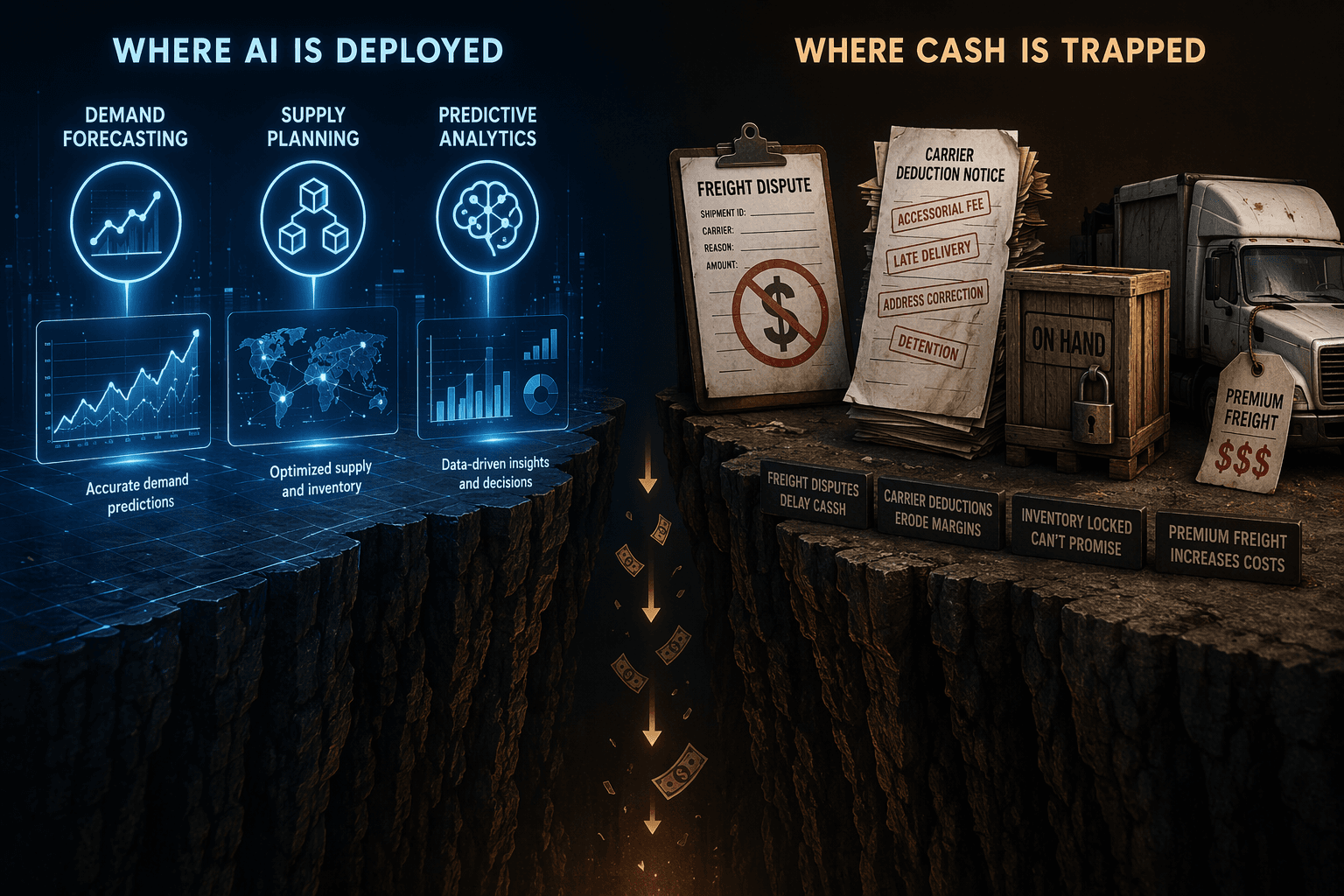
This is where the term “available-to-promise” earns its keep. The number that matters is not only inventory on hand. It is the portion of that inventory that can be committed to a customer without creating a service failure somewhere else. AI that reconciles quantity, location, allocation, hold status, order priority, and promise rules can create a financial signal by releasing usable inventory or preventing an unnecessary expedite.
The work often exposes uncomfortable governance problems. A model may find that inventory is blocked by stale allocation rules or master data defects rather than by true supply scarcity. That is not a failure of AI. It is the point. If the organization refuses to fix the rule or data owner behind the blocked inventory, the model has done its job and the operating model has not.
Premium freight is where prediction becomes expensive if the response is late
Premium freight is a useful test of AI discipline because it sits at the intersection of service, planning, transportation, and margin. A model that predicts a service miss may be valuable, but if the organization only sees the issue after the normal options have disappeared, the response is predictable: expedite, absorb the cost, explain it later.
The better use case intervenes earlier in the decision path. It identifies which late orders are likely to become premium freight events, which alternatives remain available, which customer commitments justify escalation, and which exceptions are being accelerated out of habit rather than necessity. The financial measure is not whether the model predicted lateness. It is whether premium freight as a share of total freight moved, whether avoidable expedites declined, and whether service stayed within acceptable bounds.
This distinction matters because premium freight is often treated as a transportation cost after the real decision has already been made upstream. By the time the logistics team receives the emergency request, the choice set may be narrow. AI belongs earlier in the workflow, where customer priority, production status, inventory availability, and transportation options can still be traded off before the expensive answer becomes the only answer.
Data quality is not a technical side issue
Poor data quality is often described as if it were a housekeeping problem that can be cleaned up after the exciting AI work begins. In resolution workflows, that view does not survive contact with the process. The same data defects that make a model less accurate also break the evidence chain needed to close the exception.
PwC’s finding that 87% of operations leaders say poor data quality has affected value is important for exactly this reason.[2] A freight dispute may require shipment milestones, contract terms, invoice lines, accessorial codes, proof of delivery, and payment status. If those elements do not align, the issue does not simply become harder to predict. It becomes harder to recover.
TraxTech’s analysis makes the same point more bluntly: it states that companies investing in data infrastructure first achieve 3x better AI ROI, and that 70% of AI projects fail because of data quality issues rather than algorithmic limitations.[6] The 3x figure should be used carefully because the public methodology is limited. But the operational lesson is sound: the algorithm is rarely the only constraint. If invoice data, carrier contracts, shipment events, item status, and order commitments cannot be trusted together, the resolution workflow will stall no matter how polished the prediction layer looks.
That is also why data readiness work should be tied to specific financial workflows, not treated as an endless enterprise hygiene program. Cleaning every field in every system is not a near-term ROI plan. Cleaning the fields required to validate freight disputes, release unavailable inventory, or govern expedite decisions is a business case. ChainSignal’s CSCO data readiness checklist is best read through that lens: not as documentation for its own sake, but as preparation for decisions that change money.
A better portfolio split: near-term proof versus long-horizon transformation
The Deloitte timeline finding should make leaders more precise, not more pessimistic. If most satisfactory returns arrive over two to four years and only 6% of organizations see ROI in under a year, then not every AI initiative should be sold as a near-term P&L lever.[3] Some planning, forecasting, and network optimization investments belong in a longer-horizon transformation portfolio. They may still be worth funding, but they should not be forced into a quarterly payback story if the operating path does not support it.
That separation would improve a lot of AI governance conversations. A demand planning initiative can be evaluated on forecast accuracy, planning cycle stability, inventory policy effects, and service outcomes over time. A freight dispute automation initiative can be evaluated on recoveries, cycle time, aging, write-offs, and manual effort. Both can be legitimate. They should not be defended with the same ROI clock.
The common failure is asking a planning pilot to produce rapid financial proof without connecting it to downstream decisions. If a forecast improvement does not alter production commitments, inventory deployment, transportation choices, supplier releases, or customer promise logic, the benefit remains trapped in a metric that finance will struggle to underwrite.
This is why a portfolio should separate AI initiatives by the kind of financial evidence they can reasonably produce.
| AI initiative type | Appropriate ROI expectation | Finance question |
|---|---|---|
| Prediction-heavy planning and forecasting | Often longer-horizon, dependent on downstream operating changes | Which decisions will change because of the prediction, and when will those decisions affect cash, margin, service, or inventory? |
| Exception resolution and operational-finance workflows | Better suited to near-term measurement when ownership and data are clear | Which trapped cash, avoidable cost, deduction, claim, or inventory release will be measured? |
| Visibility and monitoring tools | Weak ROI unless linked to action, escalation, or prevention | Who acts on the alert, and what cost or service consequence changes if they act faster? |
For readers comparing this view with wider adoption barriers, ChainSignal’s analysis of supply chain AI adoption barriers covers the organizational layer. The finance-room version is simpler: if ownership is unclear after the model flags the issue, the ROI case is already in trouble.
The investment test that survives a cash-flow conversation
An AI project being pitched for near-term supply chain ROI should be able to answer four questions without hiding behind transformation language:
- What cash, cost, margin leakage, inventory, claim, deduction, or charge is trapped today?
- Which resolution workflow will change after AI identifies the issue?
- Who owns the action after the model flags the exception?
- Which financial metric will move, and over what measurement window?
If those answers are vague, the project may still be worthwhile, but it belongs in a longer-horizon portfolio. It should not be sold as rapid P&L proof. The evidence does not support that kind of optimism, and finance teams have heard enough versions of it already.
Supply chain AI can deliver measurable ROI. The fastest path is usually not the cleanest dashboard or the most elegant prediction. It is the unglamorous automation of operational-finance workflows where money is already stuck: disputed freight, unresolved deductions, inventory that cannot be promised, and premium freight decisions made too late to avoid the cost.
References
- MIT research on AI pilot ROI reported via Fortune, Fortune, August 2025.
- PwC 2026 Digital Trends in Operations Survey, PwC.
- Deloitte 2025 supply chain AI investment and ROI survey, Deloitte, 2025.
- The Supply Chain AI ROI Trap, FourKites.
- Supply Chain AI Statistics: 18+ Statistics You Should Know for 2026, Open Sky Group.
- Why Supply Chain AI Projects Fail: The $100M Data Quality Problem, TraxTech.
Comments
Join the discussion with an anonymous comment.