
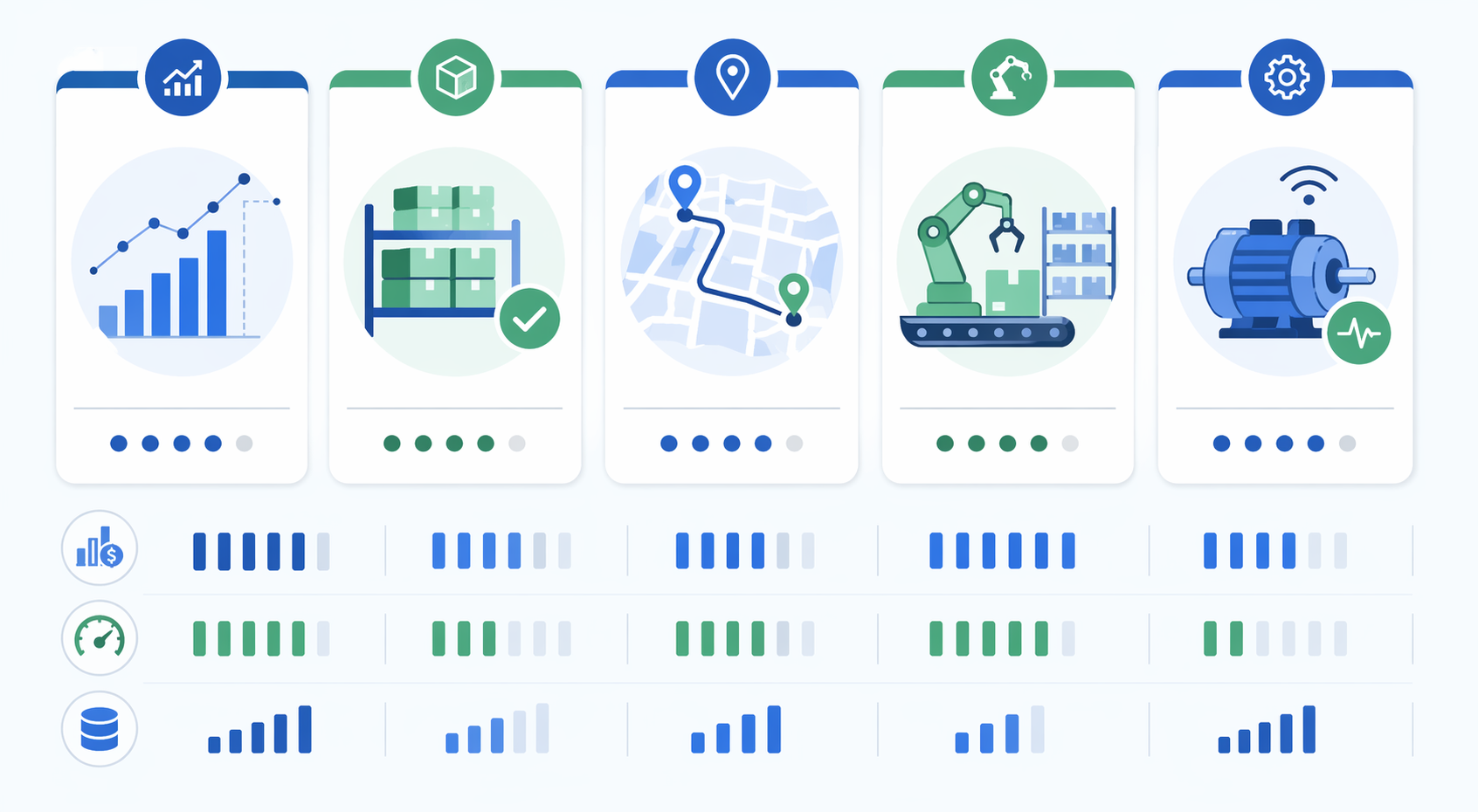
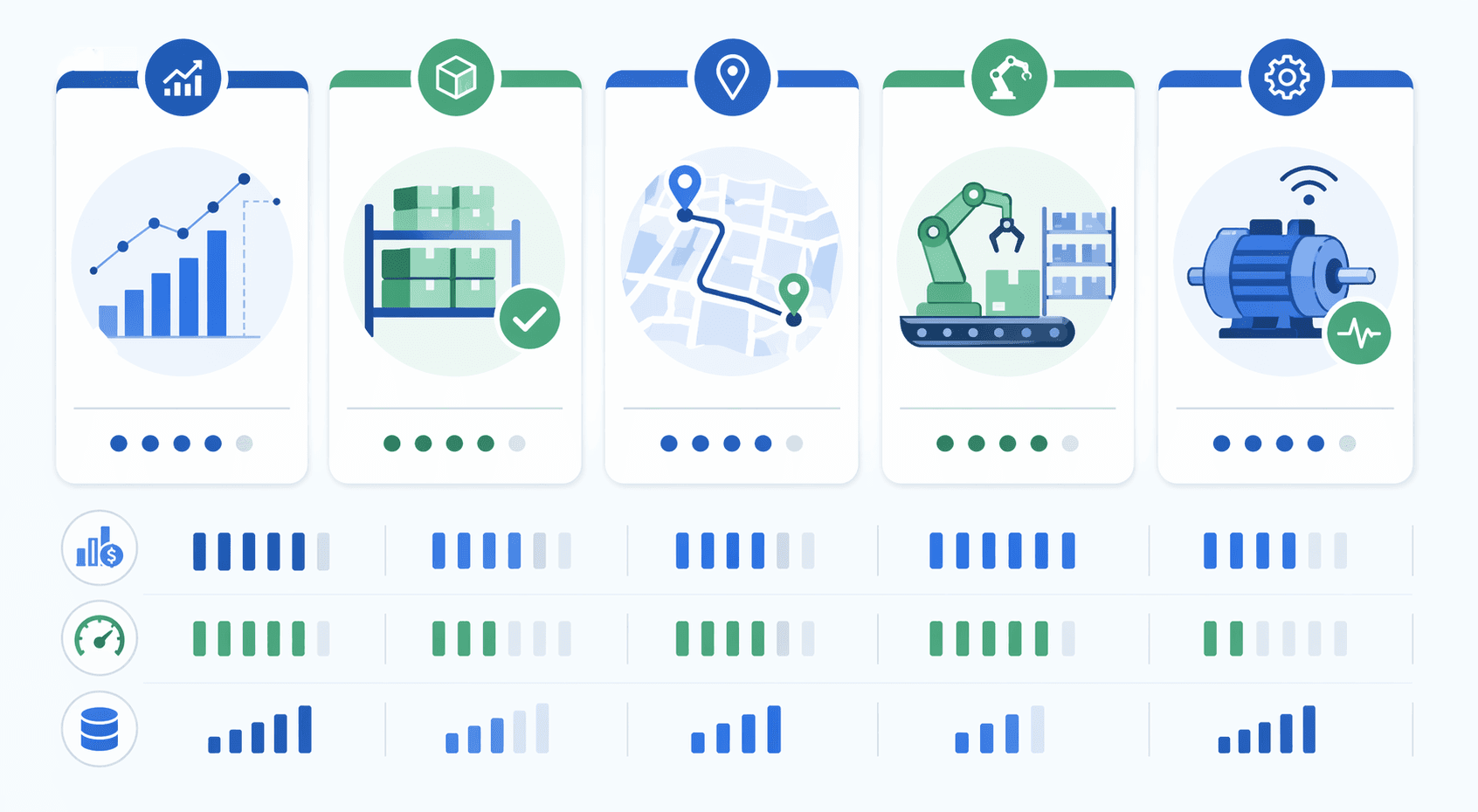
For most AI applications in supply chain, the budget question is no longer whether the technology can create value. It is which use case can survive contact with your data, your operating model, and your CFO’s payback threshold. A route optimizer with weak carrier integration will not beat a boring forecasting model that reduces avoidable stock. A predictive maintenance model without credible asset history is not a business case; it is a sensor wish list.
The practical comparison looks like this.
| AI supply chain use case | Documented return profile | Typical payback signal | Data dependency | Integration burden | Best first when... |
|---|---|---|---|---|---|
| Demand forecasting | 20–50% forecast error reduction; deployed SKU-level examples improved from 55–65% accuracy to 82–91% | Usually strongest when tied to planning cycles and replenishment decisions | High: clean demand history, product hierarchy, promotions, seasonality, lost sales logic | Moderate: planning system, ERP, sales inputs | Forecast error is visibly driving stockouts, expedites, or excess inventory |
| Inventory optimization | 20–30% inventory reduction in AI-enabled distribution contexts | Often follows forecasting; working-capital effect can be easier to defend | High: item-location master data, lead times, service targets, constraints | Moderate to high: ERP, WMS, planning and replenishment workflows | Leadership needs cash release, service-level control, or reduction in slow-moving stock |
| Route optimization | Vendor-published cases report 12–22% transportation cost reduction and 8–15 percentage-point on-time delivery improvement | Some documented manufacturer examples report breakeven in 8–14 months | Medium: shipment history, rates, constraints, geocoding, service windows | High: TMS, carrier processes, dispatch, exception management | Transportation spend is large, lane data is usable, and dispatch teams will act on recommendations |
| Warehouse automation | 67% of companies report already seeing ROI from warehouse AI; separate research points to typical payback of 2–3 years | Slower than pure software planning cases; stronger when labor constraints or throughput limits are persistent | Medium to high: inventory accuracy, task history, labor standards, slotting and movement data | High: WMS, equipment, labor planning, process redesign | The facility has stable processes and enough volume to absorb integration work |
| Predictive maintenance | 30–50% unplanned downtime reduction and 10–40% maintenance cost reduction | Attractive where downtime is expensive; weak where asset data is thin | Very high: sensors, failure history, work orders, asset hierarchy | Medium to high: CMMS, SCADA/IoT, maintenance workflows | Critical assets have enough failure and condition data to train and govern the model |
Those ranges are not interchangeable promises. Demand forecasting and inventory optimization have the cleanest line from model output to measurable financial impact: forecast error changes, replenishment decisions change, inventory moves. Route optimization, warehouse automation, and predictive maintenance can produce excellent returns, but they ask more from execution systems and from the teams expected to follow the recommendation at 2:00 p.m. on a bad operating day.
Start where forecast error is already costing money
Demand forecasting earns first position because it is both financially material and structurally repeatable. McKinsey’s 2024 work cites 20–50% reductions in forecast error from AI-enabled approaches, and its broader AI-enabled distribution ranges include 5–20% logistics cost reduction, 20–30% inventory reduction, and 5–15% procurement spend reduction.[1] A secondary OpenSky Group compilation referencing McKinsey reports deployed SKU-level accuracy improvements from 55–65% to 82–91%.[2]
That is the kind of evidence finance can work with, provided the starting point is honest. A 40% forecast-error reduction on a low-volume, erratic SKU family may not fund much. A smaller improvement on high-volume items with expensive expedites, tight shelf-life limits, or chronic service penalties may fund the program quickly. The useful business case does not average all SKUs into one headline number. It isolates the product-location combinations where better prediction changes a real decision.
The work is not glamorous. It starts with demand history, product substitutions, promotion calendars, order cuts, one-time buys, lost-sales treatment, and customer-level noise. If the data set treats a stockout as zero demand, the model learns the wrong lesson. If discontinued items sit in the training set without lifecycle flags, the forecast starts explaining yesterday’s assortment. If sales overrides are stored as spreadsheet archaeology, no algorithm can cleanly separate market signal from internal judgment.
This is why demand forecasting is usually the most defensible first AI application in supply chain, but not because it is easy. It is defensible because the decision cadence already exists. Planners already review forecasts. S&OP or IBP meetings already debate demand signals. Replenishment already consumes the output. AI has a place to plug into the operating rhythm, and its value can be measured against forecast accuracy, bias, service level, inventory, and expedite cost.
For teams comparing model-based forecasting with older statistical approaches, the deeper evaluation should sit at the item-location and decision-policy level, not at the demo-dashboard level. The practical question is whether the new forecast changes buy quantities, production plans, deployment, or exception work. A more detailed comparison belongs in AI vs. traditional demand forecasting, especially where teams need to separate statistical lift from operational lift.
Inventory optimization is where the forecast becomes a balance-sheet argument
Forecast improvement matters because inventory policy consumes it. If the safety-stock logic, service-level targets, supplier lead times, and replenishment constraints remain untouched, a better forecast may produce a better planning metric without releasing much cash. Inventory optimization converts demand signal quality into decisions about how much to hold, where to position it, and which service promises are worth funding.
The strongest business cases usually name the inventory dollars at risk before discussing the model. Excess stock, obsolete inventory, multi-echelon duplication, and emergency transfers each have different causes. AI can help identify the pattern, but the policy decision still belongs to the business: a high-service spare part, a promoted retail SKU, and a slow-moving component do not deserve the same rule just because they sit in the same ERP table.
McKinsey’s cited range of 20–30% inventory reduction in AI-enabled distribution is a meaningful planning benchmark, but it should not be pasted into a capital request as if every network has the same starting waste.[1] The attainable number depends on current inventory health, supplier reliability, network complexity, service-level discipline, and whether planners are allowed to change replenishment parameters instead of merely observing recommendations.
This is also where master data stops being an IT hygiene topic and becomes a funding gate. Item-location records, minimum order quantities, pack sizes, shelf life, approved suppliers, transit times, calendars, substitution rules, and customer service classes determine whether optimization recommendations are executable. If those fields are incomplete or politically unmanaged, the system will either recommend fantasy or be overridden until it becomes background noise.
A useful inventory optimization program normally has two tracks. One track improves the math: demand variability, lead-time variability, service targets, multi-echelon positioning. The other track improves decision rights: who can lower safety stock, who approves service-level tradeoffs, who owns obsolete inventory, and who takes the call when cash release conflicts with fill-rate targets. Without the second track, the model may be accurate and still commercially irrelevant.
Vendor profiles can help show how packaged tools frame this problem, but they should be used as examples rather than shortcuts. A profile such as C3 AI Inventory Optimization is most useful when compared against your own item master, replenishment rules, and exception workflows.
The market is moving faster than operating maturity
The urgency is real, even if some market-size theater deserves a discount. One market estimate places the global AI supply chain market at $24.4 billion in early 2026, growing at 24.5% annually.[3] Other forecasts use different category boundaries, so the exact market number is less important than the direction: vendors, boards, and competitors are pushing AI into the operating agenda now.
Adoption intent is far ahead of disciplined execution. Gartner reported in 2025 that 94% of supply chain organizations planned to adopt AI within two years, while only 23% had a formal strategy and 29% had future-ready capabilities.[4] That gap explains why many AI roadmaps feel overloaded. The organization says yes to AI in principle, then discovers that the first three proposed use cases all depend on the same fragile master data, the same integration team, and the same planners who are already closing the month.
Data readiness is not a footnote. McKinsey found that only 53% of supply chain leaders rated their master data quality as adequate.[1] That single constraint can reorder the entire investment sequence. If demand and inventory data are usable but equipment telemetry is not, planning should likely go first. If a fleet has clean telematics and transportation cost pressure is acute, route optimization may outrank a broader planning transformation. The ROI table is a starting point; the data audit decides the first funded release.

Route optimization pays when dispatch can actually use it
Route optimization is attractive because the cost line is visible. Fuel, carrier charges, empty miles, detention, missed delivery windows, and overtime are familiar pain points. Vendor-published AI Magicx case studies report 12–22% transportation cost reductions and 8–15 percentage-point improvements in on-time delivery, with some manufacturer examples reaching breakeven in 8–14 months and 150–250% cumulative ROI by month 18.[3]
Those figures belong in the business-case conversation, but with a label on them: vendor-published examples are not universal benchmarks. They are useful proof that the use case can pay under favorable conditions. They do not prove that a network with weak address quality, fragmented carrier rules, manual appointment scheduling, and limited dispatch adoption will get the same result.
The gating question is not whether the algorithm can propose a better route. It is whether the transportation operating model can accept the route in time. Customer delivery windows, driver hours, load compatibility, yard constraints, carrier commitments, weather, traffic, and late order changes all collide close to execution. A planning model can be right tomorrow morning; a route optimizer may need to be right before the truck leaves.
That is why route optimization often works best as an early operational use case when the TMS is already disciplined, shipment data is clean, and dispatch leaders are involved before vendor selection. If the transportation team is still normalizing accessorials, shipment status codes, and carrier compliance, the first investment may need to be data and process stabilization rather than optimization itself.
Warehouse automation has real payback, but it is not a plug-in
Warehouse AI covers a wide range: slotting, labor planning, task interleaving, computer vision, robotic picking, automated storage, exception detection, and WMS decision support. The payback profile is therefore less uniform than a forecasting project. A Mecalux/MIT joint study published in December 2025, based on more than 2,000 leaders, points to a typical AI payback period of 2–3 years for warehouse automation contexts.[5] A separate McKinsey-cited figure reported via Deposco says 67% of companies are already seeing ROI from warehouse AI.[6]
That combination is worth reading carefully. Many companies are seeing ROI, but the payback horizon is commonly longer than the vendor-demo version of the story. The reason is operational gravity. Warehouses have physical constraints, labor standards, equipment interfaces, safety rules, union or workforce considerations, WMS configuration limits, and peak-season risk. A model can recommend a better slotting pattern; the building still has to move product, retrain labor, update locations, and maintain service while the change happens.
Warehouse automation becomes more compelling when the pain is persistent and measurable: chronic labor shortages, high travel time, capacity pressure, poor pick productivity, safety incidents, or throughput bottlenecks that capital equipment can relieve. It is less compelling when the facility has unstable processes, poor inventory accuracy, or constant exception work that no one has standardized.
The budget package should separate software optimization from physical automation. Slotting and labor-planning intelligence can sometimes move faster. Robotics, automated storage, and vision-enabled workflows usually require deeper integration, facility readiness, and change management. For a more detailed business-case structure, see the AI warehouse management ROI guide.
Predictive maintenance is powerful when the asset data is credible
Predictive maintenance can be one of the strongest AI applications in supply chain operations where downtime is expensive. McKinsey cites 30–50% reductions in unplanned downtime and 10–40% reductions in maintenance costs.[1] For plants, fleets, cold-chain assets, automated warehouses, and critical material-handling equipment, those ranges can translate into avoided production losses, fewer emergency repairs, better spare-parts planning, and more stable service.
The condition is obvious but often underfunded: the model needs trustworthy signals before failure. Sensor coverage, maintenance work-order quality, asset hierarchy, operating conditions, failure labels, and technician feedback all matter. If failures are rare, inconsistently coded, or recorded only after the fact in free text, the model may struggle to distinguish normal variation from a real early-warning pattern.
A practical maintenance use case should begin with a narrow asset class, not the entire installed base. Choose equipment where downtime cost is high, failure modes are understood, sensor or inspection data exists, and maintenance teams will act on alerts. The economic case improves when the recommendation connects to spare-parts availability, technician scheduling, and production planning rather than stopping at a dashboard notification.
For teams that need a fuller treatment of maintenance and forecasting economics, the real ROI of predictive analytics in supply chain is the better place to pressure-test assumptions.
Autonomy is not the default operating model
One reason AI projects disappoint is that the adoption plan assumes more autonomy than the organization is prepared to grant. RELEX’s 2026 State of Supply Chain research, based on more than 500 respondents, found that 54% prefer hybrid AI, while only 10% trust full autonomy for critical decisions.[7] That is not resistance to technology. It is a realistic description of how supply chain accountability works.
A planner who accepts an AI-generated forecast still has to answer for a service miss. A logistics manager who follows an optimized route still takes the call when a key customer is late. A maintenance lead who delays a repair based on a model still owns the production risk. Human-in-the-loop design is not a temporary compromise; in many supply chain functions, it is the control model.
The implication for ROI is direct. If the organization wants hybrid decision-making, the business case must fund exception workflows, confidence scoring, override tracking, planner training, and governance. Otherwise, the model may technically perform while adoption stalls in spreadsheets, side conversations, and manual workarounds.
A defensible 2026 sequence
A practical sequencing discussion should begin with four questions before any vendor demo is allowed to dominate the room:
- Where is the money visibly leaking today: forecast error, excess inventory, freight cost, warehouse labor, downtime, or procurement spend?
- Which data domain is actually usable now, not theoretically available after a year of cleanup?
- Which operating team can absorb the new recommendation without breaking daily execution?
- Which system integrations are required for the model to change a decision rather than decorate a dashboard?
For many organizations, the answer still points to a planning-led sequence: demand forecasting first, inventory optimization close behind, then selective expansion into transportation, warehouse, procurement, or maintenance depending on data maturity. Procurement deserves attention where spend visibility is strong, especially given the 5–15% procurement spend reduction range cited in AI-enabled distribution contexts, but it should not be forced into the first wave if item, supplier, and contract data are not ready.[1] Teams building that part of the case can use a focused procurement AI ROI view rather than burying spend analytics inside a generic supply chain AI roadmap.
An operations-led sequence can also be right. If a distribution network has strong TMS discipline and a large transportation cost base, route optimization may fund itself faster than a forecasting rebuild. If a plant has mature sensor data on bottleneck assets, predictive maintenance may be the best first move. If a warehouse is capacity-constrained and process-stable, automation may deserve capital before another planning layer. The point is not to crown one universal winner; it is to stop pretending standalone ROI ranges decide the order by themselves.
A simple sequencing map helps keep the debate grounded.
| If your strongest condition is... | Fund first | Delay or narrow until... |
|---|---|---|
| Clean demand history and recurring forecast-driven waste | Demand forecasting | Promotion, substitution, and lost-sales logic are good enough to trust the baseline |
| High inventory dollars and usable item-location policy data | Inventory optimization | Service-level ownership and replenishment decision rights are clear |
| Large freight spend and disciplined TMS data | Route optimization | Dispatch teams can act on recommendations inside real execution windows |
| Stable warehouse processes and chronic labor or capacity pressure | Warehouse AI or automation | Inventory accuracy, WMS configuration, and labor processes can support the change |
| Critical assets with sensor and maintenance history | Predictive maintenance | Failure modes, work-order coding, and alert response workflows are credible |
The hard work is matching ambition to readiness. A supply chain AI maturity assessment can be useful here if it forces choices rather than producing a colorful heat map. The most useful version connects use cases to data domains, integration dependencies, operating owners, and measurable financial outcomes. A broader supply chain AI maturity playbook can help structure that conversation.
What to make vendors prove
The vendor evaluation should not start with model architecture. It should start with evidence that the tool can operate in your decision environment. Ask for comparable deployments, baseline definitions, time to value, required integrations, data fields needed, user adoption patterns, override handling, and how benefits were measured after go-live.
- For forecasting, require accuracy, bias, service, and inventory impact by product family or item-location group, not only aggregate forecast accuracy.
- For inventory optimization, require proof that recommendations changed replenishment parameters, safety stock, or deployment decisions.
- For route optimization, require integration detail for TMS, carrier constraints, delivery windows, and dispatch exception handling.
- For warehouse automation, require a phased payback model that separates software workflow gains from physical automation capital.
- For predictive maintenance, require evidence that alerts led to better maintenance actions, not just that the model detected anomalies.
It is also reasonable to ask vendors to run a data-readiness review before quoting a full ROI range. If the estimate assumes clean master data, integrated execution systems, and high user adoption, those assumptions should be visible. A more formal software screen belongs in how to evaluate supply chain AI software, especially when procurement is comparing platforms with very different implementation burdens.
The best first move in 2026 is usually planning-led: improve the forecast, then convert that signal into inventory decisions. That path is repeatable, measurable, and easier to connect to working capital and service. But “usually” is doing real work. The right sequence is the one your data can support, your systems can execute, and your operating teams are willing to use when the recommendation has consequences.
References
- McKinsey 2024 supply chain AI research, McKinsey, 2024.
- OpenSky Group statistics compilation referencing McKinsey, OpenSky Group.
- AI supply chain market and case study statistics, AI Magicx / Precedence Research, 2026.
- Gartner 2025 AI supply chain adoption findings, Gartner, 2025.
- Mecalux/MIT joint study on warehouse automation payback, Mecalux / MIT, December 2025.
- Deposco report citing McKinsey warehouse AI ROI findings, Deposco.
- 2026 State of Supply Chain, RELEX, 2026.
Comments
Join the discussion with an anonymous comment.