

The practical decision around ai in forecasting is not whether LSTM, gradient boosting, ARIMA, or Holt-Winters looks more modern on a slide. It is whether the method can carry the number into a planning meeting and survive the first three questions: What changed? Why did the model move? Which products does this actually work for?
A useful place to start is Genpact’s CPG benchmark for a cereal manufacturer. On weekly sales data, the machine-learning model produced 11.61% MAPE versus 15.17% for ARIMAX, a 23% relative improvement. More importantly, the ML approach handled promotional spikes and seasonality interactions that ARIMAX tended to smooth over.[1] That is the part that matters in demand planning. A lower error number is helpful; a lower error number during the exact weeks that break production, allocation, and inventory plans is much more helpful.

That example does not prove AI wins everywhere. It proves something narrower and more useful: when demand is shaped by promotions, seasonality, and interactions that are hard to express in a clean univariate time series, AI methods can reduce error in ways traditional models often cannot. The work is deciding which parts of the portfolio resemble that cereal case, and which parts do not.
What the head-to-head evidence actually supports
Traditional forecasting families—ARIMA, ARIMAX, exponential smoothing, and Holt-Winters—are built to extract structure from historical demand. They are still useful because many supply chain items are, frankly, not mysterious. Some move with a level, a trend, a recurring seasonal shape, or a small number of known calendar effects. If the demand series is clean and the business needs a defensible baseline, these methods often do exactly what is needed.
AI forecasting methods—LSTM networks, tree-based models such as random forest and gradient boosting, and ensemble approaches—become more interesting when demand is no longer mostly a function of its own past. The cereal benchmark is a good illustration because the relevant pattern was not simply “last year plus trend.” The model needed to respond to promotion timing, seasonal effects, and the way those effects interacted.[1]
Drivepoint makes a broader claim from the operator side: AI-based methods can reduce forecast errors by 20–50% versus Excel-based manual approaches by ingesting real-time signals such as weather, social sentiment, and competitive pricing.[2] That comparison is not the same as saying every ML model beats every statistical model. It is a comparison against manual and Excel-centered processes, and it is strongest when those external signals are genuinely predictive rather than merely available.
AWS and Kearney describe a demand-sensing pattern that is similar in spirit but more specific in mechanism: using AI with more than 200 external data signals, they report 10–20% forecast accuracy improvement and 5–10% inventory reduction.[3] Again, the lesson is conditional. The advantage comes from signal ingestion and short-cycle demand sensing, not from labeling a model “AI.” For CPG and retail teams, this is the same practical terrain covered in AI demand forecasting in CPG and retail: frequent demand shocks, high promotion density, and item-location decisions that move faster than a monthly planning cycle.
| Evidence point | What it supports | What it does not prove |
|---|---|---|
| Genpact cereal manufacturer: ML 11.61% MAPE vs ARIMAX 15.17% MAPE, a 23% relative improvement.[1] | ML can outperform ARIMAX on CPG demand with promotions and seasonality interactions. | That every SKU should move from statistical forecasting to ML. |
| Drivepoint: AI-based methods reduce error by 20–50% versus Excel-based manual methods when using real-time signals.[2] | External signals can materially improve forecasts where manual processes cannot process them well. | That AI always beats well-tuned statistical models on simple demand. |
| AWS/Kearney: AI demand sensing with 200+ external signals produces 10–20% accuracy improvement and 5–10% inventory reduction.[3] | Demand sensing can improve both forecast accuracy and inventory outcomes. | That every organization has enough usable external signal data to reproduce the result. |
The boundary line: complex, signal-rich demand versus stable or sparse demand
The first split should happen before anyone chooses an algorithm. Start with the demand pattern. If a product has stable movement, enough history, modest seasonality, and few external shocks, a traditional statistical model can be hard to beat. It is fast, auditable, and usually easier to explain than a multi-feature model whose drivers shift by segment and period.
Genpact’s own technical discussion makes that boundary explicit: traditional approaches such as ARIMA and exponential smoothing may perform better when the data is univariate, the predictors are finite and explainable, and transparency is critical for stakeholder trust.[1] That sentence should stay visible in any AI forecasting business case. A planning director does not get credit for using a more complex method when the simpler method is more defensible and just as accurate.
AI methods start to earn their place when the forecast depends on several signals at once. Promotion depth, display activity, retailer behavior, competitive pricing, weather, local events, and social demand signals can interact in ways a simple time-series model will flatten. This is where LSTM and gradient boosting approaches are usually more useful than a single statistical baseline: not because they are fashionable, but because they can learn nonlinear relationships across multiple inputs.
The Lennox Residential example shows the same logic outside cereal. Machine-learning cluster analysis across more than 200 U.S. micro-climates improved service levels by 16% and inventory turns by 25%, according to ToolsGroup.[4] The forecasting value came from recognizing that geography and climate changed the demand problem. Treating all locations as one national pattern would have hidden exactly the variation the planner needed to see.
This is also where demand sensing deployments differ from traditional batch forecasting. A batch forecast may update on a fixed planning cadence. A sensing model can react when leading indicators change between cycles. That distinction matters for products where the cost of waiting until the next formal forecast refresh is lost service, excess inventory, or a late production response.
Where traditional methods still deserve the forecast
There are several cases where the old toolkit is not old; it is appropriate.
- Stable, mature SKUs with long, clean sales histories. If the product has predictable seasonality and limited promotion distortion, Holt-Winters or exponential smoothing can provide a reliable baseline with minimal governance burden.
- Short-history or new-product items. AI methods need examples to learn from. When the item has little history, a statistical forecast combined with product hierarchy, launch assumptions, planner judgment, or analog selection may be more honest than a high-variance ML output.
- Low-volume long-tail SKUs. Sparse demand can make complex models look precise while learning very little. In these cases, aggregation, simple baselines, or intermittent-demand methods may be more practical than feature-heavy AI.
- High-explainability planning contexts. When a forecast number will be challenged by sales, finance, operations, and inventory leaders, the ability to explain the movement may be as important as the last decimal of accuracy.
That last point is often underweighted in AI comparisons. Forecast accuracy is measured after the fact. Forecast acceptance happens before the fact, in a room where someone has to commit capacity, inventory, or working capital. If the model cannot explain why a number moved, the planner may override it even when the model is statistically better on average.
Where AI forecasting usually earns its cost
AI methods deserve priority where the planning failure mode is interaction, not noise. A promotion does not simply add demand; its effect can depend on the retailer, timing, baseline velocity, competing promotions, weather, and inventory availability. A hot week can lift one category and suppress another. A competitor price move can matter in one region and barely register in another. These are the segments where a model that can combine signals has a reasonable chance of producing the kind of 20–50% error reduction claimed in AI-vs-manual benchmarks.[2]
The strongest candidates tend to have four traits:
- Sufficient history at the item, customer, channel, or location level to learn recurring behavior.
- Multiple candidate drivers beyond lagged sales, such as promotions, price, weather, local conditions, competitor actions, or digital signals.
- Forecast errors that cause operational pain, not merely reporting variance.
- A review process that can use driver explanations, exception flags, or scenario outputs rather than demanding a single transparent equation.
Data readiness becomes a real constraint here. AI forecasting needs more than a sales history extract. Promotion calendars must be usable. Product and customer hierarchies need to be consistent. Stockouts, substitutions, lost sales, one-time events, and master-data breaks need treatment. Before expanding ML across the portfolio, teams should pressure-test the same foundations covered in a data readiness assessment for AI inventory optimization. A model cannot infer a clean signal from a history that records demand, supply constraints, and data-entry artifacts as if they were the same thing.
A segment-level decision matrix works better than a model bake-off
A common mistake is to run one champion model across the full portfolio, average the error improvement, and declare a winner. That hides the decision planners actually need. A model can perform brilliantly on promoted A-items and still be the wrong tool for slow-moving long-tail SKUs. Another model can be mediocre overall and still be the safest choice for a stable replenishment segment.
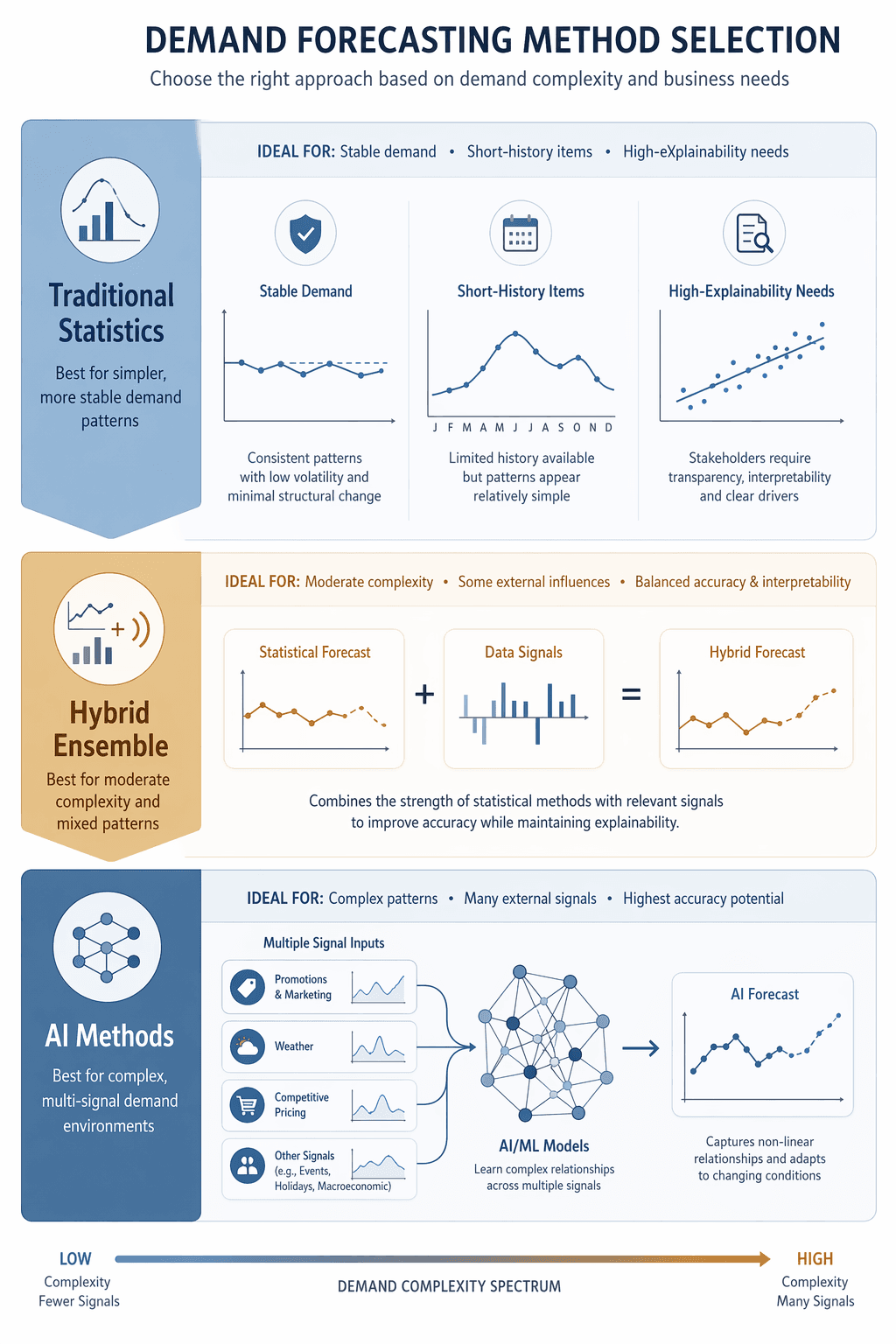
| Segment condition | Better default method | Why |
|---|---|---|
| Stable demand, long history, low promotion intensity | Exponential smoothing, Holt-Winters, ARIMA | The pattern is mostly in the history, and the forecast is easy to defend. |
| Seasonal demand with known calendar effects | Holt-Winters, ARIMAX, or hybrid baseline | Traditional methods can capture clean seasonality; external variables can be added selectively. |
| Promotion-heavy CPG or retail items | Gradient boosting, random forest, LSTM, or ensemble ML | The forecast depends on interactions among price, promotion, timing, channel, and seasonality. |
| Weather- or geography-sensitive demand | ML model with external signals and location features | Signal diversity matters; clustering or feature-rich models can separate local patterns. |
| New products or very short history | Analog-based statistical baseline plus planner judgment | There may not be enough item-level history for AI to learn reliably. |
| Sparse long-tail items | Simple statistical, aggregation-based, or intermittent-demand approach | Complex models can overfit thin data and create false confidence. |
| High-stakes S&OP number requiring explanation | Transparent statistical model, explainable ML, or constrained ensemble | The forecast must be accepted before it can be useful. |
This matrix should not be treated as a one-time classification. Products move. A formerly stable SKU may enter a promotion program. A new product may accumulate enough history to support ML. A long-tail item may become strategically important because of service commitments. Method assignment should be reviewed as part of the forecast performance cycle, not buried inside model configuration.
The hybrid ensemble is the practical middle
For most supply chain teams, the answer is not a full replacement of traditional forecasting. It is a hybrid ensemble that lets different methods compete or cooperate at the segment level. The stable part of the portfolio keeps its statistical baseline. The complex, signal-rich part gets AI methods. The uncertain middle gets monitored, blended, and escalated when the methods disagree.
A workable ensemble does not need to be elaborate at the start. It can begin with three layers:
- Create a statistical baseline. Use ARIMA, Holt-Winters, or exponential smoothing to establish a transparent reference forecast for every eligible item.
- Run AI methods where the data justifies them. Apply gradient boosting, random forest, LSTM, or other ML approaches to segments with enough history, external signals, and business value.
- Assign or blend by segment performance. Let promoted items, weather-sensitive items, and high-variance signal-rich categories use AI when it wins; leave stable and sparse items on simpler methods unless the evidence changes.
The ensemble should also expose exceptions. If the AI model moves sharply because competitor pricing changed, the planner needs to see that driver. If the statistical baseline is steady while the ML forecast jumps, the system should not simply average the two and hide the disagreement. That disagreement is often the planning conversation.
This is where governance matters more than model vocabulary. Decide who can override the forecast, what reason codes are required, how overrides are measured, and when a segment changes model class. A hybrid system without governance becomes a larger version of the spreadsheet problem: many numbers, unclear ownership, and too much time spent reconciling instead of deciding.
Data volume, signal diversity, explainability, and cold start
Four questions usually separate a good AI forecasting candidate from a poor one.
Is there enough history to learn from?
AI models need examples of the behavior they are expected to predict. If an item has only a short history, no repeated promotion patterns, or very few nonzero observations, a complex model may learn more from related items than from the item itself. That can be useful if the hierarchy is reliable. It can be dangerous if the product is genuinely different from the group it is borrowed into.
Are the extra signals real drivers?
Adding weather, sentiment, price, and competitive data does not automatically improve a forecast. The signals need to be timely, clean, and causally plausible for the product segment. Weather may matter for HVAC parts, beverages, apparel, and outdoor categories. It may add noise for a stable industrial component. Competitive pricing may matter at retail shelf level and barely matter for contracted B2B replenishment. Signal richness is valuable only when the signals belong to the demand process.
Can the forecast be explained at the level the business requires?
A planning team does not always need full model transparency, but it does need usable explanation. For some segments, feature importance, driver decomposition, and scenario comparisons may be enough. For others—capacity commitments, board-level revenue plans, constrained inventory allocation—a more transparent statistical model or a constrained ensemble may be safer. The point is not that black-box models are unusable. The point is that every forecast has an audience, and the audience determines the explanation burden.
What happens when the item is new?
Cold-start forecasting remains a hard edge for AI. A new SKU can borrow information from similar products, attributes, channels, price tiers, and launch plans, but that is not the same as learning its own demand pattern. In these cases, planner judgment, analog selection, lifecycle assumptions, and early demand sensing should carry more weight until enough real behavior appears. A model that produces a confident number from weak evidence is not helping the plan.
Newer architectures raise the benchmark, but not the decision logic
The Genpact benchmark dates to 2021, and forecasting methods have continued to evolve.[1] Transformer-based approaches and broader foundation-model ideas may shift future comparisons, especially where models can learn across large collections of related time series. That does not remove the need for segmentation. A more powerful model still needs adequate data, relevant signals, and enough explanation to support the planning process.
This is why AI forecasting should sit inside the broader supply chain investment portfolio rather than being treated as a standalone experiment. Forecasting improvements create value only when they change inventory, production, allocation, purchasing, or service decisions. For teams prioritizing across functions, AI use cases in supply chain is a better frame than a model leaderboard. The forecasting model is one part of the operating system, not the operating system itself.
A usable rule for deployment
Keep traditional statistics where demand is stable, history is clean, and the number must be easy to defend. Use AI forecasting where demand is complex, signal-rich, promotion-sensitive, weather-sensitive, or geographically variable enough that traditional models flatten the behavior planners need to see. Blend the two where the segment is important but uncertain, and make the disagreement visible rather than hiding it inside an average.
The evidence supports a real advantage for AI methods in the right conditions: 20–50% error reduction versus manual Excel-centered approaches, 10–20% improvement in AI demand-sensing examples, and a 23% relative improvement in the cereal manufacturer benchmark.[1][2][3] It also supports leaving simpler methods in place where they do the cleaner job. The practical planning question is not whether to adopt AI forecasting. It is which products have earned it.
References
- The evolution of forecasting techniques: Traditional versus machine learning methods, Genpact, 2021.
- Traditional vs AI Based Demand Forecasting, Drivepoint.
- AI-powered demand sensing, AWS Executive Insights.
- Machine Learning in Demand Planning: How to Boost Forecasting, ToolsGroup.
Comments
Join the discussion with an anonymous comment.