

What the buyer is actually choosing
C3 AI inventory optimization is real software, and the strongest case studies show meaningful inventory and working-capital effects. The harder question is not whether it can optimize inventory; it is whether a buyer wants that capability inside a horizontal enterprise AI platform rather than inside a supply-chain-native planning suite.
As of Q2 2026, that distinction is not academic. The company is in a CEO-transition period and has withdrawn its fiscal outlook, so shortlist discussions have to include execution confidence as well as feature fit [6]. This is a vendor-profile piece because it is judging one vendor's capabilities, outcomes, deployment model, integrations, and risk rather than ranking the market.

What the documented outcomes actually show
The public evidence is enough to take C3 AI seriously, but it is also uneven. The clearest numbers come from vendor-owned case studies and the Baker Hughes joint venture, so they show deployed behavior and claimed outcomes rather than independently audited industry benchmarks [1][2][3][4].
| Deployment | Reported result | What it suggests |
|---|---|---|
| Aerospace/defense manufacturer | 10-week trial; 30–40% inventory reduction potential; $180M–$240M potential value; 80% supplier delay prediction accuracy [1] | This is the strongest proof that the system can surface material upside quickly, but it is still a vendor-led trial and a potential-value claim, not a realized, independent benchmark. |
| Baker Hughes | 59,000 ML models across 340M+ data elements; 5% targeted inventory reduction; 8 years of ERP data used [2] | This shows enterprise scale and data breadth. The inventory target is smaller, which is not a contradiction; it simply reflects a different scope and objective. |
| Electronics manufacturer/distributor | 10,000 SKUs deployed in 6 months; 22–26% inventory reduction; $42M in freed working capital [3] | This is the cleanest production-style inventory result in the public material because it connects the optimization work to working capital, not just model performance. |
| Global retailer, multi-hop agents example | 20% stockout reduction; 15% transport cost decrease [4] | Useful for understanding the newer orchestration story, but not a direct substitute for a mature MEIO proof point. |
The spread matters. The aerospace trial is the most dramatic because it identified a large upside quickly; Baker Hughes shows scale and model volume but a more modest inventory target; the electronics case is the most useful working-capital example; and the retailer example widens the frame into orchestration, which is interesting but not the same thing as proving supply-chain-native planning depth [1][2][3][4].
How the engine appears to work
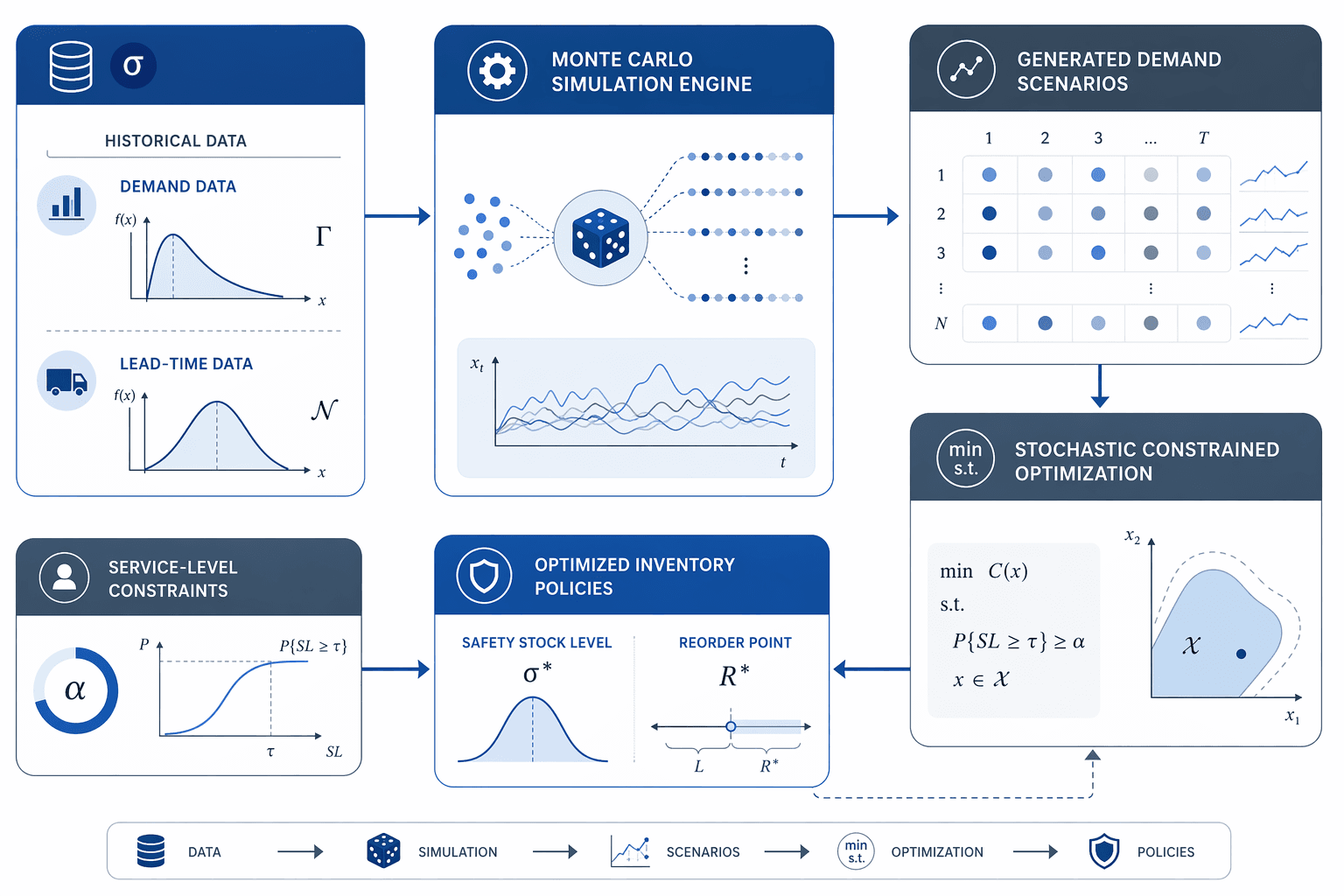
C3 AI describes the inventory application as simulation-driven optimization rather than static rule-based planning. It uses Monte Carlo methods to model demand and lead-time uncertainty, represents those uncertainties with distributions such as Gamma and Gaussian, and casts inventory management as a stochastic constrained optimization problem that tries to minimize total landed cost while preserving service-level constraints [5].
The practical difference is that the system is looking across scenarios, not applying one fixed reorder rule. The 2026 multi-hop orchestration framing adds SME-defined business rules around the optimizer, which is useful when exceptions, approvals, or channel-specific logic matter [4][5].
What is missing is almost as important. Public MEIO documentation is thinner than what Blue Yonder or ToolsGroup typically publish, and independent review volume is sparse; Lokad's April 2026 assessment rated C3 AI's supply-chain depth 4.8/10 and overall supply-chain score 4.9/10 [6].
Deployment reality: faster than a typical planning program, but not plug-and-play
C3 AI positions a rapid trial in the 8–12 week range, and the aerospace case reports results in 10 weeks; the broader production motion is described as 3–6 months [1][3].
That matters because the pilot is not just a software demo. It is usually testing how quickly the team can connect ERP data, normalize item and supplier records, encode business rules, and turn recommendations into planner actions. A buyer with several ERP instances or a messy master-data estate may care more about that integration story than about another point improvement in forecast accuracy.
- Can the platform ingest multiple ERP instances without brittle custom mapping?
- Are service-level targets explicit and editable by segment, channel, or node?
- Can planners see why a recommendation changed, not just what the new number is?
- Does the output write back into the workflow finance and operations already use?
Where C3 AI fits against specialist planning vendors
Against Blue Yonder, o9, Kinaxis, and ToolsGroup, C3 AI is not just another inventory package with a new UI. It is a horizontal platform that can be attractive when inventory sits alongside other enterprise AI work, when the data model is fractured, or when the buyer wants a common architecture across more than one function. That breadth is a differentiator only if it solves the buyer's actual integration problem.
If the requirement is purely supply-chain-native MEIO depth, planner transparency, and a large independent review base, C3 AI has more explaining to do. Lokad's April 2026 review makes that point bluntly enough: the software is real, but the supply-chain specialization looks lighter than the best-known planning vendors [6].
Bottom line for the shortlist
C3 AI belongs on the shortlist when enterprise AI architecture, rapid trial deployment, and cross-system data unification matter as much as inventory reduction. It is a reasonable candidate for organizations with fragmented ERP estates or adjacent AI ambitions that extend beyond inventory alone.
Buyers who need mature, transparent, supply-chain-native MEIO depth should benchmark it carefully against specialist planning vendors before narrowing the field. The right question is not whether C3 AI can produce inventory savings; it can. The question is whether those savings come from the kind of planning system the organization wants to standardize on.
References
- Dynamic Optimization of Inventory Management — C3 AI
- Enterprise AI Inventory Optimization — Baker Hughes
- Supply Chain Suite — C3 AI
- Transforming Supply Chain Optimization with C3 AI's Multi-Hop Orchestration Agents — C3 AI Blog, Feb 2025
- How C3 AI Powers the Future of Inventory Management — C3 AI Blog, Oct 2025
- Review of C3 AI — Lokad, Apr 2026
Comments
Join the discussion with an anonymous comment.