
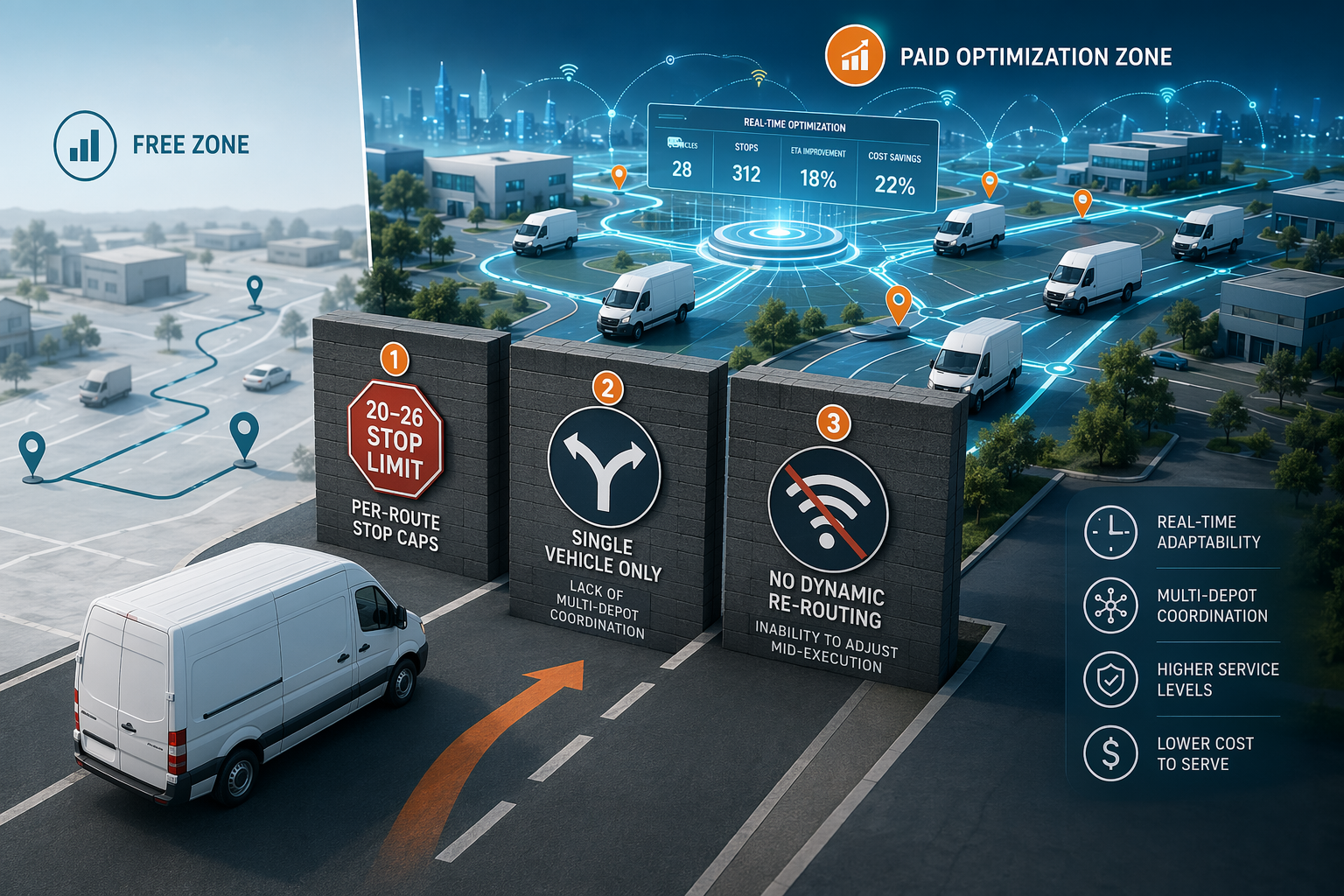
The Three Dead Zones Every Free Route Optimizer Shares
Free route optimization tools are a legitimate starting point for small delivery operations. They solve the basic traveling-salesman problem: given a list of stops, find the shortest path. For a business running one van with 15 daily stops, a free tool like RouteXL or MapQuest is often sufficient. But as your fleet scales past 5 vehicles and 50 daily stops, the operational requirements shift. The problem class changes from a simple shortest-path calculation to a dynamic, multi-constraint, real-time coordination problem that free tools were never designed to solve.
This article identifies the three specific operational requirements — the "dead zones" — where every free route optimizer fails. These are not minor feature gaps. They are structural limitations in the underlying optimization engine that, once your operation crosses a certain scale, begin to cost you real money in labor, fuel, and missed service-level agreements. The framework is designed to help you self-diagnose whether your operation has crossed any of these thresholds and, if so, to provide a data-backed case for upgrading to a paid platform.
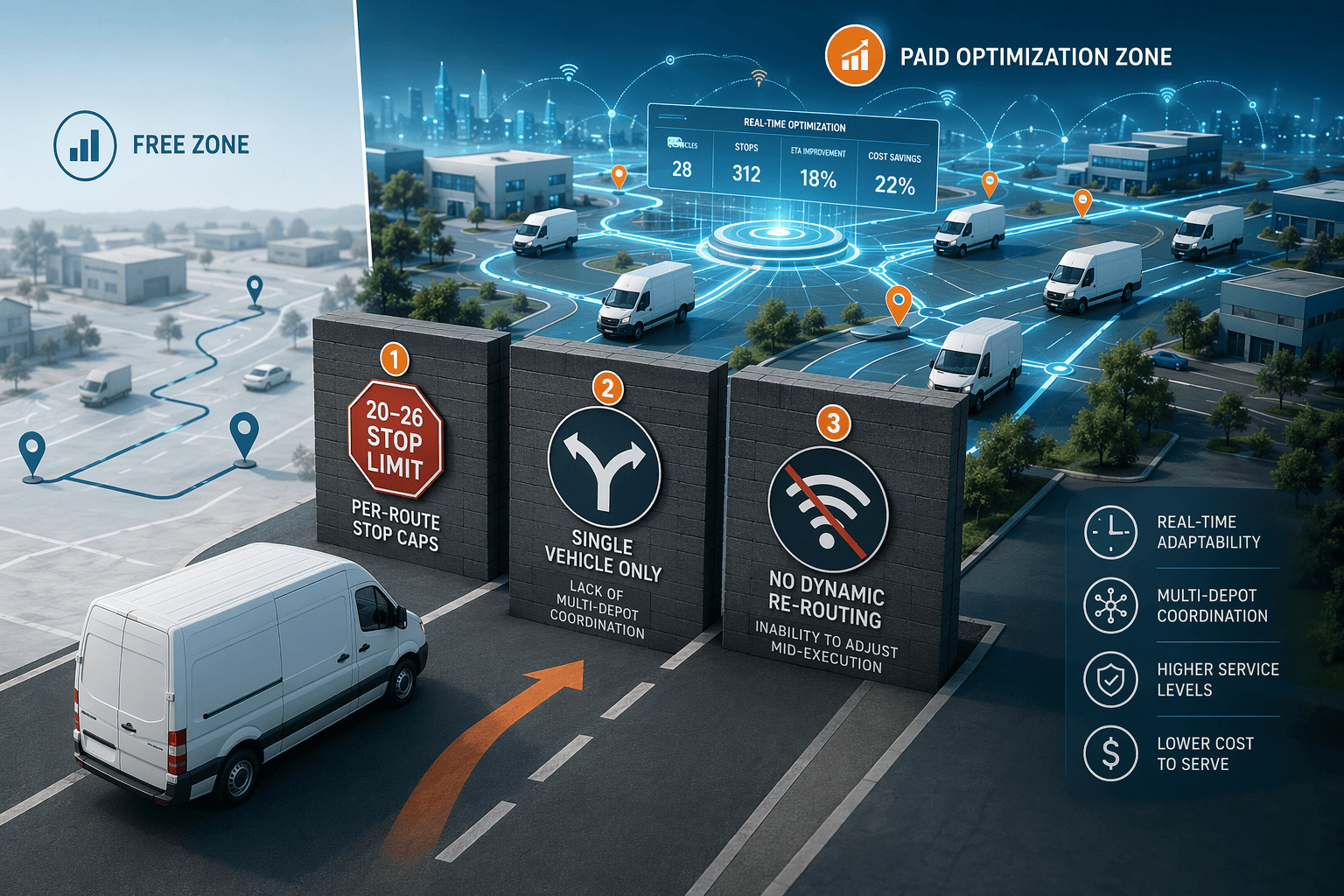
Dead Zone #1: Dynamic Re-Routing After Dispatch
The most expensive limitation of free route optimizers is their inability to re-optimize routes after the driver has left the depot. Free tools generate a static route at the start of the day. If a driver runs late, a customer adds a stop, or traffic shifts, the dispatcher must manually rebuild the route from scratch. This is not merely inconvenient — it creates a cascade failure.
The Locus 2026 evaluation of vehicle routing software describes the dynamic precisely: "A driver running 20 minutes late at stop three carries that delay forward to every subsequent stop unless the route is re-optimized against remaining orders and current traffic. Routing tools that require a dispatcher to manually trigger re-planning introduce a lag that cascades into missed SLAs, driver overtime, and re-delivery costs."
The underlying computational problem is that re-optimizing a route mid-execution requires solving a new vehicle routing problem (VRP) from scratch, incorporating the current positions of all vehicles, remaining stops, time windows, and real-time traffic data. Free tools and free API tiers — such as GraphHopper's free tier, which is limited to 5 locations and 1 vehicle per request — simply cannot handle this. They lack the constraint-handling capacity and the computational budget to re-solve a VRP in seconds.

When This Becomes Material
Dynamic re-routing becomes operationally necessary when you have 5 or more vehicles and 50 or more daily stops. Below this threshold, a dispatcher can manually re-plan a route in a few minutes. Above it, the probability of a delay at any single stop approaches certainty, and the manual re-planning workload becomes unsustainable. Each re-planning cycle takes 5–10 minutes, and with 5+ vehicles on the road, a single afternoon disruption can consume an hour of dispatcher time — time that could be spent on higher-value tasks.
Dead Zone #2: Multi-Depot Coordination
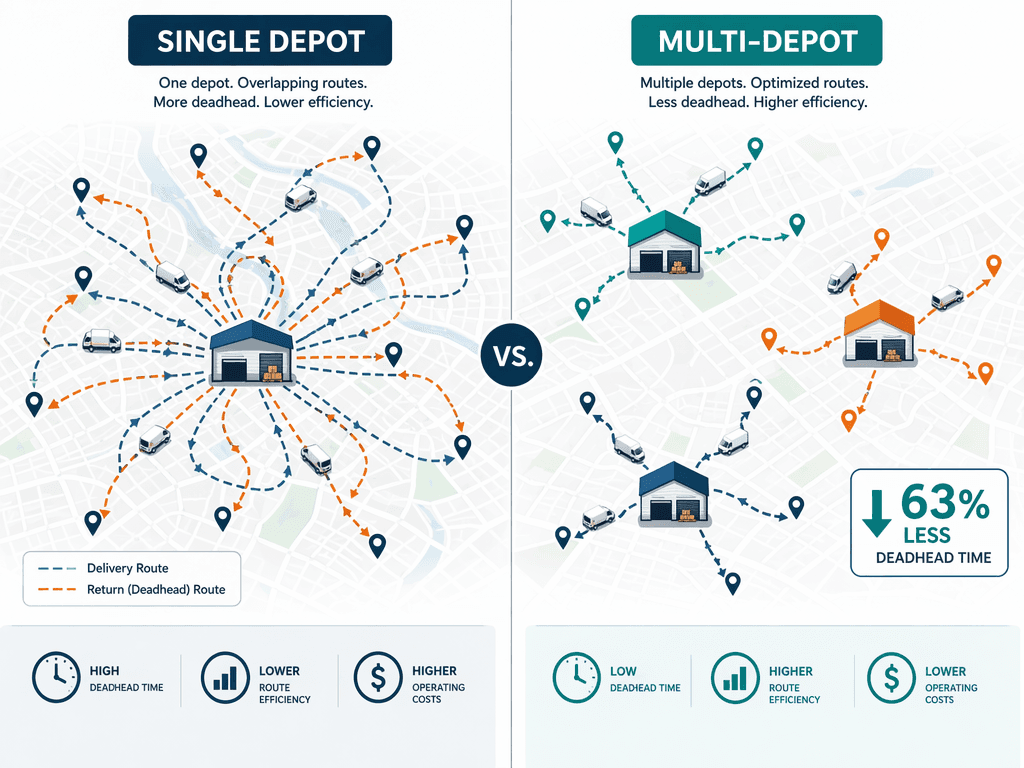
If your operation dispatches from a single warehouse, the routing problem is relatively straightforward. But as soon as you add a second depot — a cross-dock facility, a satellite warehouse, or a partner location — the problem class changes fundamentally. Multi-depot VRP is a structurally harder optimization problem because the solver must simultaneously decide which vehicles should start from which depot and which stops each vehicle should visit, all while minimizing total travel time across the entire fleet.
No free tool or free API tier supports multi-depot optimization. GraphHopper's free tier is limited to 1 vehicle. RouteXL caps at 20 stops. MapQuest at 26 stops. These tools are designed for single-vehicle, single-depot scenarios. The moment you need to coordinate vehicles across multiple starting locations, you have left the free-tool envelope entirely.
The impact of multi-depot planning is documented in a production case study by Sushant Garg, who built a vehicle routing system for operations in Dubai and Cairo. The study compared single-depot planning against multi-depot planning for a real delivery fleet. The results are striking: multi-depot planning reduced deadhead time — the time vehicles spend traveling empty between stops or back to the depot — from 3.8 hours to 1.4 hours, a 63% reduction. On-time delivery rates improved from 89.4% to 96.8%.
When This Becomes Material
Multi-depot coordination becomes necessary when you operate from 2 or more depots, regardless of fleet size. Even with 3 vehicles, if they start from different locations, a single-depot optimizer will produce suboptimal routes. The cost shows up as excess mileage, driver overtime, and missed delivery windows. Paid platforms that support multi-depot optimization start at approximately $150–200 per month (Routific, Route4Me).
| Capability | Free Tools | Paid Platforms ($150–200/mo) |
|---|---|---|
| Multi-depot support | None | Yes |
| Deadhead time reduction | N/A | 63% (documented in production case) |
| On-time delivery improvement | N/A | 89.4% → 96.8% |
| Vehicle limit | 1 (GraphHopper free tier) | 20+ vehicles |
Dead Zone #3: Real-Time, Behaviorally-Calibrated ETAs
Free route optimizers estimate arrival times using simple map-distance calculations: divide the distance by the speed limit and add a flat buffer. This works well on paper and fails in the real world. It does not account for traffic patterns by time of day, historical stop durations at specific locations, driver behavior, or the compounding effect of delays across a route.
Predictive, behaviorally-calibrated ETAs require machine learning models trained on massive historical stop-level data. Onfleet, for example, trains its AI routing engine on "over 400 million deliveries" and re-optimizes continuously as conditions change. This is not a feature that can be added to a free tool — it requires the data infrastructure, compute capacity, and ML engineering investment that only a paid platform can sustain.
The operational impact of inaccurate ETAs is measurable. In the Garg production case study, the shift from a basic routing stack to a production-grade system with real-time ETA calibration improved on-time delivery from 89.4% to 96.8%. That 7.4 percentage point improvement translates directly to fewer missed SLAs, lower re-delivery costs, and higher customer satisfaction.
When This Becomes Material
Inaccurate ETAs become expensive when you have time-window commitments (e.g., 2-hour delivery windows), SLAs with penalties, or customers who expect real-time tracking. At 5+ vehicles and 50+ daily stops, the probability of a missed window due to an inaccurate ETA approaches 100% on any given day. The cost of a single missed SLA — re-delivery, customer credit, or lost future revenue — often exceeds the monthly cost of a paid route optimization platform.
Quantitative Threshold Analysis: When Does Each Dead Zone Hit?
The following table maps each dead zone to the specific fleet scale at which it becomes operationally material. Use this to self-diagnose whether your operation has crossed any threshold.
| Dead Zone | Fleet Threshold | Free Tool Limit | Paid Tool Entry Price |
|---|---|---|---|
| Dynamic re-routing | 5+ vehicles, 50+ daily stops | Manual re-planning only | $150–600/month |
| Multi-depot coordination | 2+ depots | Not supported | $150–200/month |
| Real-time ETAs | Time-window commitments, SLAs | Map-distance estimates only | $150–600/month |
The stop-limit data from free tools confirms these thresholds. RouteXL caps at 20 stops. MapQuest at 26 stops. GraphHopper's free API is limited to 5 locations and 1 vehicle. Routific's free tier includes all features up to 100 orders per month, but only basic optimization. These limits are not arbitrary — they reflect the computational cost of solving VRPs at scale. As the Routific blog notes, "with 25 stops, the number of possible route combinations jumps to over 15 trillion."
The Cost of Not Upgrading: A Simple Calculation
The decision to stay on a free tool is not free. It has a cost — the cost of the labor, fuel, and penalties incurred by working around the tool's limitations. Below is a simple calculation that any operations manager can run against their own numbers.
| Cost Category | Assumption | Monthly Cost (5 vehicles, 50 stops/day) |
|---|---|---|
| Manual re-planning labor | 1 hour/day × $25/hr dispatcher wage × 22 days | $550 |
| Fuel waste from suboptimal routes | 10% excess mileage × 50 miles/day × $0.70/mile × 22 days | $770 |
| Missed SLA penalties | 2 missed windows/day × $15 penalty × 22 days | $660 |
| Re-delivery costs | 3 re-deliveries/week × $12 each × 4.4 weeks | $158 |
| Total cost of not upgrading | $2,138/month |
Compare that $2,138/month to the $150–600/month cost of a paid route optimization platform. The paid platform pays for itself by a factor of 3.5x to 14x, even before accounting for the softer benefits of improved customer satisfaction and reduced driver stress.
Routific's pricing page states that a 15–40% reduction in mileage, drive time, and fleet size is typical for their customers. Even at the low end of that range, a 15% reduction in mileage for a 5-vehicle fleet translates to significant fuel savings — often enough to cover the subscription cost on its own.
When Paid Tools Earn Their Keep: What You Unlock at Each Price Point
If your operation has crossed any of the three dead zones, the question is no longer whether to upgrade — it is which paid platform to choose and at what price point. The following table maps the capabilities unlocked at each price tier.
| Price Point | Capabilities Unlocked | Example Platforms | Best For |
|---|---|---|---|
| $150–200/month | Multi-depot support, basic dynamic re-routing, 1,000+ orders/month | Routific, Route4Me | Growing fleets (5–15 vehicles) that have outgrown free tools |
| $200–400/month | Real-time ETAs, continuous re-optimization, 180+ constraints | Locus, Onfleet | Mid-size fleets (15–30 vehicles) with SLAs and time windows |
| $400–600/month | Full ML-based ETA calibration, multi-depot, unlimited constraints, API access | GraphHopper Premium, Locus Enterprise | Larger fleets (30+ vehicles) requiring custom integration |
The key differentiator between free and paid tools is not just the number of stops or vehicles supported — it is the constraint-handling capacity. Locus reports that routing engines modeling fewer than 50 configurable parameters cannot accurately represent mixed-fleet, multi-depot, or VRPTW scenarios at scale. Free tools operate in the 20–30 parameter range. Paid platforms handle 180+ parameters. That is the difference between a route that is "good enough" and a route that is genuinely optimal for your specific operational constraints.
For a detailed evaluation of specific vendors, including free trials and POC frameworks, see our AI Route Optimization Buyer's Guide for Supply Chain Leaders. That guide walks through the vendor evaluation process, including how to run a structured free trial that tests for the three dead zones identified here.
The Bottom Line
Free AI route optimization tools are not bad — they are just scoped for a specific operational scale. Below 5 vehicles and 50 daily stops, with a single depot and no time-window commitments, a free tool is often the right choice. Above those thresholds, the three dead zones — dynamic re-routing, multi-depot coordination, and real-time ETAs — begin to cost real money.
The good news is that the math is straightforward. If your operation has crossed any of the thresholds described here, the cost of not upgrading almost certainly exceeds the cost of a paid platform. The decision framework in this article gives you the data to make that case to your stakeholders — and to choose the right platform for your specific operational requirements.
Comments
Join the discussion with an anonymous comment.