

The awkward fact about ai inventory optimization in 2026 is that confidence has moved faster than permission. In a RELEX survey of more than 500 supply chain leaders, 67% said their organizations are more confident in AI than they were two years ago. Yet only 10% said they trust AI to make critical supply chain decisions without human review, while 54% prefer human-in-the-loop decision-making.[1]
That is not a minor adoption wrinkle. It is the operating condition planners will live with for the next several years. The organization may believe the model is better than last year’s rules engine. The replenishment lead may still refuse to let it cut a purchase order, move allocation, or revise safety stock without someone accountable looking at the queue first.

This is where the agentic AI conversation becomes useful, and also where it often becomes sloppy. The meaningful change is not that inventory systems can now produce another forecast or prettier alert. It is that software is being designed to pursue planning goals, monitor conditions, choose from allowed actions, and in some cases execute those actions. That crosses a line from prediction into operational authority.
Crossing that line does not mean handing the keys to the system. It means deciding, with some discipline, which keys it gets.
The shift is real, but it is narrower than the sales language
Agentic AI is already appearing in supply chain planning software, including capabilities tied directly to inventory work: purchase optimization, always-on integrated business planning, autonomous exception triage, continuous safety-stock tuning, and autonomous root cause analysis.[1][4][5] Those are not all the same level of autonomy, and they do not all carry the same consequence when wrong.
Continuous safety-stock tuning is a good example because it sounds modest until Monday morning. A system monitors demand variability and lead-time shifts, then adjusts safety stock within predefined guardrails. If those guardrails are tight and the item is low-risk, that may reduce review work without creating much exposure. If the item is constrained, seasonal, expensive, or tied to a key customer, the same action deserves a different approval path.
Autonomous exception triage is another practical use case. The system can rank stockout risks, supplier delays, and forecast errors by likely operational impact. That changes work if it reduces the planner’s sorting burden and pushes the right few exceptions to the top. It changes very little if it simply creates an AI-labeled inbox that still has to be revalidated from scratch.
Purchase optimization goes further. Once an AI system recommends or executes order adjustments across suppliers based on real-time constraints, the issue is no longer just analytical quality. It is commercial authority: who approved the supplier trade-off, what budget tolerance applied, what happens when minimum order quantities conflict with service targets, and who explains the decision when inventory lands in the wrong node.
The market is moving in that direction. Gartner forecast in April 2026 that supply chain management software with agentic AI will grow from under $2 billion in 2025 to $53 billion by 2030, and that 60% of enterprises using SCM software will have adopted agentic AI features by 2030.[2] The scope matters: that forecast covers SCM software with agentic AI capabilities broadly, not inventory optimization alone. Still, it gives planning teams a useful timeline. This is not a lab curiosity, but neither is it a reason to treat every workflow as ready for autonomous execution.
What changes for inventory planners
Traditional AI-supported inventory optimization has mostly improved inputs: better demand sensing, better forecasts, better segmentation, better parameter recommendations. The planner still assembled the answer from screens, alerts, constraints, and experience. Agentic systems aim to compress more of that loop.
| Planning work | Predictive AI usually improves | Agentic AI starts to change |
|---|---|---|
| Safety stock | Calculates recommended levels based on variability and service targets | Monitors changes and adjusts levels within approved guardrails |
| Exception management | Flags items outside thresholds | Prioritizes exceptions and may initiate predefined responses |
| Replenishment | Suggests order quantities or timing | Recommends or executes order changes under limits |
| IBP and S&OP | Provides forecast and scenario inputs | Runs rolling scenarios continuously instead of waiting for a monthly cycle |
| Root cause analysis | Shows correlations and likely drivers | Investigates anomalies and proposes next actions |
The most valuable changes are not the flashiest ones. A nightly safety-stock adjustment within tight policy limits may be more useful than a dramatic autonomous planning demo. A triage agent that reliably suppresses noise and escalates the right exceptions may matter more than an AI assistant that can explain inventory theory. Planning teams do not need software that sounds decisive in a workshop. They need software that behaves predictably when a port delay, promotion miss, or supplier allocation problem hits the same replenishment queue.
Always-on IBP is the most ambitious version of this shift. Instead of waiting for the monthly S&OP meeting to reconcile demand, supply, finance, and inventory trade-offs, an agentic system can keep running scenarios as conditions change.[4] That can be genuinely useful. It can also create a governance headache if every new scenario appears to require a decision, or if the system starts treating a model-optimized plan as an approved business commitment.
The operational test is simple: did the system remove a step, shorten a review, or safely execute an action that used to wait for a person? If not, the organization may have bought agentic language around a conventional recommendation engine.
The ROI signal is still early
The case for agentic inventory systems should not rest on universal ROI promises. Deloitte’s 2025 survey of 1,854 organizations across Europe and the Middle East found that only 10% of organizations currently using agentic AI reported significant ROI, while half expected returns within three years.[3] That survey is not specific to inventory optimization, so it should not be read as an inventory KPI benchmark. It does, however, fit what planning teams see in practice: the technology can be promising before the operating model is ready to harvest the value.
Inventory ROI is also difficult to isolate. A stockout reduction may come from better forecasting, cleaner master data, changed service policies, supplier recovery, or a planner override that prevented a bad recommendation. An inventory reduction may look good until the lost sales report arrives. Agentic AI can contribute to better outcomes, but no source in the available evidence cleanly measures agentic-AI-specific impact on inventory KPIs across companies.
That makes implementation design more important, not less. If a system is only allowed to recommend, ROI comes from faster and better human decisions. If it is allowed to act inside boundaries, ROI can also come from fewer manual touches and shorter response time. If it is allowed to execute more freely, the upside may increase, but so does the burden of controls, auditability, and exception handling.
A graduated autonomy model for inventory optimization
The useful way to adopt agentic AI is to separate system capability from system authority. A model may be capable of recommending a purchase-order change today. That does not mean it has earned the right to execute the change across every supplier, item class, and planning horizon.
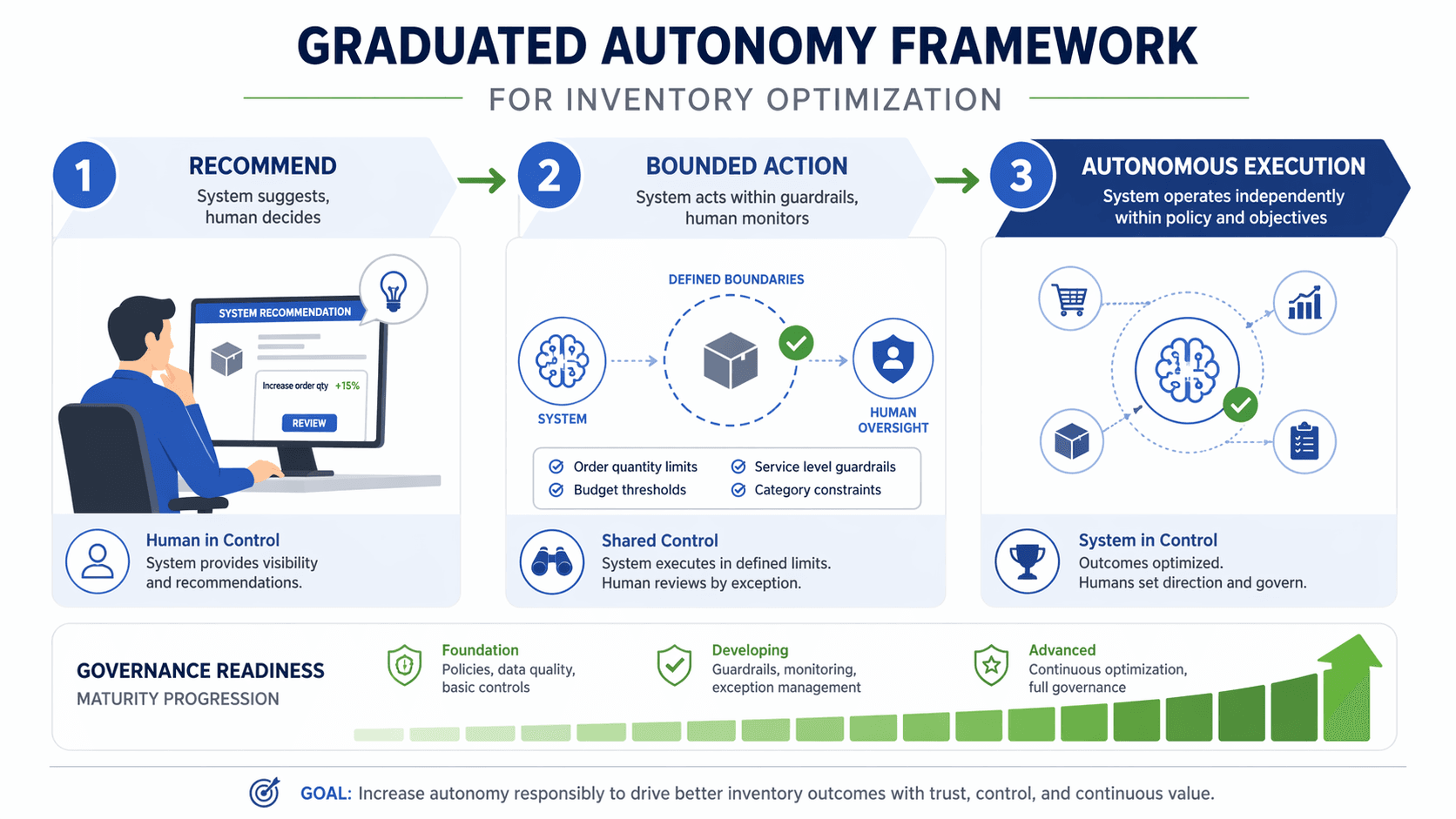
Graduated autonomy gives planning teams a cleaner question: what level of authority is appropriate for this decision, given the risk, data quality, reversibility, and review process? The answer will vary inside the same company. A slow-moving, low-margin item with stable lead times may justify more automation than a constrained component tied to a strategic customer. A safety-stock adjustment inside a narrow band may need a logged notification. A supplier switch may need approval from procurement. An inventory allocation change may need escalation if it affects promised customer orders.
Stage 1: recommendation with accountable review
At the first stage, the system recommends and explains, but a human still approves the action. This is where many companies should start, especially for decisions with financial, service, or customer consequences. The goal is not to preserve manual work indefinitely. It is to build an evidence trail: which recommendations were accepted, which were overridden, why they were overridden, and whether the outcome supported the decision.
This stage is useful only if the review loop is designed well. If planners must open five screens to validate every recommendation, the system has not changed enough work. If override reasons are captured as free-text fragments no one analyzes, the organization is throwing away the feedback needed to move to the next stage.
- Use recommendation-only mode for high-value items, new products, volatile demand, strategic customers, and decisions with unclear reversibility.
- Require structured override reasons, not just approval or rejection.
- Review accepted and rejected recommendations by item family, planner, supplier, and exception type.
- Watch for false confidence: a recommendation can be statistically strong and still violate a commercial constraint the model does not understand.
Stage 2: bounded action
Bounded action is where agentic inventory optimization starts to become operationally different. The system can act, but only inside explicit limits. It might adjust safety stock up or down within a narrow percentage band, reprioritize exceptions, release low-risk replenishment changes, or propose purchase adjustments that are automatically applied below a value threshold. Human review moves from every transaction to the exceptions that breach policy.
This is also where governance either becomes real or decorative. A useful boundary is not just “the AI may act on low-risk items.” It defines the item segment, action type, maximum change, planning horizon, supplier constraints, service-level impact, financial tolerance, escalation trigger, and rollback path. Someone must own each of those definitions. Otherwise the first bad action will be treated as a mysterious AI failure when it was actually an authority-design failure.
For continuous safety-stock tuning, bounded action might mean the system can make nightly changes only for mature SKUs, only within a defined band, only when demand and lead-time signals meet quality thresholds, and only when the projected service impact remains inside policy. The planner does not approve every change. The planner reviews exceptions, drift, and post-action performance.
For autonomous exception triage, bounded action might mean the system can suppress duplicate alerts, group related exceptions, escalate stockout risks above a threshold, and trigger a predefined supplier follow-up workflow. It should not quietly downgrade an exception because the system has low confidence or because the expected financial impact looks small. Low confidence is itself a reason to show the work.
Stage 3: autonomous execution, but not everywhere
More autonomous execution is appropriate only where the organization can tolerate the consequence of the system acting without routine human approval. That usually means the decision is frequent, well-bounded, observable, reversible, and backed by clean enough data. It also means the business has agreed in advance what the system is optimizing for when goals conflict.
Inventory optimization always contains trade-offs. Service, working capital, capacity, supplier reliability, shelf life, storage space, and customer priority do not politely align. A system that executes autonomously needs more than a target service level. It needs decision rights that reflect the business policy behind that target.
Purchase optimization shows the risk clearly. If the system changes order timing across multiple suppliers, it may improve projected availability while worsening cash flow, truck utilization, warehouse congestion, or supplier commitments. The issue is not whether the algorithm can calculate a better order. The issue is whether the company has authorized that kind of trade-off without a person reviewing it first.
Autonomous execution should therefore be earned by workflow, not granted by feature release. The system needs audit logs, performance monitoring, override analytics, exception escalation, and clear stop conditions. Planners need to know when the system acted, why it acted, what limits applied, and what changed afterward. Managers need to know when a pattern of small autonomous actions is accumulating into a material inventory position.
The trust gap will show up in specific places
The RELEX numbers are useful because they prevent a lazy conclusion. Supply chain leaders are not rejecting AI. They are becoming more confident in it while still resisting unsupervised critical decisions.[1] That is a rational posture in inventory planning, where a wrong action may not reveal itself until the shortage, excess, expedite, or customer miss is already in motion.
The trust gap usually appears around five questions:
- Who owns the decision when the system acts inside its authority but the outcome is poor?
- Which decisions require approval because they affect customers, suppliers, cash, or constrained capacity?
- What information must the system expose before a planner can trust or override the action?
- Which exceptions should interrupt the planner, and which should be handled silently under policy?
- When does a pattern of small autonomous decisions require management review?
Those questions are not solved by model accuracy alone. A system can be accurate on average and still make a decision the business is unwilling to own. It can improve planner productivity while creating new review work for managers. It can reduce alert noise while hiding the one exception a planner would have caught because they know a supplier’s real behavior is worse than the master data says.
This is why implementation should start with decision inventories, not vendor demos. List the recurring inventory decisions the planning team makes: safety-stock updates, order quantity changes, expedite recommendations, supplier substitutions, allocation changes, service-level exceptions, and replenishment holds. Then classify each by consequence, reversibility, data quality, frequency, and current review effort. The autonomy level should follow that classification.
For broader context on where agentic capabilities are useful and where they are still overclaimed, readers can pair this inventory-specific view with Agentic AI in Supply Chain: What Actually Works in 2026 — and What's Still Hype. For a deeper operating model, the companion guide on graduated autonomy in supply chain is the more detailed governance path.
What planning teams should require before allowing action
The buying question should not be “does the product have agentic AI?” It should be “what can the system do without approval, under which constraints, and how do we see and stop it?” That is less exciting than a demo, but it is closer to the work.
| Requirement | Why it matters |
|---|---|
| Action-level permissions | Authority should differ by item, supplier, customer impact, value, and decision type. |
| Guardrails that business users can understand | Planning leaders must be able to explain what the system is allowed to do without translating model logic. |
| Structured override capture | Overrides are the evidence base for expanding or reducing autonomy. |
| Escalation and stop conditions | The system needs clear triggers for human review when risk, uncertainty, or impact changes. |
| Audit trails | Teams need to know what the system changed, when, why, and under which policy. |
| Post-action performance review | Autonomy should expand only when actual outcomes support it. |
The hardest part is not writing these requirements. It is enforcing them when the system starts showing useful results. Early wins create pressure to widen authority quickly. That may be justified for some decision classes. It is dangerous when enthusiasm substitutes for a review of error modes, edge cases, and who will absorb the consequence.
There is also a planner adoption issue that gets mislabeled as resistance. If planners are asked to remain accountable while the system takes action they cannot inspect, override, or explain, they will route around it. That is not cultural failure. That is a bad accountability design.
A practical rollout gives planners more leverage before it gives the system more freedom. Start by using agentic tools to reduce exception noise, explain recommended changes, and capture override patterns. Move to bounded action where the consequences are understood. Reserve broad autonomous execution for decision classes with proven performance, clear limits, and agreed ownership.
The real 2026 decision
Agentic AI changes inventory optimization by moving some planning work from advice toward action. It can continuously tune parameters, triage exceptions, run planning scenarios, investigate root causes, and optimize purchases in ways that conventional predictive systems did not. Gartner’s forecast suggests these features will become common in SCM software by the end of the decade.[2]
But the governing question is no longer whether the technology is real. It is whether the organization has earned the right to let it act. That right is earned decision by decision: through clean boundaries, visible review loops, accountable overrides, and a willingness to keep human approval where the business is not ready to absorb autonomous risk.
References
- Supply Chain AI in 2026: The Numbers Behind the Hype — RELEX Solutions
- Gartner Forecasts Supply Chain Management Software With Agentic AI Will Grow to $53 Billion in Spend by 2030 — Gartner, April 7, 2026
- AI ROI: The Paradox of Rising Investment and Elusive Returns — Deloitte, 2025
- Resilient by Design: The Agentic Supply Chain — Deloitte
- Agentic AI in Supply Chain Planning: What It Means — ToolsGroup
Comments
Join the discussion with an anonymous comment.