

Most AI warehouse management projects do not fail in the demo. They fail when the model has to make or recommend decisions against live warehouse conditions: a pick face that was re-slotted but not reflected consistently in the location master, labor scans that arrive with unreliable timestamps, inventory that is “available” in one system and held in another, or automation events that cannot be joined cleanly to WMS order status.
That is why the first readiness question is not whether AI can improve slotting, replenishment, labor planning, exception handling, or orchestration. It is whether the warehouse data layer can carry those decisions from prototype into production without forcing operations to reconcile the answer by hand.
The failure evidence points in that direction. TraxTech, citing MIT research, attributes 73% of supply chain AI failures to incomplete data visibility rather than algorithmic weakness, and separately cites a 95% zero-measurable-value figure for GenAI projects tied to data infrastructure gaps rather than the AI technology itself.[1] Gartner has reported that only 48% of AI projects make it into production, with an average of 8 months from prototype to production.[2] It has also warned that at least 30% of GenAI projects would be abandoned after proof of concept by the end of 2025 because of poor data quality, inadequate risk controls, escalating costs, or unclear business value.[3] Informatica’s 2025 CDO survey found data quality and readiness tied with lack of technical maturity as the top AI adoption obstacle, each cited by 43% of organizations.[4]

Those numbers are not warehouse-specific proof that every AI use case will stall. They are a useful warning about where production risk accumulates. A model can rank candidate replenishment moves, but the warehouse still has to know whether the inventory exists, whether it is accessible, whether a task is already open, whether a conveyor segment is constrained, whether labor is available, and whether the recommendation is allowed under customer, safety, or compliance rules.
The five data foundations that decide whether warehouse AI is deployable
For warehouse AI, readiness is better judged as five connected capabilities: data quality, architecture and interoperability, governance, discoverability, and compliance. This is not a formal universal standard; it is a practical synthesis from AI readiness frameworks and warehouse implementation realities, including the five-dimension assessment approach described by Agility-at-Scale.[5]
| Readiness dimension | Warehouse question it must answer | What breaks when it is weak |
|---|---|---|
| Data quality | Are operational records complete, timely, consistent, and fit for training or decisioning? | The model learns from false dwell time, phantom availability, stale location status, or mislabeled exceptions. |
| Architecture and interoperability | Can WMS, ERP, TMS, WES, automation, labor, yard, and reporting systems exchange usable data continuously? | AI recommendations arrive against yesterday’s warehouse state or conflict with another execution layer. |
| Governance | Who owns each data set, who approves changes, and who can use it for AI decisions? | Teams argue over definitions after the model is already influencing work. |
| Discoverability | Can analysts, engineers, and operators find the right data sets and understand their meaning? | Every use case starts with a new excavation project. |
| Compliance | Can automated or semi-automated decisions be audited, restricted, and explained where needed? | The project gets blocked late by security, privacy, customer, labor, or regulatory concerns. |

1. Data quality: the warehouse event record has to be believable
Warehouse AI depends heavily on event history. Putaway completed, pick started, tote diverted, short picked, replenishment released, trailer arrived, dock door assigned, pack exception cleared: these are not just transaction logs. They become the evidence base for slotting models, labor forecasts, congestion prediction, dynamic wave planning, and exception prioritization.
The problem is that many warehouses have event records that were good enough for daily execution but not good enough for AI. A supervisor can work around a missing reason code. A model may treat it as a pattern. A picker can tell that a scan was delayed because the RF device dropped connection. A labor optimization system may interpret the same gap as idle time. A replenishment planner may know a location was temporarily locked during a count. A model trained on the raw history may conclude that the SKU itself is slow-moving or hard to handle.
The readiness test is therefore specific. Before training or buying a warehouse AI module, teams need to profile the operational data that will actually feed the use case: timestamp reliability, missing values, duplicate events, unit-of-measure consistency, SKU and location master accuracy, exception-code discipline, inventory status definitions, and the lag between physical movement and system recognition.
This is where many projects quietly lose months. TraxTech describes supply chain organizations spending about $10 million annually on data normalization across global supply chains.[1] That figure should not be read as a warehouse-only benchmark, but the pattern is familiar inside large distribution networks: the expensive work is often not building the model; it is making the data comparable enough that the model is not learning from contradictions.
2. Architecture and interoperability: AI cannot run on system disagreement
Architecture is the part of AI warehouse management that gets underestimated because the demo usually shows one clean interface. The actual warehouse has a WMS, an ERP, sometimes a TMS, often a WES or WCS, automation controllers, labor management, parcel systems, yard or dock tools, reporting databases, and spreadsheets that still matter more than anyone wants to admit.
Hardis Supply Chain identifies three prerequisites that matter for AI in WMS environments: continuous data flows rather than batch-only updates, orchestration across mixed automation environments, and a deployment model that supports frequent AI updates without disrupting warehouse execution.[6] Those are not nice-to-have technical refinements. They decide whether an AI recommendation arrives while it can still change work.
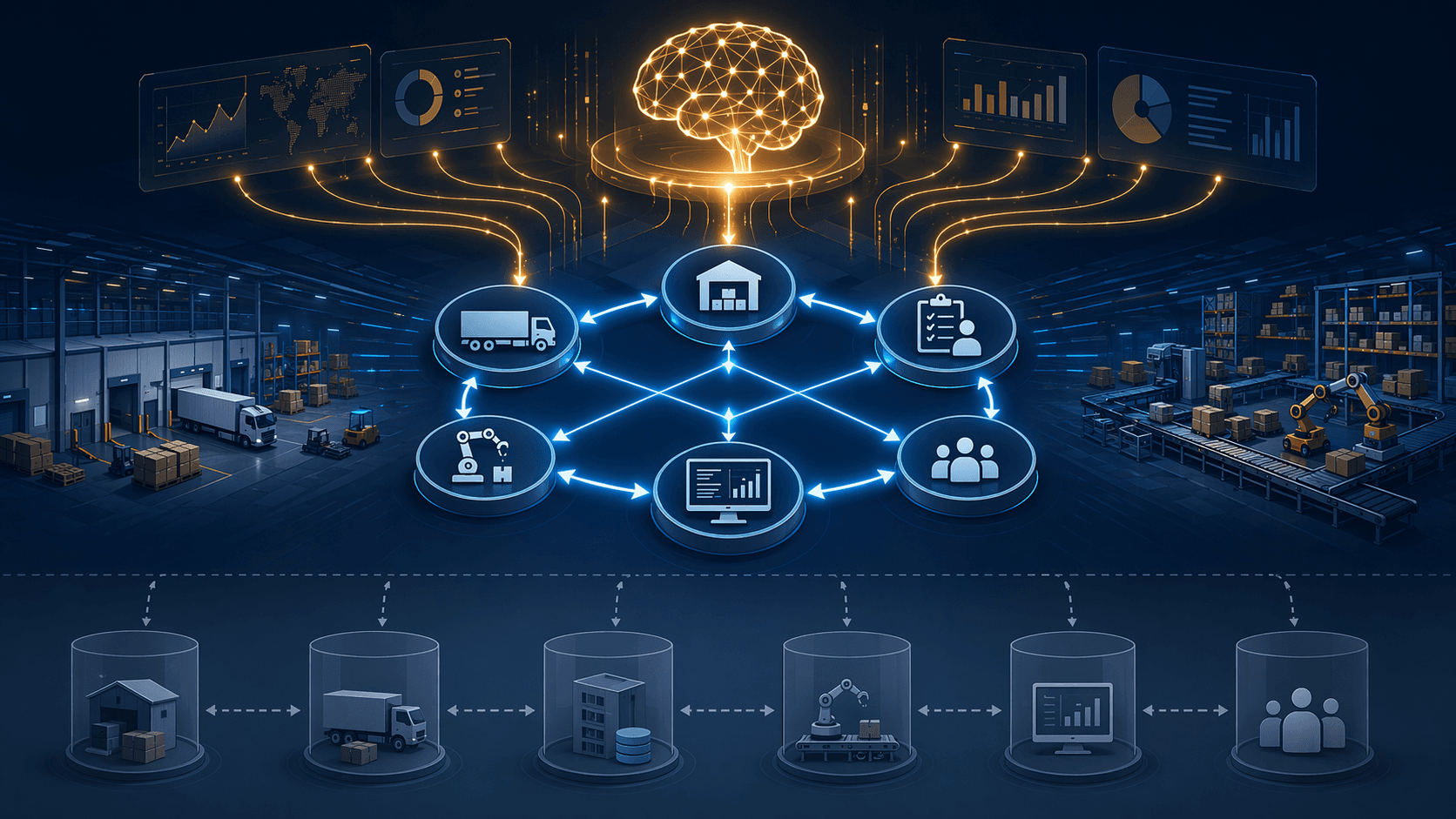
Batch integration may be acceptable for historical reporting. It is much less useful when a system is trying to resequence tasks, predict congestion, recommend labor moves, or decide whether a replenishment should be released before the next wave. If the inventory snapshot is refreshed every few hours, the model is optimizing against a warehouse that no longer exists. If the WES knows a conveyor zone is constrained but the WMS task engine does not, an AI layer sitting above both systems needs a reliable way to resolve that conflict or it becomes another source of noise.
Lumenalta’s warehouse-silo analysis gives useful context here: it says siloed WMS, TMS, and ERP systems can drain up to 30% of potential revenue, and that 75% of supply chain leaders rely on 3 to 10 different systems for basic decisions.[7] The exact impact will vary by network, but the operating condition is recognizable. Leaders ask for one answer on labor, inventory, service risk, and throughput. The data lives in several systems built for different decisions.
Interoperability work should therefore be tied to the first AI use cases, not treated as a generic modernization program. A predictive slotting project needs trustworthy SKU velocity, cube, weight, pick path, location capacity, handling constraints, and replenishment history. A labor optimization project needs task-level standards, clock data, order mix, equipment constraints, and exception history. A yard-to-dock orchestration project needs appointment data, trailer status, dock availability, carrier updates, and warehouse capacity. The integration design has to follow the decision the AI will influence.
For teams preparing an integration review, the natural companion is an operational checklist rather than another architecture diagram. ChainSignal’s AI WMS integration readiness checklist is a useful next step for testing whether the current WMS environment can support deployment rather than just a proof of concept.
3. Governance: someone has to own the warehouse meaning of the data
Warehouse data governance is often discussed as if it were a policy document. In deployment, it is more concrete. Who owns the location master? Who approves a new inventory status? Who can change labor standards? Who decides whether a customer-specific allocation rule is an operational exception or a permanent business rule? Who is accountable when the AI layer recommends something that conflicts with supervisor practice?
Without that ownership, AI projects inherit every unresolved definition fight. “Available inventory” may mean financially available in ERP, physically available in WMS, not allocated to an order, not held for quality, not blocked by customer rules, or not inside an automation zone that is down. For a dashboard, those differences cause meetings. For AI-driven execution, they can cause bad work to be released.
The governance layer should decide at least three things before production: the system of record for each critical data element, the approval process for changes that affect AI decisions, and the escalation path when operators disagree with the recommendation. This is not bureaucracy for its own sake. It protects the floor from becoming the place where unresolved enterprise data conflicts are discovered at speed.
4. Discoverability: the right data has to be findable before every pilot restarts the hunt
In many warehouses, the data exists somewhere. That is not the same as being usable. A data scientist asks for pick-path history and gets shipped order lines. An engineer asks for automation downtime and gets a maintenance spreadsheet with different asset names. Operations asks why the model ranked a location as available and discovers that the relevant hold-code table was never included.
Discoverability is the ability to find the correct data set, understand what it means, know its refresh rate, see its lineage, and judge whether it is fit for the intended AI use case. It becomes especially important in larger warehouse networks because each building may have local configuration, local naming conventions, and local workarounds that never made it into enterprise documentation.
A practical warehouse AI data catalog does not have to start as an elaborate enterprise artifact. It needs to identify the data products that matter for the first decisions: order demand, inventory state, location attributes, task events, labor availability, automation state, transportation commitments, customer constraints, and exception history. Each should have an owner, definition, source, refresh pattern, known limitations, and access rules.
5. Compliance: automated decisions need controls before they touch execution
Warehouse AI does not always look like a compliance problem at first. Slotting, wave timing, replenishment, and task sequencing can seem operational rather than sensitive. But warehouses handle customer-specific rules, labor data, safety constraints, regulated products, export or hazmat restrictions, audit requirements, and contractual service commitments. Once AI starts recommending or triggering actions, those controls need to travel with the decision.
The compliance test is whether the organization can answer basic questions after the fact. What data was used? Which rule or model version produced the recommendation? Was the recommendation accepted, overridden, or blocked? Who had permission to see the underlying data? Were customer, labor, privacy, or product-handling restrictions applied before the recommendation reached the floor?
This is where GenAI-style interfaces need particular care. A supervisor-facing assistant that explains late orders or recommends labor moves may pull from systems with different access permissions. If the assistant cannot respect those boundaries, the issue is not simply model quality; it is a control failure.
What skipping the foundations does to ROI
Vendor ROI claims are worth reading, but they need to be read with the implementation state in mind. Deposco, a WMS provider, describes warehouse AI outcomes including 6 to 18 month payback periods, 40% faster fulfillment, and 30% cost reduction; it also notes that payback can be delayed by the time needed to build enough clean data to provide context.[8] Those are vendor-published figures, not a neutral benchmark for every warehouse. The important part is the dependency: the payback clock does not really start when the slide deck is approved. It starts when the data is clean and connected enough for the system to make decisions that operations will trust.
Skipping readiness does not always create a dramatic system failure. More often, it creates quiet dilution. The pilot works on a cleaned extract, but the production feed has missing events. The model looks accurate in one building, but location and process definitions differ in the next. Operators override recommendations because the system does not know about constraints they handle every day. IT slows rollout because security and access controls were not designed into the workflow. Finance waits for measurable savings while the project team spends another quarter reconciling master data.
Agility-at-Scale cites a 70% pilot-to-production failure rate in the context of AI data readiness.[5] Combined with Gartner’s 48% production-conversion figure, the message is less about discouraging AI than about sequencing the work honestly.[2] If the project plan treats data readiness as preliminary cleanup outside the AI deployment, it hides the actual critical path.
A readiness gate before the warehouse AI pilot
A useful decision gate does not ask whether the organization has perfect data. It asks whether the data is good enough for the specific decision the AI will influence, and whether the weaknesses are known before the pilot is judged.
- Name the decision: for example, slotting recommendations, labor moves, replenishment release, exception prioritization, or dock scheduling.
- List the systems involved: WMS, ERP, TMS, WES, WCS, labor, automation, yard, parcel, reporting, and any local files still used for the decision.
- Identify the required data elements and their systems of record.
- Profile the relevant history for missing values, duplicate events, timestamp lag, inconsistent codes, and local exceptions.
- Confirm whether production integration can support the decision timing, not just historical analysis.
- Assign owners for data definitions, access, change approval, and operational override handling.
- Define how the recommendation will be audited after it affects work.
This gate should happen before a pilot is treated as evidence of scalability. A carefully cleaned prototype can show that a use case has promise. It does not prove that the warehouse network can support it on live feeds, across buildings, under peak volume, with system latency, exception noise, and access controls intact.
For broader cross-functional planning, ChainSignal’s supply chain AI data readiness checklist extends the same readiness question beyond warehouse operations into planning, logistics, procurement, and enterprise data ownership.
Where warehouse AI architecture is moving
The direction of travel is toward more active command and orchestration layers, not isolated prediction widgets. NVIDIA’s January 2026 technical blog describes a multi-agent warehouse AI command layer intended to coordinate operational intelligence across warehouse systems and automation environments.[9] JASCI has announced an MCP AI Server positioned for universal LLM interoperability with an AI-native WMS, with launch timing described for August 2026; as of June 26, 2026, that makes it a pre-launch signal rather than a generally available production proof point.[10]
These developments are worth watching because they assume exactly the conditions many warehouses have not finished building: discoverable data, governed access, reliable event streams, and interoperable execution systems. A command layer cannot command what it cannot see. An agent cannot safely act across systems that disagree about inventory, capacity, or task state.
The practical conclusion is conditional, not pessimistic. Measurable ROI from AI warehouse management is plausible when the data layer is treated as part of the AI deployment itself. If readiness is separated into a vague cleanup phase, the project will likely spend its production budget discovering the same problems that could have been surfaced at the gate.
The next step is to sequence the decision. Use the WMS integration review to test the warehouse system environment, use the broader data readiness checklist to align enterprise ownership, and then move into a phase-gated pilot plan. ChainSignal’s pilot-to-production framework is the right place to make that production decision explicit before the warehouse floor becomes the test environment.
References
- Where AI Actually Fails in Supply Chain Operations; Why 95% of AI Projects Fail—And How Supply Chain Leaders Can Beat the Odds, TraxTech
- Only 48% of AI Projects Make It Into Production, Gartner
- Gartner Says at Least 30% of Generative AI Projects Will Be Abandoned After Proof of Concept by End of 2025, Gartner
- The Surprising Reason Most AI Projects Fail, Informatica
- Data Readiness Assessment for AI: Checklist, Framework, and Scoring, Agility-at-Scale
- AI in WMS: Use Cases, Real Questions, Evaluation, Hardis Supply Chain
- The hidden cost of data silos in your warehouse, Lumenalta
- AI in Warehouse Management: How Smart Warehouses Deliver Real ROI in 2026, Deposco
- Multi-Agent Warehouse AI Command Layer Enables Operational Excellence, NVIDIA Technical Blog, January 2026
- JASCI Launches MCP AI Server: Universal LLM Interoperability for the AI-Native WMS, JASCI, August 2026
Comments
Join the discussion with an anonymous comment.