
Tropical Storm Bertha did not have to close Houston-Galveston to become a finance problem. On July 22, 2026, the Waterways Journal reported that the storm had not triggered escalated Port Conditions for Houston-Galveston, meaning the near-term operating question was not yet a full shutdown response.[1] That is exactly why the event is useful. A near-miss gives executives a cleaner view of the decision sitting underneath the weather briefing: how much money is riding on one port, how early should a company pay to move inventory, and what is the cost of being late?
For companies tied to Port Houston, the answer is not local. Port Houston reports $906 billion in national economic value, $439 billion in Texas economic value, 1.54 million Texas jobs, and $222.5 billion in foreign cargo value tied to the port.[2] Those numbers make the Houston Ship Channel look less like a weather-exposed operating node and more like balance-sheet infrastructure.
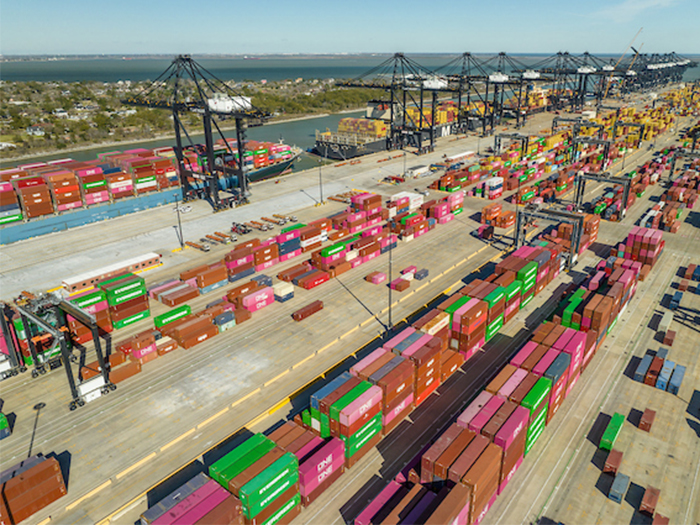
The working benchmark for a major Houston closure is large enough to change an AI investment conversation. UNCTAD’s Port Houston case study cites an Odyssey 2017 analysis estimating that Hurricane Harvey’s port closure cost up to $2.5 billion per week.[3] That figure should not be treated like an audited invoice. It is a single-source estimate attached to a specific event. But as a business-case anchor, it is still useful: the credible range is not “some inconvenience.” It is “billions can move through the variance line before the postmortem is finished.”
The AI Case Starts With Exposure, Not Software
The Bertha-Houston planning question can sound like a technology question. It is really a capital allocation question. If one serious port closure can plausibly cost a supply chain more than the multi-year cost of better sensing, scenario planning, and exception management, then the burden of proof changes. The AI spend no longer has to promise perfect prevention. It has to reduce enough late decisions, manual chasing, detention exposure, expedited freight, and lost sales to pay back against a known disruption class.
McKinsey’s 2020 work on global value chains found that companies can expect supply chain disruptions lasting a month or longer every 3.7 years on average.[4] That statistic predates some of the most visible post-pandemic disruption patterns, so it should not be stretched into a current hurricane-frequency claim. Its value is simpler: severe disruption belongs in recurring planning assumptions, not in the “rare event” drawer that only opens after the first emergency meeting.
Once a disruption is modeled as recurring, the ROI conversation becomes more honest. A company does not need AI to eliminate a $2.5 billion regional closure cost. It needs AI to help its own share of that exposure move earlier and cleaner: fewer containers accruing avoidable charges, fewer emergency premium-freight approvals, fewer customer promises made against stale ETAs, and fewer planners spending storm week reconciling spreadsheets that disagree.
| Business-case input | How to use it |
|---|---|
| Port Houston economic scale: $906B national value and $222.5B foreign cargo value | Establish whether the port is material enough to justify executive attention |
| Closure benchmark: up to $2.5B per week | Stress-test the cost of one severe event without pretending the estimate is exact |
| Month-long disruption frequency: every 3.7 years on average | Move disruption planning from contingency language into recurring risk modeling |
| Company-specific exposure | Translate the port-level benchmark into shipments, margin, service penalties, inventory timing, and working-capital impact |
Over-Warning Has a Cost Too
Storm disruption planning fails in two directions. Acting too late is expensive, but acting too often is not free. The CyPort research, based on 145 U.S. ports and 90 tropical cyclones from 2015 through 2023, found that only about 21% of cyclone-port exposures resulted in actual disruption, and that Category 4 storms represented an escalation threshold for disruption risk.[5] That is a useful calibration warning. If every named storm produces the same escalation cadence, teams burn labor, attention, and credibility long before the dangerous event arrives.
This is where AI planning has to earn its keep. The valuable tool is not the one that produces the most alerts. It is the one that helps decide when to hold, when to prepare, and when to spend real money before certainty exists. A port-dependent shipper does not need a dashboard that makes the storm look dramatic. It needs earlier exception triage: which SKUs are exposed, which purchase orders have no slack, which customers will feel the miss first, which alternate routings are still viable, and which mitigation choices will become unavailable by tomorrow.
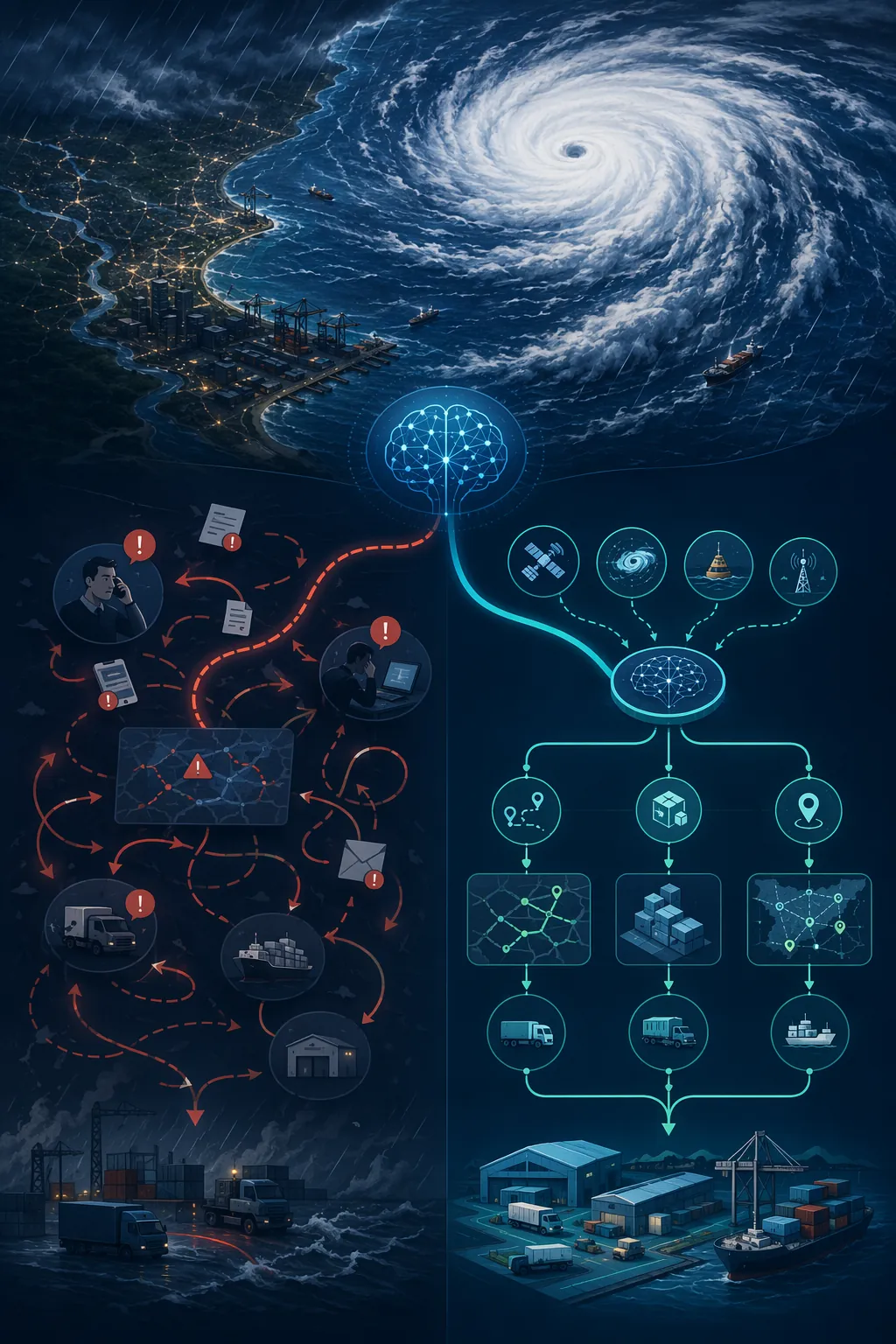
The calibration point matters because storm protocols are not just technical workflows. They create approval pressure. A planner who asks for premium freight before the port condition changes may be right, but still has to defend the cost. A sales team that receives an early warning may pull demand forward, promise substitutes, or alarm customers unnecessarily. A finance lead will later ask which actions were avoided, which actions were necessary, and which were simply noise dressed as resilience.
What AI Changes in the Actual Workday
In a port disruption, the first operational loss is often clarity. ETAs drift. Carrier updates arrive in different formats. Port notices sit beside weather advisories, customs timing, warehouse capacity, customer order priorities, and inventory positions. The human work becomes a relay: chase, reconcile, escalate, approve, explain. Good AI planning tools compress that relay. They do not make the storm disappear; they reduce the number of ambiguous manual escalations between signal and decision.
Siemens reports that its Portcast integration with the AX4 logistics platform ingests more than 200 data sources and delivered an 80% reduction in manual shipment follow-ups, a 15% decrease in detention and demurrage charges, and a 5% reduction in expedited freight costs.[6] Those are vendor-reported outcomes, not independent universal benchmarks. Still, the value categories are the right ones. Manual follow-ups are labor and delay. Detention and demurrage are direct leakage. Expedited freight is the receipt for decisions made after the cheap options have expired.
Portcast’s own materials emphasize congestion visibility and shipment rerouting as AI use cases, which is where the practical distinction sits: a better model matters only if it reaches the decision layer while options remain open.[7] That is also why the most useful internal planning conversations should connect weather AI to order promising, transportation execution, inventory positioning, and exception ownership. We have covered the broader logistics role of AI weather forecasting as a supply chain tool and the more specific AI capabilities for tropical storm disruption planning; the business case is strongest when those capabilities are attached to accountable operating decisions.
The Workflow Shift That Finance Can Actually Measure
A useful ROI model does not start with “AI accuracy.” It starts with the cost lines a storm can move. Some of them are visible immediately: detention, demurrage, premium freight, overtime, spot capacity, and chargebacks. Others arrive with a lag: lost sales, customer concessions, inventory imbalance, write-downs, and lower planner productivity during recovery.
- Before the storm: identify exposed lanes, orders, SKUs, suppliers, and customers while mitigation choices still exist.
- During escalation: separate high-consequence exceptions from routine noise so planners do not manually chase every shipment.
- During rerouting: compare cost, service, inventory, and customer impact instead of approving premium freight case by case.
- After the event: preserve the decision trail so finance can explain variance without rebuilding the week from inboxes.
That last point is underrated. In a messy event, the after-action finance question is rarely “was the weather bad?” It is “which costs were unavoidable, which were preventable, and what would have changed if we had acted earlier?” AI planning tools that keep the scenario logic, alert history, and approval trail in one place make that answer less political.
The Upside Case: Capturing Demand, Not Just Avoiding Cost
Cost avoidance is the safer resilience case, but it is not the only one. ClimateAi’s Hurricane Ian case study says its AI hurricane forecasting helped a roofing materials producer pre-position region-specific inventory before the 2022 storm and capture $15 million in additional sales.[8] This is a single vendor case study, not a general rule for hurricane season. It is still important because it shows the part of resilience that does not always appear in logistics budgets: the ability to serve demand when competitors are constrained.
The mechanics are straightforward. A storm changes demand geographically and temporally. If a company can identify the likely demand shift early enough, it can move the right inventory closer to the affected region, reserve capacity, adjust replenishment, and prepare customer commitments before the market tightens. In building materials, that can mean region-specific products. In other industries, the same logic may apply to repair parts, medical supplies, packaged goods, or industrial inputs. The exact benefit depends on margin, substitutability, lead time, and whether customers will wait.
That upside case deserves discipline. A $15 million example does not prove every storm-exposed shipper has a comparable revenue opportunity. It does show why the ROI model should not stop at avoided detention charges. For some businesses, the largest benefit of earlier planning is not the cost they avoid; it is the demand they are ready to fulfill. We have covered that tropical storm planning use case in more detail in How AI Helps Supply Chains Plan for Tropical Storm Disruptions.
A Practical ROI Frame for Port-Exposed Companies
The cleanest executive case separates documented exposure from claimed mitigation. Start with the port-dependent revenue, margin, inventory value, shipment count, and customer commitments at risk. Then layer in disruption frequency, using benchmarks like McKinsey’s 3.7-year disruption interval as a planning input rather than a precise forecast. Then model mitigation in ranges, not certainties.
| ROI line | What to quantify | Evidence standard |
|---|---|---|
| Closure exposure | Revenue, margin, inventory, and shipment value tied to the port during a severe event | Company data plus port-level benchmarks |
| Direct cost reduction | Detention, demurrage, expedited freight, overtime, and spot capacity | Internal history; vendor outcomes only as assumptions to test |
| Labor efficiency | Manual follow-ups, exception handling hours, duplicate status checks, and escalation meetings | Workflow baseline before implementation |
| Service protection | Orders protected, customers prioritized, substitutions offered, and penalties avoided | Customer and order-level analysis |
| Revenue upside | Incremental demand captured through pre-positioned inventory or faster recovery | Scenario-specific, not assumed universal |
A hypothetical example shows the math without pretending to be a real case. If a company has meaningful Houston exposure during hurricane season, even a small reduction in late premium freight, avoidable storage charges, and missed high-margin orders can fund a planning system faster than a normal IT productivity case would suggest. The executive question is not whether the model can predict every port condition correctly. It is whether it gives the organization enough earlier, better-ranked choices to reduce the cost of one serious event.
This is also where skepticism belongs. AI investment in supply chain has not always produced clean returns, and we have written separately about why record AI investment in supply chain is not paying off yet. A port-disruption business case should not borrow generic transformation language. It should name the lanes, charges, approval delays, service penalties, and revenue opportunities the tool is expected to influence.
Do Not Confuse Autonomy With Accountability
The industry is moving toward more autonomous disruption handling. Gartner projects that 60% of supply chain disruptions will be resolved without human intervention by 2031.[9] That projection is useful as a direction-of-travel marker, not as proof that today’s port-disruption tools can run unattended. Storm decisions still involve customer priorities, safety constraints, contract terms, inventory tradeoffs, and executive risk tolerance.
There is also a technical caution. The CyPortQA benchmark found that leading multimodal large language models, including GPT-4o and Gemini 2.5, under-reacted in port-condition decision tasks by recommending less stringent regulations than needed.[10] That does not argue against AI in port planning. It argues against treating a general model’s answer as the control tower. The better design is decision support with human oversight, clear escalation thresholds, auditable assumptions, and integration into the systems that execute transportation and inventory decisions.
The hardest implementation work is usually not the forecast. It is agreeing who can act on it. If the AI system recommends pulling inventory forward, who approves the working capital? If it flags a lane for rerouting, who owns the customer tradeoff? If it suppresses an alert because the event resembles the 79% of cyclone-port exposures that do not disrupt operations, who is accountable if the storm intensifies? Those questions should be settled before the first named storm approaches the Gulf.
Where Bertha Leaves the Investment Case
Bertha’s Houston-Galveston near-miss is not evidence of catastrophic port loss. It is evidence that the decision window can open before the port officially closes. That is the uncomfortable zone where planners need to recommend expensive actions while executives still see uncertainty. Waiting for certainty feels financially conservative until the only options left are premium freight, missed orders, and explanations.
For port-exposed supply chains, AI planning is justified when the expected cost of one serious closure is large enough to fund better sensing, scenario planning, and exception management over multiple years. In Houston, the port-level economics are large enough to make that test worth running. The answer is yes for many exposed companies, provided the business case separates documented exposure from vendor-claimed outcomes and treats AI as decision support under pressure, not a magic storm shield.
References
- Tropical Storm Bertha Update, Waterways Journal, July 22, 2026.
- Statistics, Port Houston.
- Case Study 14: Port Houston, United States, UNCTAD.
- Risk, resilience, and rebalancing in global value chains, McKinsey Global Institute.
- CyPort: Modeling hurricane impacts on coastal port disruptions using real-world port activity data, Transportation Research Part D, Vol. 157, August 2026.
- When Sea Freight Gets Smarter, Siemens Digital Logistics, September 5, 2025.
- Impacted by Port Congestion and Shipment Rerouting? Here’s How AI Can Help, Portcast.
- Accurate hurricane forecasting helps roofing materials producer capture $15M in additional sales, ClimateAi.
- Gartner Predicts 60% of Supply Chain Disruptions Will Be Resolved Without Human Intervention by 2031, Gartner, March 18, 2026.
- CyPortQA: A Benchmark for Multimodal Port Condition Decision-Making During Tropical Cyclones, arXiv.
Comments
Join the discussion with an anonymous comment.