
The Red Sea crisis made a familiar weakness impossible to hide: many shippers had shipment tracking, but not enough warning to make better decisions. During the 2024–2025 peak disruption, carriers avoided the Bab al-Mandeb route, Suez-linked container flows fell sharply, Asia–U.S. East Coast transit times stretched, and freight markets repriced around longer voyages and scarce capacity. project44 reported a 68% drop in Suez Canal container traffic and transit-time increases of 47% on Asia–U.S. East Coast lanes, with freight-rate increases in the 130% to 249% range depending on lane and time window.[1] Atlas Institute, using IMF PortWatch data, reported daily transit trade volume through the affected corridor falling 57.5%, from about 4.0 million to about 1.7 million metric tons.[2]
Those figures matter because they describe the kind of disruption that turns ordinary visibility into operational stress. A planner does not need another dashboard saying a vessel is late after the customer has already called. They need to know whether the delay is likely to worsen, which shipments are exposed, which orders can still be protected, and whether rerouting, inventory allocation, or customer communication should happen now rather than next week.
The human cost of poor visibility is usually less dramatic than the geopolitics, but it is where the business case starts. Siemens and Portcast describe a 50,000 TEU shipper where five to 10 different teams were chasing the same shipment updates, creating roughly 20,000 wasted hours per year.[3] That is not a visibility problem in the abstract. It is duplicated work, inconsistent customer answers, delayed escalation, and a control room full of people reconciling carrier portals instead of managing exceptions.
Tracking Told Teams What Had Already Gone Wrong
Traditional shipment tracking tends to work tolerably well when the network behaves. It can collect carrier events, show location milestones, and publish an ETA. During a chokepoint disruption, the same model starts to fray. Carrier schedules change, vessels slow steam or divert, port calls move, feeder connections slip, terminal congestion builds, and the same shipment can carry conflicting ETAs across portals.
The operational distinction is simple but important: tracking is often a record of status; predictive visibility is an operating signal. The better systems ingest satellite data, AIS transponder signals, weather, port and terminal telemetry, and carrier schedule feeds, then use machine learning models to estimate arrival risk and explain why an ETA is changing. Siemens describes this as a multi-source approach spanning more than 200 data sources, with delay explanations such as terminal congestion, weather, or carrier rescheduling rather than a bare revised date.[3]
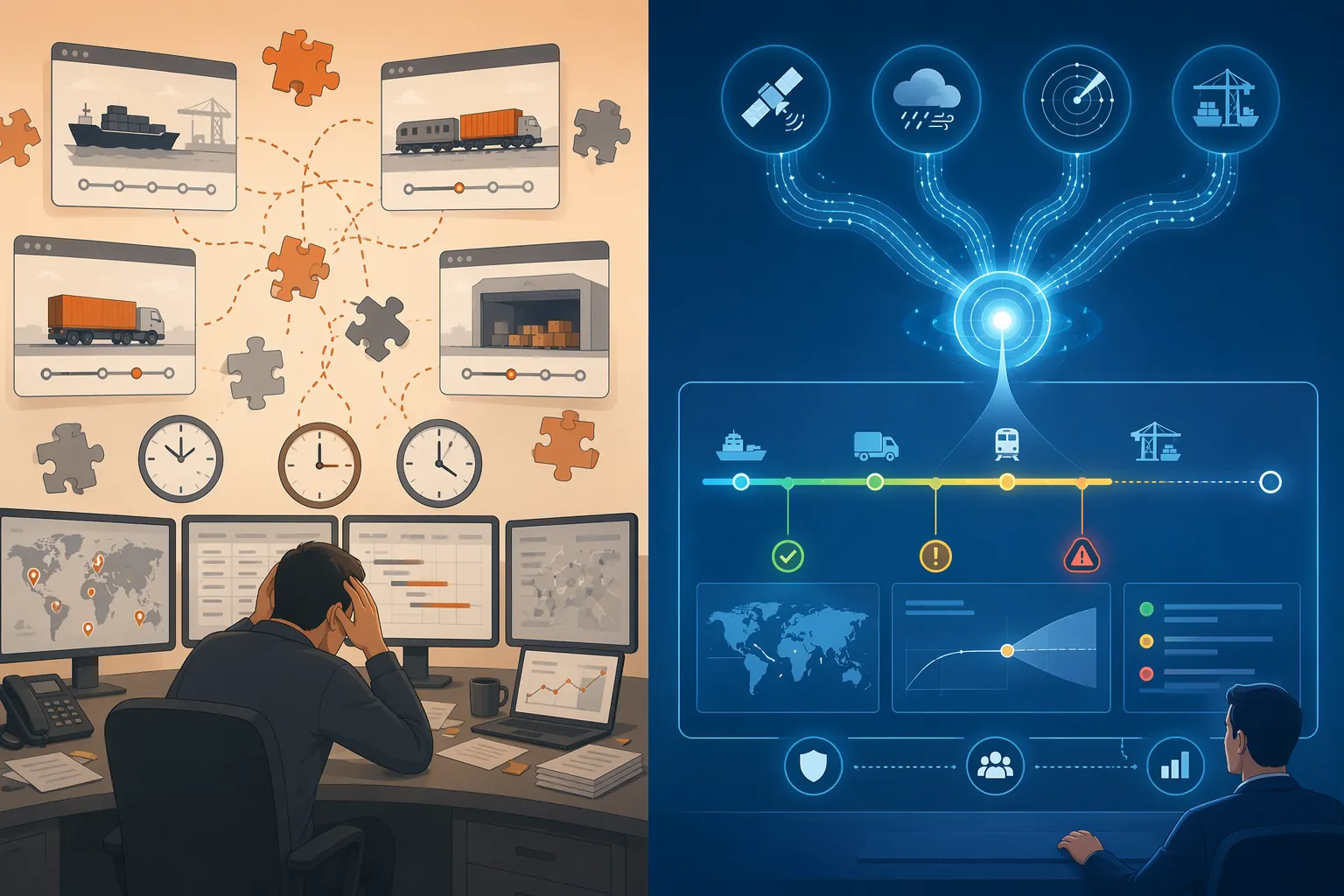
That explanation layer is not cosmetic. If a delay is driven by weather, the next action may be customer communication and downstream schedule adjustment. If it is terminal congestion, detention and demurrage risk moves up the list. If it is carrier rescheduling, procurement and transport teams may need to decide whether alternative capacity is still worth buying. A generic late ETA leaves all those teams to investigate from scratch.
| Operational Need During Red Sea Disruption | Traditional Tracking | AI-Powered Predictive Visibility |
|---|---|---|
| ETA confidence | Often carrier-sourced and revised after schedule changes appear | Uses multi-source signals to forecast arrival risk earlier |
| Exception handling | Teams manually search portals and emails for updates | Alerts focus attention on shipments most likely to miss plan |
| Delay cause | Late status may appear without enough context | Models can attribute likely causes such as congestion, weather, or schedule changes |
| Customer communication | Updates are often reactive and inconsistent across teams | Earlier warning supports more consistent customer ETAs |
| Cost control | Premium freight and detention decisions happen under time pressure | Earlier exception signals can support rerouting and escalation before options close |
The Strongest Evidence Comes From One Deployment
The most useful proof point is the Portcast and Siemens automotive OEM deployment, because it reports operational outcomes rather than only describing product capability. In that case, the deployment achieved 100% ocean freight traceability, a 70% improvement in data accuracy compared with carrier-sourced data, a 50% user productivity boost, and roughly a 10% reduction in premium freight costs.[4]
Each metric deserves a careful reading. Full ocean freight traceability means the shipper moved closer to a single operating view of shipments that previously required manual reconciliation. The 70% data accuracy improvement is especially relevant during disruption because bad ETAs do not merely inconvenience planners; they trigger wrong inventory promises, unnecessary escalation, and late customer warnings. A 50% productivity gain suggests that users spent less time hunting for updates and more time acting on exceptions. The roughly 10% reduction in premium freight costs is the number most likely to interest finance teams, but it should be read as a case outcome, not a guaranteed savings rate.
The value pattern is credible. When a system improves traceability, raises ETA accuracy, and reduces manual update chasing, premium freight pressure should fall in some situations because teams see exceptions earlier. But this is still a single well-documented deployment from Portcast and Siemens. It is strong enough to justify serious evaluation by shippers with maritime exposure. It is not strong enough to quote as an industry benchmark.
What the Automotive OEM Case Actually Shows
- It supports the claim that predictive visibility can reduce manual shipment-status work when data is unified and trusted.
- It supports the claim that better ETA accuracy can change operational behavior before disruption costs are locked in.
- It supports the claim that ocean freight traceability can be treated as a planning capability, not only a reporting feature.
- It does not prove that every manufacturer will reduce premium freight by about 10%, because network design, inventory buffers, carrier mix, and escalation rules vary.
That last boundary matters. A shipper with rigid production windows and little inventory slack may use earlier warnings differently from a retailer with more flexible allocation options. A company that already has disciplined exception workflows may see smaller productivity gains than one where regional teams still maintain their own spreadsheets. The technology creates earlier signals; the organization still has to decide who acts on them.
The Webinar Data Points in the Same Direction, With a Smaller Weight
A Siemens and Portcast webinar poll from March 2026 adds useful directional evidence, but it should not be handled like a cross-industry census. The poll involved about 50 supply chain leaders in an AI-focused setting, so the audience likely skewed toward people already interested in the problem. Within that group, 93% reported that their organizations still operated in reactive firefighting mode despite having visibility tools.[5]
The same webinar reported that organizations using predictive AI for disruption planning during the Red Sea crisis saw about a 15% reduction in detention and demurrage charges and about a 5% reduction in expedited freight costs.[5] Those figures fit the operational logic of earlier exception detection: fewer containers sit unnoticed, fewer escalations arrive too late, and fewer teams buy speed after cheaper options have disappeared.
The limitation is not that the numbers are useless. It is that they are directional. A live poll of roughly 50 leaders can validate that the pain pattern and savings categories are real among interested practitioners. It cannot establish what the median shipper should expect across industries, lanes, or operating maturity levels.
Where AI Changed the Planning Window
For supply chain teams planning around the Houthi Red Sea attacks, the question is not whether AI could describe the crisis after the fact. The question is whether it gave planners more time before operational choices narrowed.
Siemens and Portcast describe predictive systems producing seven to 10 days of advance warning on delays during the disruption.[3] In a control room, that extra week is not an abstract forecast improvement. It can determine whether a customer receives a credible revised ETA before their own production plan breaks, whether inbound materials can be resequenced, whether a container is watched for detention risk, or whether premium freight is avoided because the team still has a normal-cost workaround.
The best use of the technology is exception triage. Most shipments should not require human attention every day. A planning system earns its keep when it separates normal noise from the few moves that threaten service, cost, or production. Supply Chain Management Review described AI-enabled exception management as part of a broader shift from routine monitoring toward predictive operations, including automation of much routine monitoring work.[6]
That does not make human planners less important. It changes what they should spend time on. Instead of five teams asking the same carrier for an update, one team can review the exception, check the predicted cause, decide whether action is needed, and give sales, production, or customer service a common answer.
Predictive Visibility Is One Layer, Not the Whole Resilience Stack
The Red Sea crisis also showed why predictive visibility should not be oversold as a complete answer to geopolitical disruption. It helps answer shipment-level and lane-level questions: where is the cargo, what is the likely ETA, why is the ETA changing, which exceptions deserve action, and which costs are becoming avoidable or unavoidable.
It does not decide sourcing strategy, redesign the network, negotiate carrier capacity, or resolve political risk. Those decisions need scenario planning, supplier mapping, inventory policy, and executive trade-offs. MIT Sloan Management Review has argued for digital twins and scenario planning as ways to prepare for geopolitical supply chain risks before they become live operating crises.[7] In practice, those capabilities sit beside predictive visibility rather than replacing it.
| Layer | What It Helps Decide | What It Does Not Decide Alone |
|---|---|---|
| Predictive visibility | Which shipments are at risk and when teams should act | Whether the whole network should be redesigned |
| Exception management | Which alerts require planner review and escalation | Which commercial trade-offs leadership will accept |
| Digital twins and scenario planning | How chokepoint disruption could affect flows, cost, and service under different assumptions | The real-time status of each shipment unless connected to live visibility data |
| Sourcing and inventory strategy | Where resilience should be built into the network | Which vessel will miss a port call this week |
The cleanest architecture is usually not another dashboard sitting beside the old ones. It is a workflow in which predictive ETAs, risk alerts, and delay explanations feed the people who can take action: transport planners, customer-service teams, plant schedulers, trade compliance, and procurement. If the alert does not change who acts, when they act, or what decision is made, it is just a better-looking status feed.
What Transfers to the Next Chokepoint
The Houthi attacks began in November 2023 and the most severe operational effects ran through the 2024–2025 period. A ceasefire or peace-plan period in October 2025 reduced but did not erase the planning relevance of the disruption, and 2026 discussions are largely about residual effects and lessons for the next maritime shock.[2] The next test may not look like the Red Sea. It could involve drought-linked capacity constraints around the Panama Canal, a Taiwan Strait scenario, or another chokepoint where vessel routing, port congestion, and customer commitments change faster than weekly planning cycles.
What transfers is not the exact ROI number from the automotive OEM case. The transferable pattern is narrower and more useful: combine independent maritime signals with carrier schedules, generate predictive ETAs, explain likely delay causes, push exception alerts to the right teams, and measure whether earlier warning changes cost and service outcomes.
- For a Panama Canal drought scenario, the key signal may be capacity restriction, queue development, and changed booking behavior.
- For a Taiwan Strait scenario, the key signal may be route avoidance, port call changes, insurance constraints, and supplier exposure.
- For another Red Sea escalation, the key signal may be carrier diversion decisions, Suez-linked schedule reliability, and downstream detention risk.
A vendor evaluation should therefore start with operating questions, not model claims. Can the platform ingest enough independent data to challenge carrier ETAs? Does it explain why an ETA moved? Can users set exception thresholds by customer, lane, product, or plant? Does it integrate with transport management, order management, or customer communication workflows? Can the vendor show before-and-after evidence on accuracy, productivity, premium freight, or detention and demurrage in a comparable operating environment?
The Investment Implication
The Red Sea crisis did not prove that every AI visibility platform delivers resilience. It did prove that traditional tracking leaves too many teams reacting after options have narrowed. The difference shows up in practical places: warning time, ETA confidence, traceability, exception handling, duplicated work, detention exposure, premium freight escalation, and customer communication.
The evidence is good enough for early adopters with meaningful maritime exposure to evaluate AI-powered predictive visibility seriously before the next chokepoint disruption. The Portcast and Siemens automotive OEM case provides concrete operating outcomes, and the webinar data points toward similar savings categories among interested supply chain leaders. But the strongest quantified results remain concentrated in one deployment, while the poll evidence is directional rather than representative.
That is still a real conclusion. For shippers moving critical volume through maritime chokepoints, waiting for industry-scale certainty may mean waiting until the next crisis has already turned into another round of portal checking, customer calls, and premium freight approvals.
References
- Houthi Attacks Disrupt Global Supply Chains — project44
- The Red Sea Shipping Crisis (2024–2025): Houthi Attacks and Global Trade Disruption — Atlas Institute, 2025
- When Sea Freight Gets Smarter: How AI Is Turning Supply Chain Chaos into Competitive Advantage — Siemens Digital Logistics Blog, September 2025
- Building AI-Enabled Supply Chain Resilience: The Portcast and Siemens Collaboration — Portcast Blog, 2025
- 5 Eye-Opening Insights from Our AI Supply Chain Webinar — Siemens Digital Logistics Blog, March 2026
- How AI Is Shifting Global Supply Chains from Reactive to Predictive — Supply Chain Management Review, January 2026
- Stay Ahead of Geopolitical Supply Chain Risks — MIT Sloan Management Review, 2026
Comments
Join the discussion with an anonymous comment.