
The hard part of AI for airline fleet planning optimization is not producing a cleaner schedule in a planning model. It is deciding, during a live disruption, which aircraft should still fly, which tail should be swapped, which crew pairing is about to go illegal, which passengers will misconnect, and which cancellation prevents a larger failure three banks later.
That is where the strongest near-term case for AI in airline fleet planning now sits: irregular operations recovery. In DataIntelo's 2026 synthesis of AI disruption recovery deployments, airlines using these platforms reported 15–22% reductions in total disruption cost and 4.2–6.8 percentage point improvements in on-time performance compared with legacy tools; the broader range is often rounded to 4–7 points.[1] Those are not controlled universal guarantees. They are synthesized, attributed outcomes from vendor-reported results and case studies. Still, they point to the right operational question: can the system close the loop between prediction, feasible recovery options, and an executable decision fast enough to matter?
Decision latency matters because disruption cost compounds minute by minute. McKinsey has cited one industry group estimate that each additional minute an aircraft spends taxiing or airborne costs an airline more than $100.[2] That figure is only one cost lens, and it does not capture crew knock-ons, missed connections, hotel costs, or aircraft out of position. But it is enough to explain why a recovery plan that arrives after the weather cell has moved and the crew window has closed is not a plan. It is a postmortem.

The Recovery Problem Is a Network Constraint Problem
A weather delay at one airport rarely stays local. It changes aircraft arrival times, which changes departure feasibility, which changes crew duty legality, which changes passenger connections, which changes gate occupancy, which may force a different tail assignment. Mechanical issues behave differently but produce the same kind of network pressure: one aircraft is unavailable, and the operation has to decide whether to delay, cancel, swap, ferry, reassign, or protect downstream capacity.
Legacy recovery tools and experienced controllers already handle this work. The question is not whether an algorithm has discovered disruption recovery. It has not. The question is whether AI changes the tempo inside the operations control center: fewer stale spreadsheets, fewer manually compared scenarios, faster visibility into downstream effects, and better-ranked options when no option is clean.
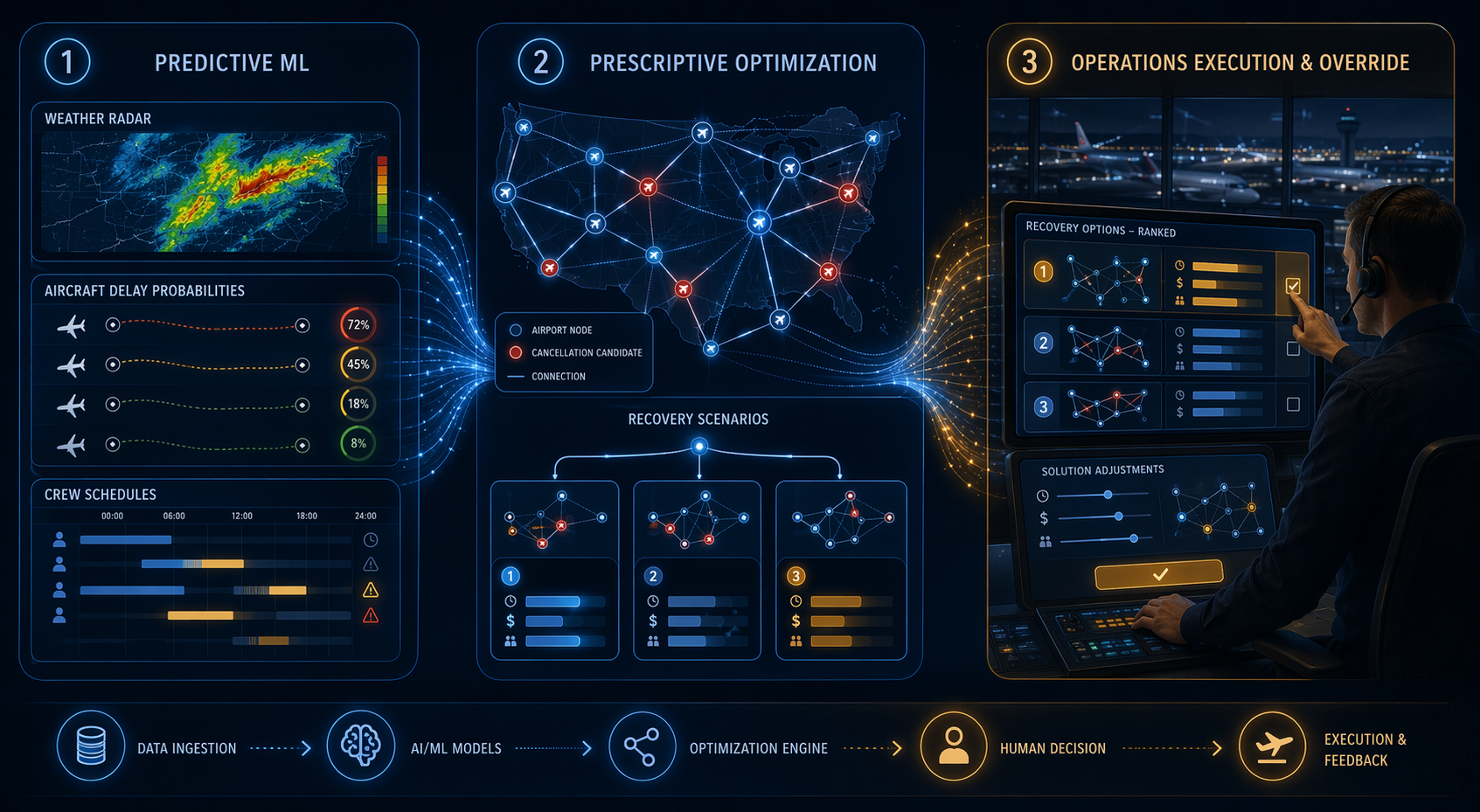
The practical workflow has three parts. Predictive models estimate what is likely to break next. Prescriptive optimization searches for recovery options that respect operational constraints. Human controllers execute, modify, or reject the recommendation because the system does not carry the certificate, the customer consequence, or the union-rule interpretation by itself.
United Shows the Event Volume Problem
United's TCS Aviana deployment is useful because it does not frame disruption recovery as a single grand optimization run. According to an AWS for Industries customer story, United configured more than 500 operations anomaly types and the platform flagged about 400 business events per second for immediate remediation.[3] Those numbers are not proof that every recovery decision improved, and the source is a customer-success narrative. What they do show is the scale of signal management that a large airline operation has to absorb before anyone even gets to optimization.
In a live network, anomaly detection is not glamorous, but it is foundational. A controller cannot evaluate a tail swap if the maintenance constraint is late. A crew desk cannot protect a legal pairing if the aircraft arrival estimate is stale. A passenger recovery team cannot prioritize missed connections if the system does not know which inbound delay is now structurally unrecoverable. High-volume event processing matters because disruption recovery is partly a race against bad information aging into worse decisions.
United's example therefore supports a narrower but important conclusion: production AI infrastructure can monitor and classify operational exceptions at a volume that manual workflows are not built to match. It does not, by itself, prove a 15–22% disruption cost reduction. It helps explain why such reductions become plausible when detection is connected to recovery decisions rather than left as dashboard noise.
KLM Is the Stronger Recovery Optimization Case
The KLM and BCG operations control AI platform is the more direct evidence for AI-assisted IROPS recovery. BCG describes a platform that integrates rules, maintenance schedules, airport data, crew rosters, passenger behavior, and predicted aircraft arrivals to optimize fleet and tail assignments during disruptions.[4] That list matters. It names the constraints that make airline recovery hard, rather than presenting AI as a generic planning layer.
Fleet recovery is not just an aircraft-assignment puzzle. A tail may be available but unsuitable because of maintenance routing. A crew may be available but close to a duty limit. A departure slot may exist but the inbound passengers most worth protecting are not yet at the gate. A cancellation may look expensive in isolation but prevent a larger missed-bank cascade. The value of an integrated platform is that it can compare these trade-offs while the choices are still executable.
KLM's case does not remove the operations controller from the loop. That is a strength, not a weakness. The better version of AI disruption recovery compresses the search space and makes the consequences legible: if this aircraft is swapped, these rotations recover; if this flight is canceled, these crews remain legal; if this bank is protected, this later station absorbs the delay. The decision still belongs to the operation.
Alaska Proves Adjacent Flight-Operations Gains, Not Full IROPS Recovery
Alaska Airlines' Flyways AI results deserve attention, but they should be used carefully. Aerospace America, citing Alaska Airlines data, reported that Flyways saved an average of 2.7 minutes per flight from January through September 2022 and helped avoid 6,866 metric tons of CO2.[5] Alaska's own newsroom also reported 3–5% fuel savings on flights over four hours.[6]
Those are meaningful production outcomes. They show that AI-supported flight planning can produce measurable operational savings in the live airline environment. They also sit closer to route and fuel optimization than to full disruption recovery. Saving minutes through more efficient routing is not the same as rebuilding a broken aircraft, crew, passenger, and maintenance plan during IROPS.
That distinction is important for buyers comparing AI systems. Alaska's evidence supports the claim that AI can improve flight execution under real operating constraints. It should not be stretched into proof that any AI fleet planning platform will reduce disruption cost across cancellations, crew legality, passenger reaccommodation, and tail routing.
How AI Recovery Optimization Actually Changes the Work
The simplest useful distinction is predictive versus prescriptive. Predictive ML answers questions such as: which inbound aircraft is likely to miss its turn time, which stations will be hit hardest by weather, which crew pairings are at risk, and which passenger connections are no longer realistic. Prescriptive optimization answers the next question: given those forecasts, what feasible recovery options should the airline act on now?
| Recovery layer | What it does in the operation | Why it matters |
|---|---|---|
| Predictive ML | Forecasts delay propagation, aircraft arrival risk, crew exposure, and connection pressure | Gives the control center earlier warning before constraints become fixed |
| Prescriptive optimization | Generates feasible tail swaps, reroutes, delays, cancellations, and crew adjustments | Turns forecasts into ranked choices rather than more alerts |
| Human execution and override | Controllers approve, modify, or reject recommended recovery actions | Keeps operational judgment, safety responsibility, and local context in the loop |
The strongest systems are not merely faster calculators. They evaluate recovery scenarios across a graph of airports, aircraft rotations, flight legs, crews, gates, and passenger flows. Mosaic Data Science describes graph-based optimization as a way to identify the minimum set of flights to cancel while minimizing downstream network impact.[7] That framing is operationally useful because cancellation minimization is rarely about protecting the individual flight with the loudest problem. It is about preventing the problem from multiplying.
A hypothetical example shows the difference. Suppose a late inbound aircraft can either delay its next flight, swap with another tail, or trigger one cancellation. A rules-based system may flag the aircraft delay and show available tails. A stronger recovery optimizer scores the downstream consequences: whether the substitute tail has the right maintenance path, whether the receiving crew remains legal, whether the delayed passengers miss the last connection of the night, and whether canceling a less full segment now protects a larger bank later. The useful output is not a perfect answer. It is a short list of feasible answers with visible trade-offs.
This is also where decision compression becomes credible. If the platform can eliminate infeasible options early, compare the remaining scenarios quickly, and surface the operational consequence of each choice, the recovery team spends less time building the comparison and more time deciding. That is different from automation theater. It changes who is waiting on whom inside the NOC.
Speed Claims Need Source Discipline
Some optimization claims are interesting but should be kept in their lane. BQP says its quantum-inspired platform can evaluate fleet scenarios up to 20 times faster than classical methods for IROPS recovery.[8] That may matter in scenario-heavy disruption windows, especially when many aircraft and crew constraints are moving at once. But it is a vendor-reported speed claim, not independent proof that an airline will achieve the same cost or on-time performance improvement in production.
The same discipline applies across the vendor landscape. IBS iFlight, Sabre Mosaic, Jeppesen, SITA, Optym, BQP, TCS Aviana, and airline-specific systems all occupy parts of the planning, scheduling, crew, network, and IROPS stack. Listing them does not answer the buying question. The buying question is whether a given platform is integrated deeply enough to see the constraints that actually govern recovery and fast enough to influence the decision before the operating picture changes.
That is why production evidence from United and KLM carries more weight than a generic market forecast. DataIntelo valued the airline schedule optimization AI market at $3.2 billion in 2025 and projected it to reach $9.8 billion by 2034, a 13.2% CAGR.[1] BCG has also estimated that AI-first airlines could enjoy operating margins 5–6 points higher than peers by 2030.[4] Both figures are useful context, but neither tells a dispatch manager whether tomorrow's thunderstorm recovery will be better.
What the Evidence Supports
The evidence supports a strong but bounded conclusion. AI-powered disruption recovery is one of the most practical applications of airline fleet planning optimization because it attacks a high-cost, time-sensitive, constraint-heavy problem. The reported 15–22% cost reduction and 4–7 point on-time performance improvement range is credible as an attributed benchmark, not as a guaranteed result.[1]
United shows that production systems can classify operational anomalies at very high event volumes.[3] KLM shows the more complete recovery logic: rules, maintenance, airport data, crew rosters, passenger behavior, predicted arrivals, and tail assignment in the same decision environment.[4] Alaska shows that AI can produce measurable flight-operation gains in routing, time savings, fuel savings, and CO2 avoidance, while remaining adjacent to full IROPS recovery rather than identical to it.[5][6]
For readers looking at the broader planning picture, disruption recovery sits inside the wider set of fleet planning applications covered in Five Ways AI Is Reshaping Airline Fleet Planning. It also overlaps with flight planning and fuel optimization, where Alaska's Flyways results are especially relevant; that adjacent use case is covered in How AI optimizes flight planning for fuel savings.
The practical evaluation standard is straightforward: production integration, latency reduction, feasible recovery quality, and source-attributed outcomes. If a platform cannot ingest the messy constraints of the airline operation, show the trade-offs behind its recommendations, and get a usable option to the control center while the decision is still live, its AI label is not doing much work.
References
- Airline Schedule Optimization AI Market, DataIntelo, 2026.
- The airline industry enters a new age of ecosystem collaboration, McKinsey & Company.
- United Airlines uses TCS Aviana on AWS to transform airline operations, AWS for Industries.
- The AI Operations Advantage, Boston Consulting Group.
- AI Flight Planning, Aerospace America.
- Alaska Airlines uses artificial intelligence to fly more efficiently, Alaska Airlines Newsroom.
- Airline Disruption Management Using Graph Optimization, Mosaic Data Science.
- Quantum-Inspired Optimization for Airline Irregular Operations Recovery, BQP.
Comments
Join the discussion with an anonymous comment.