
The budget problem with AI for tornado-driven supply chain disruption planning is that the spend usually shows up before the loss does. A software line item looks optional in February. By April or May, the same company may be paying overtime, expediting inbound materials, reallocating scarce inventory, calling alternate suppliers, or explaining why a damaged node was still treated as a static line on a spreadsheet.
That mismatch is what makes the business case worth building carefully. Tornadoes and severe convective storms do not need to stop an entire network to create a financial event. One supplier loses power. One regional distribution center closes. One transportation lane becomes unreliable. The first-order damage may sit on someone else’s balance sheet, while the revenue consequence lands with the company that missed allocations or paid for emergency freight.
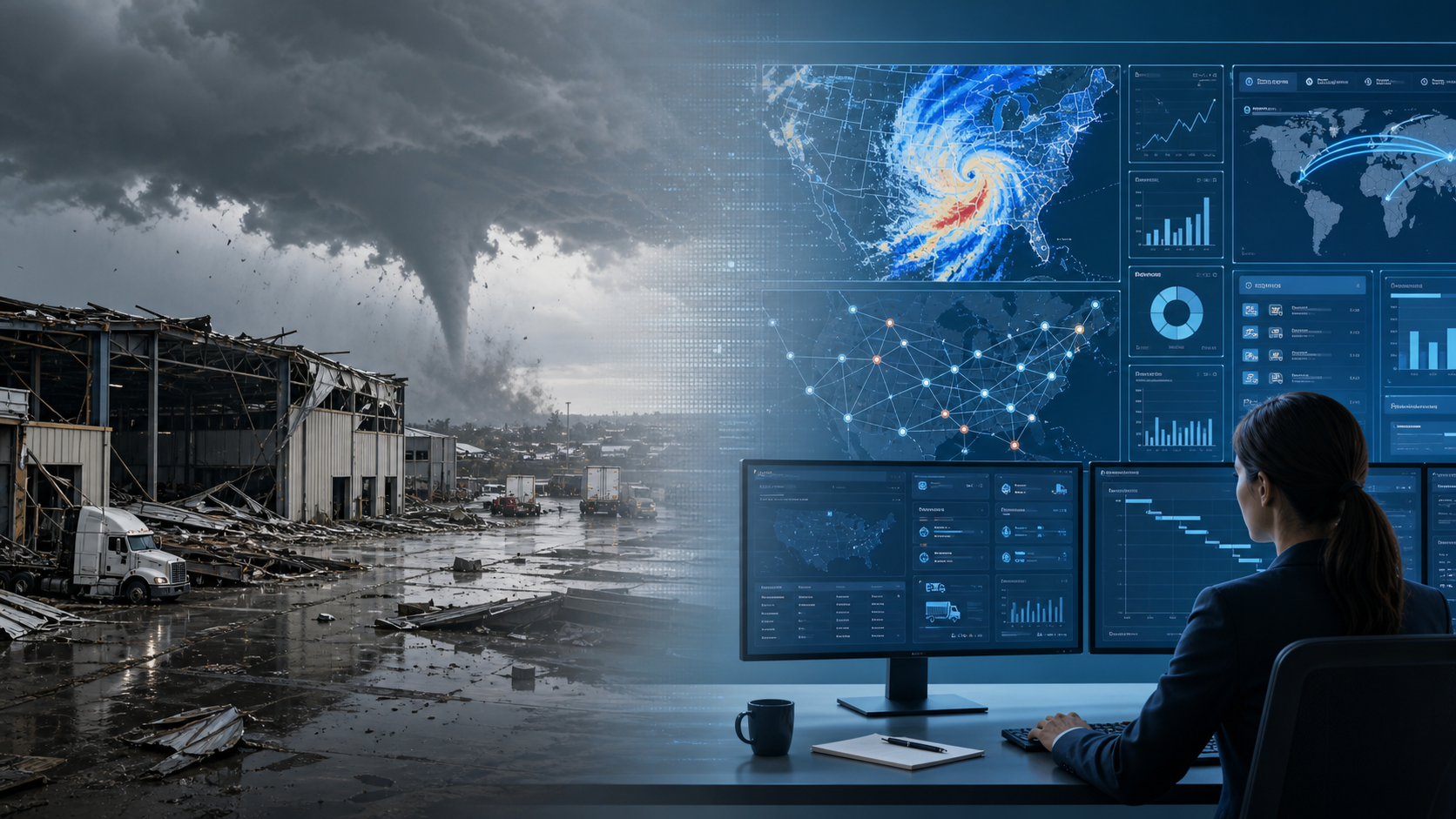
The ROI case is not that AI can tell a planner the exact path of a tornado weeks in advance. That is not what the evidence supports. The case is narrower and more useful: AI can improve probabilistic risk windows, connect weather signals to exposed suppliers and lanes, accelerate impact assessment, and help teams make inventory, procurement, logistics, and customer-allocation decisions before a weather event becomes a revenue miss.
Start With the Loss Baseline, But Keep the Categories Clean
The cleanest tornado-specific number in the current evidence set is the March 2024 outbreak cited by Falvey Insurance Group, which put damages at $5.9 billion.[1] That figure is useful because it is large enough to be board-visible without needing to borrow from broader climate categories. It is still a direct-damage number, not a full estimate of every downstream purchase order, missed shipment, margin concession, or late customer delivery that followed.
The supply chain examples from the December 2021 Kentucky tornadoes show why direct damage understates the operating problem. Supply Chain Digital reported that the storms destroyed grain systems, a chicken hatchery, a John Deere dealership, and an Amazon hub.[2] Those are not interchangeable assets. A hatchery affects agricultural production flow. A dealership affects parts and equipment access. A fulfillment hub affects labor, inventory, and parcel movement. The disruption is local in origin but networked in consequence.
A broader tornado cost marker also matters: ABS Group cites $1.38 billion in 2023 tornado damages.[3] The number should not be stretched beyond what it measures. It helps quantify the recurring property-damage exposure from tornadoes, but it does not by itself prove how much a given manufacturer, retailer, hospital system, or distributor would save from an AI tool.
From there, the category widens. NOAA’s billion-dollar disaster data put 2024 U.S. losses at 27 separate billion-dollar disasters with total costs of $182.7 billion.[4] That is no longer a tornado-only claim. It is the larger severe-weather and disaster-cost environment in which tornado planning competes for capital. For a CFO, the distinction matters: tornado-specific evidence supports the direct hazard case; broader disaster data supports the exposure-management case.
Everstream’s 2026 risk outlook, as reported by Supply Chain Exchange, ranked extreme weather as the number-two threat to global supply chains, with a 93% threat level.[5] Everstream has also framed extreme-weather disruption as a recurring operating problem rather than an exceptional event, including flood disasters averaging $42 billion per year and rising 27% since 2000.[6] Flood data should not be used as tornado data. It does, however, reinforce the planning reality: weather risk is now frequent enough that manual exception handling becomes expensive.
The Real Cost Is Often Revenue Exposure, Not the Damaged Roof
For many companies, the damaged facility is not even their facility. The cost appears as a supplier miss, a transportation failure, a constrained SKU, or a customer-service penalty. Procurement Tactics’ 2026 supply chain statistics compilation cites McKinsey-style disruption economics: supply chain disruptions cost companies about $1.5 million per day on average and roughly 8% of annual revenue, while disruptions erased 45% of one decade’s profits.[7]
Those figures are not tornado-specific, and they should not be presented as if every tornado produces an 8% revenue hit. Their value is different. They give finance teams a defensible way to size the pool of loss that better disruption planning might affect. If a company has facilities, suppliers, lanes, or demand regions in tornado-prone areas, the relevant question is not whether AI prevents the storm. It is whether earlier and better decisions can reduce the share of disruption cost that comes from late awareness.
That distinction changes the business-case model. A tornado preparedness deck should not claim the tool saves $5.9 billion because an outbreak caused $5.9 billion in damages. It should ask a smaller set of questions: Which exposed revenue streams depend on facilities or suppliers in the risk zone? How much margin is lost when orders are expedited? Which customers trigger penalties or allocation conflicts? Which materials have no qualified alternate source? Which decisions would have been different with a seven-day risk window instead of a day-of phone tree?
| Cost category | What the number supports | What it does not prove |
|---|---|---|
| Tornado-specific direct damages | The hazard can create multi-billion-dollar loss events | A single company’s AI savings |
| Broader billion-dollar disaster costs | Severe weather is a recurring capital and operating risk | That all disaster losses are tornado-related |
| Supply chain disruption revenue impacts | Late response can affect sales, margin, and profit | That AI automatically captures the avoidable portion |
| Vendor or company case studies | Mechanisms by which earlier action can create value | Guaranteed tornado ROI across industries |
Where AI Can Plausibly Move the Financial Levers
The AI side of the case is strongest when each capability is tied to a decision. Forecast accuracy is not valuable because a dashboard looks smarter. It is valuable if it changes inventory positioning, production sequencing, supplier follow-up, transportation booking, or customer allocation soon enough to matter.
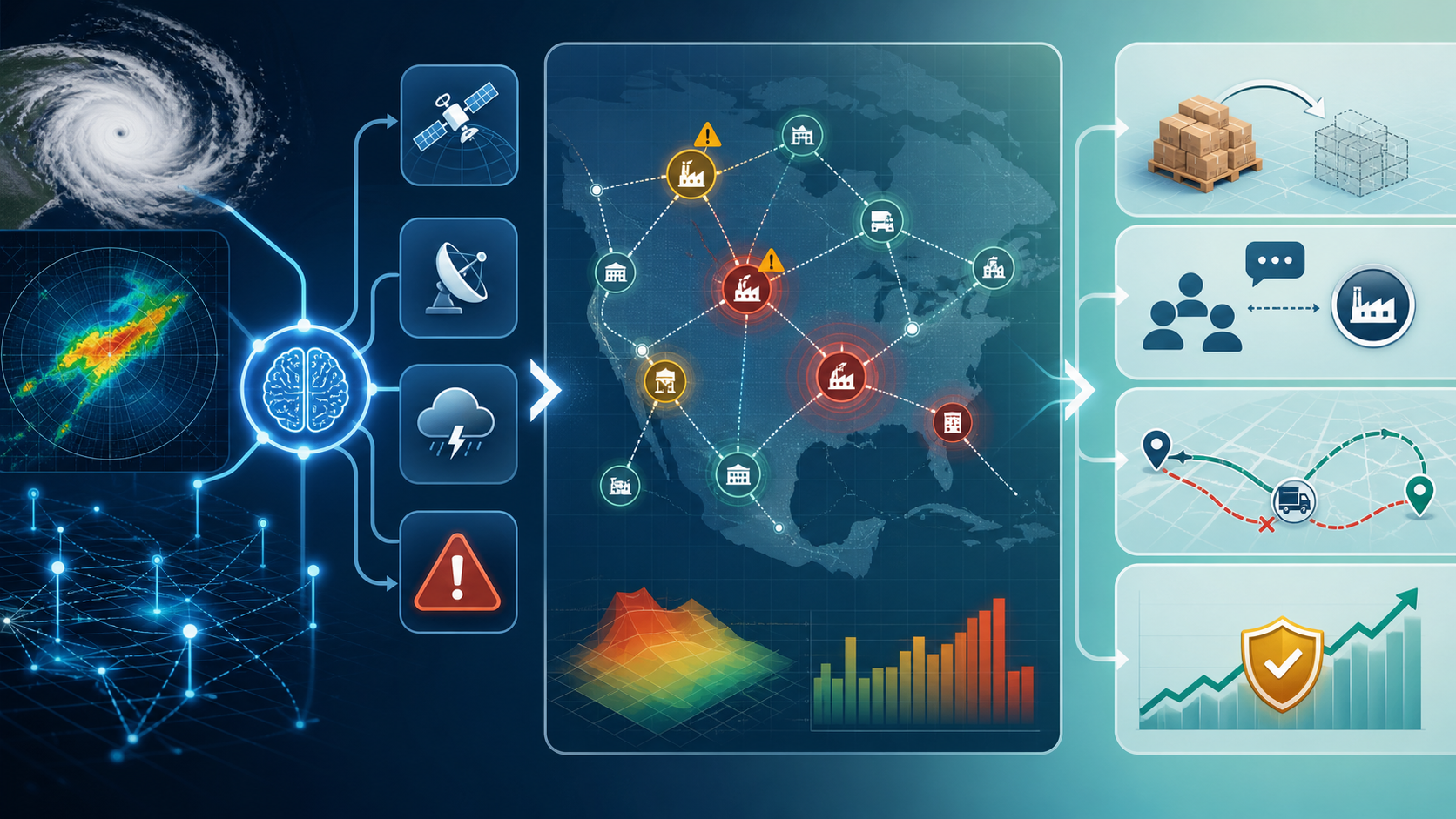
The first lever is forecast error. AI-enabled forecasting systems are commonly cited as reducing forecast errors by 20% to 50% and mitigating up to 65% of lost sales.[8] In a tornado disruption context, that does not mean predicting an exact touchdown weeks out. It means improving the demand and supply assumptions around elevated risk windows: whether to pull forward production, reposition inventory, protect scarce components, or delay noncritical transfers into an exposed region.
The second lever is lead time. A Johnson & Johnson AI system is cited by the World Certification Institute as detecting 85% of major supply disruptions seven days ahead.[9] That is an important figure, but it needs a caveat: in the available material, it is secondhand reporting rather than an independently reviewed study from the original company. Treated as an indicative benchmark, it still clarifies the value of earlier warning. Seven days is not a weather miracle. It is enough time to ask suppliers for status, reserve transportation capacity, place protective orders, shift safety stock, or escalate constrained items before everyone else is calling the same carriers.
The third lever is impact-assessment speed. AI disruption tools are cited as making disruption impact assessment 50% to 70% faster.[9] The financial value here is usually not in the alert itself. It is in collapsing the time between “there is a severe weather risk” and “these are the affected suppliers, sites, SKUs, orders, customers, and lanes.” That compression matters because many response costs compound while teams are still finding the right spreadsheet owner.
The fourth lever is procurement risk optimization. Supply Chain Brain cites a 30% reduction in revenue losses from disruptions through risk-optimized procurement.[10] For tornado planning, the practical translation is not buying from the lowest-cost supplier and hoping the weather misses. It is segmenting categories by revenue dependency, geographic concentration, substitutability, and recovery time, then using that segmentation before a storm system threatens the region.
These levers also explain why AI logistics disruption planning should not be evaluated as a weather subscription alone. A better forecast with no supplier master data is an interesting alert. A better forecast connected to supplier sites, open purchase orders, inventory positions, carrier capacity, and customer commitments becomes an operating decision.
What the Case Studies Actually Prove
Vendor case studies are useful when they show the mechanism of preparedness. They are less useful when treated as a universal payback calculator.
ClimateAi’s roofing manufacturer case, cited by the World Certification Institute, reported $15 million in incremental revenue after the manufacturer positioned inventory ahead of Hurricane Ian.[9] That is not a tornado case, and it is vendor-reported rather than independently audited in the available material. Still, the mechanism is directly relevant to tornado planning: a risk signal changed where inventory sat before weather disrupted demand and supply conditions.
Hitachi’s work with ClimateAi points to a different mechanism. The case study describes a six-month cyclone forecast for supplier-level risk in Chennai at 1-kilometer resolution.[11] Again, this is cyclone risk, not tornado touchdown prediction. The business relevance is supplier granularity. Planning teams do not act on “India risk” or “Midwest risk” with enough precision to protect revenue. They act when a named supplier, part family, or site moves into a higher-risk planning window.
The Cooper University Health Care example, also cited by the World Certification Institute, is smaller but operationally sharp: the organization identified three suppliers exposed to Hurricane Idalia and secured orders before cutoff.[9] That is the kind of action a business case should value. The benefit is not abstract resilience. It is earlier supplier identification, faster order placement, and less exposure to a cutoff that would otherwise become a clinical or service-level problem.
The common thread is not the storm type. It is the operating pattern: detect risk early, map it to supply chain dependencies, decide what to move or buy, and execute before the market becomes congested. For leaders comparing weather AI investments, that pattern matters more than whether a case study uses the same hazard label. Adjacent hurricane and flood planning evidence can inform tornado planning, but only if the decision mechanics are transferable.
A CFO-Friendly ROI Model
A practical business case does not need to start with a perfect catastrophe model. It needs a credible avoidable-loss model. The cleanest structure is to separate exposure, decision improvement, and capture rate.
- Exposure: revenue, margin, inventory, service-level penalties, emergency freight, and supplier recovery costs tied to tornado-prone sites, suppliers, and lanes.
- Decision improvement: measurable gains such as lower forecast error, earlier disruption detection, faster impact assessment, or risk-adjusted procurement choices.
- Capture rate: the portion of theoretically avoidable loss the organization can actually prevent because data, authority, suppliers, and playbooks are ready.
For example, a company should not multiply total tornado damage by a vendor’s forecast-accuracy claim. A more defensible model starts with the company’s own disruption cost history and exposed revenue. It then tests scenarios: what happens if forecast error improves by a conservative share of the cited 20% to 50% range; if lost-sales exposure falls toward, but not automatically to, the cited 65% mitigation ceiling; if impact assessment moves from days to hours; and if procurement decisions reduce the revenue-at-risk pool rather than only lowering unit cost.[8][9][10]
This is also where internal benchmarking helps. Companies already evaluating AI weather intelligence logistics ROI or AI demand forecasting accuracy can reuse parts of the same model: forecast error, lost sales, expedited freight, safety-stock efficiency, and avoided service failures. Tornado disruption planning simply adds a geographic and time-sensitive hazard layer.
| AI capability | Financial lever | Business-case evidence to request |
|---|---|---|
| Probabilistic severe-weather risk windows | Inventory positioning and production timing | Forecast accuracy by region, horizon, and product family |
| Supplier and site exposure mapping | Revenue-at-risk and material availability | Supplier geocoding coverage and bill-of-material linkage |
| Disruption detection and alerting | Lead time for orders, capacity, and substitutions | Historical alert precision, false positives, and escalation logs |
| Impact assessment automation | Response labor, emergency freight, and customer allocation speed | Time from alert to affected order, SKU, supplier, and lane list |
| Risk-optimized procurement | Lower revenue loss from supplier concentration | Category segmentation, alternate sourcing readiness, and contract flexibility |
Seasonal Planning Is Not Tornado Warning
One of the fastest ways to oversell the investment is to blur the line between seasonal tornado-risk planning and minute-by-minute public tornado warning. Supply chain AI is strongest in the former. It helps teams understand that certain geographies, suppliers, crops, transport corridors, or facilities may face elevated severe-weather risk over a planning horizon. That can support inventory builds, supplier outreach, alternate lane planning, and procurement decisions.
It does not replace meteorological warning systems or emergency management. It should not be sold as a guarantee that a company will know the exact path of a tornado far enough in advance to avoid every cost. A realistic implementation connects weather intelligence to business dependencies and action rules. The action rule is the part that often determines whether the ROI exists.
That is why the most useful severe-weather AI programs are designed around decisions rather than alerts. If a supplier enters a risk window, who reviews it? If an at-risk component supports a high-margin customer order, who can authorize a pull-forward buy? If the logistics team sees a lane risk, which alternative carriers or modes are preapproved? If sales needs to allocate limited stock, which customer commitments take priority?
The Market Is Scaling, But That Is Supporting Evidence
The broader investment category is growing quickly. Precedence Research estimates the AI in supply chain market at $7.15 billion in 2024 and projects it to reach $192.51 billion by 2034.[12] That trajectory is relevant because it signals that AI-enabled planning is moving from experimental spend toward mainstream supply chain infrastructure.
It is not, by itself, an ROI argument. Market growth can validate a direction without validating a specific subscription, integration scope, or implementation plan. A board should treat the market forecast as context, then ask whether the company has enough exposed value, decision latency, and data maturity to capture benefits.
The Readiness Gap Can Eat the ROI
The limiting factor is rarely whether a severe-weather alert can be generated. It is whether the organization can act on it. Procurement Tactics’ 2026 compilation cites a GEODIS survey finding that only 6% of companies have full end-to-end supply chain visibility, and a Gartner finding that only 23% have a formal AI strategy.[7] Those numbers make the ROI case more conditional, not weaker.
A company without supplier location data may know a storm is likely and still not know which tier-two site matters. A company without clean SKU-to-supplier mapping may know a facility is exposed and still not know which customer orders are at risk. A company without decision rights may see the alert early and still wait for a cross-functional meeting while carrier capacity disappears.
Implementation should therefore be scoped around the highest-value exposed flows first. For many organizations, that means a focused pilot around critical suppliers, high-margin SKUs, regional distribution centers, or lanes with poor substitution options. The target is not a beautiful all-hazards command center on day one. It is a workflow where an alert produces a named owner, a constrained decision set, and a financial consequence that can be measured after the event.
The strongest budget cases also include the operating costs that make the tool useful: supplier data cleanup, geocoding, integration with purchase orders and inventory systems, alert governance, response playbooks, and post-event variance analysis. Leaving those costs out may make the project look cheaper, but it also makes the claimed savings less believable.
A Defensible Investment Posture
For exposed supply chains, the financial case for AI-driven tornado disruption planning is compelling. The loss baseline is already large: tornado-specific events can reach multi-billion-dollar damage levels, broader severe-weather costs are recurring, and supply chain disruptions can translate physical events into revenue and profit losses. Against that baseline, the measurable AI benefits — lower forecast error, reduced lost-sales exposure, earlier detection, faster impact assessment, and risk-optimized procurement — are material enough to justify serious investment analysis.
The case is strongest where leaders can connect alerts to inventory, supplier, logistics, and procurement decisions. It is weakest where the company lacks end-to-end visibility, clean supplier data, decision rights, or the discipline to act before the storm becomes a revenue event. AI does not remove tornado risk from the network. It can reduce the cost of being late.
References
- Is Your Supply Chain Ready for the 2025 Tornado Season? — Falvey Insurance Group
- Tornados deliver death and destruction to US supply chain — Supply Chain Digital
- Convective Storm Risk: Understanding Your Unique Vulnerability — ABS Group
- U.S. Billion-Dollar Weather and Climate Disasters — NOAA National Centers for Environmental Information
- Everstream predicts top four supply chain disruptions for 2026 — Supply Chain Exchange
- The Impact of Extreme Weather on the Supply Chain — Everstream Analytics
- Supply Chain Statistics — 70 Key Figures of 2026 — Procurement Tactics
- AI in Supply Chain Resilience: Forecasting Disruptions Before They Hit the Line — Bronson.ai
- From Reactive to Proactive: How AI-Driven Supply Chains Weather Every Storm — World Certification Institute
- How AI Can Turn Supply Chain Disruptions Into Bumps Rather Than Sinkholes — Supply Chain Brain
- ClimateAi Enables Global Supply Chain Risk Model for Hitachi — ClimateAi
- AI in Supply Chain Market — Precedence Research
Comments
Join the discussion with an anonymous comment.