
The weather alert was right. The storm track was right. Then the power went out at a supplier site, a distribution center, or a plant, and the useful question changed fast: which orders are now exposed, which parts are trapped behind a dark facility, which refrigerated assets are warming, which labor plan is invalid, and who has authority to approve the first recovery move?
That is where AI for storm power outage recovery becomes a practical supply chain use case rather than a technology theme. Forecasting helps before the outage. Recovery orchestration matters after the outage, when operations teams need to move from scattered status checks to a defensible sequence of reroute, expedite, idle, restart, or communicate delay.
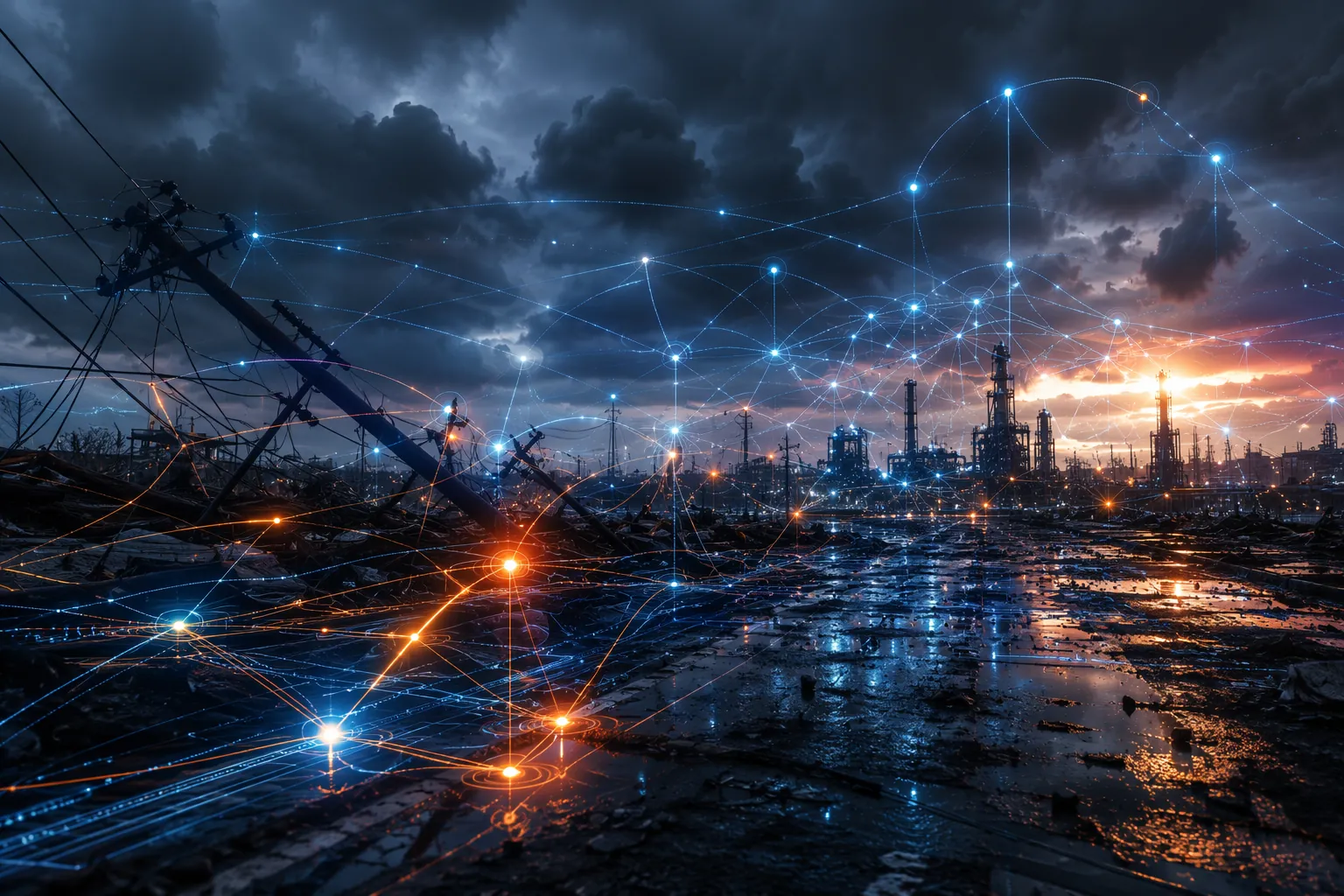
Power loss is not just an IT inconvenience. In manufacturing, a widely cited industry estimate puts the average power outage at 5 hours and says losses can reach $1 million per hour, though the figure comes from an SCMR article authored by a Briggs & Stratton marketing director and should be treated as an advocacy-adjacent estimate rather than a universal audited benchmark.[1] Even with that caveat, the operating risk is obvious: when electricity is gone, production, refrigeration, automated storage, electronic proof of delivery, access control, and site communications can all degrade at once.
The concern is not isolated. A 2026 Prologis/Harris Poll survey of 1,816 global executives found that 89% had experienced energy-related disruptions in the past year, 83% feared power reliability would drive the next supply chain crisis, and only 27% reported advanced power resilience capabilities.[2] The survey comes through a logistics real estate lens, so it should not be stretched into a perfect proxy for every manufacturer, retailer, or 3PL. It is still useful because it captures the gap operators recognize: disruption exposure is broad, while mature resilience capability is much thinner.
The Manual Playbook Breaks Down in the Middle Hours
The slow part of outage recovery is rarely the first alert. It is the middle layer of work that begins immediately after: confirming whether the site is actually down, whether backup power is holding, whether outbound loads already departed, whether inventory is physically accessible, whether the affected SKU matters to a committed customer order, and whether an alternate site can absorb the work without creating a second failure.
Manual recovery usually starts with a conference call and a spreadsheet that was not designed for this exact event. The plant manager has partial facility status. Procurement has supplier contacts, some stale. Transportation knows which lanes are open but not which orders should be protected first. Customer service knows who will call in an hour. Finance may know revenue exposure, but not the physical constraint that will decide whether recovery is possible today.
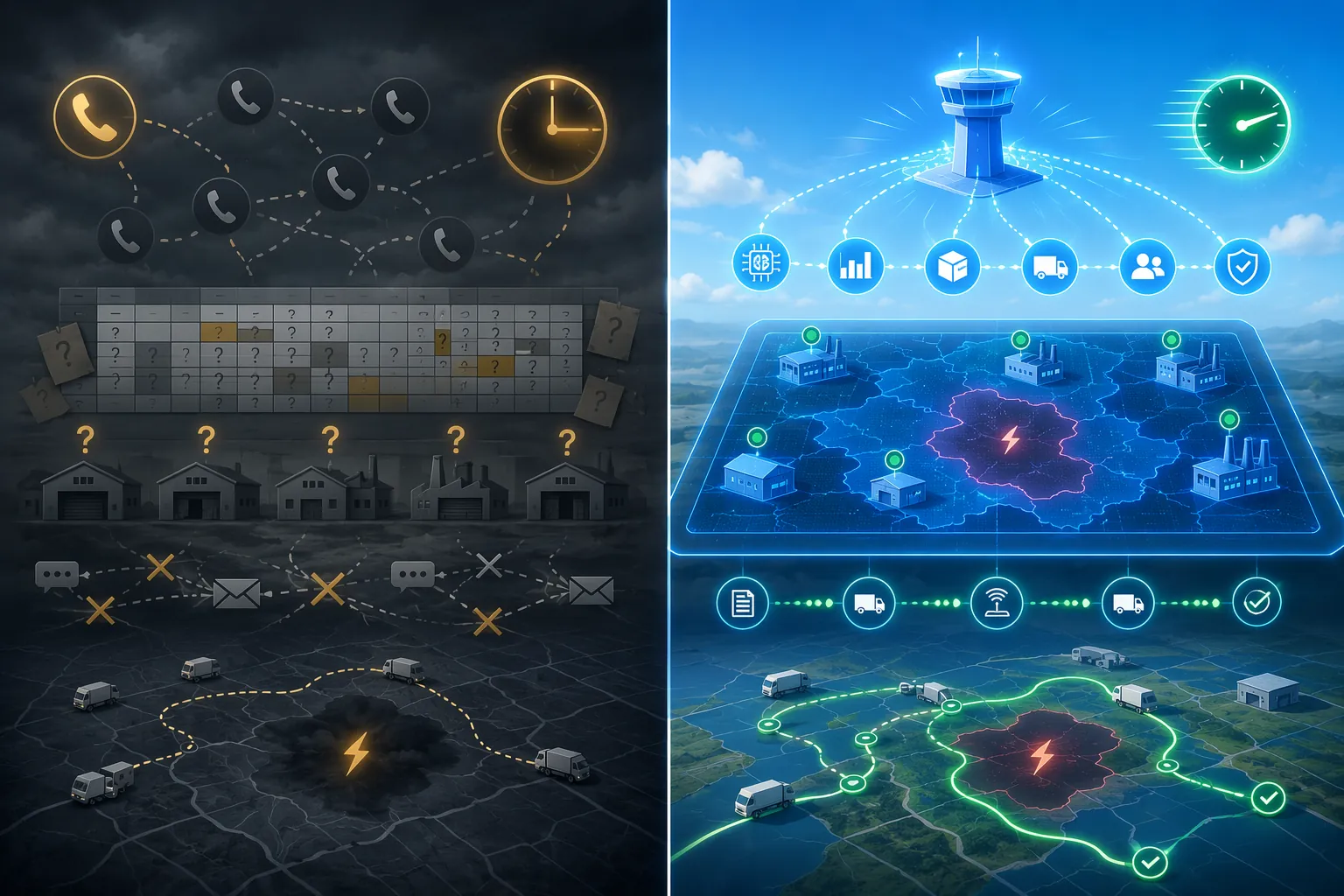
That is why a good AI recovery system should be judged less by how impressive its prediction model sounds and more by whether it compresses three delays: time to know what happened, time to decide what matters, and time to launch coordinated action. If it only produces another alert, it has not solved the recovery problem.
| Recovery question | Manual playbook behavior | AI-orchestrated behavior |
|---|---|---|
| Which sites are affected? | Teams call plants, DCs, carriers, and suppliers one by one. | The system ingests outage, weather, IoT, ERP, TMS, WMS, and supplier signals into a shared disruption view. |
| What is exposed? | Analysts manually connect parts, orders, inventory, customers, and lanes. | A digital twin maps affected facilities to SKUs, suppliers, tiers, inventory positions, and customer commitments. |
| What should move first? | Prioritization waits for revenue, service, and operational data to be reconciled. | The control tower ranks exposure by service risk, revenue at risk, production dependency, perishability, or contractual penalty. |
| What action is feasible? | Teams debate options before the constraints are visible. | Scenario models compare reroute, expedite, alternate sourcing, partial restart, or planned idle time against available capacity. |
| Who approves? | Approval trails often form after the decision. | Human-in-the-loop workflows route recommended actions to accountable owners before execution. |
What AI Actually Does After the Power Fails
The useful architecture is not a shelf of separate AI products. It is a recovery sequence. A digital twin models the network before the event. Predictive analytics and monitoring tools ingest the disruption. A cognitive control tower calculates exposure. Agentic disruption software launches structured workflows. Humans approve the moves that change cost, customer promises, or operating risk.
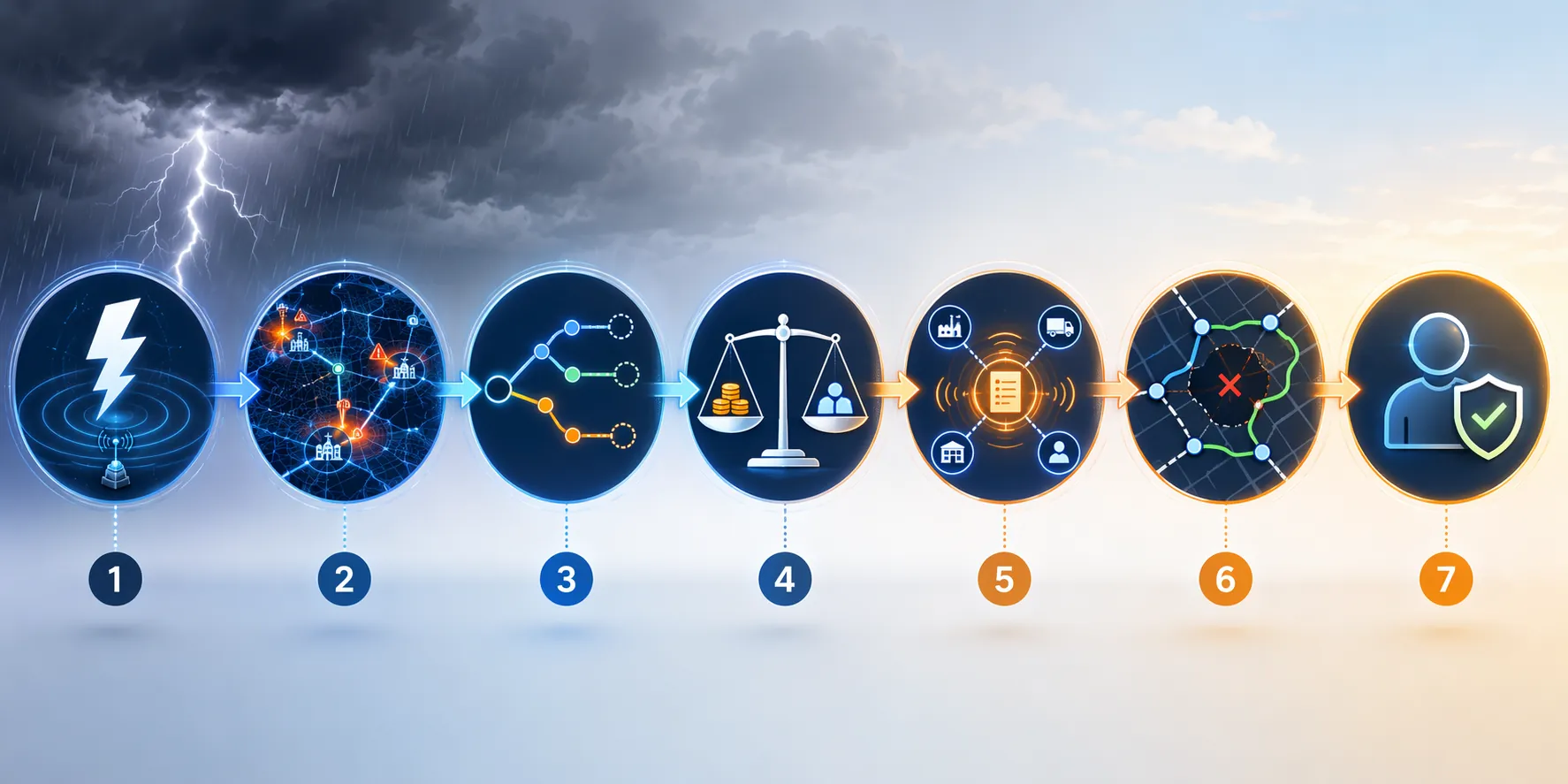
In practice, the flow looks like this:
- Detect the outage signal from utility feeds, weather intelligence, facility telemetry, carrier updates, supplier alerts, or incident reports.
- Map the affected node against the supply chain digital twin: site, supplier tier, part, SKU, lane, inventory, labor plan, and customer order.
- Calculate exposure by revenue, service level, production dependency, perishability, safety stock, and recovery time sensitivity.
- Simulate alternatives, including rerouting, alternate fulfillment, expedited replenishment, supplier substitution, controlled shutdown, or restart sequencing.
- Trigger communications to suppliers, logistics partners, sites, customer teams, and executives using one shared impact view.
- Route recommended actions to human approvers when the decision affects spend, allocation, customer commitments, or safety.
The point is not that AI restores power. It does not clear roads, repair switchgear, reopen a damaged facility, or create refrigerated capacity that does not exist. Its value is in removing avoidable decision latency around those constraints.
For pre-storm planning, the operating questions are different: inventory pre-positioning, capacity buffers, hurricane lane exposure, and supplier readiness. ChainSignal covers that adjacent phase in How AI Helps Supply Chains Plan for Hurricane Disruptions. This article stays with the narrower recovery window after power is already lost.
Where the Measured Improvement Comes From
The strongest performance claim in the available material is not a storm-specific audited case study. It is a benchmark comparison cited in secondary reporting: Gartner’s 2025 Resilience Benchmark is reported to show that AI-embedded resilience KPIs produce 28% faster response rates and 19% shorter recovery cycles compared with manual contingency management.[3] That is useful evidence, but it should be read as directional until buyers can inspect the benchmark definitions, sample, and disruption mix.
A nearly 20% shorter recovery cycle is plausible when the AI system cuts work that is mostly informational and coordinative. It is less plausible when the bottleneck is purely physical. If a transformer is down, an access road is flooded, or a freezer has lost product integrity, orchestration cannot make those facts disappear. It can, however, keep the company from spending six hours discovering what the first two hours could have revealed.
The response-time improvement is easiest to believe in four places. First, site identification: the system can connect outage geography to facility masters and supplier locations faster than a phone tree. Second, exposure mapping: it can trace affected parts and inventory to orders without waiting for every function to rebuild its own spreadsheet. Third, scenario comparison: it can test feasible reroute or fulfillment choices against constraints already in the model. Fourth, workflow launch: it can notify the right supplier, planner, transportation lead, and executive approver before the first meeting turns into a status hunt.
This is also where the phrase “from days to minutes” needs discipline. Resilinc says its Disruption Agent can filter disruption signals, identify affected sites, parts, and suppliers across tiers, prioritize by revenue at risk, and launch mitigation workflows with human-in-the-loop controls, reducing response from days to minutes.[4] That describes a credible compression of assessment and workflow initiation. It does not prove that a whole supply chain recovers from a storm outage in minutes.
The same boundary applies to disruption frequency data. Resilinc reported in January 2026 that supply chain disruption notifications jumped 38% year over year in 2025, with extreme weather events up 33% and floods up 34%.[4] Those numbers support the case for faster response infrastructure. They do not, by themselves, prove that every company needs the same AI workflow or that every weather-related disruption has the same recovery profile.
A Hypothetical Recovery Run
Consider a hypothetical manufacturer with a regional plant, two distribution centers, and several tier-one suppliers in a storm corridor. A storm knocks out utility power at one supplier and causes intermittent power at a DC. In a manual process, procurement confirms supplier status, warehousing checks inventory, planning reviews production impact, transportation looks for alternate lanes, and sales waits for an answer on customer orders. The order of discovery is accidental.
In an AI-orchestrated process, the first outage signal is matched to the supplier location and DC. The digital twin shows which parts depend on that supplier, which plant lines consume them, which finished-goods orders are due soon, and which inventory is already in another node. The control tower flags that one customer commitment is more urgent than a lower-margin replenishment order. Scenario simulation shows that an alternate DC can cover part of the exposure, but only if transportation is booked before the next pickup window.
The system can draft the supplier check-in, propose the DC transfer, calculate the expedite cost, and present the restart implication. A human still approves the customer allocation and premium freight. That is not weak autonomy; it is a safer operating model for decisions with financial and service consequences.
Digital Twins Matter When They Contain the Right Constraints
Digital twins earn their place in outage recovery only when they represent the operating network at useful resolution. A map of facilities is not enough. The model has to know which sites make or store which items, which suppliers feed which components, which lanes can be substituted, which inventory is usable, which orders are time-sensitive, and which constraints prevent a simple reroute.
Research discussed by SCMR, citing work associated with Rutgers and MIT, says AI-driven digital twins and cognitive supply chain models show potential to reduce average disruption duration by 40% by 2030.[5] That is a forward-looking research claim, not a present-day guarantee for storm power outages. Its practical value is in showing the mechanism: better network models let teams test recovery choices before committing scarce capacity.
For power outages, the missing constraint is often the one that breaks the plan. A DC may have inventory but no functioning dock equipment. A plant may have backup generation for safety systems but not full production. A supplier may be online but unable to transmit ASN data. A cold-chain site may have power but not enough remaining temperature margin to wait for a normal carrier schedule. If the digital twin cannot see those differences, its recommendation will look clean and fail on contact with operations.
Agentic Workflows Need Guardrails, Not Theater
Agentic AI is useful in outage recovery when it performs bounded work: monitor signals, classify disruption relevance, enrich the event with internal context, open tasks, draft messages, recommend scenarios, and escalate decisions. It becomes dangerous when vendors imply that the system should independently change allocations, incur expedite spend, or promise customer recovery dates without accountable approval.
The better design is human-in-the-loop by default. The AI can prepare the decision packet: affected sites, orders at risk, inventory options, cost ranges, supplier confidence, and recommended next action. The resilience manager or operations VP approves the move, rejects it, or asks for another scenario. The audit trail then shows why the action was taken under incomplete information.
ChainSignal has treated agentic response in other disruption settings, including AI agents for recall response and agentic AI for geopolitical supply chain risk. Storm outage recovery is narrower, but the approval principle is the same: let the agent accelerate analysis and coordination, not quietly take ownership of business judgment.
What Has to Be in Place Before the Storm
AI recovery orchestration is much harder to install during the outage. The system needs data plumbing and operating rights before the weather turns. Otherwise, the team is just asking a model to reason over stale facility records, incomplete supplier tiers, and disconnected execution systems.
- Real-time site data: utility status, backup power state, equipment availability, access constraints, refrigeration risk, and facility operating status.
- Supplier-tier visibility: not only direct suppliers, but the upstream sites and parts that can stop production when a tier-two or tier-three node loses power.
- Execution-system integration: ERP, WMS, TMS, order management, supplier risk, transportation visibility, and control tower workflows need to share event context.
- Decision rules: thresholds for premium freight, allocation changes, customer notification, production idle time, alternate sourcing, and executive escalation.
- Human approval paths: named owners for actions that affect money, safety, customer commitments, or regulatory obligations.
This is where many resilience programs remain underbuilt. The Prologis/Harris Poll finding that only 27% of organizations have advanced power resilience capabilities matters because AI cannot compensate for every missing operating capability.[2] If a company has no reliable site status feed, no current supplier contact data, and no agreed escalation rights, the model’s first job will be to expose that fragility.
The Practical Verdict
AI can accelerate recovery after storm power outages when it is used as orchestration infrastructure: detect the event, map impact, rank exposure, simulate alternatives, launch workflows, and put the approval request in front of the right person fast. The best available evidence supports faster response and shorter recovery cycles, with the clearest quantified benchmark pointing to 28% faster response and 19% shorter recovery compared with manual contingency management.[3]
The adoption question is not whether the system uses digital twins, predictive analytics, a cognitive control tower, or agentic AI as product labels. The question is whether it can see the facilities, parts, orders, suppliers, inventory, lanes, labor plans, and approval rights that determine recovery. If it can, it may move the first defensible decision from hours toward minutes. If it cannot, it is another alerting layer arriving at the same dark dock.
References
- How manufacturers can avoid a power outage — SCMR
- Power outages drive supply chain worries, report says — CFO Dive
- AI-Powered Supply Chain: Automating Response to Disruption — Consumer Goods Technology / AWS
- Supply Chain Disruption Is Accelerating into 2026 — Resilinc EventWatchAI, January 2026
- Beyond resilience: How AI and digital twins are rewriting the rules of supply chain recovery — SCMR/Rutgers, November 2025
Comments
Join the discussion with an anonymous comment.