
For anyone looking at AI for airline disruption logistics, the hard part is not predicting the delay. It is deciding, before the first callback starts, which aircraft can move, which crew pairing survives duty-time rules, which passengers need rebooking, and which bags will miss the same connection. Once one delayed aircraft turns into a chain of swaps, the recovery work stops being a single problem and becomes four coupled ones.
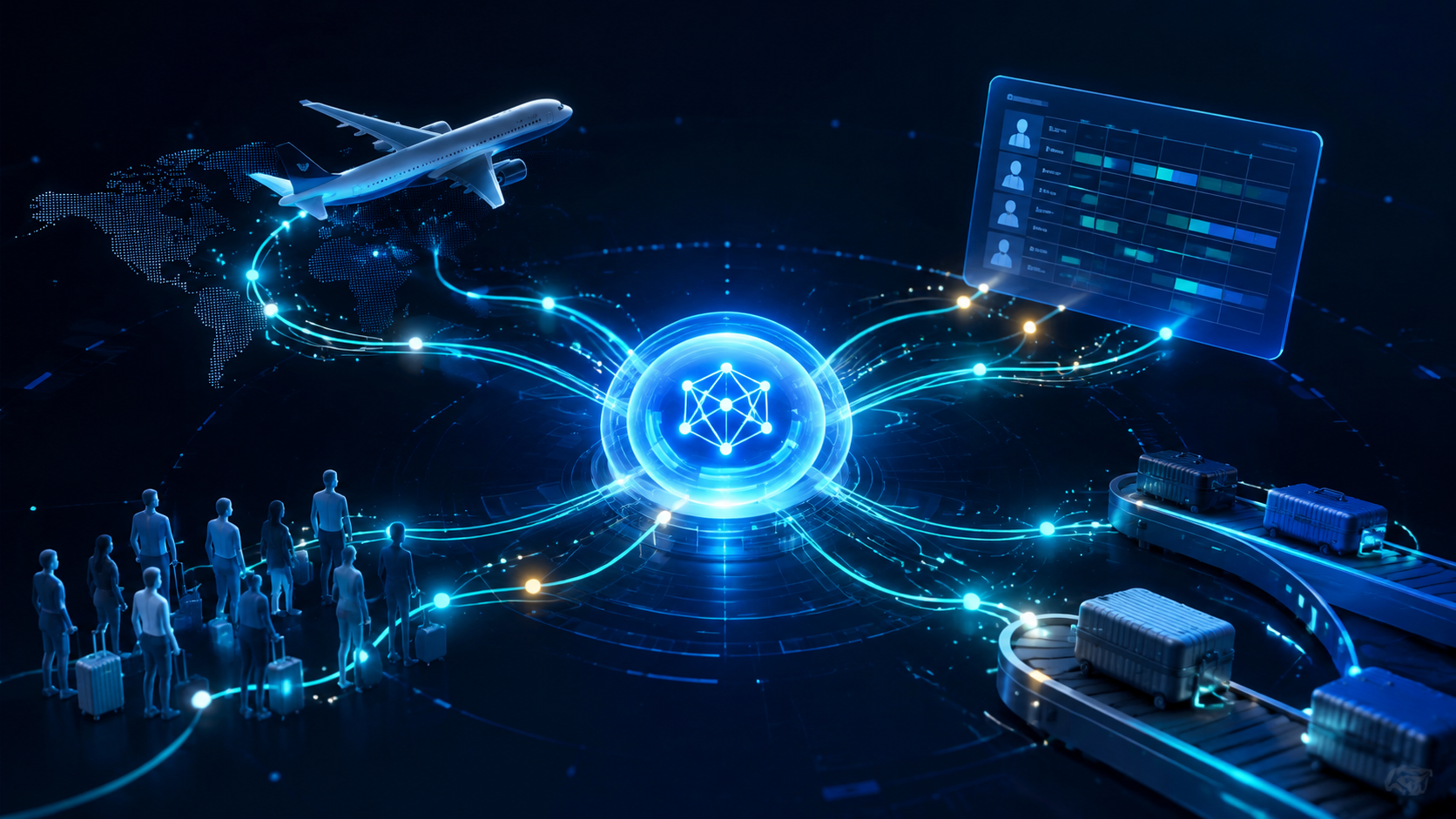
The business case is ugly enough to keep attention. Industry and vendor-linked estimates put flight disruptions at $60B a year, or about 8% of total revenue, and a mid-size carrier with 100+ aircraft can still face $70-80M in annual disruption costs.[1] At that scale, a better dashboard is not enough; the operator needs a system that can clear the queue, not just redraw it.
Why Sequential Recovery Keeps Failing
Most legacy recovery tools still work in a handoff chain: fix the aircraft plan, then repair crew coverage, then rebook passengers, then mop up baggage exceptions. That sequence is comfortable for software, but it is expensive for operations because every new constraint can invalidate the earlier answer. A crew legality change can undo the aircraft swap. A missed connection can force another rebooking wave. A baggage mismatch can send customer service back into the same case for the third time.
Market research summaries put the ripple effect at 5-8 subsequent flights from one delayed aircraft, versus 2-3 before the pandemic, as fleets are used harder at roughly 11-12 flight hours a day.[1] That is the practical reason sequential recovery keeps breaking down: by the time one layer is fixed, the next layer has moved.
| Recovery mode | What gets solved first | Typical failure mode |
|---|---|---|
| Sequential | Aircraft, then crew, then passengers, then baggage | Rework cascades when a later constraint invalidates an earlier fix |
| Parallel | Aircraft, crew, passengers, and baggage together | Harder to coordinate, but far less rework when conditions keep changing |
How Agentic Orchestration Actually Works
The useful shift is the move from sequential repair to parallel orchestration. In the four-stage sense-reason-execute-learn loop, the system first ingests real-time data from 30+ sources, then simulates thousands of recovery scenarios per second, then pushes coordinated actions into DCS, PSS, crew, and baggage systems, and finally learns from what happened on the live disruption.[2] That is not just a smarter forecast; it is a different operating model.
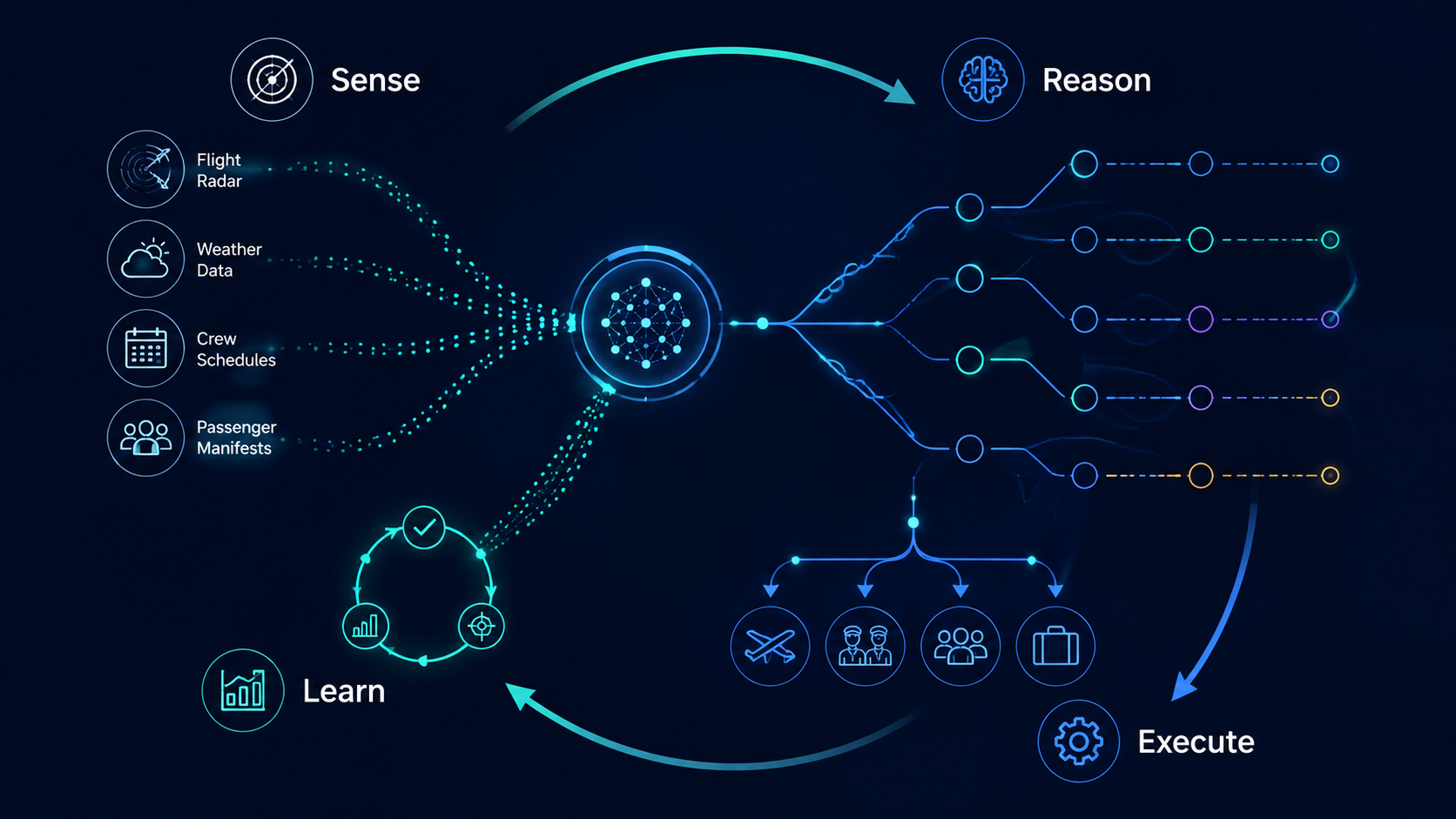
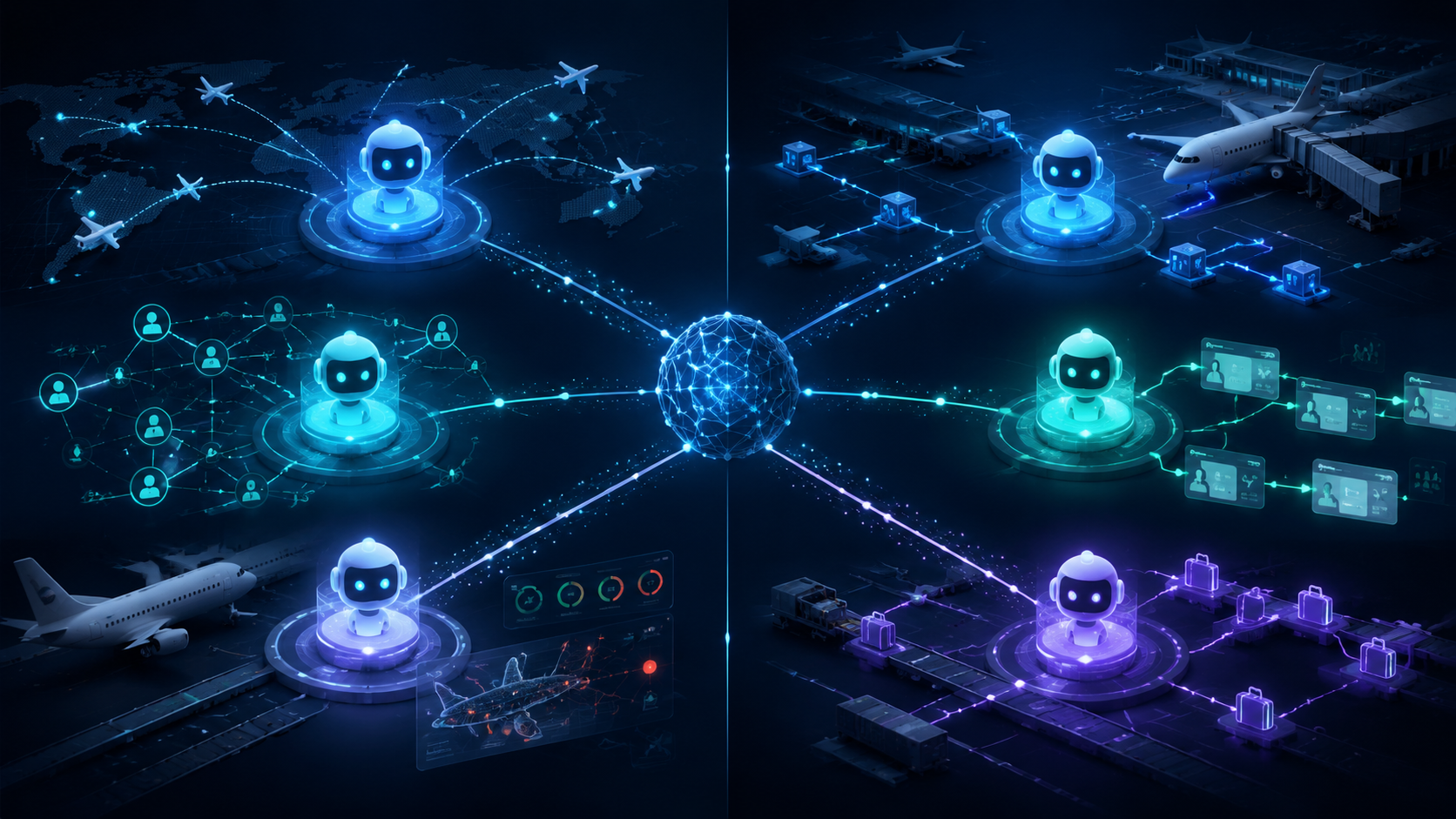
The architecture matters because it explains why this is more than predictive analytics with a new label. The system breaks the problem into specialized agents: network recovery, crew reassignment, gate and turnaround control, maintenance triage, customer communications, rebooking, and baggage flow. Each agent handles a narrower sub-problem, but all of them share the same disruption state, so the platform can resolve constraints in parallel instead of passing them down a chain.
That decomposition is also what makes aviation tractable. One agent does not need to know everything; it needs to know enough to propose an option that survives the other agents' constraints. The operations team still sees the whole picture, but it is no longer forced to rebuild the whole picture manually every time a flight slips.
What Live Operations Are Showing
SITA's OCCam platform is the cleanest live anchor in this space. In June 2026, SITA said OCCam had shown in live airline operations that it could cut disruption costs by up to 30% by optimizing aircraft, crew, passengers, and maintenance together after the acquisition.[3] That figure is vendor-reported, not independently audited, but it is still production evidence rather than lab theater.
The broader deployment story points in the same direction. Materials in this area describe 75-85% of disruption scenarios being handled autonomously, with passenger wait times down 30-50% and satisfaction scores up by about 20%, but those are best read as deployment-linked outcomes, not universal guarantees.[1][4] The real operational gain is often less visible: OCC staff stop burning time on routine replans and can stay focused on exceptions, approvals, and the safety-critical edges.
Where The Guardrails Still Matter
This is where the aviation constraint set stays non-negotiable. FAA and EASA duty-time limits, union agreements, and audit-trail requirements are not decorative policy layers; they define which options are legal, which actions need approval, and which decisions have to be explainable after the fact. That is why full autonomy is not the point yet.
The credible deployment model is tiered human-in-the-loop control. Let the agents clear routine scenarios. Route borderline cases to dispatch or operations control. Keep humans on the exceptions where legality, safety, or customer impact turns the answer into judgment rather than optimization. That is the difference between automation that helps and automation that creates a new kind of mess.
The point is fewer manual handoffs after the first plan breaks, with humans still covering the exceptions and legal edges.
References
- 1. Airline disruption cost research and recovery impact summary — MarketIntelo / related industry summaries — 2026
- 2. The Architecture of Resilience — Tech Mahindra — 2026
- 3. OCCam acquisition and live operations report — SITA — June 2026
- 4. Agentic AI orchestration in airline operations — StackAI / related deployment materials — 2026
Comments
Join the discussion with an anonymous comment.