

The hard part of using artificial intelligence in procurement and supply chain is no longer finding possible use cases. It is deciding which ones deserve scarce implementation capacity. The most popular applications are familiar: spend analytics, RFP/RFQ generation, and contract summarization. They are sensible places to start because they sit close to work procurement already understands. Yet the strongest documented savings signals are appearing in more demanding workflows: agentic sourcing, invoice-to-contract compliance, and automated tail spend repricing.
That mismatch matters when a pilot has to survive finance review. A sourcing team can save hours drafting an RFx and still fail to show negotiated savings. A contract tool can summarize obligations quickly and still leave leakage untouched. Conversely, an AI sourcing agent that changes supplier analysis, event design, and negotiation targeting may create larger value, but only if the organization can govern the workflow and act on the recommendations.

The ROI ranking starts with separating popularity from value
CPO priority is still useful. It shows where procurement leaders see enough pain, data availability, and organizational acceptance to justify investment. In Deloitte’s 2025 Global CPO Survey, spend analytics led the listed AI priorities at 53.44%, followed by RFP/RFQ generation at 42.33% and contract summarization at 41.27%.[1] Those rankings are a demand signal, not an ROI result.
The same Deloitte data makes the distinction clearer: procurement leaders cited enhanced analytics and decision-making at 67.68% and productivity gains at 49.43%, ahead of direct cost optimization at 28.90%.[1] In other words, the most common value story is better and faster work. That can be valuable, but it should not be booked automatically as savings.
| Use case | CPO priority or adoption signal | Documented ROI signal | Maturity | Readiness burden |
|---|---|---|---|---|
| Spend analytics and classification | Highest Deloitte CPO priority among listed use cases: 53.44%.[1] | Usually visibility, decision quality, and spend opportunity identification rather than automatic savings. | High | Moderate: depends heavily on spend data quality, taxonomy, and category ownership. |
| RFP/RFQ generation | Deloitte priority: 42.33%.[1] EFESO reports 55% use AI for RFP automation among its European CPO sample.[2] | Productivity and cycle-time improvement; hard-dollar savings depend on whether faster events lead to better competition or decisions. | High | Moderate: template governance, category review, and supplier-facing quality control matter. |
| Contract summarization and analysis | Deloitte priority: 41.27%.[1] EFESO reports 69% use AI for contract analysis.[2] | Faster review and improved obligation visibility; direct savings require follow-through on renewals, leakage, and compliance. | High | Moderate: contract repository quality and legal/procurement review rules determine usefulness. |
| Agentic sourcing optimization | Less mature than drafting and analytics use cases, but supported by emerging case evidence. | McKinsey reports one tech-company deployment identifying 12–20% savings in contact center operations and 20–29% in BPO/financial services spend.[3] | Medium to emerging | High: needs clear category outcomes, workflow redesign, human approval points, and supplier strategy. |
| Invoice-to-contract compliance | Emerging workflow rather than a common first pilot. | McKinsey describes an AI-enabled compliance workflow reducing leakage by about 4%.[3] | Medium | High: depends on contract, invoice, PO, and approval data integration plus ownership of exception resolution. |
| Tail spend repricing and supplier consolidation | Practical use case for fragmented indirect spend; adoption signal is case-based rather than survey-ranked. | SCMR cites a Spendflo case in which a SaaS company used AI-based supplier analysis to cut software expenses by 23% and halve sourcing cycle times.[4] | Medium | Moderate to high: requires reliable supplier, contract, usage, and stakeholder demand data. |
| Supplier risk assessment and monitoring | ISG reports supplier risk assessment/monitoring had the highest production rate among procurement-adjacent AI functions at 58%, with average investments of $2.0M per use case.[5] | Risk visibility and monitoring value; financial ROI is usually indirect unless tied to avoided disruption, compliance, or supplier action. | Medium to high | Moderate to high: needs trusted external and internal risk signals and escalation processes. |
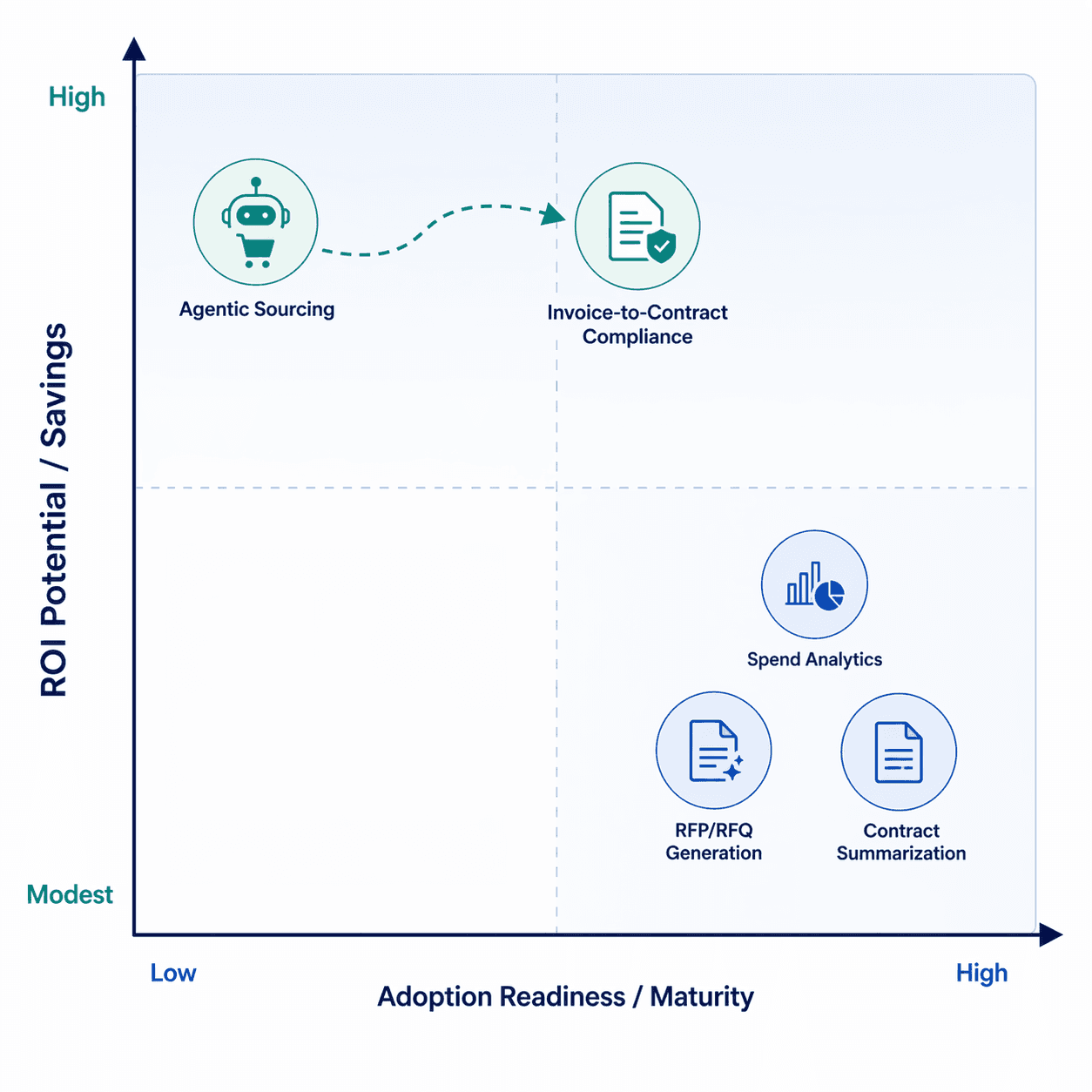
The table is deliberately uneven. Some entries have survey priority data. Others have case-based savings evidence. Some are mature enough for broad piloting; others should not be touched until a team has the data, governance, and business owner to absorb the workflow change. Treating all of them as interchangeable “AI ROI” options is how pilots look good in a demo and weak in a benefits tracker.
Why the mature use cases are still worth doing
Spend analytics, RFx generation, and contract summarization are not consolation prizes. They remove friction from work that is repetitive, document-heavy, and often delayed by incomplete information. They also create the operating conditions for more ambitious AI later: cleaner category views, faster sourcing preparation, more searchable obligations, and better evidence for supplier decisions.
Spend analytics is the cleanest example. A model that classifies spend more consistently can help category managers see supplier fragmentation, off-contract purchasing, price variance, or demand patterns that were previously buried in ERP descriptions. The ROI, however, usually appears in the next action. Someone still has to decide whether the category is addressable, whether supplier consolidation is realistic, and whether stakeholders will accept the change.
RFP and RFQ generation has a similar shape. Drafting acceleration is real value when teams are overloaded, especially in indirect categories where event quality varies by stakeholder input and time available. But a faster first draft is not the same as a better award decision. If the AI-generated pack merely gets pushed through the same weak supplier list, the benefit stays mostly in cycle time.
Contract summarization is often sold as a way to get control of contract sprawl. That is a credible claim when procurement has hundreds or thousands of agreements sitting across repositories, shared drives, and business-owner inboxes. Summaries can expose renewal dates, termination rights, pricing structures, and unusual obligations faster than manual review. The financial return comes when those findings trigger action: renegotiating before auto-renewal, enforcing contracted pricing, consolidating duplicate tools, or stopping leakage.
This is why mature productivity use cases need a benefits design, not just a deployment plan. If the business case says “buyers save time,” finance will eventually ask what happened to the time. A stronger case names the conversion mechanism: more events handled per category manager, shorter sourcing cycle time for priority categories, more spend brought under management, fewer missed renewals, or more exceptions resolved before payment.
The higher-savings cases change the workflow, not just the document
The more ambitious ROI signals come from AI being attached to a specific commercial outcome. McKinsey’s 2026 agentic AI procurement work describes a tech company using linked AI agents for sourcing. In that deployment, the agents identified 12–20% savings in contact center operations and 20–29% in BPO and financial services spend.[3] Those numbers should not be treated as a category benchmark. They are evidence that, in one company’s workflow, AI was close enough to supplier analysis and sourcing decisions to identify material savings.
The important detail is not that the tool was “agentic.” It is that the workflow connected analysis, supplier options, category context, and sourcing action. A sourcing agent that only drafts supplier emails is a productivity tool. A sourcing agent that compares incumbent pricing, demand requirements, supplier capabilities, and negotiation scenarios starts to influence negotiated value. That second version needs more guardrails because it gets closer to commercial judgment.
Invoice-to-contract compliance follows the same logic. McKinsey describes an AI-enabled workflow reducing leakage by about 4%.[3] Leakage reduction is a different class of value from drafting speed. It asks whether the company is actually paying according to the contract, whether exceptions are routed to someone who can fix them, and whether suppliers or internal requesters change behavior after the exception is found.
That makes compliance AI operationally demanding. The model may identify a mismatch, but procurement still needs an owner for exception review, a rule for when accounts payable should hold or release payment, and a process for recurring supplier issues. Without that operating model, the organization creates a better alerting system rather than a leakage-control system.
Tail spend repricing is another place where the value story becomes more concrete. SCMR cites a Spendflo example in which a SaaS company used AI-based supplier analysis to consolidate vendors, reduce software expenses by 23%, and cut sourcing cycle times by half.[4] Again, this is a case, not a universal expectation. Its usefulness is in the pattern: AI helped identify supplier and spend opportunities, but the savings required consolidation decisions and sourcing execution.
Teams considering AI-assisted supplier discovery or supplier selection for indirect categories can go deeper into workflow design with AI-assisted supplier selection for indirect spend. The practical question is whether the tool will simply surface more suppliers, or whether it will help the category team make a better commercial decision.
Adoption readiness is part of ROI, not a separate workstream
The satisfaction data should make procurement teams cautious about broad claims. EFESO’s 2026 CPO Annual Pulse Report, reported by Consultancy.eu, found that only 34% of procurement leaders were fully satisfied with AI value delivered so far, even as 69% used AI for contract analysis, 61% for market intelligence, and 55% for RFP automation.[2] The sample was more than 50 CPOs and Europe-focused, so it is best read as a directional signal rather than a global measure.
Still, the signal is familiar: adoption can move faster than value capture. A tool can be live, used weekly, and liked by buyers while still failing to change the commercial result. The difference is usually not model quality alone. It is whether the deployment had a named outcome, a baseline, an owner, and a plan for how users would change the way they work.
CASME’s 2026 peer research makes that point directly: high-ROI deployments are distinguished by starting with outcomes rather than features, building adoption into the plan early, and learning from peers before investing.[6] That is a useful corrective to the common pilot sequence where a team buys capability first and defines the measurable business result later.
For teams stuck between promising pilots and production pressure, the useful comparison is not “AI versus no AI.” It is whether the workflow is ready for the kind of value being claimed. A summarization tool can tolerate more human review and looser integration. An invoice compliance workflow cannot. A sourcing agent that recommends negotiation moves needs a stronger approval model than a tool that rewrites an RFP question.
That is where human-in-the-loop design becomes more than risk language. Agentic sourcing and compliance workflows need explicit thresholds: what the system may do alone, what it may recommend, what a buyer must approve, when legal or finance reviews the output, and how exceptions are audited. The governance work should begin before the first production category, not after the first uncomfortable supplier conversation. A more detailed treatment belongs in a dedicated human-in-the-loop guide for autonomous procurement AI.
Survey numbers should be used for what they actually measure
The available evidence is useful, but it does not all answer the same question. Deloitte’s figures show CPO priority, not realized savings.[1] EFESO’s figures show usage and satisfaction among a Europe-focused group of procurement leaders, not global ROI.[2] McKinsey’s savings ranges come from a specific tech-company agentic sourcing deployment, not a guaranteed result for every BPO or contact center sourcing event.[3] SCMR’s Spendflo example is a concrete case, not a category-wide benchmark.[4]
ISG’s production-readiness data adds another useful but narrow lens. Its 2025 State of Enterprise AI Adoption reported that supplier risk assessment and monitoring had the highest production rate among procurement-adjacent AI functions at 58%, with average investments of $2.0 million per use case; the procurement-specific subset was 72 implementations out of 1,200 AI implementations across all functions.[5] That helps identify where AI is making it into production, but it should not be stretched into a savings ranking.
This discipline matters because procurement AI business cases often blur four separate claims: people are using it, leaders prioritize it, the tool saves time, and the company captures financial value. Those claims can all be true in the same organization, but one does not prove the next.
A practical sequence for 2026 procurement teams
The strongest sequence is not to chase the most advanced use case first. It is also not to stop at safe drafting pilots. Start where data quality, workflow fit, and user adoption can support fast measurable gains. Then move toward agentic sourcing and compliance when the business outcome and control model are explicit.
- Use spend analytics and classification to build visibility into addressable spend, supplier fragmentation, and category opportunities. Measure the value by the decisions it enables, not by dashboard usage.
- Use RFP/RFQ generation where sourcing teams face high document volume and repeatable event types. Track cycle time, event throughput, supplier response quality, and whether more spend moves through a competitive process.
- Use contract summarization where renewals, obligations, and pricing terms are hard to find. Connect the tool to renewal action, compliance checks, and leakage prevention.
- Move into tail spend repricing and supplier consolidation when the team can act on supplier recommendations and has stakeholder support for rationalization.
- Deploy agentic sourcing only when the category outcome is specific, the approval points are defined, and category managers are prepared to challenge or accept AI-generated recommendations.
- Deploy invoice-to-contract compliance when contract, PO, invoice, and approval data can be connected and when someone owns exception resolution.
That sequence can be adapted by category and maturity. A procurement organization with clean contract and invoice data may be ready for compliance earlier. A team with poor spend taxonomy may need to fix classification before any sourcing agent has enough context to be useful. The point is to match ambition to the work the organization can actually absorb.
Teams building a broader rollout plan can use a phased approach such as AI in Procurement Implementation: A Phased Roadmap from Pilot to Production Scale. The pilot-to-production gap deserves particular attention because the value case often breaks after the proof of concept, when real users, messy data, and approval bottlenecks enter the workflow. For deployment patterns, see From Pilot to Production: How Procurement Teams Are Actually Deploying AI.
The best use case is the one where procurement can name the commercial outcome, measure the baseline, assign ownership, and change the workflow around the tool. For many teams, that means starting with mature productivity and visibility use cases, but designing them so they create the data and adoption foundation for higher-value sourcing and compliance workflows later.
References
- 2025 Global CPO Survey, Deloitte, 2025.
- Gen AI in procurement is shifting from broad experimentation to more high-impact areas, Consultancy.eu.
- Redefining Procurement Performance in the Era of Agentic AI, McKinsey & Company, February 2026.
- Doing More with Less: Practical AI Moves for Procurement Teams in 2026, Supply Chain Management Review, February 2026.
- 2025 State of Enterprise AI Adoption, ISG, 2025.
- AI in Procurement: Real-World Use Cases Delivering Measurable ROI, CASME, February 2026.
Comments
Join the discussion with an anonymous comment.