
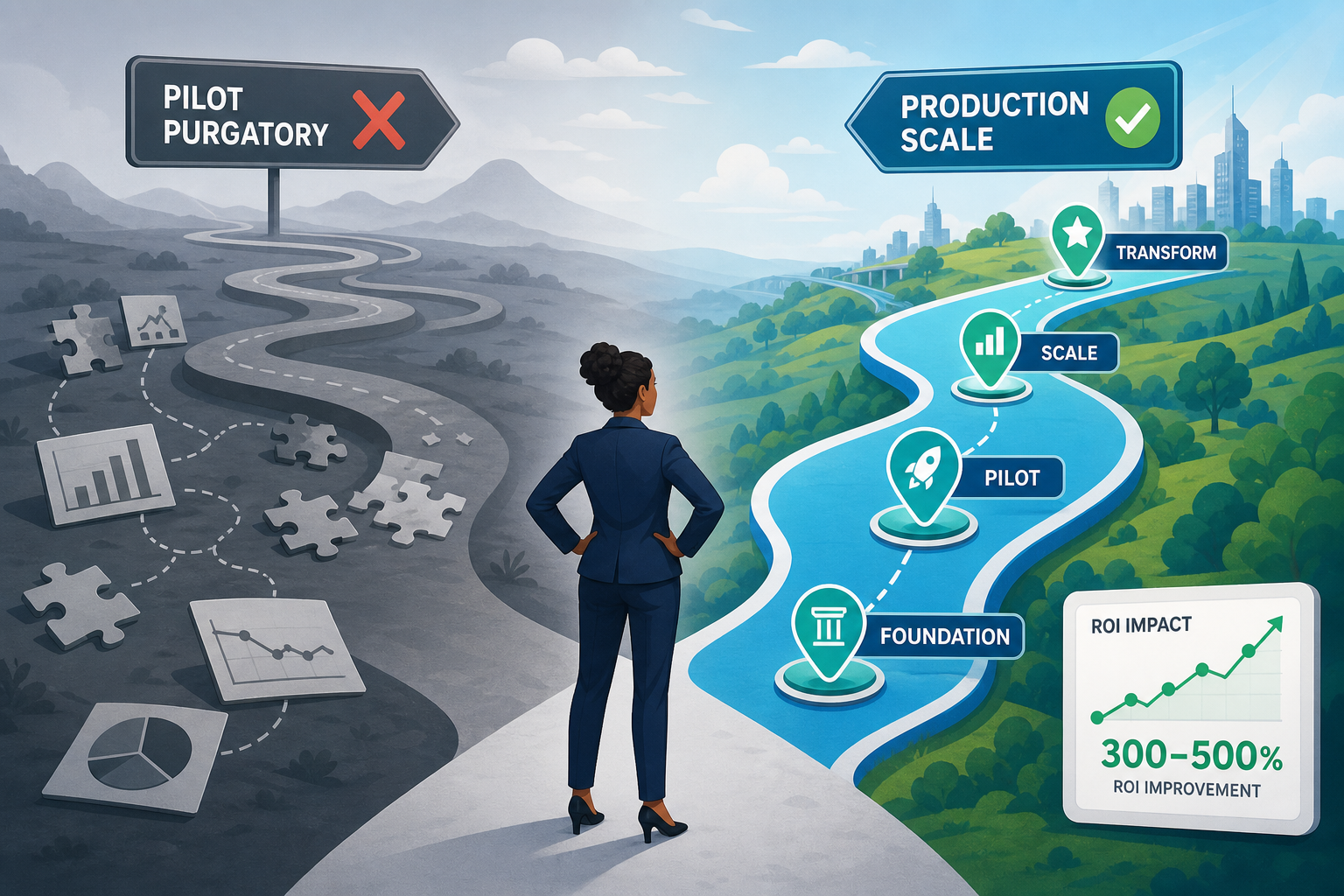
The Pilot-to-Production Gap: Why Most Procurement AI Initiatives Stall
The numbers are stark. In 2024, 49% of procurement teams piloted generative AI, yet only 4% achieved large-scale deployment, according to the Hackett Group's 2025 CPO Agenda Report. Across the broader enterprise landscape, the picture is even more sobering: a 2025 MIT Sloan study of 52 organizations and over 300 AI initiatives found that 95% of enterprise AI pilots failed to deliver measurable ROI. The gap between experimentation and production-scale impact is not a technology problem — it is an execution problem.
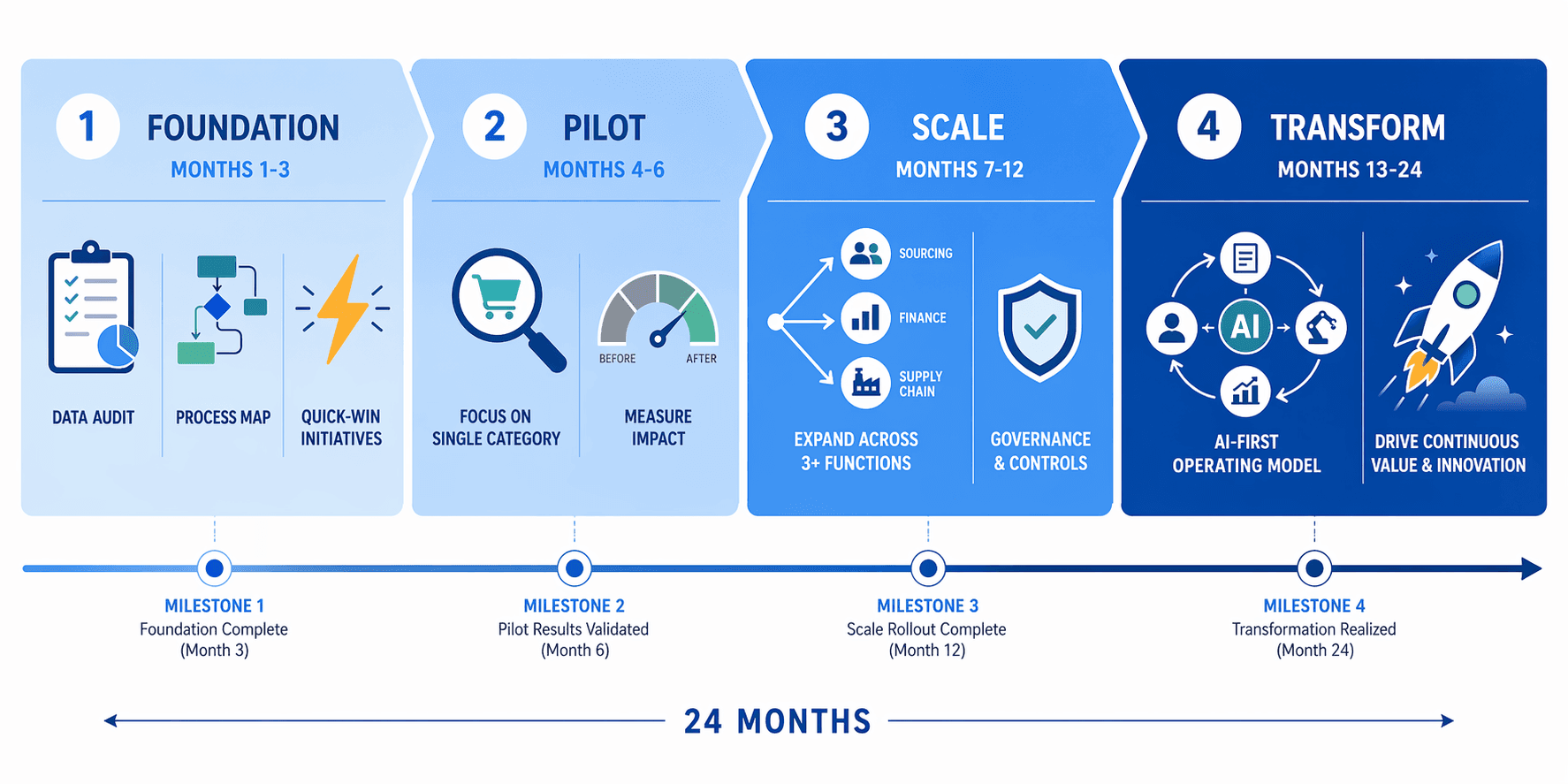
Procurement leaders are not short on ambition. An EY 2025 Global CPO Survey found that 80% of CPOs plan to deploy generative AI over the next three years, but only 36% have meaningful implementations today. The disconnect between intent and outcome stems from a common pattern: teams jump to tool selection before establishing data readiness, process clarity, and a phased adoption strategy. This guide provides a prescriptive, timeline-based roadmap — Foundation (Months 1–3), Pilot (Months 4–6), Scale (Months 7–12), and Transform (Months 13–24) — designed to move your organization from the 4% to the 96% that are still searching for a repeatable path to production.
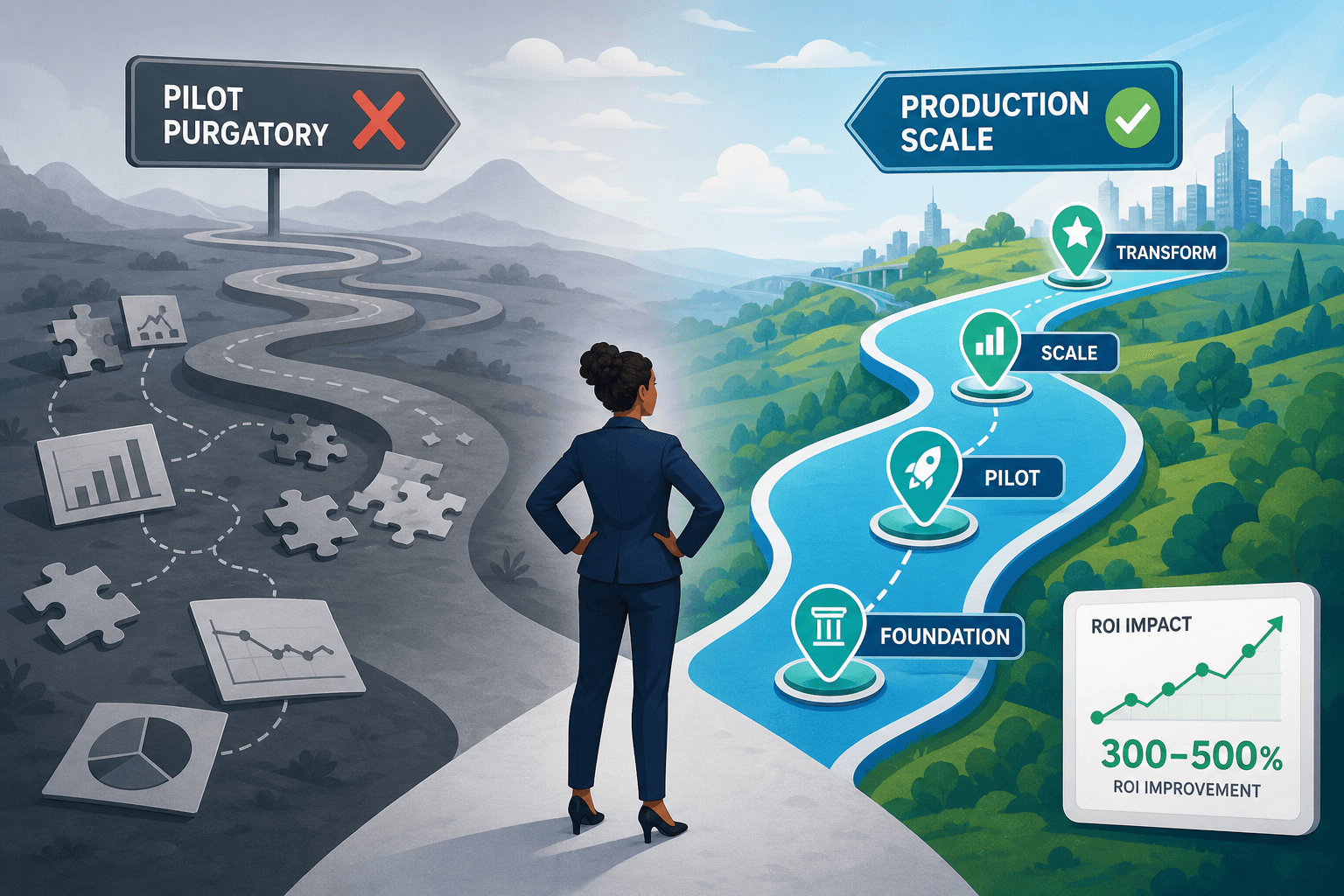
Phase 1: Foundation (Months 1–3) — Data Audit, Process Mapping, and Quick Wins
The first three months are about building the conditions for success, not deploying software. Gartner reports that 74% of procurement leaders say their data is not AI-ready. Yet paradoxically, AI itself can improve data quality as a byproduct of use — APQC research shows that organizations that start using AI tools see data quality improve through the process of cleaning and structuring inputs for model consumption. The goal of Phase 1 is to create a foundation that makes subsequent phases faster and less risky.
The Three Workstreams of Phase 1
- Data readiness audit: Inventory your procurement data sources — ERP spend data, contract repositories, supplier master files, invoice databases. Assess completeness, consistency, and format standardization. The Suplari/Procurement Tactics AI Readiness benchmark scores the average organization at 2.1 out of 5 for Data Foundation and 2.2 out of 5 for System Integration. Identify the highest-priority gaps.
- Process mapping: Document your current procurement workflows — from requisition to purchase order, from contract creation to renewal, from invoice receipt to payment. Identify which steps are rule-based and repetitive (candidates for automation) versus judgment-intensive (candidates for augmentation).
- No-regret quick wins: Deploy ad-hoc generative AI tools for low-risk, high-visibility tasks like drafting RFPs, summarizing supplier contracts, or generating spend category descriptions. These quick wins build organizational confidence and generate the data artifacts needed for more advanced use cases.
During this phase, you should also evaluate your technology architecture. The decision between orchestration layers and full source-to-pay (S2P) suites has significant implications for integration complexity and scalability. Our architectural decision framework for procurement AI tools provides a structured comparison to help you make this choice before committing to a pilot platform.
Phase 2: Pilot (Months 4–6) — One Use Case, One Category, Measured Results
The pilot phase is where most initiatives fail — not because the technology doesn't work, but because the scope is too broad, the metrics are undefined, or the timeline stretches beyond 90 days. The MIT Sloan study found that successful AI deployments take an average of 90 days from pilot to production, while failed ones take 9 months or more. The difference is discipline: one use case, one category, clear before-and-after measurement.
Selecting the First Use Case
Spend analytics is the most common and highest-ROI entry point. According to Deloitte's 2025 survey, spend analytics and dashboarding is the top GenAI use case in procurement, cited by 53.44% of respondents. Aggregated data from McKinsey and BCG implementation studies indicates that spend analytics AI delivers a 3-to-6-month payback period with 300–500% first-year ROI. Invoice processing is a close second, with a 6-to-9-month payback and 200–400% first-year ROI.
For a deeper technical understanding of how machine learning drives these outcomes, see our dedicated article on how ML transforms spend analytics.
Real-World Pilot Outcomes
| Company | Use Case | Outcome | Timeline |
|---|---|---|---|
| Coca-Cola Europacific Partners (CCEP) | AI-driven procurement across 28 countries | $40M annual savings | Not disclosed |
| Bristol Myers Squibb (BMS) | RFP automation | Cycle time reduced from 27 days to 3 days (90% reduction) | Not disclosed |
| Pentair | Autonomous sourcing | 22% first-year savings, 85% autonomous sourcing rate | 2-month rollout |
Measurement Framework for the Pilot
- Define baseline metrics before deployment: cycle time per process, cost per transaction, error rate, spend under management percentage.
- Set target improvement thresholds: 20–30% cycle time reduction, 10–15% cost avoidance, 50%+ automation rate for the selected process.
- Establish a 90-day measurement cadence: weekly during the first month, bi-weekly thereafter. If you haven't seen measurable improvement by day 60, escalate.
- Document qualitative feedback from procurement team members: ease of use, trust in outputs, time saved per task.
Phase 3: Scale (Months 7–12) — Expand to Multiple Functions, Build Governance
With a validated pilot producing measurable results, Phase 3 focuses on expanding to 3 or more procurement functions while building the organizational infrastructure to sustain growth. The Hackett Group's 2025 data shows that workloads in procurement are projected to rise 9.8% while staffing grows only 1%. AI is not an alternative to addressing this gap — it is the primary mechanism for closing it.
Expansion Priorities
- Contract management: AI-powered contract summarization, clause extraction, and obligation tracking. Deloitte's survey found contract summarization is the third most common GenAI use case at 41.27%.
- Supplier risk scoring: Machine learning models that ingest financial data, news feeds, and ESG ratings to produce dynamic risk scores.
- Autonomous sourcing: Agentic AI that handles RFx creation, bid evaluation, and supplier selection for low-complexity categories. McKinsey reports that a chemicals company using autonomous sourcing agents increased procurement staff efficiency by 20–30% and boosted value capture by 1–3%.
Building the Governance Structure
Scaling AI across multiple functions requires a formal governance mechanism. Establish a procurement AI council with representation from procurement operations, IT, legal/compliance, and finance. The council's responsibilities include: approving new use cases, monitoring model performance and drift, managing vendor relationships, and ensuring compliance with internal AI policies.
Change management and capability building must receive dedicated budget and attention. Industry benchmarks suggest allocating 30% or more of your AI budget to change management and training. For a detailed playbook on upskilling, team restructuring, and managing organizational resistance, see our change management playbook for procurement AI transformation.
Phase 4: Transform (Months 13–24) — The AI-First Procurement Operating Model
The end-state vision is an AI-first procurement operating model where agentic AI handles routine decisions — purchase order approvals, price negotiations for low-complexity categories, compliance checks, and invoice reconciliation — while humans focus on strategic supplier relationships, innovation sourcing, and category strategy. McKinsey's February 2026 analysis projects that AI agents will make procurement 25–40% more efficient by shifting human activity from routine tasks to strategic decision-making.
What Agentic AI Looks Like in Practice
| Agent Type | Function | Reported Outcome | Source |
|---|---|---|---|
| Price negotiation agents | Automated vendor negotiations for low-complexity categories | 90% reduction in analysis/email time; 10–15% vendor savings | McKinsey (telco client, Feb 2026) |
| Invoice-to-contract compliance agents | Cross-referencing invoices against contract terms | $10M+ value leakage identified in 4 weeks; 4% leakage reduction | McKinsey (pharma client, Feb 2026) |
| Order execution agents | Automated PO creation, inventory matching, and order tracking | 30% reduction in active inventory; ~$700M EBIT improvement | McKinsey (aircraft OEM, Feb 2026) |
| Autonomous sourcing agents | End-to-end RFx, bid evaluation, and supplier selection | 20–30% staff efficiency increase; 1–3% value capture boost | McKinsey (chemicals client, Feb 2026) |
Achieving this operating model requires sustained investment in three areas: data infrastructure (to support real-time decision-making), capability building (to develop the skills needed to manage AI agents), and governance (to ensure accountability and auditability). The procurement function of 2028 will look more like a center of AI-augmented expertise than a traditional cost-reduction department.
Common Pitfalls and How to Avoid Them
The Suplari analysis of procurement AI failures identifies six recurring reasons why pilots fail to scale. Each has a concrete mitigation strategy.
- The data quality trap: Teams wait for perfect data before starting. Mitigation: Start with a pilot that forces data cleanup. AI tools surface data quality issues faster than manual audits.
- No defined problem or metrics: Teams adopt AI because 'we should do AI' rather than solving a specific operational pain point. Mitigation: Define the problem and success metrics before selecting the tool.
- Team fear of replacement: Procurement professionals resist tools they perceive as threats. Mitigation: Frame AI as augmentation, not replacement. Invest in upskilling and communicate the shift toward strategic work.
- Integration chaos: AI tools that don't connect to ERP, P2P, or contract management systems create data silos. Mitigation: Evaluate integration requirements during Phase 1 and prioritize tools with pre-built connectors.
- Shiny object syndrome: Teams jump from one vendor to the next without completing a pilot. Mitigation: Commit to a 90-day pilot with a single vendor and defined success criteria before evaluating alternatives.
- No accountability ownership: No single person or team is responsible for AI outcomes. Mitigation: Assign a dedicated AI program owner with executive sponsorship and clear KPIs.
90-Day Quick-Start Checklist
The following checklist provides a concrete action plan for the first 90 days of your procurement AI journey. Each item includes a priority indicator and a suggested owner.
| Timeframe | Action | Priority | Owner |
|---|---|---|---|
| Days 1–30 | Conduct data readiness audit across ERP, contract, and supplier data sources | Critical | IT / Data Team |
| Days 1–30 | Map 3–5 procurement processes end-to-end, identifying automation candidates | Required | Procurement Ops |
| Days 1–30 | Deploy ad-hoc GenAI for RFP drafting or contract summarization as a quick win | Required | Procurement Team |
| Days 31–60 | Select one high-impact use case (spend analytics or invoice processing recommended) | Critical | Procurement Director |
| Days 31–60 | Choose one category for the pilot (preferably a category with clean data and clear processes) | Required | Category Manager |
| Days 31–60 | Define baseline metrics and target improvement thresholds | Critical | Procurement Ops / Finance |
| Days 61–90 | Deploy pilot tool and begin data ingestion | Critical | IT / Vendor |
| Days 61–90 | Measure results at day 30 and day 60 against baseline | Required | Procurement Ops |
| Days 61–90 | Document lessons learned, including data quality issues and team feedback | Required | Program Owner |
From Roadmap to Results: Your Next Move
The phased roadmap outlined here is not theoretical — it is drawn from the deployment patterns of organizations that have successfully bridged the pilot-to-production gap. The common thread across CCEP, BMS, Pentair, and McKinsey's client engagements is not a specific technology choice but execution discipline: start small, measure rigorously, build capability in parallel, and scale only after validation.
Your next move is not to evaluate vendors or build a business case — those steps come later. Your next move is to start Phase 1: conduct the data audit, map the processes, and deploy a quick win. The 90-day checklist above is your immediate action plan. Begin today, and within three months you will have the foundation needed to launch a pilot that has a real chance of reaching production scale.
For additional guidance on the organizational and change management dimensions of this journey, see our change management guide for autonomous procurement AI.
Comments
Join the discussion with an anonymous comment.