

Predictive analytics in supply chain usually gets into trouble before anyone argues about ARIMA, XGBoost, or neural networks. The weak point is more ordinary: demand history sits in one system, inventory balances in another, lead times are half-entered, shipment events arrive late, and planners keep the unofficial truth in spreadsheets. KNIME’s practical guidance that roughly 60% of project time should go to connecting and cleaning data is not a footnote; it is the operating budget of the project.[1]
That matters because executives are already impatient with technology programs that look impressive and still fail to change daily decisions. PwC’s 2026 survey of 767 US operations leaders found that 89% say technology investments have not fully delivered, with integration complexity, data issues, and user adoption gaps among the reasons.[2] Those are not model-selection problems. They are implementation problems.
A good supply chain predictive analytics program can still pay back within months. The practical version starts as a bounded data-and-workflow program: choose one decision, join the minimum useful data, test a model that planners can challenge, run recommendations in advisory mode, and expand only after the output has entered the planning rhythm.

Start With the Decision, Not the Forecasting Method
The first scoping question should be dull enough to survive production: which decision will change if the prediction is better?
“Improve demand forecasting” is too wide for a first pilot. “Recommend weekly inventory targets for one distribution center and one high-volume category” is closer. So is “flag purchase orders at risk of late arrival for one region,” or “predict which SKUs in one product line need planner review before the monthly S&OP cycle.” The narrower version gives the team a place to inspect data, a named operational owner, and a decision cadence.
SR Analytics describes mid-market pilots in the $25,000–$75,000 range, with initial pilots commonly taking 8–12 weeks and systematic expansion taking 6–12 months.[3] Those numbers are useful because they force a choice. A pilot cannot examine every lane, SKU, supplier, and facility in twelve weeks. It has to pick the part of the business where better prediction can move a real lever and where the source data is least hostile.
- Pick one product line, category, region, distribution center, supplier group, or transportation lane.
- Tie the model to one recurring decision, such as reorder quantities, safety stock review, replenishment timing, expedite risk, or capacity alerts.
- Choose the area with the cleanest usable data, not the area with the loudest executive complaint.
- Confirm that a planner, buyer, or operations lead will review the output weekly and explain where it is wrong.
- Assign an executive sponsor who can unblock access to ERP, WMS, TMS, demand planning, and finance data.
The pilot should be small, but it should not be fake. A sandbox that cannot touch real order history, inventory positions, service constraints, or planner review routines only proves that a dashboard can be built.
Data Readiness Is the Main Workstream
The implementation plan should reserve most of the early calendar for data access, data joining, and data quality checks. This is where many supply chain teams underestimate the project. The forecasting method may be mathematically sophisticated, but the data questions are blunt: Can the team match orders to shipments? Can it connect purchase orders to actual receipts? Can it distinguish demand from constrained sales? Can it see promotions, stockouts, substitutions, minimum order quantities, and lead-time variability?
For inventory and demand pilots, the minimum dataset often spans ERP, WMS, TMS, planning tools, and spreadsheets that nobody wants to name in the steering committee. The data engineer needs system access. The domain expert needs to say which fields are trusted and which are decorative. The analyst needs enough history to test whether the model is learning a pattern or memorizing noise.
This is the right point to run a formal data readiness assessment. Not as a governance exercise after the pilot, but before the team promises an accuracy target. If the assessment shows that inventory snapshots are unreliable, shipment events are delayed, or lead-time fields are overwritten, the honest answer is to fix the foundation before paying for model tuning.
| Data Area | What To Verify Before Modeling |
|---|---|
| Demand history | Orders, shipments, cancellations, backorders, promotions, stockouts, and substitutions are separated rather than treated as one clean demand signal. |
| Inventory | On-hand, allocated, in-transit, safety stock, and cycle-count adjustments can be traced by SKU, location, and date. |
| Lead time | Planned lead times and actual receipt dates are both available, with supplier, lane, and mode attached where relevant. |
| Operations events | Capacity constraints, weather disruptions, labor issues, supplier delays, and transportation exceptions are captured consistently enough to be useful. |
| Master data | SKU, customer, supplier, location, and unit-of-measure fields are stable enough to join across systems. |
A pilot can proceed with imperfect data. It cannot proceed with unknown data quality. Missing values, inconsistent units, and late events can often be handled if the team knows where they occur and how they affect the decision. The dangerous version is the beautiful dataset assembled for the model while the planner knows the actual business rule lives elsewhere.
The Team Is Small, but It Cannot Be Only Technical
A practical pilot team needs four roles: a data engineer to connect and prepare sources, a domain expert such as a planner or buyer to interpret operational reality, an analyst or data scientist to build and test the model, and an executive sponsor to clear access and priority conflicts. If any one of those roles is missing, the gap usually appears late: the model works on the dataset, but nobody can explain why it recommends a purchase quantity that violates a supplier minimum or a warehouse constraint.
A Roadmap That Can Survive Production
The roadmap is not a technology ladder from simple to glamorous. It is a sequence of gates. Each gate asks whether the project has earned the right to get bigger.
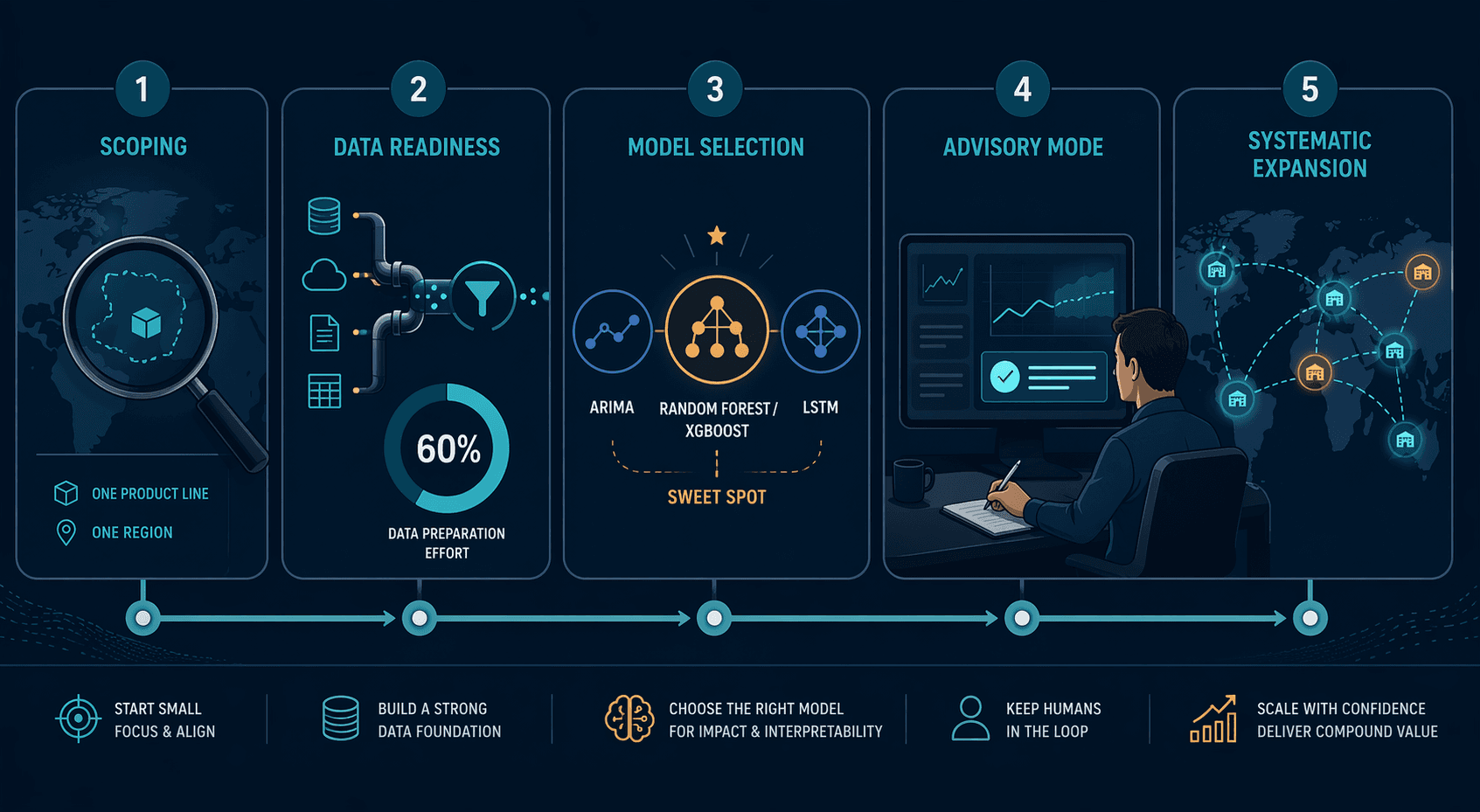
| Phase | Main Decision | Evidence To Move Forward |
|---|---|---|
| Scope the pilot | Which bounded decision will the model support? | Named owner, limited business area, measurable decision cadence, and executive sponsor. |
| Prepare the data | Can the required sources be joined and trusted enough? | Documented data lineage, known quality gaps, usable history, and agreed business definitions. |
| Select and test the model | Which model is adequate for the data shape and decision? | Back-test results, interpretability, planner review, and comparison against current baseline. |
| Run in advisory mode | Can planners use the recommendation without surrendering judgment? | Recommendation review process, exception tracking, and visible reasons for model output. |
| Integrate and expand | Should the workflow be embedded or scaled? | Adoption evidence, workflow handoff, benefits tracking, and reusable data pipeline. |
This sequence also gives procurement a cleaner brief. If the team later evaluates platforms, the selection criteria are no longer abstract. The buyer can ask whether a tool connects to the actual source systems, exposes model reasoning clearly enough for planners, supports workflow integration, and fits the expansion plan. The 2026 AI supply chain tool buyer’s guide is more useful after these pilot constraints are known.
Model Selection: Keep It Useful, Not Ceremonial
Model selection matters. It just does not deserve to be the first serious conversation. Once the data and decision are clear, the model choice becomes easier.
| Model Family | Best Fit | Implementation Judgment |
|---|---|---|
| ARIMA/SARIMA | Stable seasonal history with clean time-series data | A sensible starting point for established products when the main signal is historical seasonality. |
| Random Forest/XGBoost | Mixed variables, non-linear relationships, missing values, promotions, lead times, and operational signals | Often the practical sweet spot for supply chain pilots because they balance accuracy, tolerance of real-world data, and interpretability. |
| LSTM/neural networks | Large datasets with real-time streams, complex sequential behavior, or IoT-scale signals | Usually justified only when data volume and operating maturity support the added complexity. |
KNIME’s model comparison guidance places ARIMA and SARIMA with stable seasonal patterns, tree-based methods such as Random Forest and XGBoost with multivariable demand and inventory signals, and neural-network approaches with larger, more complex data environments; the same guidance notes that LSTM-style approaches are better justified at roughly 100,000 or more records with real-time streams.[1] For most teams, the center of gravity is tree-based models. They can handle mixed inputs, tolerate some missingness, capture non-linear effects, and still give planners a way to inspect which variables influenced a recommendation.
A planner does not need a lecture on gradient boosting. They do need to know whether the recommendation changed because demand rose, lead time slipped, service targets changed, a promotion is approaching, or inventory is already in transit. If the model cannot support that conversation, it will struggle in the Monday morning meeting.
Teams that want the technique vocabulary can use a machine learning in supply chain management glossary as a side reference. The project itself should stay anchored in the operational test: does this method improve the decision compared with the current baseline, and can the user understand enough to act?
Run the Pilot in Advisory Mode Before Automating Decisions
The first production-like version should recommend, not decide. ThroughPut describes an advisory-mode approach in which models make recommendations while planners retain decision authority, building trust over time rather than forcing immediate automation.[4] This is slower than the demo version of predictive analytics. It is also much closer to how planning organizations actually absorb risk.
Advisory mode needs structure. The model should show the recommendation, the current plan, the main drivers, and the expected consequence if the planner accepts or rejects the recommendation. The planner should record whether they accepted, changed, or ignored the suggestion, along with a reason code when practical. Those reason codes are not clerical debris. They reveal business rules the model missed, policy constraints that were never documented, and exception patterns that may deserve new features in the next training cycle.
- For inventory: show recommended target, current target, projected stockout or excess risk, and the variables driving the change.
- For demand: show forecast, baseline comparison, confidence band or exception flag, and relevant demand drivers.
- For supplier risk: show the at-risk order, expected delay signal, affected production or service impact, and recommended escalation.
- For transportation: show predicted delay, route or carrier factors, affected delivery commitments, and available mitigation choices.
This is also where overfitting shows itself. A model may perform well against historical data because it learned a pattern that will not repeat: a pandemic-era demand spike, a one-time supplier allocation, a promotion that changed channel behavior, or a discontinued customer program. Planner review is not an obstacle to analytics. It is one of the cheapest controls against automating a false pattern.
Do Not Let the Prediction Die in a Spreadsheet
A pilot that produces a weekly CSV for a planner to copy into another file has not reached the hard part. It may still be a useful test, but the implementation is unfinished. The last mile is workflow: where the recommendation appears, who reviews it, what system of record changes if it is accepted, and how exceptions are escalated.
For demand planning, that may mean pushing forecast exceptions into the planning workbench before the consensus meeting. For replenishment, it may mean surfacing recommended target changes inside the inventory planning process rather than in a separate dashboard. For supplier risk, it may mean creating a review queue for buyers before production planners discover the shortage.
PwC’s small 4% “leaders” cohort in its 2026 operations survey is directionally useful here, not because the subsample is large, but because the distinction is operational: those companies report embedding AI more fully alongside data foundations and operating-model redesign.[2] The caution is important. A model that is not connected to the operating model is still a sidecar.
What ROI Claims Are Worth Believing
ROI ranges for predictive analytics are real enough to justify pilots, but not precise enough to promise in a budget deck without caveats. Published materials commonly cite forecast-error reductions, inventory-cost reductions, and service improvements, but outcomes vary with data maturity, scope, baseline performance, and whether the prediction changes the workflow. ChainSignal’s AI use cases in supply chain by function is the better place to compare use-case-level evidence before attaching a business case to a specific function.
The more believable near-term business case is modest: fund a pilot in the $25,000–$75,000 range, run it over 8–12 weeks, measure against the current planning baseline, and decide whether the data pipeline and adoption evidence justify expansion over 6–12 months.[3] That is not a transformation slogan. It is an authorization path.
Vendor-published case studies can help set ambition, as long as they are read as cases rather than guarantees. KNIME reports that Procter & Gamble applied analytics across 5,000 products and more than 22,000 components, reducing certain response times from more than two hours to instantaneous; it also reports that Karcher reduced inventory value by 15% and that Volkswagen eliminated about 500 hours of manual work while improving supplier data quality by 15%.[1] Those are real published customer examples, but they do not remove the need to inspect your own data, workflow, and adoption constraints.
When To Expand, Pause, or Stop
Expansion should follow evidence, not enthusiasm. The pilot has earned a wider rollout when the team can show that the data pipeline is repeatable, the model beats the baseline on the chosen decision, planners understand the main drivers, recommendations are reviewed in the normal workflow, and accepted changes lead to measurable operational movement.
Pause the model work if the team cannot reconcile source data, if planners do not trust the business definitions, if the recommendation requires manual re-entry into too many systems, or if the executive sponsor cannot force cooperation across functions. None of those failures means predictive analytics is the wrong direction. They mean the organization has found the real prerequisite.
Proceed when the pilot has five things in place: clean enough data, a bounded decision, an operational owner, interpretable recommendations, and a path into the planning workflow. If those are missing, delay the model work and fix the foundation first.
Comments
Join the discussion with an anonymous comment.