

When predictive analytics in supply chain management stalls, the easiest postmortem is also the least useful one: “the model didn’t work.” Sometimes that is true. More often, the model is being asked to compensate for missing lead times, disputed customer hierarchies, late promotion updates, manual overrides no one reviews, and planning meetings where the forecast is admired on a dashboard and then ignored in the purchase order.
The gap is no longer anecdotal. In PwC’s 2026 Digital Trends in Operations survey of 767 US operations leaders, 89% said technology investments have not fully delivered expected results, 87% said poor data quality affected the value of digital initiatives, and only 30% reported significant improvement in data quality over the previous two to three years. The same survey found that only 4% of organizations were succeeding simultaneously across AI embedding, agent scaling, horizontal organizational structures, and technology investment ROI.[1]

That 4% figure is a useful brake on wishful thinking. Most companies are not failing because they lack ambition or because the market has hidden all the good algorithms from them. They are failing somewhere in the data-to-decision chain. The repair work starts by locating the break.
Failure mode 1: Starting with the model instead of the data
A supply chain analytics project can survive an imperfect model. It usually cannot survive unowned, untrusted, or unmaintained data.
Poor data quality is not a cosmetic problem that gets cleaned up after the pilot. It determines whether the model is learning the business or learning the residue of broken process. PwC’s 87% data-quality finding matters because it points to the part of the project that is often treated as preparation but is actually the foundation. The same survey’s 30% improvement figure shows why the issue keeps reappearing: many organizations know data quality is hurting value, but far fewer have measurably improved it.[1]
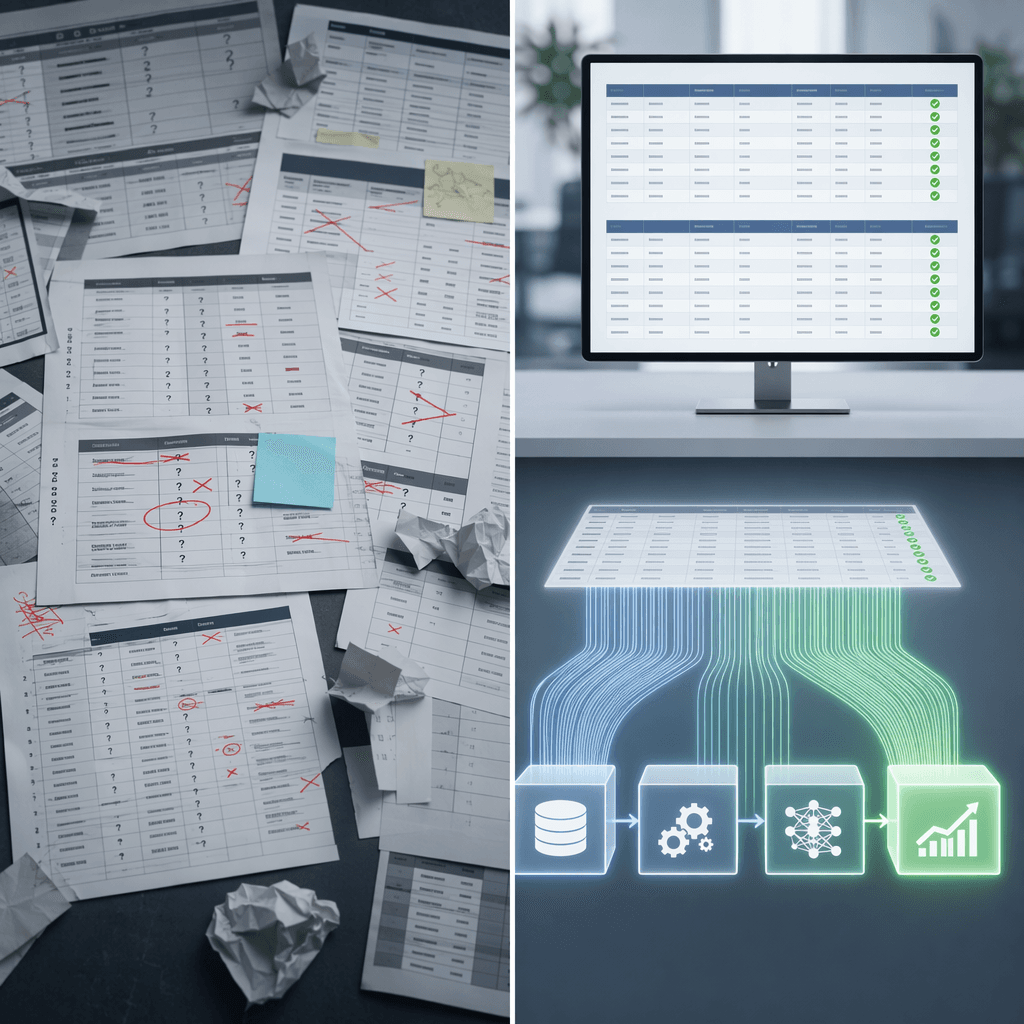
The operational symptoms are familiar. The item master has obsolete SKUs that still appear in history. One business unit treats substitutions as lost demand; another treats them as fulfilled demand. Supplier lead time exists in the ERP, but the field is blank for a high-share supplier group. Sales and planning disagree on which customer belongs to which channel. Promotions are stored outside the planning system, so the model sees a demand spike but not the event that caused it.
At that point, a more advanced algorithm may only make the error look more sophisticated. The project needs a data readiness gate before it needs another tuning cycle. A practical data readiness assessment should answer four questions before model selection becomes the main agenda:
- Which data fields are required for the decision the model is supposed to improve?
- Who owns each field when the value is missing, stale, duplicated, or disputed?
- Which transformations are approved business logic, and which are analyst workarounds?
- How will data quality be monitored after go-live, not just during the pilot?
Practitioner guidance often uses a blunt rule of thumb: expect data preparation to consume the majority of the work, sometimes 60% or more of project time. KNIME’s practical guide to predictive analytics in supply chain frames data preparation as a major share of implementation effort, but that should be treated as a heuristic, not a scientific constant. The point is not to defend a percentage. The point is to stop treating data work as administrative drag when it is the work that determines whether the model has a fair chance.[2]
| Data issue | What it breaks | Data-driven fix |
|---|---|---|
| Missing supplier lead times | Replenishment and inventory risk predictions | Assign field ownership, set completeness thresholds, and block production use for affected supplier groups until gaps are resolved or explicitly modeled |
| Inconsistent customer or product hierarchies | Demand aggregation, segmentation, and forecast reconciliation | Create governed hierarchy rules and document how historical changes are restated or preserved |
| Unlabeled promotions, stockouts, or substitutions | Historical demand interpretation | Separate true demand signals from constrained or event-driven sales history before training |
| Manual overrides without reason codes | Learning loops and trust in forecast adjustments | Require override reasons, review bias by planner or category, and compare override performance against baseline forecasts |
The fix is not “clean all the data.” That is how teams lose a year. The fix is to make the data fit for the specific decision: inventory targets, production sequencing, supplier expedites, allocation, capacity planning, or demand sensing. A model predicting stockout risk does not need perfect enterprise data. It does need the fields that determine availability, replenishment timing, demand volatility, and current inventory position to be governed well enough that operations can act on the output.
Failure mode 2: Treating history as if the operating regime has not changed
Supply chain models learn from history, but supply chains do not owe the model a stable future. A forecast trained on one pricing environment, service policy, supplier base, freight pattern, or channel mix can degrade quietly when those conditions change. The first few misses look like noise. Then planners start building side spreadsheets.
This is where overfitting becomes more than a statistics problem. A model can fit historical data well and still fail when the business enters a different regime. New distribution rules, changed minimum order quantities, supplier constraints, product substitutions, channel shifts, and promotion patterns can all turn yesterday’s signal into today’s trap.
The repair is monitoring, not annual remorse. Teams need a model drift process that watches whether forecast error, bias, service exceptions, or decision outcomes are changing in ways the original validation did not anticipate. A practical model drift detection and response framework should specify when to investigate, when to recalibrate, when to retrain, and when to stop using the model for a particular segment.
- Monitor error and bias by segment, not only at total business level.
- Track business events that change the meaning of history, such as channel migration, supplier changes, policy changes, or product substitutions.
- Define thresholds for investigation before users lose confidence.
- Keep a fallback rule for decisions where the model is temporarily unreliable.
Accuracy still matters. A sloppy model should not be excused by blaming the organization. But accuracy measured only on a back-test is not enough evidence for ongoing operational use. The model has to be watched in the conditions where planners, buyers, and schedulers are actually using it.
Failure mode 3: Building analytics in isolation when the value depends on orchestration
A demand forecast that never changes supply decisions is not a supply chain capability. It is a reporting asset with better math.
PwC’s operating-structure data explains why this failure is so common. Only 41% of companies said they currently operate with collaborative, horizontal structures, while 94% said they intend to shift in that direction. That gap is where many predictive analytics projects get stuck: the model spans functions, but the organization still approves, disputes, and executes decisions in vertical lanes.[1]

The handoffs are where predictive analytics either becomes operational or dies politely. Sales forecasting hands a number to demand planning. Demand planning reconciles it with events, constraints, and commercial judgment. Supply planning turns it into inventory, capacity, and procurement implications. Procurement has to trust the signal enough to adjust buys or supplier conversations. Logistics has to see the impact on lanes, capacity, and timing. Finance may need to approve the working-capital consequence.
If those handoffs are not designed, the forecast becomes another artifact in the meeting. The forecasting-to-demand-planning connection is often the first place to inspect because it exposes whether the organization has agreed on the decision rights around the number: who can override it, what evidence is required, how exceptions are escalated, and how downstream teams are notified.
The sector signals in PwC’s survey make the orchestration problem more concrete. In consumer markets, 59% cited integration complexity. In industrial products, 55% cited integration complexity and 51% cited user adoption. Those are not abstract transformation barriers; they are the practical reasons a decent prediction fails to move through the operating system.[1]
| If the analytics output is... | The orchestration question is... | Evidence the handoff works |
|---|---|---|
| A demand forecast | Who reconciles it with promotions, constraints, and commercial commitments? | Forecast changes are visible in demand review decisions and downstream supply plans |
| A stockout-risk score | Who decides whether to expedite, reallocate, or accept the risk? | Exceptions are assigned, resolved, and tracked against service outcomes |
| A supplier-delay prediction | Who contacts the supplier, changes the order plan, or updates customer commitments? | Procurement and planning actions are logged against the prediction |
| A production-risk alert | Who can change the schedule, and what trade-offs require approval? | Schedule adjustments are traceable to risk thresholds and reviewed after execution |
This is also where platform buying can become a distraction. Planning platforms matter, especially when architecture affects scenario planning, latency, workflow, and integration. But a platform chosen in isolation cannot settle decision rights between procurement, planning, logistics, sales, and finance. Architecture comparisons such as demand planning platform fit are most useful after the operating model is explicit enough to say what the system must orchestrate.
The data-driven fix is to instrument the handoff, not just the forecast. Track whether a prediction was reviewed, whether it was accepted or overridden, who made the call, what action followed, and whether the downstream outcome improved. Without that chain of evidence, the team can argue forever about whether the model was “right” while no one knows whether the business actually used it.
Failure mode 4: Treating change management as a training session
Adoption is not secured by showing users where the button is. In supply chain planning, adoption means people are willing to let the output influence commitments they will be held accountable for: inventory, service, capacity, supplier orders, expedites, allocation, and schedule changes.
That is why implementation readiness matters before go-live. r4.ai’s executive guidance emphasizes readiness and adoption as part of predictive analytics implementation, not as a communications layer added after technical deployment.[3] The practical point is simple: users need to know what the model is for, when to trust it, when to challenge it, and how their decisions will be evaluated.
A planner who overrides a forecast is not necessarily resisting analytics. They may know about a customer commitment, a promotion, a channel shift, or a supply constraint that the model cannot see. The failure is not the override. The failure is an override process that captures no reason, has no review, and teaches the system nothing.
- Define which decisions the model is allowed to influence and which remain advisory.
- Give users clear override rights, with required reason codes for material changes.
- Review overrides for bias and value, not just compliance.
- Measure adoption by decision use, not logins or dashboard views.
- Make exception ownership visible so predictions do not become unassigned work.
The adoption metric should be close to the work. Did the buyer change an order? Did the planner adjust safety stock? Did logistics rebook capacity? Did the team suppress an expedite because the risk score was low and later confirm that decision was safe? Those are different from “active users,” and they are harder to fake.
Failure mode 5: Stopping before the last mile of execution
The last mile is where many analytics initiatives become visibly expensive. A team improves a prediction, publishes a dashboard, celebrates the pilot, and then discovers that procurement still orders on the old cadence, production scheduling still uses a separate spreadsheet, and exception handling still depends on who notices the red cell first.
A prediction has operational value only when it changes a decision path. In supply chain management, that usually means one of five things changes: replenishment, procurement, scheduling, allocation, or exception handling. If none of those changes, the model may be informative, but it is not yet embedded.
| Prediction | Execution link required | Failure sign |
|---|---|---|
| Demand will exceed baseline | Replenishment rules, inventory targets, or supply plan review | Forecast accuracy improves but service or inventory outcomes do not move |
| Supplier delivery is at risk | Procurement follow-up, alternate sourcing, or rescheduling | Risk alerts are viewed but purchase orders remain unchanged |
| Capacity will be constrained | Finite scheduling, labor planning, or allocation decision | Schedulers rebuild the plan manually outside the analytics workflow |
| SKU-location stockout risk is rising | Exception queue with owner, due date, and approved actions | The dashboard shows risk but no one owns resolution |
Automation does not have to mean fully autonomous execution. In many environments, the right first step is decision automation around routing, prioritization, and evidence gathering: assign the exception, prefill the recommended action, show the trade-off, and require approval only where the risk or cost crosses a threshold. That is still a real operating change.
The test is plain: if the analytics team cannot point to the transaction, schedule, order, allocation, or exception queue affected by the prediction, the project has not reached the operating layer.
What the 4% exception should make teams audit
PwC’s 4% full-success cohort should not be turned into a fantasy benchmark. It is better used as an audit prompt. If so few organizations are simultaneously embedding AI, scaling agents, operating horizontally, and realizing technology ROI, then a stalled project should be inspected across all four conditions rather than judged only by model performance.[1]
Successful implementations tend to be boring in the right places: clear data ownership, monitored models, explicit handoffs, governed overrides, and execution links. Broader examples of AI supply chain ROI are useful only if they are read through that implementation lens. A result without the operating mechanism behind it is not much help to the team trying to make Monday’s planning meeting work.
| Audit question | If the answer is no, the likely failure mode is... |
|---|---|
| Is the data fit for the specific decision the model supports? | Starting with the model instead of the data |
| Is the model monitored against changing business conditions? | Treating historical patterns as stable |
| Are cross-functional handoffs and decision rights explicit? | Building analytics in isolation |
| Do users know when to accept, override, and explain the output? | Skipping real change management |
| Does the prediction alter procurement, replenishment, scheduling, allocation, or exception handling? | Stopping before last-mile execution |
Predictive analytics succeeds when the data is fit for use, the model is monitored against changing conditions, the functions are aligned around decisions, users are brought into the workflow, and the output reaches execution. If a project is not producing value, the next question is not automatically which model to buy or build next. It is which part of that chain is broken.
Comments
Join the discussion with an anonymous comment.