
Executive Summary: Why Industry Fit Should Drive Your Demand Planning Platform Decision
When supply chain leaders at $3B+ enterprises evaluate demand planning platforms, the natural instinct is to compare AI architectures, feature counts, or the number of machine learning models each vendor supports. That approach leads to analysis paralysis. The three platforms that consistently top shortlists — Blue Yonder, Kinaxis, and o9 Solutions — all deploy sophisticated AI, all hold Gartner Magic Quadrant Leader status in 2026, and all claim forecast accuracy improvements in the double digits. The differences that actually determine success or failure in production are not architectural; they are operational.
This decision framework is built for supply chain VPs and procurement leads who need a structured, repeatable method to match their company's industry profile, operational complexity, and planning scope to the right platform. The core thesis is straightforward: Blue Yonder is optimized for CPG and retail-heavy enterprises that need deep trade promotion management and execution integration; Kinaxis is built for multi-industry, multi-region, multinationals that require concurrent planning across complex, heterogeneous ERP landscapes; and o9 is designed for large enterprises that want a single, unified platform spanning demand, supply, financial, and revenue planning — provided they have the data engineering maturity to feed its knowledge graph.
The framework that follows covers the three buyer profiles in detail, supported by specific case studies, TCO ranges, deployment timelines, and a decision matrix. It is scoped to demand planning within the broader supply chain planning suite each vendor offers. Readers evaluating a wider set of options — including Anaplan — should reference the broader 4-way comparison on this site.
The Industry-Fit Decision Framework: Three Buyer Profiles
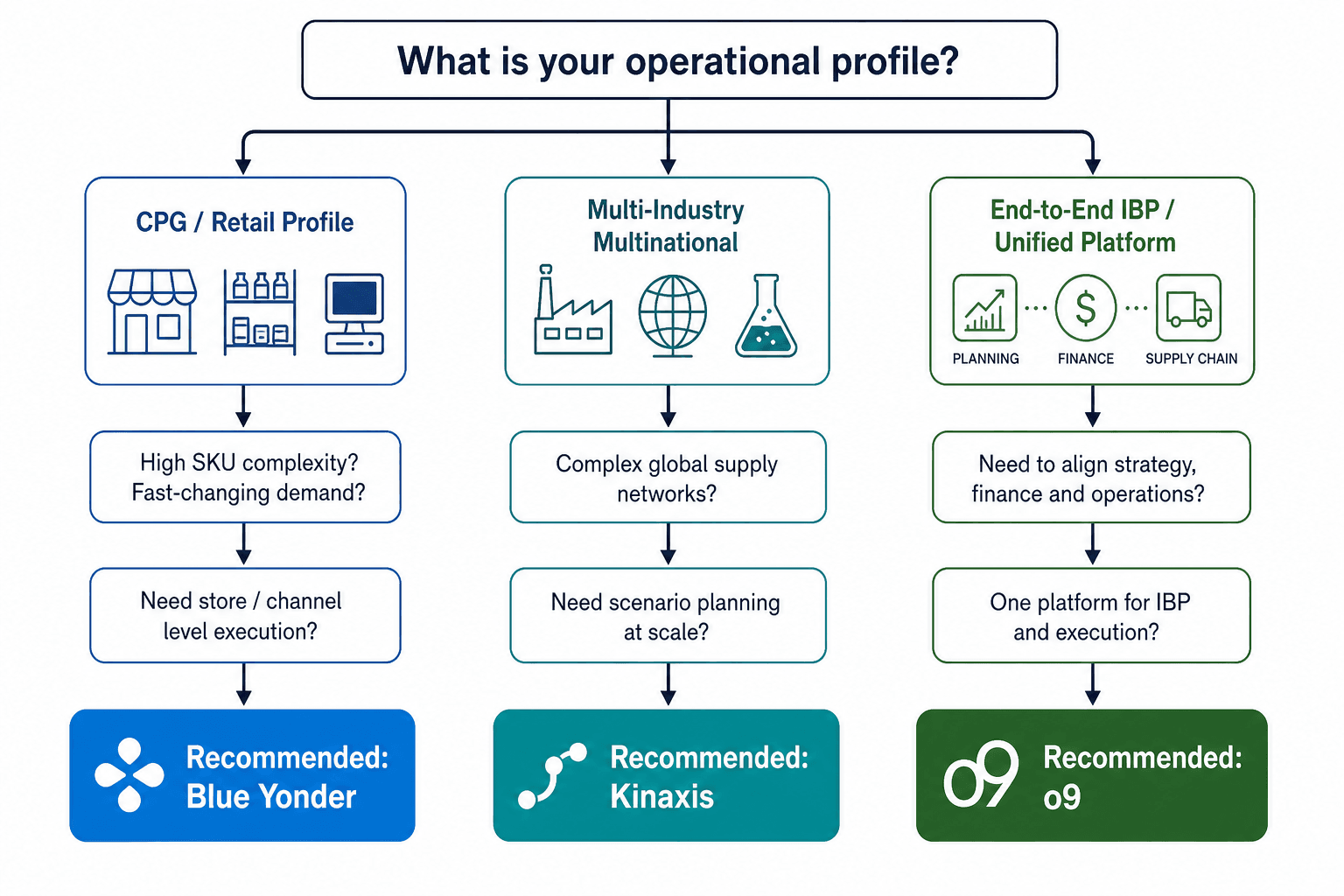
The most reliable way to shortlist among these three platforms is to identify which buyer profile your organization matches. Each profile reflects a distinct combination of industry vertical, operational complexity, and planning scope. The table below summarizes the three profiles and their recommended platform match.
| Buyer Profile | Industry Fit | Operational Characteristics | Recommended Platform |
|---|---|---|---|
| CPG / Retail-Heavy Enterprise | Consumer packaged goods, retail, food & beverage, apparel | Trade promotion management is critical; high volume of retail POS data; store-level replenishment needs; strong execution integration required (WMS, TMS, retail systems) | Blue Yonder |
| Multi-Industry Multinational | Automotive, electronics, aerospace, pharma, industrial manufacturing | Multiple ERP instances across regions; complex global supply networks; need for real-time scenario analysis across demand, supply, inventory, and capacity; ERP-agnostic deployment | Kinaxis |
| End-to-End IBP Enterprise | Any industry with complex cross-functional planning needs | Desire to unify demand, supply, financial, and revenue planning on a single platform; mature data engineering capability; willingness to invest in data foundation before AI value materializes | o9 Solutions |
The rationale behind these recommendations is not about which platform has more AI models or better forecast accuracy in a benchmark. It is about which platform's design assumptions — its data model, its integration patterns, its planning logic — align most closely with the operational reality of each buyer profile. A platform that excels at trade promotion optimization for a CPG company will struggle in an aerospace environment where bill-of-materials complexity and long lead times dominate. A platform built for concurrent planning across 20 ERP instances will be overengineered for a single-ERP CPG company that needs store-level replenishment.
Blue Yonder: Optimized for CPG and Retail-Heavy Enterprises
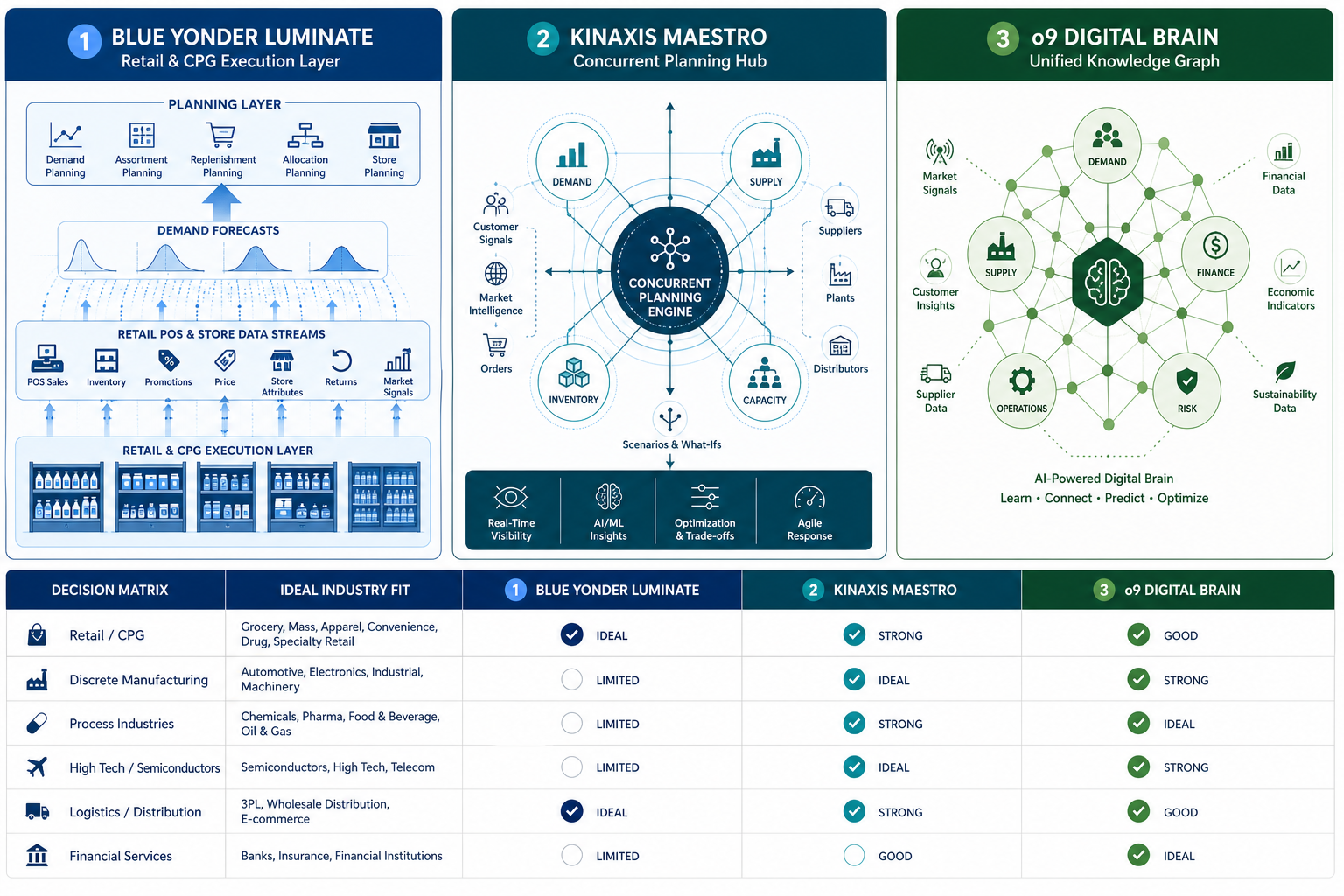
Blue Yonder's demand planning platform is built from the ground up for the operational realities of CPG and retail. Its deepest strengths lie in three areas that matter most to these industries: trade promotion management, retail POS data integration, and store-level replenishment. The Luminate platform — Blue Yonder's connected planning and execution layer — ties demand planning directly to warehouse management, transportation management, and retail execution systems, creating a closed loop between what the plan predicts and what actually happens on the shelf.
The Lenovo deployment illustrates the type of outcomes Blue Yonder delivers in a complex, multi-market environment. Lenovo operates 30 manufacturing facilities and serves 180 markets. After deploying Blue Yonder's digital planning initiatives across demand, supply, and factory planning, the company achieved a 5% boost in forecast accuracy, a 4% improvement in on-time delivery, and a 10% higher delivery accuracy, according to Jack Fiedler, Lenovo's VP of Digital Transformation. These figures, reported by Supply Chain Digital, are modest in percentage terms but represent significant operational impact at Lenovo's scale.
Blue Yonder's vendor marketing claims a 12% improvement in forecast accuracy, 75% improvement in planner efficiency, and 50% reduction in costs and expenses. These figures should be treated as aspirational benchmarks rather than guaranteed outcomes, as they are vendor-reported and not independently verified. The platform's probabilistic forecasting approach, which replaces traditional deterministic models, and its ability to process hundreds of internal and external demand signals through outside-in forecasting, are the technical mechanisms behind these claims.
For readers evaluating Blue Yonder specifically for demand planning, the Blue Yonder Demand Planning AI vendor profile provides a deeper look at the module's AI capabilities. The AI demand forecasting in CPG and retail use case reference covers the broader application pattern for readers who want to understand how AI demand forecasting works in these verticals before committing to a specific vendor.
Kinaxis: Concurrent Planning for Multi-Industry Multinationals
Kinaxis Maestro is the platform of choice for enterprises that operate across multiple industries, regions, and ERP systems. Its concurrent planning architecture — which continuously propagates changes across demand, supply, inventory, and capacity views in real time — is designed for the complexity of automotive, electronics, aerospace, pharmaceutical, and industrial manufacturing supply chains. Unlike platforms that require a single source of planning truth in a single ERP instance, Kinaxis is ERP-agnostic and can ingest data from multiple, heterogeneous systems without forcing consolidation.
The operational value of concurrent planning is most visible in multi-ERP environments where a demand shift in one region must be evaluated against supply constraints in another. Kinaxis enables planners to assess trade-offs and downstream impacts in near real time. Nucleus Research reported in April 2026 that organizations deploying Kinaxis Maestro achieved planning time reductions of up to 99%, $50 million in procurement cost avoidance, multimillion-dollar labor savings, and approximately 20% reductions in material waste costs. These figures are from a third-party research firm, not vendor marketing, which strengthens their credibility — though the sample size and methodology of the Nucleus study were not disclosed in the available source material.
Two named customer deployments illustrate Kinaxis's fit for complex multinationals. Procter & Gamble uses Kinaxis Maestro to manage its North American supply chain, reducing planning time and shifting from reactive to proactive planning. Reckitt partnered with Kinaxis to improve enterprise scheduling; Vivek Bhat, Reckitt's Global Process and Technology Director, noted that Maestro Enterprise Scheduling enables schedulers to spend less time manually building schedules and more time analyzing scenarios. These cases, cited by Supply Chain Digital, are consistent with the profile of a company that needs to coordinate planning across multiple brands, regions, and manufacturing sites.
| Capability | Kinaxis Maestro | Relevance to Multi-Industry Buyer |
|---|---|---|
| Concurrent planning | Real-time propagation of changes across demand, supply, inventory, capacity | Critical for multi-ERP, multi-region operations where a single change affects multiple planning dimensions |
| ERP integration | ERP-agnostic; ingests data from SAP, Oracle, JDE, and others without consolidation | Eliminates the need to standardize on a single ERP before deploying planning |
| Planning cycle reduction | Up to 99% reduction reported by Nucleus Research | Directly addresses the pain of slow, manual planning cycles in complex global operations |
| Procurement cost avoidance | $50M reported by Nucleus Research | Relevant for enterprises with high procurement spend across multiple categories and regions |
| Maestro Agents | Embedded digital co-workers that autonomously detect anomalies and recommend actions | Reduces the burden on planners who manage thousands of SKUs across multiple business units |
Kinaxis's TCO typically ranges from $4 million to $12 million over three years, according to Horizon Solutions, with full deployment timelines of 12 to 18 months. The lower end of the TCO range compared to Blue Yonder reflects Kinaxis's narrower functional scope — it does not include the WMS, TMS, and retail execution modules that Blue Yonder bundles. For buyers who already have strong execution systems and need a planning layer that coordinates across them, Kinaxis's pricing is often more predictable.
Readers who want a deeper evaluation of Kinaxis's full platform capabilities should consult the Kinaxis Maestro vendor profile. For those specifically comparing Kinaxis and Blue Yonder without o9 in the mix, the pairwise comparison on this site provides a more detailed side-by-side analysis.
o9 Solutions: End-to-End IBP with a Unified Knowledge Graph
o9 Solutions positions its Digital Brain platform as the single source of planning truth for enterprises that want to unify demand, supply, financial, and revenue planning. The core architectural differentiator is the Enterprise Knowledge Graph, which functions as a neural-network-like data structure connecting every planning entity — products, locations, customers, suppliers, financial targets — into a single, queryable model. This approach enables o9 to model complex interdependencies that traditional relational databases struggle to represent, but it also imposes significant data engineering requirements on the buyer.
The case study evidence for o9 is the most extensive of the three platforms, with multiple named customers reporting specific, quantified outcomes. AB InBev achieved a 60% reduction in out-of-stocks, a 53% decrease in inventory losses, and 70-90% touchless planning adoption, according to o9's published case study. Kraft Heinz reported an 11% increase in monthly forecast accuracy (to 87%), a 25% reduction in excess inventory, and a 32% reduction in time spent on forecasting. T-Mobile realized $1 billion in value over three years, with 100% fulfillment rates and 99%+ service levels. These figures are sourced from o9's own marketing materials and should be read as vendor-reported outcomes, not independently verified results.
o9's TCO is in the same enterprise range as Blue Yonder and Kinaxis — typically $5 million to $15 million over three years — but the cost profile is different. o9's pricing model is usage-based and scales with the number of planning entities (products, locations, customers) in the knowledge graph, which can make cost forecasting more complex than the subscription-based models of Blue Yonder and Kinaxis. Buyers should request detailed pricing scenarios based on their actual data volume and planning scope.
For readers who want a deeper understanding of o9's demand planning module, data readiness requirements, and touchless planning capabilities, the o9 Solutions demand planning module vendor profile provides a comprehensive reference.
Total Cost of Ownership and Deployment Timeline Comparison
TCO and deployment timeline are often the deciding factors in enterprise platform evaluations, yet they are the least transparent dimensions of vendor comparisons. The table below consolidates the available data from third-party sources and vendor disclosures. All figures should be treated as indicative ranges, not guaranteed pricing.
| Dimension | Blue Yonder | Kinaxis | o9 Solutions |
|---|---|---|---|
| Three-year TCO (enterprise) | $5M – $15M+ | $4M – $12M | $5M – $15M (usage-based) |
| Typical full deployment timeline | 12 – 18 months | 12 – 18 months | 12 – 18 months |
| Primary cost driver | Module breadth (demand + WMS + TMS + retail) | Concurrent planning complexity and data volume | Number of planning entities in knowledge graph |
| Mid-market alternative TCO | 50-70% lower with Horizon, Logility, or RELEX | 50-70% lower with Horizon, Logility, or RELEX | 50-70% lower with Horizon, Logility, or RELEX |
A critical observation from the TCO data is that mid-market manufacturers with revenues between $100 million and $3 billion typically use only 25-35% of the capability of any of these enterprise platforms, according to Horizon Solutions, while paying full enterprise pricing. For these buyers, mid-market alternatives such as Horizon, Logility, or RELEX can deliver similar functional scope at 50-70% lower TCO. This is not a recommendation to avoid the three enterprise platforms — it is a recommendation to be honest about whether your organization will actually use the full capability set you are paying for.
Gartner Ratings and Market Position Snapshot (Q2 2026)
All three platforms hold Gartner Magic Quadrant Leader status for Supply Chain Planning Solutions in 2026, covering both Discrete and Process industry quadrants. Gartner Peer Insights ratings provide a useful, though imperfect, signal of customer satisfaction. The table below presents the ratings as a snapshot from June 2026.
| Platform | Gartner Peer Insights Rating | Number of Reviews | 2026 Gartner Magic Quadrant Status |
|---|---|---|---|
| Blue Yonder | 4.6★ | 284 reviews | Leader (Discrete and Process) |
| Kinaxis | 4.4★ | 276 reviews | Leader (Discrete and Process) |
| o9 Solutions | 4.8★ | 165 reviews | Leader (Discrete and Process) |
Decision Matrix: Mapping Your Buyer Profile to the Right Platform
The decision matrix below consolidates the analysis into a single reference table. Use it as a starting point for shortlisting, then validate the recommendation through vendor demos, customer reference calls, and proof-of-concept deployments scoped to your specific use case.
| Decision Factor | Choose Blue Yonder If... | Choose Kinaxis If... | Choose o9 If... |
|---|---|---|---|
| Primary industry | CPG, retail, food & beverage, apparel | Automotive, electronics, aerospace, pharma, industrial | Any industry with complex cross-functional planning needs |
| Planning scope | Demand + trade promotion + retail execution | Demand + supply + inventory + capacity (concurrent) | Demand + supply + finance + revenue (unified IBP) |
| ERP landscape | Single or few ERP instances; strong SAP integration | Multiple, heterogeneous ERP instances; ERP-agnostic | Single or multiple ERP instances; data engineering maturity required |
| Data maturity | Moderate; POS and retail data are key inputs | Moderate; concurrent planning handles data quality variance | High; knowledge graph requires clean, governed master data |
| Deployment timeline tolerance | 12-18 months | 12-18 months | 12-18 months (with data engineering phase) |
| Budget range (3-year TCO) | $5M – $15M+ | $4M – $12M | $5M – $15M (usage-based) |
| Mid-market alternative | Consider Horizon, Logility, or RELEX at 50-70% lower TCO | Consider Horizon, Logility, or RELEX at 50-70% lower TCO | Consider Horizon, Logility, or RELEX at 50-70% lower TCO |
No single platform is the right choice for every enterprise. The decision framework presented here is designed to help buyers eliminate the platforms that are clearly wrong for their profile before investing time in deep evaluations. A CPG company that does not need trade promotion management should not default to Blue Yonder. A multi-industry multinational with a single ERP instance should not assume Kinaxis is overkill. An enterprise with weak data governance should not pursue o9 until the data foundation is ready.
For readers who want to expand their shortlist beyond these three platforms, the 4-way comparison including Anaplan provides a broader view. The Blue Yonder full-suite vendor profile covers the platform's capabilities beyond demand planning for readers evaluating a broader digital transformation.
Comments
Join the discussion with an anonymous comment.