
Weather risk has moved from an exception queue problem to a planning problem. The United States recorded 27 billion-dollar weather and climate disasters in 2024, with total costs of $182.7 billion, while supply chain weather alerts rose 119% year over year in Resilinc data cited by Everstream Analytics.[1] Coupa’s 2026 disruption research puts the average annual cost of supply chain disruptions at $16 million per organization, and the same research points to early supplier-risk detection as a material differentiator: 60% of leaders who detect supplier risk early avoid major disruption costs.[2]
That is the operating context for using AI weather forecasting in supply chain disruption planning. The question is no longer whether weather intelligence is interesting. It is whether a probabilistic flood signal, typhoon track, heat-risk gradient, or storm warning changes a shipment plan, an inventory posture, a supplier escalation, or an executive decision before the disruption arrives.
Investment appetite is already there. The Weather Company reported that 92% of executives planned to increase or maintain investment in weather intelligence, and it frames weather-aligned operations as capable of supporting 5% to 10% revenue uplift in relevant use cases.[3] Those figures should not be read as a weather-AI guarantee; they are a signal that leaders are willing to fund better weather decisioning. The harder work is making sure the investment lands in the workflow instead of stopping at another dashboard.
Why 2026 Is Different
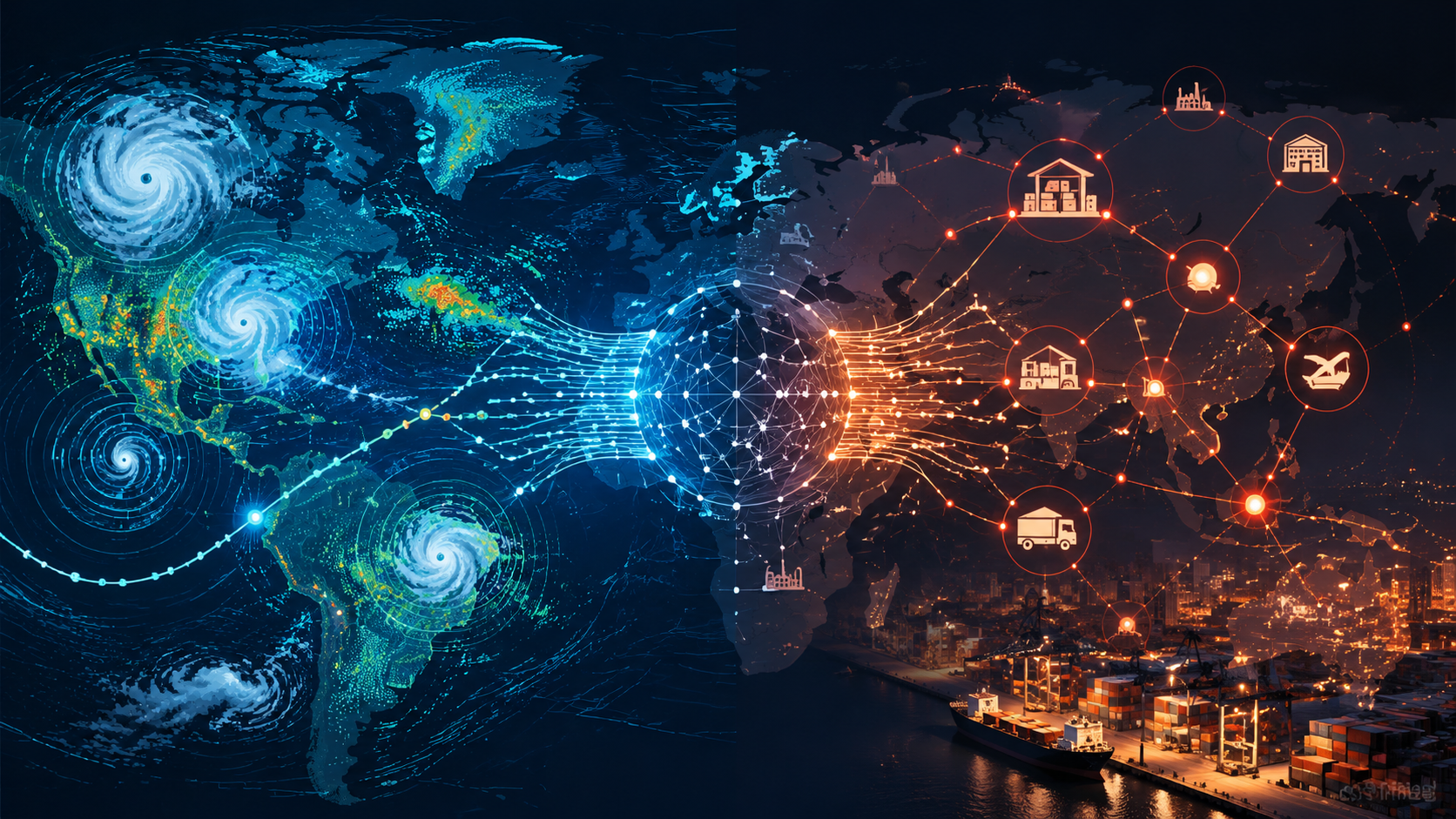
Three things are arriving together: credible AI weather models, higher disruption exposure, and planning platforms that can consume external risk signals. Any one of those would be useful. Together, they make proactive weather-risk management practical for more supply chain teams than it was even a few years ago.
On the model side, the shift is real. DeepMind described GraphCast as a machine-learning weather model that can generate 10-day global forecasts in under a minute on a single Google Cloud TPU v4 machine, while outperforming the European Centre for Medium-Range Weather Forecasts’ high-resolution forecast system on most evaluated variables and lead times in the published comparison.[4] GenCast extends that direction into probabilistic ensemble forecasting, with DeepMind reporting state-of-the-art accuracy for weather and extreme-condition risk prediction across evaluated targets.[5]
Other systems matter too. The European Centre for Medium-Range Weather Forecasts operationalized its Artificial Intelligence Forecasting System in 2024; China’s meteorological community has used Pangu-Weather for typhoon tracking; NOAA has been integrating AI guidance into hurricane forecasting workflows. The important point for supply chain teams is not that one model has won. It is that AI-generated weather guidance has become credible enough to enter operational discussion alongside numerical weather prediction, not merely sit in research demos.[6]
But usable is not the same as operationalized. A forecast feed does not know which customer lane has no slack, which plant is running a promotion, which supplier is already late, or which regional team is allowed to spend money on an expedite. Supply chain value appears when the weather signal is translated into the units that planners actually use.
The Translation Layer Is the Work
A useful AI weather implementation has a middle layer between meteorology and execution. That layer converts probabilistic weather outputs into operational risk metrics tied to lanes, facilities, suppliers, inventory positions, customer commitments, and decision rights.
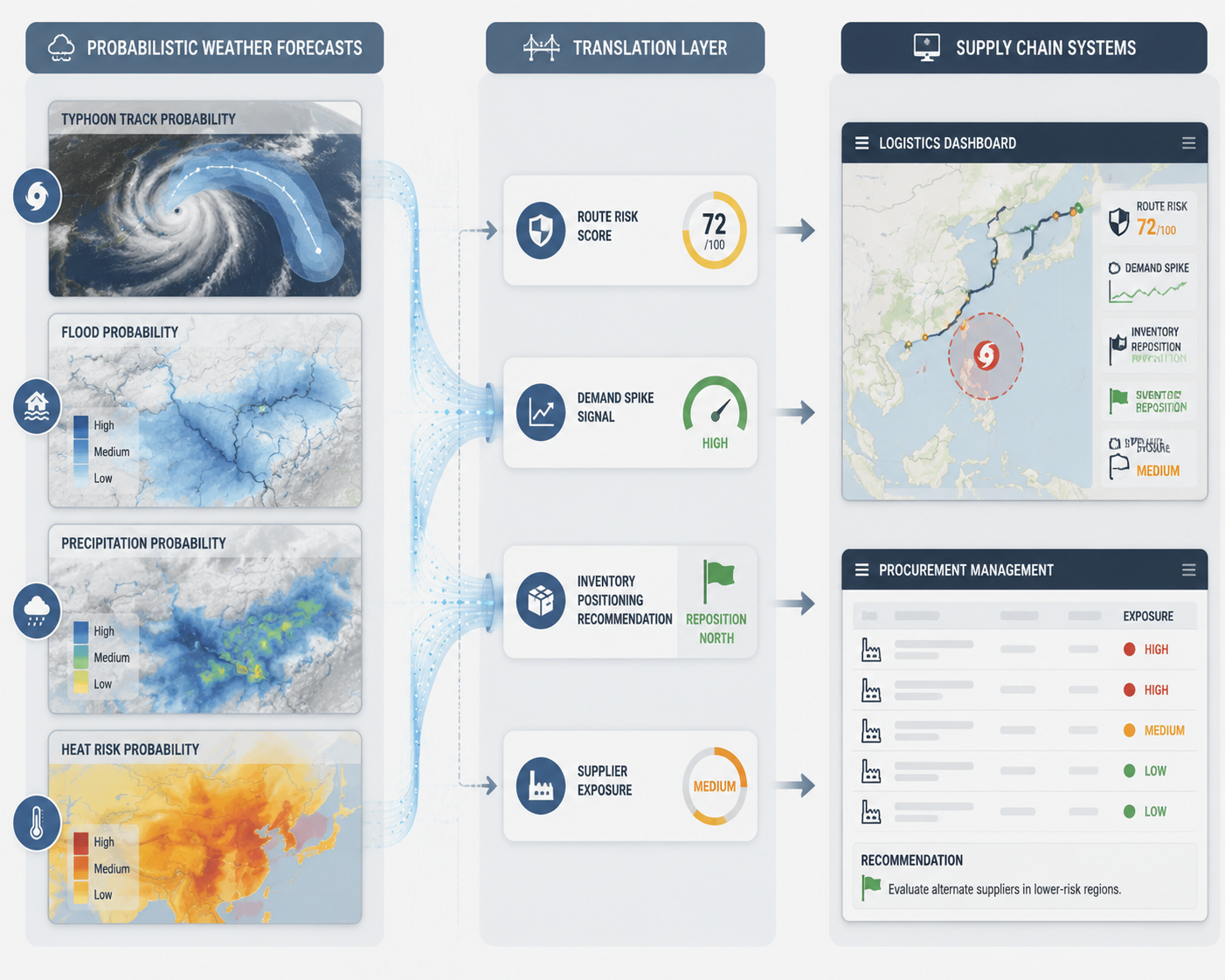
This is where many programs either become useful or quietly fail. A planner does not need to know that a model has updated a precipitation probability unless that update changes a lane risk score, carrier cut-off decision, warehouse labor plan, safety-stock recommendation, or supplier escalation threshold. The translation layer defines that conversion.
| Weather input | Operational metric | Likely workflow owner | Decision it can trigger |
|---|---|---|---|
| Probabilistic typhoon track | Port, lane, and supplier exposure score | Logistics control tower or regional operations | Reroute freight, pull forward shipment, escalate supplier status |
| Flood warning or heavy rainfall probability | Facility access risk and route disruption score | Transportation planning and warehouse operations | Shift dock appointments, change carrier routing, pre-position inventory |
| Heat-risk forecast | Cold-chain failure risk and demand-spike signal | Logistics, demand planning, sales and operations planning | Reprioritize refrigerated capacity, adjust allocation, increase monitoring |
| Agricultural weather window | Harvest-timing and supply availability risk | Procurement, sourcing, agricultural operations | Advance harvest, delay procurement commitment, qualify alternate supply |
| Supplier-region climate exposure | Supplier risk flag and continuity score | Procurement risk and category management | Request mitigation plan, adjust sourcing mix, review inventory buffer |
Everstream’s work with Unilever is a useful example because it is not just a model-performance story. Everstream describes applying NOAA data and AI weather models to supply chain workflows including refrigerated truck routing, where weather intelligence supports operational decisions about where and how temperature-sensitive freight should move.[7] The weather signal matters because it enters the routing choice, not because it looks more sophisticated on a map.
ClimateAi describes a similar translation problem from the sourcing and agricultural side. Its examples include Hitachi using climate intelligence for global supplier risk and Advanta Seeds avoiding millions in potential harvest-timing losses by adjusting decisions around weather windows.[8] These are different workflows, but the operating pattern is the same: the forecast becomes a risk measure, the risk measure maps to an asset or supplier, and a named team changes a decision.
A Practical Translation Design
For an implementation team, the translation layer should answer six questions before anyone buys another alert feed:
- Which weather hazards matter for each product, lane, supplier, facility, and customer commitment?
- What probability, lead time, and severity level is enough to justify an action?
- Which operational metric will represent that risk: lane score, facility exposure, inventory recommendation, demand signal, supplier flag, or escalation status?
- Which system must receive the metric: TMS, WMS, ERP, control tower, demand planning, supplier-risk platform, or procurement workflow?
- Who owns the decision when the signal fires?
- How will the team record the decision, outcome, and false alarm cost for later tuning?
The last question is easy to skip during a pilot and painful to reconstruct after the season ends. Without decision logs, teams can debate whether the forecast was “right” but cannot tell whether the operating rule was too conservative, too slow, or assigned to the wrong owner.
Where AI Weather Enters the Planning Stack
Weather intelligence should not enter every system in the same form. A control tower may need a cross-network exposure view. A TMS needs lane-level route risk and feasible alternatives. A WMS needs labor, yard, and inbound appointment implications. ERP and planning systems need inventory, allocation, and procurement implications. Supplier-risk tools need facility and region exposure attached to supplier records.
That integration work is often the bottleneck. Coupa’s 2026 research, summarized by Conexiom, reports that 58% of leaders cite legacy systems as a barrier to handling disruption.[2] In weather-risk programs, legacy constraints show up as static supplier master data, route plans that do not update quickly, disconnected warehouse calendars, and escalation processes that live in email.
The integration sequence should usually start with the workflow where the decision clock is shortest and the action path is clearest. For many companies, that is transportation: route, carrier, port, and facility risk can be mapped directly to planned movements. For others, it is supplier exposure or agricultural sourcing, where the decision is less about rerouting a shipment and more about whether to secure alternate supply, adjust a harvest window, or shift inventory earlier.
If the organization is still evaluating the broader use case, this overview of how AI weather forecasting mitigates supply chain disruptions is the better starting point. For an implementation program, the priority is narrower: pick the workflows where a risk score can cause an approved action.
A Workflow Pattern That Holds Up Under Pressure
A resilient workflow does not ask planners to improvise from a vague alert. It gives them a sequence:
- Ingest probabilistic weather guidance and traditional meteorological sources.
- Map the hazard to assets, lanes, suppliers, inventory nodes, and customer commitments.
- Convert exposure into an operational risk metric.
- Compare the metric with predefined escalation thresholds.
- Trigger a playbook action or human review.
- Record the decision, cost, service impact, and outcome.
This pattern works because it separates sensing from deciding. The model produces guidance. The translation layer produces a supply chain risk metric. The playbook defines what the organization is willing to do at a given confidence level. The owner decides whether to execute, override, or escalate.
Decision Rules Beat Weather Alerts
The biggest culture shift is moving from “Will the storm hit?” to “What action is justified at this probability, lead time, and consequence level?” That shift is uncomfortable because supply chain teams are often punished for visible cost and only loosely credited for avoided loss. An expedite that prevents a stockout looks expensive in the ledger. A missed reroute looks obvious after the flood.
Probabilistic decision rules make that tradeoff explicit. A high-margin launch shipment may justify action at a lower confidence threshold than a replenishment move with ample buffer. A single-source supplier in a flood-prone region may require earlier escalation than a dual-sourced commodity. A refrigerated lane through an extreme-heat corridor may need a different threshold from a dry van move with multiple routing options.
A simple rule library can be enough for a first pilot:
| Risk condition | Action threshold | Decision owner |
|---|---|---|
| Critical customer shipment on exposed lane | Moderate probability plus limited recovery time | Transportation control tower |
| Supplier facility in forecast flood zone | Rising probability across two forecast cycles | Supplier risk or category lead |
| Cold-chain move through heat-risk corridor | Heat-risk signal above agreed service-risk tolerance | Logistics and quality team |
| Inventory node serving promotion or launch | Weather exposure plus low days of supply | Planning lead and commercial owner |
| Agricultural supply with harvest window at risk | Weather window narrowing before committed supply date | Sourcing or agricultural operations |
The thresholds do not need false precision on day one. They do need executive sponsorship. If teams are expected to act before certainty, leaders have to pre-approve the kinds of cost they are willing to absorb: alternate carrier premiums, early inventory moves, supplier qualification work, extra monitoring, temporary buffer, or lost utilization. Otherwise, “AI weather” becomes a faster way to tell people they might have a problem without giving them permission to reduce it.
Use AI Weather With Its Limits Visible
AI weather models deserve attention because they are fast, increasingly accurate, and cheaper to run than full traditional numerical weather prediction. They do not remove the need for meteorological judgment, ensemble comparison, or operational skepticism.
Several limitations matter for supply chain use. Research summaries have noted underprediction risks for extreme precipitation, including ranges of 20% to 35% in discussed cases; weaker skill for short-range convection; and the tendency of some deterministic machine-learning forecasts trained with mean-squared-error objectives to produce “blurrier” outcomes.[6] Those weaknesses are directly relevant to flood access, yard operations, last-mile delivery, and fast-forming storm decisions.
There is also a methodological issue behind some benchmark claims. Many AI weather systems are trained on ERA5, a reanalysis dataset that incorporates outputs from traditional numerical weather prediction systems. That creates an active debate about circularity when AI models are compared against the same forecasting tradition that helped shape their training data.[6] For supply chain leaders, the practical conclusion is straightforward: do not treat AI guidance as a replacement for all existing weather sources.
Climate change adds another constraint. Models trained heavily on historical atmospheric data may face systematically warmer and more novel conditions than those represented in training windows; GraphCast’s published description, for example, references training on decades of historical weather data, and secondary analysis has discussed the implications of training periods such as 1979 to 2017 for newer climate regimes.[4][6] That does not invalidate AI weather for operational planning. It does mean long-range resilience decisions should not lean on a single model feed as if the past fully contains the future.
What Responsible Governance Looks Like
Responsible deployment keeps fallback and review mechanisms in the operating model:
- Use AI forecasts as guidance alongside traditional meteorological sources, especially for high-consequence events.
- Separate model confidence from business consequence; low-probability, high-impact events may still justify action.
- Track false positives, false negatives, avoided disruption, and unnecessary cost.
- Require human review for actions that materially change customer commitments, inventory allocation, or supplier status.
- Update thresholds after storm seasons, heat waves, flood events, and post-incident reviews.
The governance point is not caution for its own sake. It is how teams earn permission to act earlier. If the organization can show why a decision was made, what signal triggered it, and how the outcome compared with the alternative, probabilistic planning becomes auditable rather than subjective.
Selecting Platforms: Look Past the Forecast Map
Platform selection should start with the decisions the organization wants to change. A beautiful typhoon visualization is not enough if the tool cannot connect to shipment plans, supplier locations, inventory policies, customer commitments, or escalation workflows.
The practical criteria are narrower than a general AI evaluation checklist:
- Data integration: Can the platform ingest supplier sites, lanes, shipment milestones, inventory nodes, purchase orders, and customer commitments?
- Risk-score translation: Does it convert weather into lane risk, supplier exposure, demand-spike signals, inventory recommendations, or facility alerts?
- Planning-system connectivity: Can it connect with TMS, WMS, ERP, control tower, supplier-risk, procurement, or demand planning systems?
- Explainability: Can planners see the hazard, confidence level, affected assets, threshold, and recommended action?
- Alert governance: Can teams tune thresholds, suppress noise, route alerts by owner, and capture decisions?
- Workflow fit: Does the tool match the company’s highest-value exposure: logistics, cold chain, supplier risk, agricultural sourcing, facility continuity, or demand volatility?
A logistics-heavy organization may prioritize route risk, carrier options, port exposure, and control-tower integration. A manufacturer with concentrated upstream exposure may care more about supplier geocoding, regional hazard scoring, and procurement escalation. A food or agriculture business may need weather-window intelligence tied to harvest, yield, quality, and cold-chain decisions.
For broader market scanning, the 2026 AI supplier risk monitoring vendor directory is a better place to compare the supplier-risk ecosystem. For a specific weather-risk scenario, the wildfire-smoke platform comparison in this AI wildfire smoke monitoring guide shows how evaluation changes when the hazard is specific and operational consequences are uneven.
A Pilot That Can Survive the First Real Event
The best first pilot is not the most dramatic hazard. It is the one where the organization can map exposure, define an action, and measure whether the action helped. A regional transportation pilot during storm season may be easier to govern than a global climate-exposure program that touches hundreds of suppliers but has no clear decision owner.
A workable pilot scope might look like this:
- Choose one exposed workflow, such as refrigerated truck routing, port disruption, flood-prone inbound lanes, or harvest timing.
- Map the relevant assets: lanes, suppliers, facilities, inventory nodes, customer commitments, and recovery options.
- Define two or three operational metrics, not a dozen: route risk score, supplier exposure flag, or inventory-at-risk indicator.
- Set action thresholds by lead time, probability, severity, and business consequence.
- Connect alerts to the system where the owner already works, rather than forcing a separate portal.
- Run post-event reviews that compare forecast signal, decision taken, cost incurred, disruption avoided, and service impact.
The pilot should include at least one “do nothing unless reviewed” category. Some alerts should be watched, not acted on. That distinction prevents threshold creep, where every yellow signal becomes an escalation and the team slowly stops trusting the tool.
Supplier risk is often the next expansion point. Weather exposure can feed broader supplier scoring rather than sit as a standalone alert stream. The same logic applies to autonomous procurement workflows: a weather-driven supplier flag may change order timing, sourcing priority, or review frequency when paired with commercial dependency and continuity data. The operating model described in this supplier risk scoring use case is useful when weather intelligence becomes one input in a wider risk score.
Measuring Value Without Overclaiming ROI
Weather-AI ROI should be measured carefully. McKinsey-style estimates of 20% to 50% forecast-error reduction are often cited in AI supply chain discussions, but the research brief behind those figures is broader than weather-specific AI deployments. They are useful as directional evidence for AI-enabled planning, not proof that a weather model alone will cut disruption costs by the same amount.
A supply chain weather program should measure value closer to the decision:
- Lead time gained before disruption.
- Shipments rerouted before closure or delay.
- Expedites avoided through earlier inventory movement.
- Stockouts avoided for weather-sensitive demand.
- Supplier escalations completed before impact.
- False alarms that created unnecessary cost.
False alarms belong in the scorecard. If they are hidden, the program will look cleaner than it is and planners will lose confidence. If they are tracked, thresholds can improve. The aim is not to prove that every alert was worth action. The aim is to learn which probabilities and consequences justify action in this network.
What Leaders Should Be Ready to Fund and Govern
By 2026, a serious AI weather program should have a budget line for more than data access. It needs integration work, master-data cleanup, workflow design, threshold governance, training, and post-event review. The spend profile looks less like buying a forecast and more like building decision infrastructure.
Before approving a pilot, leaders should be able to answer four questions:
- Which weather-driven decision are we trying to improve?
- Which operational metric will translate the forecast into that decision?
- Which system and owner will receive the trigger?
- What cost are we willing to incur before certainty to reduce a higher-impact disruption?
If those answers are missing, the organization is not ready to operationalize AI weather intelligence. It may still be ready to explore model feeds, run simulations, or map exposure. But the shift from reactive disruption response to proactive weather-risk management starts only when probabilistic weather guidance is connected to a metric, a threshold, an owner, and an action.
That is why 2026 is a realistic inflection point, not a finish line. AI weather models are strong enough to be operationally useful. Disruption costs are high enough to justify action. Planning platforms are mature enough to ingest external risk signals. The companies that benefit will be the ones that treat AI weather as decision infrastructure, not as a better forecast feed.
References
- The Impact of Extreme Weather on Supply Chain, Everstream Analytics, link
- Supply Chain Disruption Stats 20 Costs 2026, Conexiom, link
- Managing Supply Chain Weather Risks with Predictive Analytics, The Weather Company, link
- GraphCast: AI model for faster and more accurate global weather forecasting, DeepMind, link
- GenCast predicts weather and the risks of extreme conditions with state-of-the-art accuracy, DeepMind, link
- AI Weather Forecasting 2026 Models Accuracy, ArticSledge, link
- Applying NOAA and AI Weather Models to Supply Chains, Everstream Analytics, link
- 5 Ways Weather Intelligence Can Reduce Supply Chain Disruptions, ClimateAi, link
Comments
Join the discussion with an anonymous comment.