
The CFO objection to AI for supply chain weather disruption planning is usually not whether storms, floods, heat, and fires matter. They do. The harder question is whether another intelligence platform can defend its place in the budget when the business already pays for forecasts, planners, safety stock, insurance, expedited freight, and supplier-risk monitoring.
That question has become easier to answer, but only if the business case starts with money at risk rather than with technology features. Marsh, citing Swiss Re, puts annual global supply chain disruption costs at $184 billion.[1] In the United States, NOAA’s billion-dollar weather and climate disaster data recorded $182.7 billion in costs across 27 events in 2024.[2] Interos.ai estimated that 30.8 million more businesses were at risk of extreme weather in 2025 than in 2024, a 48% year-over-year increase based on its proprietary exposure model.[3] Coupa’s 2026 direct spend research, as summarized by Tradeverifyd, reported $16 million in average annual direct procurement disruption cost per organization.[4]
Those figures do not prove that every company should buy the same weather intelligence tool. They do prove that weather exposure is now large enough to deserve capital allocation discipline. The relevant question is not “Can AI predict the weather?” It is: where would earlier, more location-specific intelligence have changed a revenue, inventory, procurement, logistics, or customer-service decision before the cost landed?

Start With the Loss Base, Not the Model
AI weather intelligence earns its place in a supply chain budget when it changes one of five financial categories: avoided disruption cost, protected revenue, reduced operating cost, mitigated procurement exposure, or better working-capital deployment. That is a narrower and more useful frame than “resilience.”
| Financial category | Weather-driven decision it can change | How value shows up |
|---|---|---|
| Cost avoidance | Reroute freight, shift production, qualify alternate lanes, or accelerate supplier outreach before a disruption hits | Lower expediting, downtime, penalty, spoilage, or recovery cost |
| Revenue protection | Move inventory closer to expected demand or protect service levels in exposed markets | Fewer stockouts, retained orders, or event-driven sales capture |
| Operating cost reduction | Replace blanket buffers with more targeted action windows | Less overtime, emergency transport, excess handling, and reactive replanning |
| Procurement disruption mitigation | Map weather exposure beyond tier-one suppliers and flag commodities or regions at risk | Fewer surprise shortages and better sourcing escalation |
| Working-capital tradeoff | Pre-position selectively rather than increasing safety stock everywhere | Inventory moves from generic buffer to risk-specific deployment |
The technology mechanics matter, but they are not the center of the ROI case. In practical terms, AI weather intelligence combines forecast data, facility and supplier locations, transportation lanes, demand history, and event probabilities to warn teams earlier and more specifically. For a deeper explanation of the mechanics, see how AI weather forecasting mitigates supply chain disruptions. The investment case belongs one layer downstream: what action became possible, and what financial exposure did that action reduce?
The ROI Evidence Stack Has Three Different Kinds of Proof
The evidence for AI weather intelligence is useful, but it is not all the same type of evidence. A defensible business case separates broad market exposure, benchmarked ROI indicators, and named deployment outcomes. Mixing them together creates the kind of slide that looks impressive until finance asks what, exactly, the number measures.
1. Broad exposure shows the size of the problem
The $184 billion global disruption-cost figure from Marsh and Swiss Re is a loss-base indicator, not an AI ROI figure.[1] The same is true of NOAA’s 2024 U.S. disaster-cost data and interos.ai’s 48% modeled increase in businesses at risk.[2][3] These numbers establish why weather disruption has become material enough for executive review. They do not tell a company what percentage return it will get from a platform.
That distinction matters. If a manufacturer has two exposed plants, seasonal demand, a fragile supplier cluster, and a high penalty for late delivery, the relevant baseline may be large. If a software-heavy business has limited physical flow and minimal inventory exposure, the same market data should not be stretched into a procurement case.
2. Benchmarked ROI indicators show what users report
The Weather Company’s 2024 Magid-commissioned report is one of the clearer benchmark sources because it ties weather intelligence to business outcomes. The report says companies using weather intelligence can achieve 5–10% revenue increases and substantial operating cost reductions.[5] That is worth attention, but it should be treated as survey-based evidence, not as a controlled-study guarantee.
For a CFO, the right use of that benchmark is not to paste “5–10% revenue upside” into a capital request. It is to ask which revenue is actually weather-sensitive. A retailer with storm-driven demand swings, a distributor with regional replenishment constraints, or a building-materials producer facing hurricane-season demand may have a plausible revenue-protection case. A company whose sales do not move meaningfully with weather should look first at cost avoidance, service-level protection, or procurement continuity.
3. Named deployments show the mechanism
The most concrete case in the public record is ClimateAi’s roofing materials example. Ahead of Hurricane Ian, a roofing materials producer used ClimateAi hurricane risk forecasts to pre-position inventory before the storm, then captured an additional $15 million in sales.[6] The value did not come from a generic dashboard. It came from a changed operating decision: move product into the right demand zone before demand appeared in the order book and before transportation capacity became harder to secure.
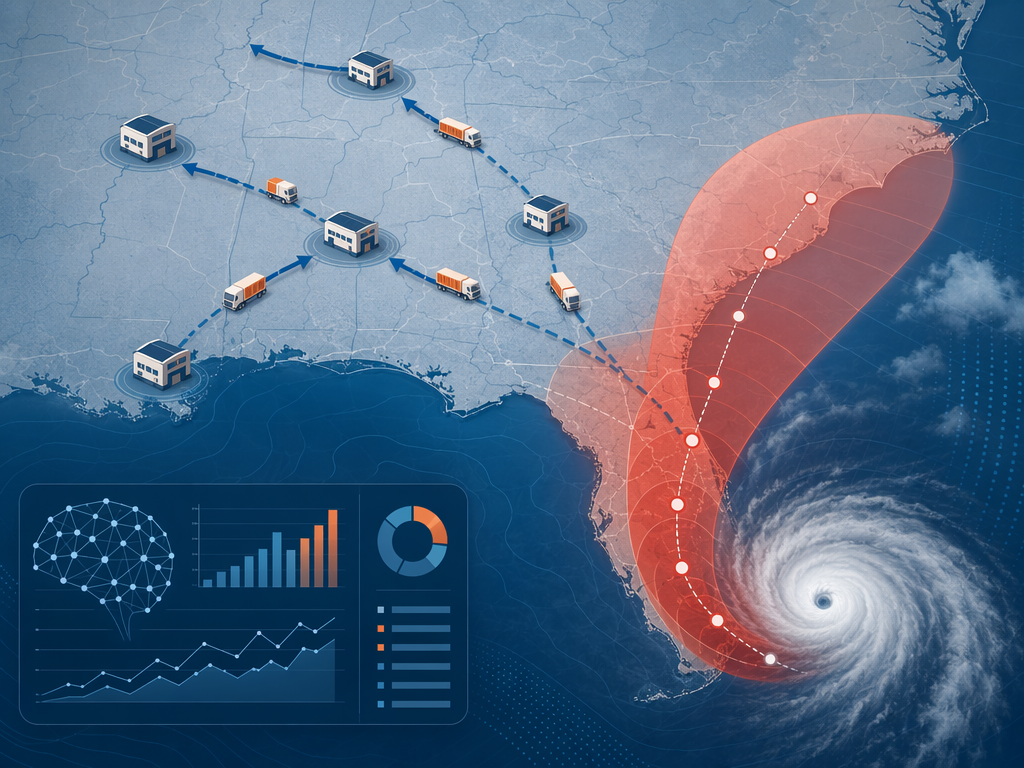
That case deserves more weight than a vague productivity claim because it links the forecast to a commercial action and then to a dollar outcome. It also has boundaries. It was an event-specific case, published by the vendor, in a category where hurricane damage can create a sharp demand spike. A company should learn from the mechanism, not assume it can manufacture a $15 million opportunity every storm season.
What AI Weather Intelligence Actually Changes in Planning
Weather intelligence creates value when it changes the timing, specificity, or confidence of a decision. The timing piece is often the easiest to understate. A planner who receives a credible signal early enough can move inventory, reserve transport, notify customers, or shift production. The same signal delivered after ports close, roads flood, or suppliers miss shipments becomes an explanation, not a lever.
Specificity matters just as much. A hurricane forecast for a region is useful background. A forecast connected to exposed facilities, supplier sites, inbound lanes, customer demand zones, and alternate stocking locations is a decision tool. That is where AI weather systems differ from ordinary weather feeds: they can connect external signals to operational nodes that finance can recognize.
- Demand-spike prediction: identifying where weather may increase order volume before historical demand signals catch up.
- Inventory pre-positioning: moving stock selectively toward likely demand or away from likely disruption.
- Logistics rerouting: changing transport lanes, modes, or cutoffs before capacity tightens.
- Supplier-risk visibility: flagging exposed supplier locations, including sub-tier clusters where direct operational data may be limited.
- Executive escalation: giving finance, procurement, supply chain, and commercial teams a shared exposure view before the emergency call.
The logistics-specific case can be modeled separately because freight decisions often have their own cost baseline. For that angle, see how AI weather alerts optimize logistics routes. A route-optimization ROI case should not be blended casually with a demand-capture case; the cost owners, decision windows, and benefits are different.
How to Build a Company-Specific Business Case
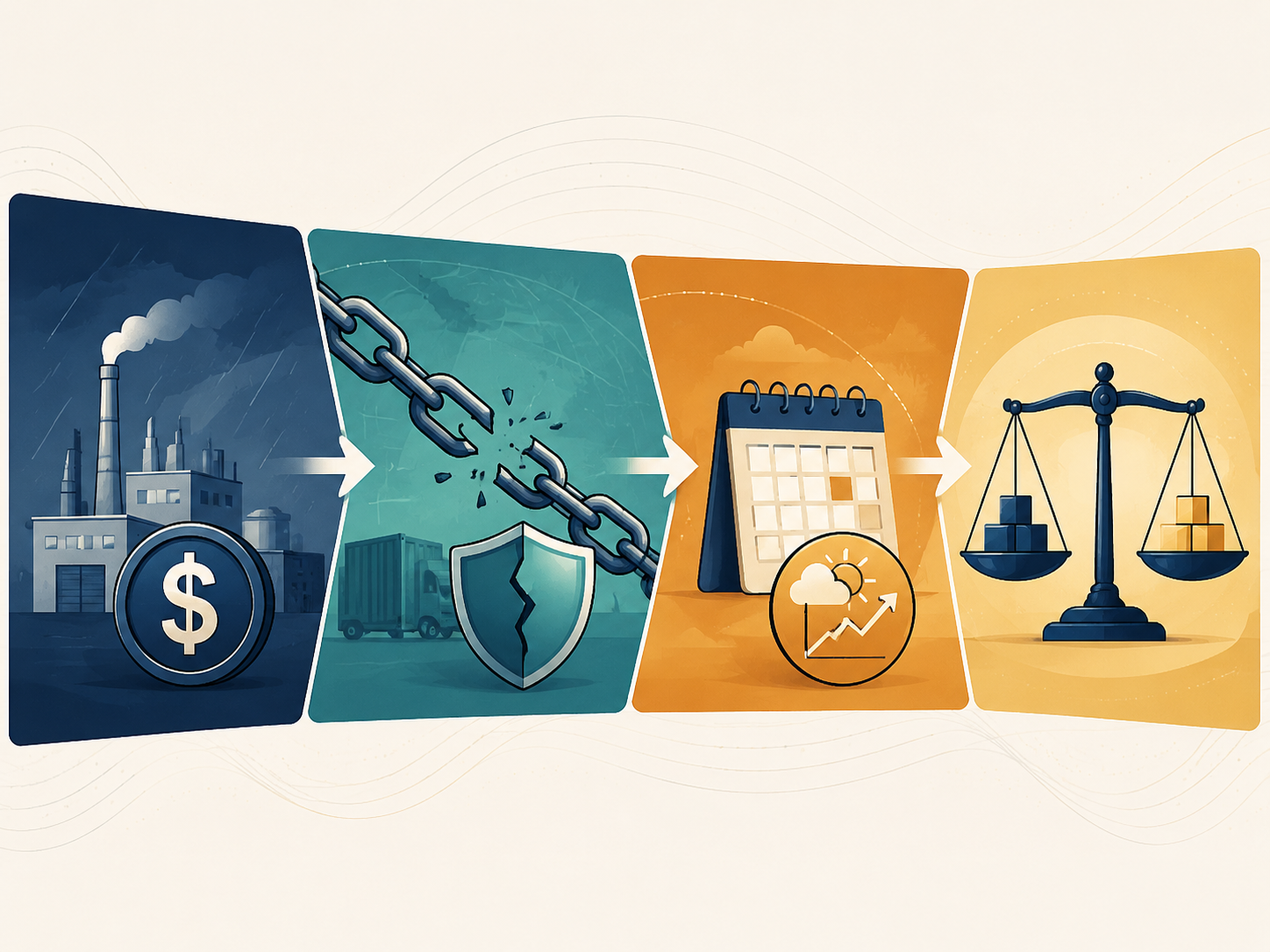
The internal case should begin with exposed value, not with the vendor subscription cost. The subscription cost is real, but it is the denominator question. The numerator has to come from the company’s own revenue, cost, and working-capital exposure.
Map exposed revenue and operating nodes
Start with facilities, distribution centers, supplier regions, customer demand zones, transportation lanes, and weather-sensitive product categories. The output should not be a climate-risk atlas that nobody uses. It should be a ranked list of places where weather can interrupt revenue, increase cost, or force working-capital decisions.
Sub-tier exposure is especially important because many supply chain teams can see their tier-one suppliers far better than the upstream network. ClimateAi and Veridion have argued that 85% of supply chain risks are in tier 2–4 suppliers, and that geography-based climate risk mapping can help assess exposure even when detailed operational data is limited.[7] That does not make the number a universal law. It does make sub-tier geography a reasonable place to look before the next supplier disruption becomes a surprise.
Add current disruption costs
The fastest way to make the business case credible is to use costs the company already recognizes: expedited freight, overtime, detention and demurrage, missed-service penalties, lost orders, write-offs, spoilage, supplier premiums, emergency buys, and recovery labor. Coupa’s $16 million average annual direct procurement disruption cost is a useful external baseline, but the internal model should replace it with the company’s own purchasing and disruption history wherever possible.[4]
Identify decisions that forecasts can actually move
Not every weather alert has economic value. The business case should list specific decisions where earlier warning changes action: inventory release, temporary stocking locations, production sequencing, carrier booking, supplier escalation, purchase-order timing, customer allocation, or alternate sourcing. If the organization cannot act differently, the forecast may improve awareness without improving ROI.
This is also where the planning team should define the required lead time. A two-day warning may be enough to change a last-mile delivery plan. It may be useless for ocean freight or supplier qualification. AI capability selection should follow those decision windows, not the other way around. For broader planning capability tradeoffs, see which AI capabilities to invest in for disruption planning.
Apply conservative assumptions
External benchmarks are a starting point. The internal model should use a haircut. If the Weather Company/Magid report indicates 5–10% revenue increases among companies using weather intelligence, a conservative model might apply that only to weather-sensitive revenue, only in exposed regions, and only where operations can pre-position, reroute, or allocate supply in time.[5] The same discipline applies to cost avoidance: count only costs attached to decisions the new system can influence.
| External claim | What it supports | How to use it safely |
|---|---|---|
| $184B annual global disruption cost | Weather and supply chain disruption are financially material | Use as market context, not as company ROI |
| 5–10% revenue increase | Survey-based indication that weather intelligence can support revenue outcomes | Apply only to weather-sensitive revenue and label as benchmark evidence |
| $15M additional sales in roofing case | Event-specific proof that pre-positioning can create commercial value | Use as a mechanism example, not a universal forecast |
| $16M average annual direct procurement disruption cost | Procurement disruption has a measurable cost baseline | Replace with internal cost history where available |
| 48% modeled increase in businesses at risk | Exposure is expanding across business networks | Treat as modeled exposure, not confirmed disruption frequency |
Where Vendor Evidence Helps, and Where It Does Not
The vendor landscape is broad enough that buyers do not need to treat AI weather intelligence as an experimental niche. ClimateAi, The Weather Company/IBM, Everstream Analytics, interos.ai, C3 AI, and Bronson.ai are examples of providers or platforms associated with weather, climate, disruption, or planning intelligence. That said, vendor coverage is not the same as vendor fit.
The strongest vendor evidence is usually a named outcome tied to an operational decision, like the ClimateAi roofing materials case.[6] The next-best evidence is a transparent benchmark with a clear methodology label, like the Weather Company/Magid survey-based revenue finding.[5] The weakest evidence is a general claim that the platform “improves resilience” without showing which cost pool moved.
Weather also now sits higher on the disruption agenda than it did in many older risk frameworks. The BCI Horizon Scan 2025 finding, cited in a TraxTech interview with ClimateAi, says extreme weather surpassed cyber incidents as the single largest cause of supply chain disruption in 2025 for the first time since 2017.[8] That supports prioritization. It still does not remove the need to model the buyer’s own exposure.
The Investment Judgment
AI weather intelligence has a credible ROI case when the organization can connect exposed revenue, avoidable disruption costs, and specific operational decisions. The public evidence is strong enough to justify serious budget review: global disruption costs are large, U.S. disaster costs remain material, modeled exposure is rising, procurement disruption has a measurable annual cost, benchmark studies report revenue and operating-cost benefits, and at least one named deployment shows a clear path from forecast to inventory action to additional sales.[1][2][3][4][5][6]
The mistake is turning that evidence into borrowed certainty. A defensible business case labels each source for what it is: modeled exposure, disaster-cost data, survey-based benchmark, vendor-published case study, or internal cost history. Then it narrows the claim to what the company can actually change: a lane rerouted earlier, a supplier escalated sooner, inventory placed more precisely, a demand spike served before competitors catch up, or a disruption cost avoided before it hits the P&L.
References
- Supply Chain Trends, Marsh, 2026, link
- U.S. Billion-Dollar Weather and Climate Disasters, NOAA National Centers for Environmental Information, link
- Protecting Your Supply Chain from Extreme Weather: Steps to Minimize Risk, interos.ai, 2025, link
- Supply Chain Statistics, Tradeverifyd, link
- Managing Supply Chain Weather Risks with Predictive Analytics and Real-Time Insights, The Weather Company, 2024, link
- Accurate Hurricane Forecasting Helps Roofing Materials Producer, ClimateAi, 2023, link
- Climate Risk and Supply Chain Risk Mapping, ClimateAi, link
- AI Weather Forecasting and Supply Chain Risk Management, TraxTech, 2025, link
Comments
Join the discussion with an anonymous comment.