
If the immediate question is still whether smoke deserves its own risk workflow, start with AI Wildfire Smoke Forecasting for Supply Chain Resilience. This comparison starts one step later: the team already accepts the risk and now has to decide what kind of AI for supply chain disruption from wildfire smoke belongs on the shortlist.
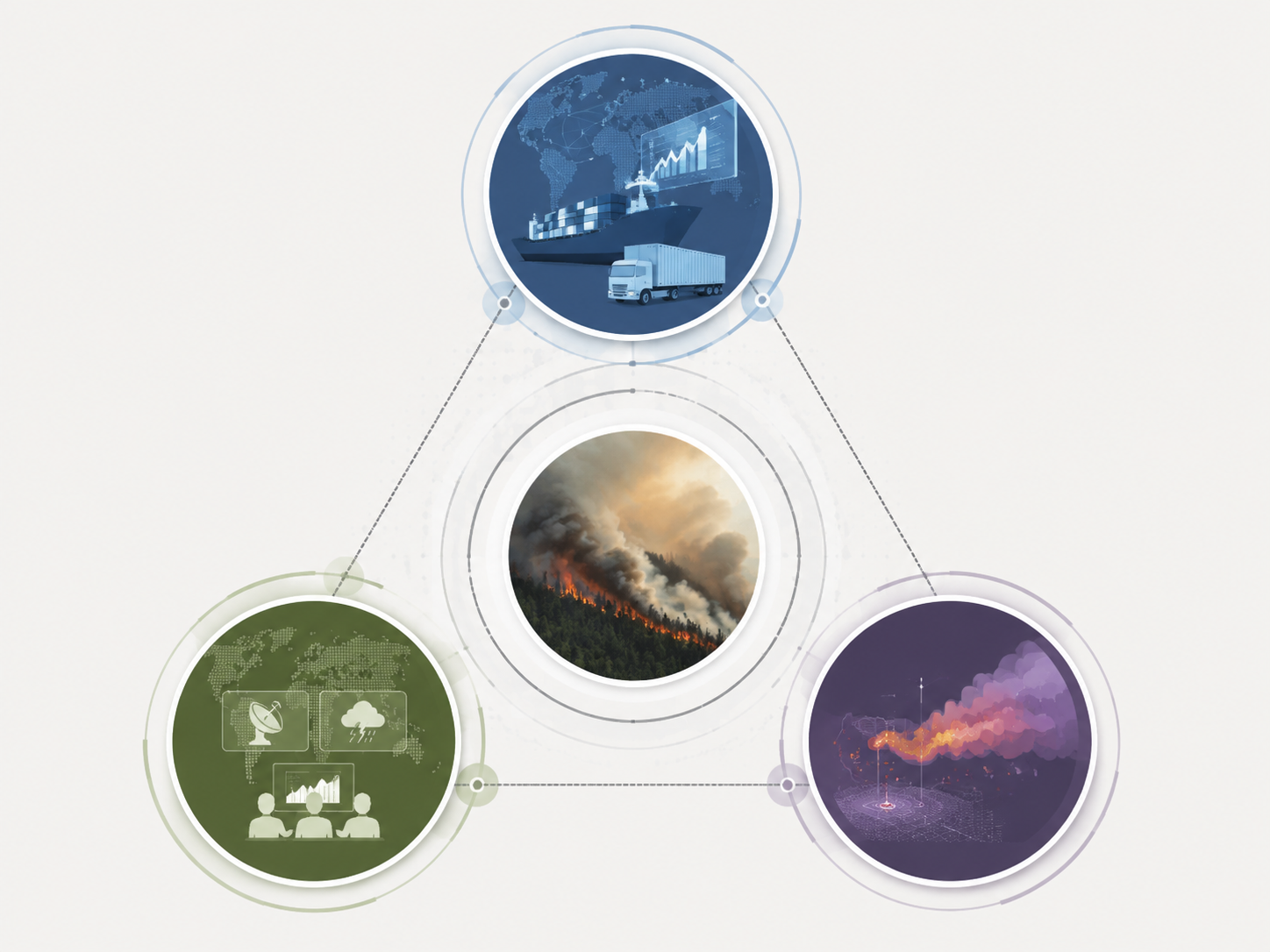
The important split is architectural. Wildfire smoke monitoring is not one capability. A system may detect that a smoke-related event exists, forecast where the plume is likely to move, translate that exposure into supplier or lane risk, and help the organization coordinate a response. Everstream Analytics, Resilinc, and Trace AQ each answer a different part of that sequence better than the others.
| Platform archetype | Best fit | Smoke-specific strength | Main limitation to check |
|---|---|---|---|
| Everstream Analytics: supply chain risk intelligence | Teams that need quantified impact on shipments, lanes, facilities, and longer-range climate exposure | Published analysis of nearly 5 million U.S. shipments, including 50-75% shipment reduction and 2+ day delivery delays during the June 2023 Canadian wildfire smoke event affecting Chicago and New York City corridors [1] | The strongest public smoke evidence is event- and corridor-specific, not a universal benchmark for every smoke event |
| Resilinc: broad disruption monitoring and collaboration | Programs that need smoke handled inside a wider supplier-risk and disruption-response workflow | EventWatchAI scans 104M+ sources across 200 countries and 100+ languages; WeatherWatchAI monitors 50+ weather alert types including air-quality advisories [2][3] | Official materials confirm air-quality advisory monitoring, but do not clearly establish physics-based smoke plume trajectory forecasting |
| Trace AQ: specialized air-quality forecast data/API | Teams that already have a TMS, control tower, or risk platform but need a stronger smoke forecast layer | Purpose-built air-quality AI with hourly 4-day forecasts, plume rise forecasting, continuous source detection, and API delivery [4][5] | It is not presented as a standalone supply chain risk management platform |
Start With The Workflow, Not The Dashboard
A wildfire smoke dashboard can look impressive while still leaving the planner with the real work. A colored plume over the Midwest does not say which shipments are already tendered, which customer orders can still be moved, which supplier is inside the exposure window, or who needs to approve a mode change.
For procurement and logistics teams, the buying question is therefore sequential. First, can the platform detect relevant smoke-related events before the response turns reactive? Second, can it forecast smoke movement with enough precision to trust the exposure window? Third, can it connect that exposure to the actual operating model: suppliers, facilities, lanes, shipments, inventory buffers, and customers? Fourth, can it help coordinate the response rather than simply publish another alert?
No vendor in this set should be treated as a clean winner across all four questions. Everstream is strongest when the business case depends on quantified supply-chain impact. Resilinc is strongest when smoke is one disruption type inside a broad monitoring and collaboration program. Trace AQ is strongest when the missing ingredient is the smoke forecast itself, delivered as a data layer into another operational system.
Detection Breadth: Resilinc Covers The Widest Event Surface
Detection is the first filter because a supply chain team cannot model an exposure it never sees. This is where Resilinc’s proposition is clearest. EventWatchAI is positioned around large-scale signal scanning: 104M+ sources, 200 countries, and 100+ languages [2]. WeatherWatchAI adds weather-specific monitoring across 50+ alert types, including air-quality advisories [3].
That breadth matters for a risk program that does not want a separate specialist tool for every disruption category. Smoke rarely arrives alone in the operating calendar. The same team may be watching port congestion, supplier insolvency, flood alerts, labor actions, geopolitical events, and severe weather. A broad event-monitoring platform reduces the chance that wildfire smoke becomes an isolated side process with its own inbox and its own escalation habits.
The caveat is precision. Resilinc’s public WeatherWatchAI materials support monitoring of air-quality advisories and weather alert types, but they do not clearly confirm the kind of physics-based smoke plume trajectory modeling that a forecaster would expect from a purpose-built air-quality system [3]. That does not disqualify Resilinc; it defines what should be tested in diligence. Ask whether the platform is consuming official advisories, producing its own smoke trajectory forecasts, or integrating third-party air-quality feeds.
Resilinc also deserves attention for what happens after detection. Its WarRoom collaboration module is designed for supplier-level mitigation workflows [2]. For a distributed procurement organization, that can be more valuable than a more elegant plume visualization. The operational bottleneck is often not noticing that smoke exists; it is getting the supplier, category manager, logistics planner, and customer team to work from the same event record before the mitigation window closes.
Forecast Accuracy: Trace AQ Belongs In The Stack When The Smoke Model Is The Weak Link
Trace AQ should not be evaluated as though it were trying to replace Everstream or Resilinc. Its role is narrower and, for some buyers, more important because of that narrowness. The company describes a purpose-built air-quality forecasting system using physics-based AI, with hourly 4-day forecasts available through API access [4][5]. Its Aero product materials also identify plume rise forecasting and continuous source detection as part of the forecast layer [5].
That is a different value proposition from a control tower that already knows the purchase orders, lanes, and suppliers. Trace AQ is closer to a specialized input: a forecast service that can feed a transportation management system, supply chain control tower, enterprise risk platform, or custom analytics layer. If a company already has the operational context but does not trust its smoke data, this is the part of the stack to examine.
The distinction matters because bad smoke forecasting creates two opposite failures. Under-forecast the plume and the team reacts late, with fewer options for rerouting, rescheduling, or protecting labor availability. Over-forecast it and planners may hold shipments, reassign carriers, or escalate suppliers unnecessarily. A platform that can display supply-chain entities beautifully still depends on the quality of the exposure signal underneath.
Trace AQ’s institutional profile also points to technical specialization rather than supply chain workflow breadth. It is a University of Utah spinout, has raised $1.25M in seed funding, and was named Startup of the Year by the university [6]. Those facts do not prove superior forecast performance in a buyer’s network, but they help explain why the platform belongs in the diligence path when the requirement is smoke science, plume behavior, and API-level integration rather than supplier collaboration.
The procurement trap is to reject Trace AQ because it does not look like a supply chain risk platform. That is the wrong comparison. The better question is whether its forecast output improves the decisions made inside the risk platform, TMS, or control tower the company already uses. If the answer is yes, Trace AQ may be the forecast layer that makes the rest of the stack more useful.
Impact Quantification: Everstream Has The Strongest Public Supply Chain Evidence
Everstream deserves the deepest look for teams whose business case needs to move beyond environmental exposure. Its public smoke analysis connects smoke to shipment behavior, not just air quality. During the June 2023 Canadian wildfire smoke event, Everstream analyzed nearly 5 million U.S. shipments from its network and reported a 50-75% shipment reduction in affected Chicago and New York City corridors, along with 2+ day delivery delays from smoke events [1].
That is the closest public evidence in this set to an operational proof point. It does not merely say that smoke was present or that air quality deteriorated. It says shipment volume changed and delivery performance suffered in identified corridors. For a supply chain risk manager trying to justify spend, that is the kind of evidence that connects a hazard signal to a planning consequence.
The boundary is just as important. The 50-75% reduction should not be quoted as an average impact of wildfire smoke on freight. The source ties it to the June 2023 Canadian wildfire smoke event and to Chicago and New York City corridor impacts [1]. In a vendor comparison, the right lesson is not that every smoke event cuts shipments by that amount. The lesson is that Everstream has shown an ability to analyze smoke through a shipment network lens.
Everstream’s broader fit comes from its supply-chain-contextualized modeling. The same source describes digital twin and lane-level risk scoring, 14+ day and 6-month climate risk forecasts, and Climate Risk Scores projecting to 2040 and 2050 [1]. Those capabilities matter when the smoke question is not only “what happens tomorrow?” but also “which lanes, facilities, and supplier regions are becoming structurally more exposed?”
That longer horizon will not matter equally to every buyer. A transportation team focused on next-week dispatch exposure may care more about near-term plume accuracy. A network design or supplier risk team may care more about climate-linked lane scoring and facility exposure. Everstream is strongest when those views need to live together: immediate disruption, shipment impact, lane context, and longer-range climate risk.
Response Coordination: Match The Alert To The Decision Owner
Once a smoke signal becomes a supply chain risk, the platform has to reach the person who can change something. That may be a transportation planner deciding whether to delay a shipment, a procurement manager asking a supplier about staffing exposure, a warehouse leader adjusting labor plans, or a customer team preparing revised delivery commitments.
Resilinc’s WarRoom capability is the most explicit collaboration workflow in the research set [2]. That gives it a clear place in organizations where supplier outreach, confirmation, and mitigation tracking are the main pain points. The system’s broad monitoring only becomes useful if alerts can be converted into a shared work record with accountable participants.
Everstream’s response value is different. Its strongest public evidence points to quantification and context: shipment reductions, delivery delays, lane-level scoring, and digital twin analysis [1]. That helps the risk team prioritize which exposed nodes are worth escalation. If ten facilities sit under a smoke advisory but only two affect critical lanes this week, the better decision is not a louder alert; it is a narrower one.
Trace AQ, again, should be judged as an input layer. It will not, on its own, tell a buyer which supplier should be called first or which lane has enough slack to absorb a delay. Its contribution is earlier in the chain: improve the forecast signal so the operational system can make a better call.
How To Shortlist Without Overbuying
A practical shortlist should separate must-have workflow coverage from nice-to-have model sophistication. The wrong move is to buy a broad platform and assume its smoke intelligence is deep enough, or to buy a precise smoke API and assume the supply chain organization will somehow operationalize it. The requirement should name the handoff points.
- Choose Everstream for primary evaluation when the business case depends on quantified supply-chain impact: shipment disruption, delivery delay, lane exposure, facility risk, and longer-range climate scoring.
- Evaluate Resilinc when wildfire smoke is one event type inside a broader disruption-monitoring program and supplier collaboration is a core requirement.
- Treat Trace AQ as a specialist forecast data source when the organization already has a TMS, control tower, or risk platform but needs more credible smoke movement, plume rise, and air-quality forecast inputs.
- Test Resilinc’s smoke capability specifically, because public materials confirm air-quality advisory monitoring but do not clearly confirm physics-based plume trajectory forecasting.
- Verify any pricing found on third-party comparison sites directly with the vendor, especially for enterprise deployments where scope, integrations, and supplier network coverage can change the commercial model.
The cleanest procurement recommendation may not be a single-platform choice. A mature stack could use Resilinc for broad event detection and supplier response, Everstream for supply-chain impact quantification, or Trace AQ as a forecast layer feeding whichever operational system owns transportation and facility decisions. The right answer depends on which part of the smoke workflow is currently weakest.
References
- Climate Proofing Your Supply Chain, Everstream Analytics
- Agentic AI Supply Chain Monitoring, Resilinc
- Resilinc Launches WeatherWatch AI to Help Companies Combat Disruptions Due to Local Weather Advisories, Resilinc
- Trace AQ, Trace AQ
- Aero, Trace AQ
- TraceAQ's AI-powered air quality forecasting earns it Startup of the Year, University of Utah
Comments
Join the discussion with an anonymous comment.