
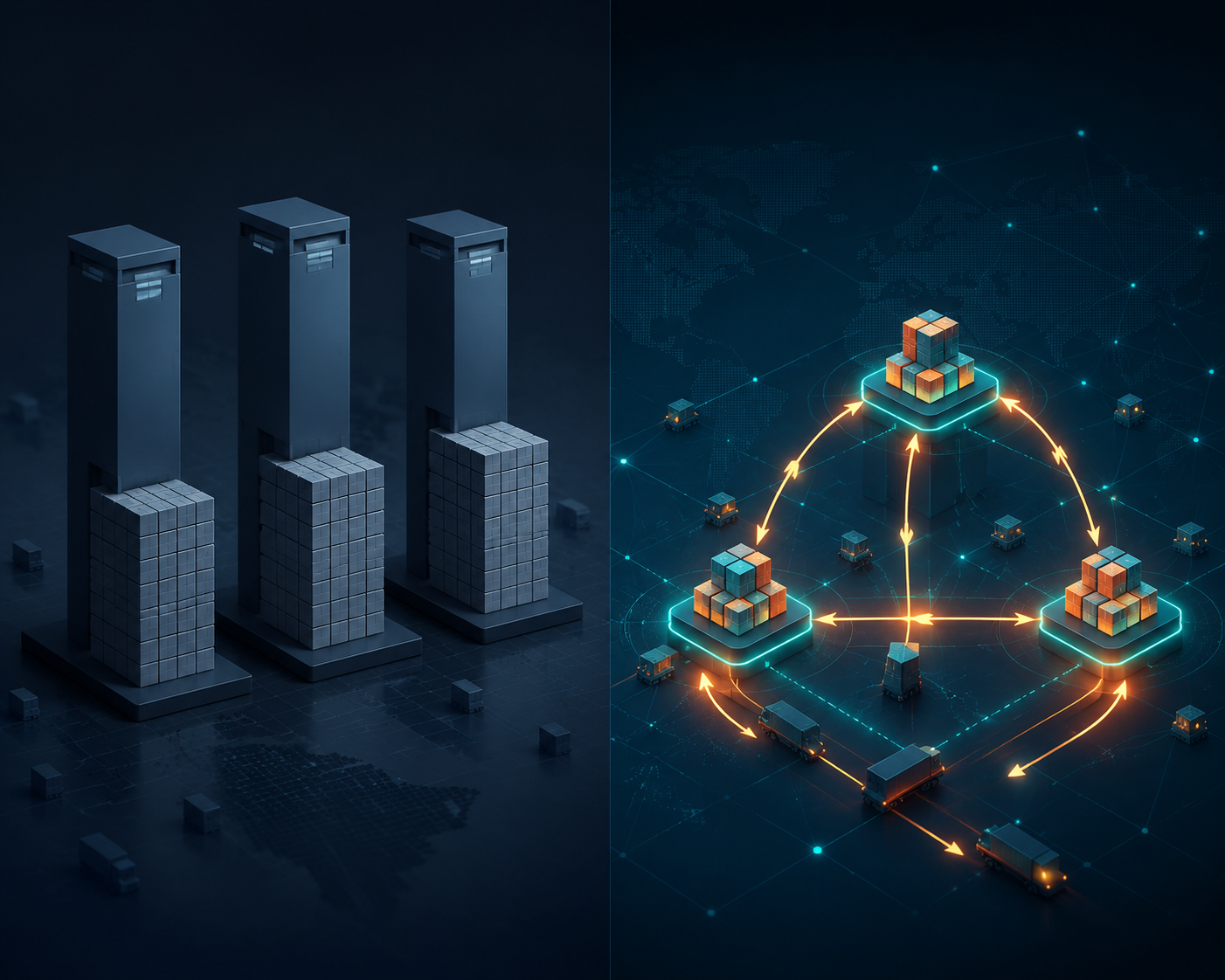
A rule such as “keep two times average demand at every location” feels safe until the network gets large enough for each location to protect itself against the same uncertainty. A plant holds extra because the consolidation center is unreliable. The consolidation center holds extra because distributor demand is noisy. The distributor holds extra because upstream replenishment is late. On paper, each buffer has a reason. Across the network, those reasons can stack into working capital that is no longer buying much service.
That is where machine learning in logistics and supply chain becomes useful in a very specific way. In multi-echelon inventory optimization, the model is not simply forecasting the next order. It is deciding where safety stock should sit across plants, CFAs, distributors, and customer-facing nodes so the same service promise is protected with less duplicated inventory.
The useful claim is strong, but it needs its guardrails: ML-driven MEIO can reduce safety stock materially while maintaining service levels, but only when the model can see multi-tier inventory positions, demand variability, and lead-time variability, and only when planning teams allow model-adjusted positions to replace local habit. A 28% reduction is meaningful. It is also not a number that should be lifted from one network and pasted into another.
The Evidence Is Promising, but Not Universal
The clearest quantified examples in the available material come from Mathnal Analytics case studies. In one pharmaceutical manufacturer engagement, Mathnal reports a 28% safety stock reduction across 4,200 SKUs using multi-echelon inventory optimization while maintaining the required service level.[1] In another specialty chemicals engagement, the firm reports a 1.6-month reduction in inventory days and 14 Cr, approximately $1.7 million, in freed working capital.[1]
Those numbers are large enough to matter to finance, but the attribution matters. These are vendor or implementation-firm case studies, apparently anonymized, not independently benchmarked industry averages. They show what can happen in a data-connected engagement; they do not prove that every manufacturer or distributor should expect the same reduction.
| Reported outcome | Context | How to read it |
|---|---|---|
| 28% safety stock reduction across 4,200 SKUs | Pharmaceutical manufacturer MEIO case documented by Mathnal Analytics | A concrete upper-end example, not a universal benchmark |
| 1.6-month reduction in inventory days | Specialty chemicals company case documented by Mathnal Analytics | Evidence that MEIO can release working capital beyond SKU-level tuning |
| 14 Cr, approximately $1.7M, in freed working capital | Same specialty chemicals case | A finance-relevant result that still depends on service-level preservation |
For teams building a business case, the safer way to use these figures is as a conditional range of possibility. A reduction target around 18–28% may be plausible when the network has excess duplicated buffers, reliable multi-echelon data, and disciplined adoption. It is much less plausible when the planning system cannot reconcile inventory positions across tiers or when every model recommendation is overwritten during the weekly planning cycle.
What ML Changes in the Safety Stock Decision
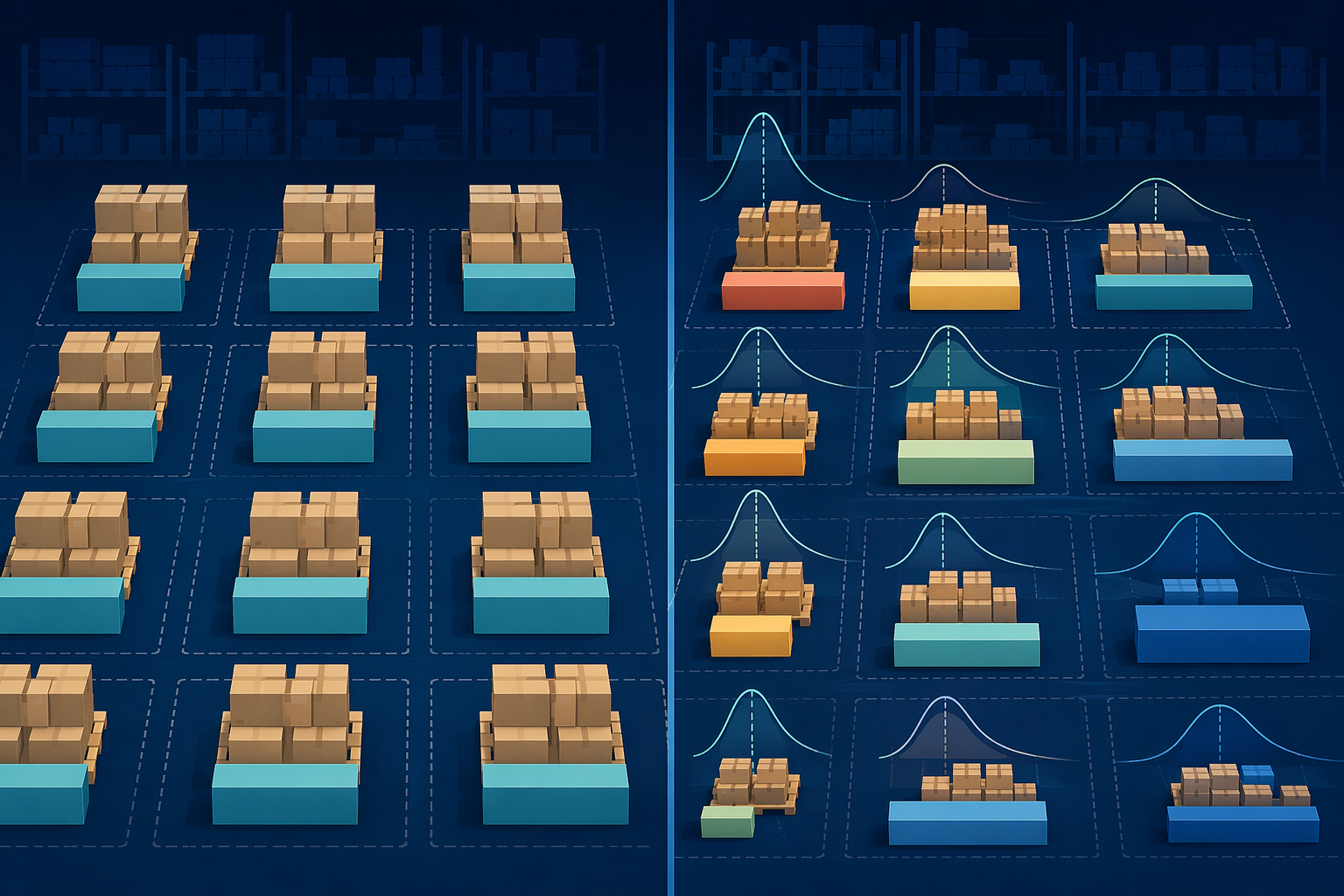
Traditional safety stock math usually starts at the SKU-location level. It asks how much buffer one node needs against demand and supply uncertainty, then applies a service factor. That is a reasonable starting point, and it is often better than a pure spreadsheet rule. But in a multi-echelon network, the downstream location’s risk is not independent from the upstream location’s inventory, replenishment behavior, and lead-time distribution.
ML-driven MEIO changes the question from “How much buffer should each node carry?” to “Where should the network hold inventory so the customer-facing service target is protected at the lowest total stock?” That is a different planning problem. It requires the model to understand demand behavior, service requirements, lead-time uncertainty, upstream availability, and substitution or pooling effects across locations.
A useful MEIO model normally does several things that a static buffer cannot do well:
- It segments SKUs by business value and demand behavior, often through ABC-XYZ logic, so a high-value stable item is not treated the same way as a low-value intermittent item.
- It estimates stockout risk probabilistically rather than assuming every SKU follows a clean normal distribution.
- It models lead time as a variable, not a fixed master-data field, so unreliable lanes receive different protection than stable lanes.
- It optimizes across the network, so safety stock can move upstream or downstream depending on where it protects service most efficiently.
- It uses simulation or solver-based optimization to test whether proposed positions still meet service targets before planners execute them.
The technical vocabulary matters only if it changes the decision. Bayesian posterior stockout estimates are useful because they replace a single assumed safety factor with an updated probability of stockout as demand and supply evidence changes.[2] Stochastic lead-time modeling is useful because a lane that averages ten days but swings widely is not the same planning risk as a lane that reliably arrives in ten days. Solver-based network optimization, using tools such as Pyomo or Gurobi, is useful because it can compare thousands of possible inventory placements across echelons instead of optimizing each node in isolation.
For readers who want the adjacent single-echelon discussion, machine learning safety stock optimization is the closer comparison point. MEIO adds the network placement problem on top of the statistical safety stock problem.
Where the Inventory Reduction Actually Comes From
Inventory reduction from MEIO does not come from one magic forecast. It usually comes from removing duplicated protection. If a distributor is already protected by a reliable upstream buffer, it may not need to carry the same level of local safety stock. If a high-variability item serves a volatile region, the model may keep more stock closer to demand. If an item is slow-moving and low-value, the model may accept longer replenishment exposure instead of letting it consume working capital everywhere.
That distinction is easy to miss when inventory reduction becomes the headline. A company can cut safety stock by lowering service. That is not MEIO success; that is a service trade-off. The stronger case is when the model identifies inventory that is not materially improving fill rate or OTIF and redeploys or removes it while preserving the customer promise.
In practice, the model has to separate at least three types of stock:
- Protective stock that genuinely absorbs demand or lead-time variability at the right echelon.
- Duplicated stock that exists because upstream and downstream teams do not trust the same signal.
- Compensating stock that hides poor master data, late supplier updates, allocation rules, or transportation volatility.
Only the second category is a clean MEIO win. The first category should usually stay, even if finance dislikes it. The third category is more awkward: the model can expose it, but the business may need process repair before inventory can come out safely.
ABC-XYZ Segmentation Keeps the Model From Treating Every SKU as Equal
ABC-XYZ classification is not advanced on its own, but it becomes more useful when connected to probabilistic MEIO. ABC separates items by business value or contribution. XYZ separates them by demand variability. Together, they stop the planning system from applying one buffer policy to items with very different consequences.
A high-value, stable-demand SKU may justify tight replenishment and a service target that the model protects carefully. A low-value, erratic SKU may be better served by a different stocking point, a different replenishment cadence, or a lower buffer if the service consequence is acceptable. The point is not to make every SKU lean. It is to stop using the same safety stock rule for SKUs that behave nothing alike.
Lead-Time Variability Often Matters More Than the Average
Planning systems often store lead time as a fixed number because fixed numbers are easier to maintain. Planners know the reality is messier. A supplier with a stable average but occasional severe delays can create a very different stockout risk than a supplier with the same average and a tight delivery spread. MEIO needs that variability because safety stock is protecting the tail of the distribution, not the average day.
This is one reason static rules can feel safe while still being wasteful. They may overprotect stable lanes and underprotect volatile lanes at the same time. A stochastic lead-time model can reassign protection toward the lanes and echelons where variability actually threatens service.
The Data Requirement Is the Hard Part, Not the Math
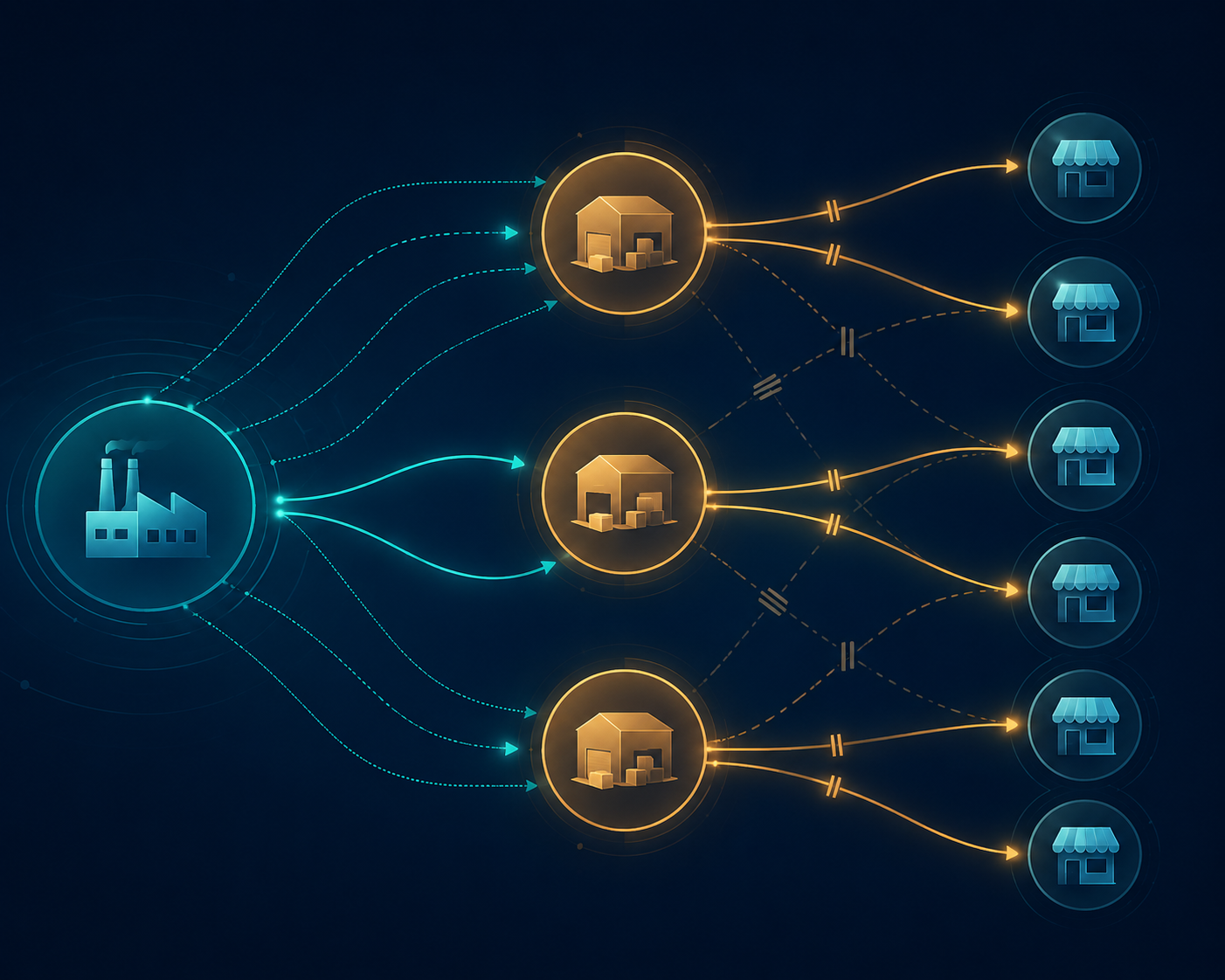
MEIO is not a plug-in upgrade for a company that cannot reconcile inventory positions across plants, CFAs, distributors, and customer-facing locations. The model needs current stock, open orders, transfer lead times, demand signals, service targets, lot constraints, capacity constraints, and replenishment rules. If those inputs live in different systems with different item codes, calendars, units of measure, and refresh cycles, the optimization layer will inherit the confusion.
That is why the legacy-system barrier deserves more attention than the algorithm demo. A compilation from OpenSky Group reports that 56% of chief supply chain officers cite integration with legacy systems as a major AI adoption barrier.[3] The figure is not MEIO-specific, and the underlying survey methodology should be checked before treating it as a precise benchmark. Still, it matches the practical failure mode: planning teams can understand the model and still be unable to feed it a dependable multi-tier picture.
Before treating an 18–28% reduction target as realistic, a planning leader should ask whether the model can answer operational questions that planners already struggle with:
- Can it see inventory and in-transit stock across all relevant echelons, not just the local warehouse?
- Can it distinguish sell-in noise from real downstream demand where that distinction matters?
- Can it estimate lead-time variability by lane, supplier, and echelon instead of relying only on a master-data average?
- Can it preserve service targets by SKU segment, customer group, or channel instead of applying one network-wide target?
- Can planners see why a position changed, or does the recommendation arrive as an unexplained number?
The last question is not cosmetic. If planners cannot explain a changed safety stock position to sales, operations, and finance, they will override it as soon as the first escalation arrives. That does not mean planners are resisting technology. It means they are still accountable for the stockout after the model has moved on to the next run.
For implementation planning rather than use-case evaluation, an AI inventory management implementation playbook is the better next layer of detail. MEIO readiness is as much about data governance and planning process design as it is about model selection.
Planner Overrides Can Quietly Erase the Result
A model can recommend lower stock at one node and higher stock at another, but the result only reaches the balance sheet if those recommendations survive the planning process. Excessive overrides are one of the easiest ways to turn MEIO into a reporting exercise.
Some overrides are necessary. A planner may know about a customer launch, regulatory delay, supplier issue, or allocation decision that has not entered the data yet. The problem is not human judgment. The problem is unmanaged exception behavior: every planner adds a little local protection, every region defends its own service risk, and the network slowly returns to the same duplicated safety stock the model was meant to remove.
A workable governance model usually separates policy from exception. The model sets the baseline safety stock positions by segment and echelon. Planners override when there is a time-bound reason. The override has an owner, an expiration date, and a reason code. Without that discipline, the organization may buy MEIO and still operate by spreadsheet instinct.
When the 18–28% Reduction Range Is Realistic
The higher end of the reduction range is most believable in networks with visible duplication: multiple echelons holding large buffers against the same uncertainty, static rules that have not been recalibrated, and enough transaction history to estimate demand and lead-time variability. The Mathnal pharmaceutical case fits the kind of environment where the opportunity can be large: thousands of SKUs, multi-echelon positioning, and a reported 28% safety stock reduction while maintaining service.[1]
The lower end is more realistic when the company already has disciplined planning, cleaner parameters, or less duplicated inventory. A network that has already segmented SKUs, reviewed service targets, and maintained lead-time data may still benefit from MEIO, but the easy buffer removal may already be gone.
The range should be treated with more caution when any of these conditions are present:
- Inventory accuracy is weak enough that the system cannot tell what stock is actually available.
- Lead times are stored as static assumptions and not refreshed from actual receipts or transfers.
- Demand history is distorted by stockouts, allocation, one-time tenders, or channel stuffing that the model cannot identify.
- Service targets are politically defined but not operationally measurable through fill rate, OTIF, or equivalent metrics.
- The organization rewards inventory reduction in finance reviews but punishes planners personally for the first shortage.
That last condition matters because safety stock is an accountability mechanism as much as an inventory parameter. If the planner bears the consequence of a stockout but does not trust the model, the rational behavior is to keep the buffer.
How to Judge an MEIO System Before Buying the Reduction Story
The best evaluation is not a tour of model terminology. It is a controlled comparison against current policy. Pick a representative set of SKUs, locations, and lanes. Freeze the service definitions. Run the model against historical periods, including volatile ones. Then compare not just inventory value, but stockout frequency, fill rate, OTIF, inventory days, and the number of recommendations planners would have overridden.
A credible MEIO pilot should make several outputs visible:
- Baseline inventory by SKU-location and echelon before optimization.
- Recommended inventory by SKU-location and echelon after optimization.
- Expected service impact by SKU segment, not only at aggregate network level.
- Key drivers of each major change, such as demand variability, lead-time volatility, upstream protection, or service target.
- Override tracking, including where planners reject the recommendation and why.
This is also where vendor-specific evidence should be read carefully. A platform case may be useful, especially when it shows simulation-driven reorder parameters or documented customer outcomes, but the question remains the same: did the system preserve service while changing inventory positions, and can the buyer’s data environment support the same logic? A vendor-specific example such as C3 AI inventory optimization can help compare implementation patterns without turning one vendor claim into a general law.
The Practical Deployment Judgment
MEIO is one of the stronger use cases for machine learning in logistics and supply chain because the outcome is measurable. Inventory comes down or it does not. Service holds or it does not. Working capital is released or it remains trapped in the network. That makes the business case more concrete than many broader AI programs.
But the real decision is not whether machine learning can calculate a better safety stock position than a static rule. In many multi-echelon networks, it can. The real decision is whether the organization has enough connected data and enough confidence in model-driven planning to let safety stock move from local habit to network policy.
References
- Case Studies, Mathnal Analytics
- Machine Learning in Logistics, SoftTeco
- Supply Chain AI Statistics, OpenSky Group
Comments
Join the discussion with an anonymous comment.